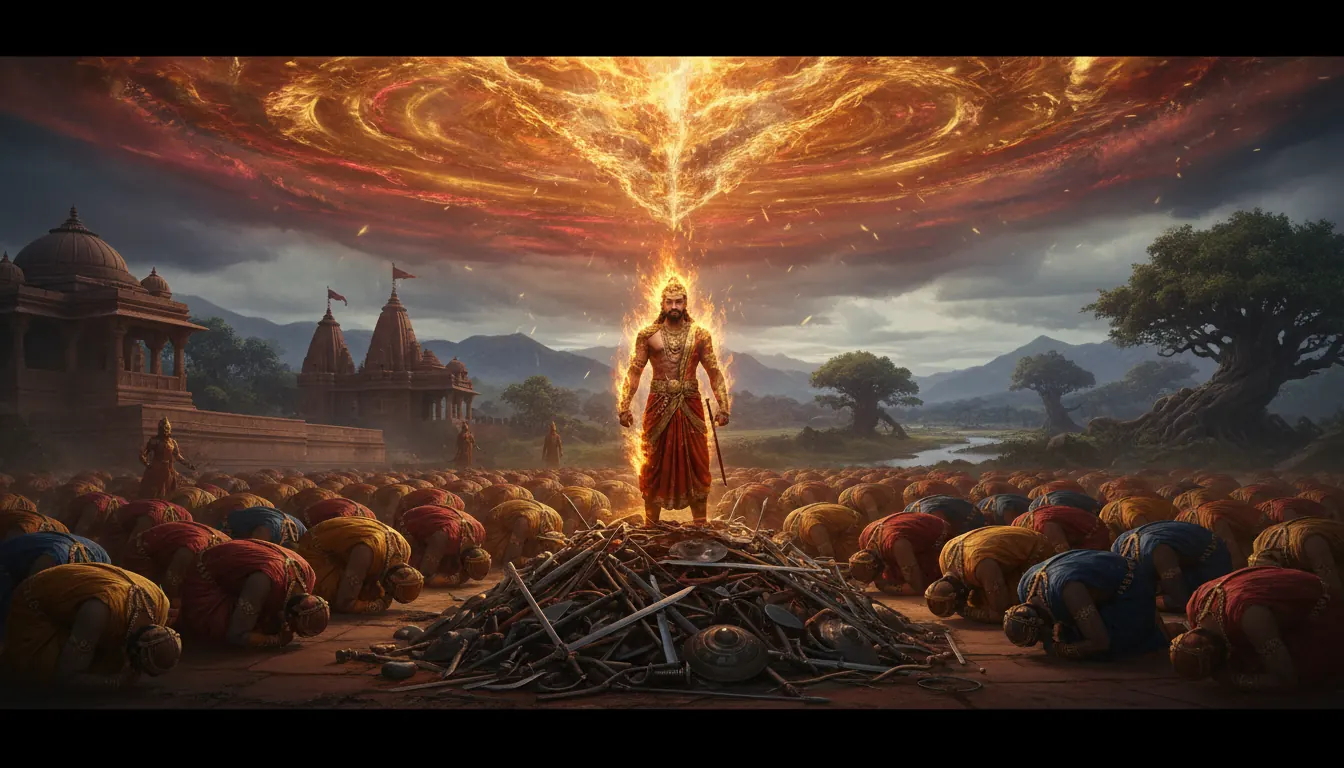
How Drona Won the Narayana Weapon
Ashwatthama tells the Kauravas where his father's last astra came from, and the one rule that came with it
In short
On the fifteenth day, hearing that Dhrishtadyumna has cut off his father's head, Ashwatthama tells Duryodhana that he does not grieve the death but cannot bear the seizure of Drona's hair. Swearing to wipe out the Panchalas, he names the great warriors on the other side one by one and says that not one of them knows the weapon he holds. Then he gives its history: how Narayana came to Drona in the form of a brahmana, accepted his offerings with his own hands, and granted the Narayana astra together with a warning that it must never be hurled at a man who has thrown down his arms or asked for quarter. The Kuru army rallies at the sound of him, and he touches water and invokes it.
Told in the Drona ParvaSet in Kurukshetra and Forest Hermitage15 min read
What Did the Son Say
It was the fifteenth day of the war, and the news carried back into the hall at Hastinapura was that Drona was dead.
The old king wanted one thing out of it, and it was not the manner of the killing. He had been told that already: how the teacher, hearing that Ashwatthama had fallen, had let his bow drop out of his hands and given his mind to yoga on the terrace of his chariot; and how Dhrishtadyumna, son of Drupada of the Panchalas, who had been born out of a fire for exactly this, had taken the old man by the hair and cut off his head in the sight of both armies.
What Dhritarashtra wanted was the consequence.
"When he heard that his aged father had been killed by unrighteous means," he said, "what did the valiant Ashwatthama say?"
Sanjaya answered him.
"When he heard that his father had been killed by Dhrishtadyumna of sinful deeds, bull among men, Drona's son was filled with grief and rage."
That is the plainest sentence in the whole account, and everything else in this story comes out of it. Sanjaya then reached for the comparison the epic keeps for its darkest moments. Filled with rage, he said, the body of Drona's son seemed to blaze forth like the body of the Destroyer while he is engaged in slaughtering creatures at the end of the Yuga.
Around him the Kuru host was coming apart. Their commander was down, the man they had followed for five days was lying headless in the dust with his white hair in a Panchala's fist, and the line was loosening the way a line does when nobody left in it can think of a reason to stay.
Ashwatthama stood in his chariot in the middle of that and wiped his eyes, and they filled again, and he wiped them again. He was breathing hot sighs in rage, the way a man breathes when he cannot get enough air.
Then he turned to Duryodhana and began to speak, and the speech he made is the reason this hour is remembered.
Death in Battle Is To Be Applauded
"Now I have learned how those low wretches killed my father after he laid down his weapons," he said, "and how Yudhishthira, disguised in the garb of virtue, committed a sinful act. Now I have heard of that unrighteous and exceedingly cruel act of Dharma's son."
Then he said the thing nobody standing there expected, and he said it before any of the rest.
"Indeed, to those engaged in battle, either of two things must happen, victory or defeat. Death in battle is always to be applauded. When a man fighting in battle dies in a righteous way, his death does not deserve grief, as the sages have said. Without doubt my father has gone to the region of heroes. Since he met such a death, I should not grieve for him."
This is a son who has just been told his father is dead, standing in front of an army, refusing on principle to mourn the death itself. Drona had gone out that morning knowing what the field was, and he had ended where such men hope to end. There is no complaint to be made about the fact of it, and Ashwatthama had been too well taught to make one.
What he could not get past was the half minute that came after it.
"But the humiliation of being seized by the hair, which he suffered in full sight of all the troops while he was fighting righteously, is tearing at the very core of my heart."
The hair. Not the sword and not the blood. A hand in the white hair of an old man, in front of everybody, with his son somewhere on the same field and not there.
"While I was alive," he said, "my father was seized by the hair. Why, then, should the sonless ever wish for children?"
There is no answer to that question, and it was not asked for one. If a man can have a son like me, a son with every divine weapon in his keeping, and still be handled like that in public, then what is it exactly that childless men spend their lives praying for?
The Debt
"People commit unrighteous acts or humiliate others," he went on, "moved by lust or anger or folly or hatred or levity."
He was going down the five looking for the one that fitted, and he did not find any of them, which left contempt.
"The cruel and wicked-souled son of Prishata has committed this exceedingly sinful act with no regard for me at all."
Prishata was Drupada's father, and the epic reaches back for that older name when it wants the whole quarrel of the two houses standing behind a man at once. The grandfather, the father whom Drona had humbled and whose kingdom he had halved, and now the fire-born son with the blood on his hands.
"So Dhrishtadyumna will surely suffer the dreadful consequence of that act, and so will the lying son of Pandu who has acted so wrongly. Today the earth will certainly drink the blood of king Yudhishthira the just, who tricked the teacher into laying down his weapons. I swear by truth, Kauraveya, and by my religious acts, that I will never bear the burden of life if I fail to wipe out the Panchalas. By every means I will fight the Panchalas in dreadful strife. I will certainly kill Dhrishtadyumna in battle, that doer of unrighteous deeds. Gentle or violent, whatever the means may be, I will destroy all the Panchalas before I know peace."
Mild or violent, let the means be what they will. It is worth marking that clause, because he kept it.
"Tiger among men, people want children so that, having them, they may be rescued from great fears both here and hereafter. Yet my father fell into that plight like a creature without a friend, though I am alive, his disciple and his son, as mighty as a mountain."
Then he turned on the only thing left to turn on, which was his own equipment.
"Shame on my divine weapons. Shame on my arms. Shame on my prowess. For Drona, though he had a son in me, was seized by the hair!
"So now, chief of the Bharatas, I will do what will free me from the debt I owe my father, who has gone to the other world."
The One Thing None of Them Knows
"A good man never praises himself," he said. "But since I cannot bear the killing of my father, I will speak of my prowess."
Having apologised for the boast, he made it, and it ran on for some time.
"Let the Pandavas, with Janardana among them, see my energy today, while I grind down all their troops, doing what the destroyer himself does at the end of the Yuga. Neither the gods, nor the Gandharvas, nor the Asuras, the Uragas and the Rakshasas, nor all the greatest of men, will be able to defeat me on my chariot in battle today. There is none in the world equal to me or Arjuna in knowledge of weapons.
"Going into the midst of the troops, like the sun himself in the midst of his blazing rays, I will use my divine weapons today. Today the countless shafts I shoot from my bow in dreadful battle, showing their terrible energy, will grind down the Pandavas. Today the warriors of our army will see every point of the compass shrouded by my sharp, winged arrows, as if by torrents of rain. Scattering showers of shafts on every side with a loud noise, I will overthrow my foes, like a storm felling trees."
Then he stopped, and did something colder than boasting. He went down the list of the best men on the other side, one after another, by name, and said what none of them had.
"Neither Bibhatsu, nor Janardana, nor Bhimasena, nor Nakula, nor Sahadeva, nor king Yudhishthira, nor Prishata's wicked-souled son, nor Shikhandi, nor Satyaki, Kauravya, knows the weapon I have, along with the mantras for hurling it and for withdrawing it."
Bibhatsu is Arjuna, who had been Drona's other son in everything but blood and had been given nearly everything Drona knew. Janardana is Krishna, who had been present at the founding of the world. Between them those two had seen every weapon there was to see.
They had not seen this one. Ashwatthama had it, and he had both halves of it, the mantra that sends it out and the mantra that calls it back, and the nine men he had just named had neither.
Then, because an army about to witness a thing like that is owed some account of where it came from, he told them.
The Brahmana at the Door
"Once, long ago," he said, "Narayana took the form of a brahmana and came to my father."
That is the whole of the setting, and the epic offers no more of it. No mountain, no thousand years standing on one leg, no voice out of the fire. A brahmana walked up to the house of a brahmana and was received.
What happened next was the oldest rite there is, and it is the hinge of the story. Drona did what any householder in the land was bound to do for a guest at his door, and he did it correctly.
"My father bowed to him and presented his offerings to him in due form."
Water for the feet, water for the hands, the seat, the honey and the curds, the words that go with each of them. The epic does not say when this was. If it fell in his lean years, his was the household where the wife stirred flour in water and gave it to the child to drink for milk, and the guest at that door was given whatever there was, in due form, because form was the one thing in that house which had never run short.
"The divine Lord accepted them himself, and offered him a boon."
Taking them himself. The text puts that in deliberately. The god did not decline the poor man's offering, or transmute it, or leave it standing on the ground. He accepted it with his own hands, and then, being under the obligation a guest incurs, he offered payment.
A man to whom Narayana offers a boon may ask for anything in the three worlds. He could have asked for the herd, or the kingdom, or bread for the remainder of his life.
"My father then asked for that supreme weapon called Narayana."
He asked for the god's own weapon. He asked for the thing that would settle every quarrel he was ever going to have, and he asked for it standing at his own door.
And the divine Lord, the greatest of all gods, said to his father: "No man shall ever be your equal in battle."
That was the boon. Then, before Drona could take his hands out of the gesture of receiving, the god attached the conditions.
The Rule That Came With It
"But this weapon, brahmana, should never be used in haste."
That was the first of them, and every clause after it explains why.
"It never comes back without destroying the foe. I know no one it cannot kill, lord. Indeed, it would kill even those who cannot be killed. Therefore it should not be used without the greatest deliberation."
Read that as the maker's own account of the thing he had made. Not that the weapon is very strong. That there is no exception to it anywhere, that its owner cannot name a creature it would fail against, and that once it is out it does not return unfed. A weapon of that kind has no aim in it worth speaking of. It has only a direction.
So the god who had just granted it spent the rest of his breath on the fence around it.
"This mighty weapon, scorcher of foes, should never be hurled at those who abandon their chariots or their weapons in battle, or at those who ask for quarter, or those who surrender. Whoever tries to strike down with it in battle those who must not be killed is himself struck down hard by it."
Three men are named there: the one who has thrown down his weapons, the one who asks for quarter, and the one who gives himself up. Against those the weapon is not merely forbidden. It turns. The man who sends it at someone who has laid down his arms is the man it comes back on.
It is a strange thing to hand across a threshold. The gift and its leash were spoken in one breath, in a brahmana's house, in front of a son old enough to keep every word of it for years and repeat it on a battlefield.
"That is how my father received that weapon."
Then Lord Narayana turned to the son.
"With the aid of this weapon, you too will pour down showers of every kind of divine weapon in battle, and blaze with energy because of it."
When he had said this, the divine Lord rose to heaven.
"This," said Ashwatthama, to Duryodhana and to every man within hearing, "is the history of the Narayana weapon, which my father's son has obtained."
He had just recited aloud, in front of witnesses, the one rule by which the thing in his keeping could be turned aside. He did not appear to notice that he had done it.
He Touched Water
"With that I will rout and slay the Pandavas, the Panchalas, the Matsyas and the Kaikeyas in battle, like Shachi's lord routing and slaying the Asuras."
Shachi's lord is Indra, and that comparison is kept for a slaughter which is also a victory of the order of the world over its enemies. Ashwatthama had put himself on the side of the gods and the four peoples in front of him on the side of the Asuras, and having arranged them that way he described what he intended to do to them.
"My shafts, Bharata, will fall on the foes who fight me in whatever forms I wish them to take. Standing firm in battle, I will pour down showers of weapons as I please. I will rout and kill all the greatest chariot-warriors with sky-ranging arrows with iron points. Without doubt I will shower innumerable battle-axes upon the foe. With the mighty Narayana weapon, scorcher of foes that I am, I will destroy the Pandavas, and make an immense carnage among them."
And then, last, the man it was really for.
"That wretch among the Panchalas, who harms friends and brahmanas and his own teacher, that deceitful wretch of the most shameful conduct, will never escape me today with his life."
Sanjaya said that hearing these words of Drona's son, the Kuru army rallied.
That is the whole effect of the speech, stated in a single sentence. The host that had been dissolving an hour earlier stopped dissolving. Many foremost of men blew their gigantic conchs. Filled with delight, they beat their drums and their dindimas by thousands. The earth resounded with the noise, pounded by the hoofs of horses and the wheels of chariots, and the firmament echoed it back at them.
Across the field the Pandavas heard it. Sanjaya says it reached them deep as the roll of the clouds, and that those foremost of chariot-warriors drew together and began to take counsel of one another, because a beaten army does not make a sound like that.
Meanwhile Drona's son, having said those words, touched water, and invoked the divine weapon called the Narayana.
Dharma Lesson
The most dangerous gifts arrive with their limits attached, and the limit is usually spoken in the same breath as the gift. Narayana told Drona plainly that the weapon would kill even those who cannot be killed, and in the next sentence named the three men it must never be sent against: the one who has dropped his weapons, the one who asks for quarter, the one who yields. Ashwatthama recited that condition aloud to an army before he ever used the astra, and it did not slow his hand by a moment. A man who can repeat a rule and a man who keeps it are not the same man, and the distance between them is where this epic does most of its work.