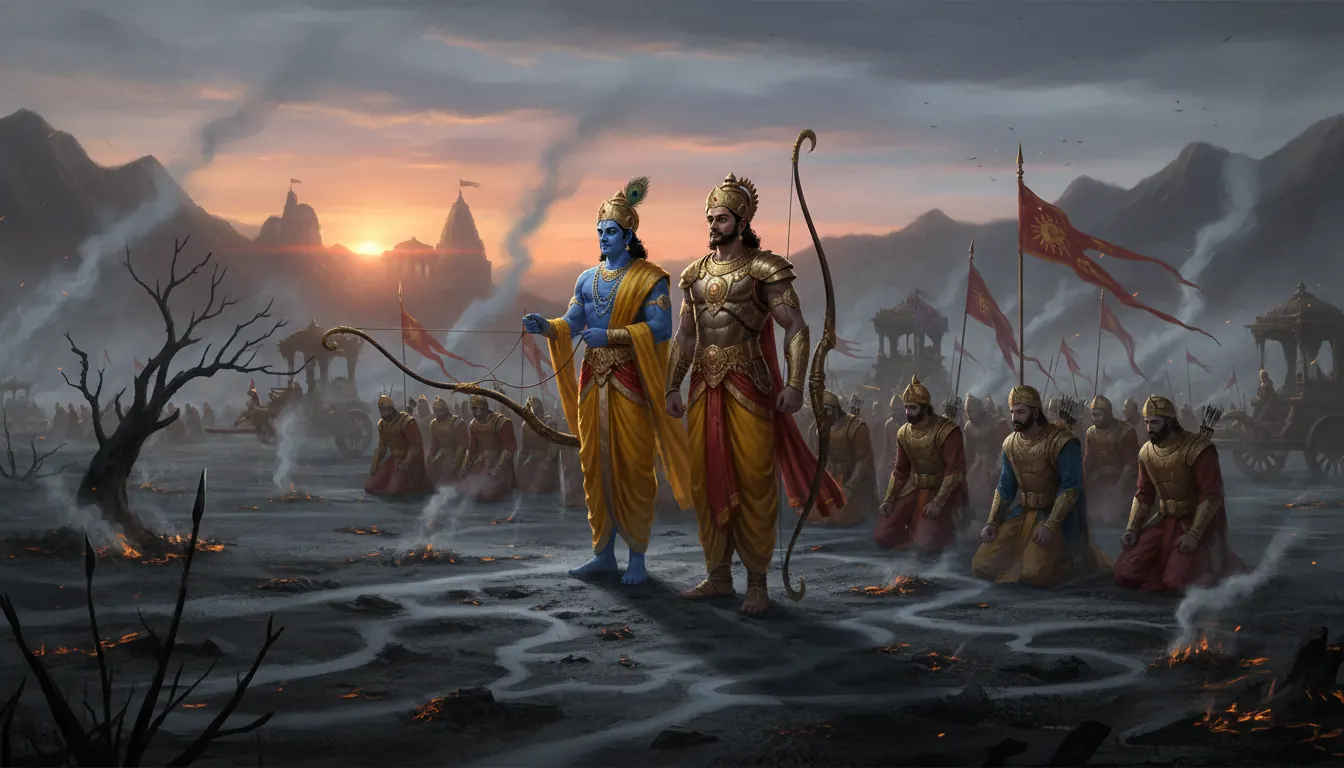
Vyasa Tells of Narayana and Rudra
Why Ashwatthama's fire weapon left Krishna and Arjuna unhurt
In short
Ashwatthama, whose Agneya weapon has left Krishna and Arjuna standing unhurt, stops Vyasa on the road and asks why. Vyasa answers with Narayana's austerities on Mount Mainaka, his vision of Rudra, the hymn he sang and the boons he was given, and tells Ashwatthama that Arjuna is Nara and that he himself is a portion of Rudra. Later the same day Arjuna asks the rishi about a blazing figure with an uplifted lance who went ahead of his chariot and broke every division before he reached it. Vyasa names him Shankara, recites the Sata-Rudriya to him, and sends him back to the war.
Told in the Drona ParvaSet in Kurukshetra and Himavat23 min read
The Man Who Threw His Bow Down
Sanjaya was telling it in a hall to a blind king, and he had come to the end of the fifth day of Drona's command.
Drona was dead by then. His son had answered that death with two weapons in one afternoon, and the second of them, the Agneya, had burnt an entire akshauhini of the Pandava host down to shapes nobody could put a name to. Then Arjuna had called up the Brahma weapon, and the darkness went off the field like a cloth pulled away, and cool winds blew, and the two men everybody had given up for dead were standing there together, unwounded, like the sun and the moon in one sky.
Ashwatthama looked at that for a while and could not carry it.
He thought over what had happened, sire, and when he had thought it over he was filled with anxiety and grief, and began to heave long, hot sighs. Then he laid his bow aside on the terrace of his chariot, and came down off the chariot, and said out loud, "Shame, shame. Everything is false," and walked away from the fighting.
On the road he met Vyasa.
This was the son of Parashara, the compiler of the Vedas and the home of Saraswati, the man who had fathered Dhritarashtra and Pandu and who walked in and out of that war as freely as a man walks through his own house. He was the colour of a rain-cloud, and he was untouched by sin, and he was standing in the road.
Ashwatthama saluted him in a voice choked with grief, like a man utterly without hope.
"Sire, sire, is this an illusion, or some whim of the weapon? I do not know what it is. Why has my weapon failed? Was something wrong in the way I invoked it? Or is it something unnatural, or a defeat of Nature itself, since they are still alive? It seems that Time cannot be resisted. Neither Asuras nor Gandharvas nor Pishachas nor Rakshasas nor Yakshas nor birds nor human beings can check this weapon when I shoot it. It has killed one akshauhini and then gone quiet. It can kill every creature. Why then could it not kill Keshava and Arjuna, who are only human after all? Answer me truly, holy one. I want to hear all of it, in detail."
Sixty-Six Thousand Years on Air
"What you ask me in your astonishment is a matter of great weight," Vyasa said. "I will tell you everything. Listen carefully."
He did not begin with the weapon. He began with the man in the chariot the weapon had failed to burn, and he began a long way back.
"The one called Narayana is older than the oldest. To accomplish a certain purpose, that creator of the universe was born as the son of Dharma. On the mountain Mainaka he performed the severest austerities."
Mighty in energy, blazing like fire or the sun, he stood on that mountain with his arms raised. His eyes were like lotus petals. He wasted himself there for sixty-six thousand years, living the whole time on air alone. Then, not having finished, he took up austerities of another kind for twice that long, and with them he filled the whole space between earth and heaven with his energy.
And when those austerities had made him like Brahma, he was given the thing he had been standing there for.
He saw the Master, the Origin and the Guardian of the Universe, the Lord of all the gods, whom it is so hard to look upon, who is smaller than the smallest and larger than the largest. He is called Rudra. He is called Hara and Shambhu. He has matted locks on his head. He breathes life into every form and is the first cause of all things moving and unmoving, irresistible, fearful to look at, fierce in anger and great of soul, the All-destroyer, and large of heart.
He carried the celestial bow and a pair of quivers, and was clad in golden armour. He held Pinaka. He was armed with the thunderbolt, a blazing trident, a battle-axe, a mace and a large sword. His eyebrows were fair and his locks were matted, and he had the moon on his forehead, and he was dressed in a tiger-skin. He wore beautiful angadas, and he had snakes for his sacred thread, and he was surrounded by crowds of ghosts and spirits. He is the One. He is Water, Heaven, Sky, Earth, Sun, Moon, Wind and Fire, and he is the measure of how long the universe lasts.
People of wicked conduct never see that unborn one. Only righteous brahmanas, once they are cleansed of their sins and freed from the hold of grief, see him, and they see him with the mind's eye.
Narayana, standing on the mountain, saw him with both.
The Praise of the Three-Eyed One
When he saw that supreme home of all splendour, that God with a garland of Akshas round his neck, Vasudeva was filled with a delight he tried to express with words, heart, understanding and body all at once.
First he worshipped him: the divine Lord, the giver of boons, that mighty one at play with fair-limbed Parvati, surrounded by his bands of ghosts and spirits. Then, after saluting Rudra, destroyer of the Asura Andhaka, lotus-eyed Narayana praised the Three-eyed one.
"Adorable one, first of all the gods. The Prajapatis, the guardians of the world, who entered the earth, your first work, and protected it, all sprang from you. Gods, Asuras, Nagas, Rakshasas, Pishachas, human beings, birds, Gandharvas, Yakshas and every other creature, with the whole universe, all sprang from you: this we know. Everything that is done to please Indra, and Yama, and Varuna, and Kubera, and the Pitris, and Tvashtri, and Soma, is really offered to you.
"Form and light, sound and sky, wind and touch, taste and water, scent and earth, time, Brahma himself, the Vedas, the Brahmanas, and all these moving things have sprung from you.
"Vapours rise from many bodies of water and become raindrops, and the drops fall on the earth and are separated from one another. When the time of the universal dissolution comes, those separate drops unite once more and turn the earth into one vast expanse of water. The learned man, who watches the birth and the destruction of all things in this way, understands your oneness.
"Two birds, which are Iswara and Jiva. Four Aswatthas with their branches of words, which are the Vedas. The seven guardians, which are the five elements and the heart and the understanding. And the ten others that hold this city, which are the ten senses that make up the body. You created them all, and you are separate from them and independent of them.
"The Past, the Future and the Present, which no one can rule, come from you, and so do the seven worlds and this universe.
"I am your devoted worshipper. Be gracious to me. Do not harm me by sending evil thoughts into my heart. You are the Soul of souls, beyond knowing. Whoever knows you as the Universal Seed attains to Brahma. Wanting to honour you, I am praising you, trying to grasp your true nature, you whom even the gods cannot understand. Worshipped by me, grant me the boons I desire. Do not hide yourself in your illusion."
You Will Be Greater Than I
The blue-throated God, wielder of Pinaka, then gave boons to Vasudeva, who deserved them all.
"Narayana, by my grace, among men, gods and Gandharvas, your might and your soul will be boundless. Neither gods, nor Asuras, nor Uragas, nor Pishachas, nor Gandharvas, nor men, nor Rakshasas, nor birds, nor Nagas will ever be able to withstand your prowess. By my grace, no one will ever be able to hurt you with the thunderbolt, or with anything wet or dry, or with anything moving or unmoving. You will be greater than I, if you ever go into battle against me."
"That is how Sauri won these boons long ago," Vyasa said. "That same God now walks the earth as Vasudeva, beguiling the universe with his illusion."
That was one of the two men in the chariot accounted for.
"From Narayana's asceticism a great Muni named Nara was born, equal to Narayana himself. Know that Arjuna is none other than that Nara. Those two rishis, said to be older than the oldest gods, are born in every Yuga to serve the purposes of the world."
Ashwatthama had shot the Agneya at two ascetics who are born in every age to do the world's work, and it had killed an akshauhini of other men instead. The rishi was not finished, and the last part of it was about him.
"You too were born as a portion of Rudra, through all your religious acts and as the fruit of severe austerities, full of great energy and wrath. Believing the universe to consist of Mahadeva alone, you wasted yourself with many vows to please that God. You worshipped him with mantras, with homa and with offerings, and the great God was pleased with you and granted you many of the boons you had longed for in your heart. Like them, in every Yuga, you have worshipped the great God in his Phallic form. Keshava is that devoted worshipper of Rudra who sprang from Rudra himself, and the God whose sign is the bull holds Keshava in higher regard than anyone else."
When he heard this, Drona's son bowed to Rudra, and came to regard Keshava as worthy of the highest respect. His soul came back under his own control, and he was filled with a delight that showed in every part of his body.
Then he bowed to the great rishi, and looked out over the Kuru army, and gave the order to withdraw it for the night. Having fought for five days and caused an immense carnage, Drona had gone to the region of Brahma.
The Lance That Never Left His Hand
"When Prishata's son had slain Drona," Dhritarashtra said, "what did my sons and the Pandavas do next?"
Sanjaya said that after the rout of the Kuru army, Vyasa came that way again in the course of his wanderings, and this time it was Arjuna who stopped him.
Dhrishtadyumna had killed the teacher. The field was quiet. And Arjuna, who had spent those days breaking a line that the greatest bowman alive had built to hold him, had a question he had been carrying for some time and had told nobody, because it is not the kind of thing a man says out loud while there is still fighting to do.
"Great rishi, while I was killing the enemy in battle with showers of bright arrows, I kept seeing in front of me, moving ahead of my chariot, a blazing figure, as if made of fire. Wherever he went with his lance raised, all the enemy warriors broke before him. They were really broken by him, but people thought it was I who broke them. I followed in his wake and only destroyed those he had already destroyed."
That is the whole of Arjuna's difficulty, and it is worth stopping on. He had won. Men had watched him win. Both armies had spent days describing what the wielder of Gandiva had done to the Kaurava divisions, and the wielder of Gandiva had been riding along behind somebody else the entire time, finishing off what was already finished.
Then he gave the details, the way a bowman would.
"Holy one, tell me who that foremost of beings was, armed with a lance and like the sun himself in energy, whom I saw. His feet did not touch the earth. And he did not hurl his lance even once. By his power, thousands of lances came out of the one lance he held."
He had never hurled it. That was the part Arjuna could not get past. Whatever went ahead of his horses through the Kaurava host for those days had held one weapon in its hand and had never once let go of it, and everything in front of it had fallen anyway.
You Have Seen Shankara
"Arjuna, you have seen Shankara," Vyasa said.
"The first cause from which the Prajapatis sprang, that mighty Being of great energy, the embodiment of heaven and earth and sky, the Divine Lord, the protector of the universe, the great Master, the giver of boons, who is also called Isana. Seek the protection of that boon-giving Deity."
Then he named him properly, because with this God the naming is the teaching.
He is called Mahadeva, the Supreme Deity, the Supreme Soul, the one only Lord, with matted locks, the home of all that is auspicious. Three-eyed and mighty-armed, he is called Rudra, with his locks tied up like a crown and his body dressed in skins. He is called Hara and Sthanu. He is the foremost of every being in the universe, its delight and its supreme ruler. He is Yoga and the lord of Yoga. He is the Soul of knowledge, beyond the reach of knowledge, the highest of all knowledge, and he is unknowable. By his grace he gives his worshippers the boons they desire.
And his companions, Vyasa said, are celestial beings of many forms. Some are dwarfs. Some have matted locks and some are bald. Some have short necks, some big bellies, some huge bodies, some enormous strength, some long ears. All of them, Partha, have misshapen faces and mouths and legs, and strange clothes. Such are the followers by whom that Supreme Deity called Mahadeva is worshipped.
"That same Shiva, son, with all his energy, goes ahead of you out of kindness."
Then the rishi asked Arjuna the practical question, which was the one the bowman had not thought to ask himself.
"In that fierce battle, Partha, which made the very hair stand on end, who but the divine Maheshvara, the greatest of all bowmen, could even dream of defeating that army, guarded as it was by fighters like Drona and Karna and Kripa? No one dares stand before the warrior who has Maheshvara walking ahead of him. There is no being in the three worlds equal to him. At the very scent of an enraged Mahadeva, enemies in battle tremble, lose their senses and fall in great numbers. Men of pious conduct who devoutly worship the boon-giving, divine and auspicious Rudra find happiness here and reach the highest state hereafter."
And then, because Arjuna had asked who it was, Vyasa began to answer that question in the only way it can be answered, which is at length.
Bow Down to Him Who Is Peace
"Son of Kunti, bow down to him who is peace."
To him called Rudra of the blue throat, extremely subtle and of great radiance. To him called Kapardin, the terrible one, the tawny-eyed one, the giver of boons. To that great ordainer with red locks and righteous conduct. To him who always does auspicious deeds. To him who is the embodiment of all sacred waters, and the God of gods.
Him who lives in the mountains. Him who is peace and him who is the protector. Him who dresses in the bark of trees, and whose arms are decked with ornaments of gold. Him who is lord of the clouds and of all created beings, lord of all trees and of all cows. Him who is commander of the gods. Him who holds the sacrificial ladle. Him who wore munja grass for clothing. Him who has a thousand heads, a thousand eyes, a thousand arms and a thousand legs.
"Seek the protection of that boon-giving Lord of the universe, the lord of Uma, that three-eyed God, destroyer of Daksha's sacrifice."
He is the one whose navel is like a bull's and whose symbol is the bull, who is lord of bulls and bull of bulls, and who has the image of the bull on his banner. He can be reached through Yoga alone. He owns the finest weapons, and he has Vishnu himself for his arrow. He wields the sword and the shield and the trident and the bow called Pinaka.
"Salutations," said Vyasa, "to that Lord of the gods who has Vaishravana for his friend. Salutations always to him of excellent vows. To him who has fine bowmen for his companions. To that God whose favourite weapon is the bow, who is himself the arrow the bow drives, who is the bowstring and the bow, and the teacher of the bow. Salutations to him who destroyed the triple city. Salutations to him who slew the Asura Bhaga. Salutations to him who is lord of the celestial Mothers and of the tribes of spirits called the Ganas. Salutations always to him who is lord of cows and of sacrifices, and to him who destroyed Pushan's teeth."
Arjuna, who was a bowman by trade, had just been told that the God is the archer and the bow and the string and the arrow and the man who teaches the craft. He said nothing, and Vyasa went on to the deeds.
The Sacrifice and the Three Cities
"If Mahadeva is angry, neither gods nor Asuras nor Gandharvas nor Rakshasas can find peace, even if they hide in the depths of the ocean."
Long ago, Daksha had gathered everything needed for a sacrifice, and Mahadeva destroyed that sacrifice in his anger. He shot an arrow from his bow and gave terrible roars. The waters heaved, the earth trembled, the mountains split, and the universe was wrapped in a thick darkness that blotted out the splendour of all the heavenly lights, the sun with them.
Pushan was eating the sacrificial cake at the time. Shankara came up to him, smiling, and tore out his teeth.
Then he loosed at the gods a shower of blazing arrows like flames of fire mixed with smoke, and the gods, bowing down to Maheshvara, gave Rudra a substantial share in every sacrifice and sought his protection in terror. When his anger was gone, the great God restored the sacrifice. To this day, Vyasa said, they are afraid of him.
The second deed was one Arjuna would have known by name.
The Asuras had three cities in heaven, each splendid and large. The iron city belonged to Tarakaksha, the silver to Kamalaksha, and the third, made of gold, was ruled by Vidyunmalin. With all his weapons Indra could make no impression on them. The tormented gods went to Rudra and said that the people of the triple city had received boons from Brahma and were tormenting the universe, and that no one but he could kill them; if he did it, the creatures slain in every sacrifice would be his.
So he built a chariot out of the world.
Gandhamadana and Vindhya were its two poles. The earth with her oceans and forests was the chariot. Shesha, that prince of snakes, was the axle. The moon and the sun were the two wheels, the Malaya mountains the yoke, and the great Takshaka the cord that tied the yoke to the poles. The four Vedas were his four horses and the supplementary Vedas their bits, and Gayatri and Savitri were the reins, and the syllable Om was the whip, and Brahma was the driver.
He made the Mandara mountains his bow, Vasuki the bowstring, Vishnu his arrow, Agni the arrowhead, Vayu the two wings of that arrow, Yama the feathers in its tail, and Meru the standard.
Then he stood still, in an array named after himself, and did not move for a thousand years. When at last the three cities came together in the sky, he pierced them with that one arrow of three knots, and the Danavas could not so much as look at it.
The Child on Parvati's Lap
While the triple city was burning, the goddess Parvati came to watch it, and she had a child on her lap.
It was a small boy with a bald head that had five clumps of hair on it. The goddess asked the gods who the child was, and none of them knew, and Shakra, out of ill will, tried to strike that child with his thunderbolt. The divine lord Mahadeva, for the child was no one else, smiled, and froze the arm of the furious Shakra where it was.
So the king of the gods went to Brahma with his arm hanging useless and all the gods behind him.
"Brahma, we saw some wonderful creature in the form of a child, lying on Parvati's lap, and we did not salute him. He has defeated us all. We want to ask you who he might be. That boy, without even fighting, has defeated every one of us with the greatest ease, Purandara at our head."
Brahma thought for a moment and understood.
"That child is the divine Hara, the Lord of the whole universe, moving and unmoving. There is nothing higher than Maheshvara. That Being of boundless splendour whom you all saw with Uma had taken the form of a child for Uma's sake. Let us all go to him. Gods, you did not recognise that master of the universe."
Then all the gods went with the Grandsire to the child, who shone like the morning sun, and Brahma worshipped him.
"You are Sacrifice, lord. You are the support and refuge of the universe. You are Bhava, you are Mahadeva, you are the home of all things and the highest refuge. Lord of the past and the future, protector of the universe, let Shakra, stricken by your wrath, have your grace."
Maheshvara was pleased. Wanting to show his grace, he laughed aloud, and the gods praised Uma and Rudra together, and the arm of Shakra the thunder-wielder returned to its natural state.
He is Rudra, he is Shiva, he is Agni, he is everything, and he knows everything. He is Indra, he is the Wind, he is the twin Ashvins, he is the lightning. He is the Moon, he is Isana, he is Surya, he is Varuna. He is Kala, he is Antaka, he is Mrityu, he is Yama.
Brahmanas versed in the Vedas say that he has two forms, the terrible and the auspicious. Half his soul is fire and half of it is the moon. With the auspicious half he practises Brahmacharya, and with the terrible half, as supreme Lord, he devours everything.
Go and Fight, Son of Kunti
The names came last, and Vyasa gave the reasons with them, because a name that is only a sound teaches nothing.
Because he always protects the creatures of the universe and plays among them, and because he is lord of all creatures, he is called Pashupati. Because that God has many forms in the past, the future and the present, he is called Vahurupa, the many-formed. Because three goddesses turn to him, Firmament and Water and Earth, he is called Tryamvaka. Because he always increases every kind of wealth and wishes mankind well in all they do, he is called Shiva. Because he protects this vast universe, he is called Mahadeva. Because he is great and ancient and is the source of life and of its continuance, he is called Sthanu. Because the rays of the sun and moon that appear in the world are spoken of as the hair of the Three-eyed one, he is called Vyomakesa. Because he afflicts Brahma and Indra and Varuna and Yama and Kubera and destroys them in the end, he is called Hara. Because Maheshvara, with his two eyes closed in meditation, created a third eye on his forehead by sheer force of will, he is called the Three-eyed. And because he burns, because he is fierce, and because he devours flesh and blood and marrow, he is called Rudra.
"I could not list all the attributes of that God," Vyasa said, "even if, son of Pandu, I recited them without stopping for a thousand years."
Then he closed the circle and brought it back to the dust of that afternoon.
"That is the deity called Mahadeva, armed with Pinaka, whom you saw killing your foes ahead of your chariot. After you vowed to kill the ruler of the Sindhus, Krishna showed you this God in your dream, sitting on the summit of that greatest of mountains. It was he who gave you the weapons with which you killed the Danavas. The hymn approved by the Vedas and called Sata-Rudriya, in honour of that God of gods, has now been explained to you, Partha. It destroys all sins, and it can drive away every stain and kill every sorrow and every fear."
And then the last of it, which is the only instruction the rishi actually gave.
"Go and fight, son of Kunti. Defeat is not for you, who have Janardana on your side as your adviser and protector."
When he had said this to Arjuna, the son of Parashara went back to where he had come from.
Dharma Lesson
Arjuna is told, at the height of his fame as a bowman, that the ranks he thought he was breaking had already been broken before he reached them. He is not humiliated by that, and he is not asked to stop fighting either; he is told to go back and fight, knowing it. The story sets a devotion that costs sixty-six thousand years on a mountain beside a devotion that consists of drawing a bow all day, and refuses to rank them, because the God who was praised on Mainaka is the same one walking in the dust ahead of the horses. What is asked of a man is that he do his own work without mistaking it for the whole of the work being done.