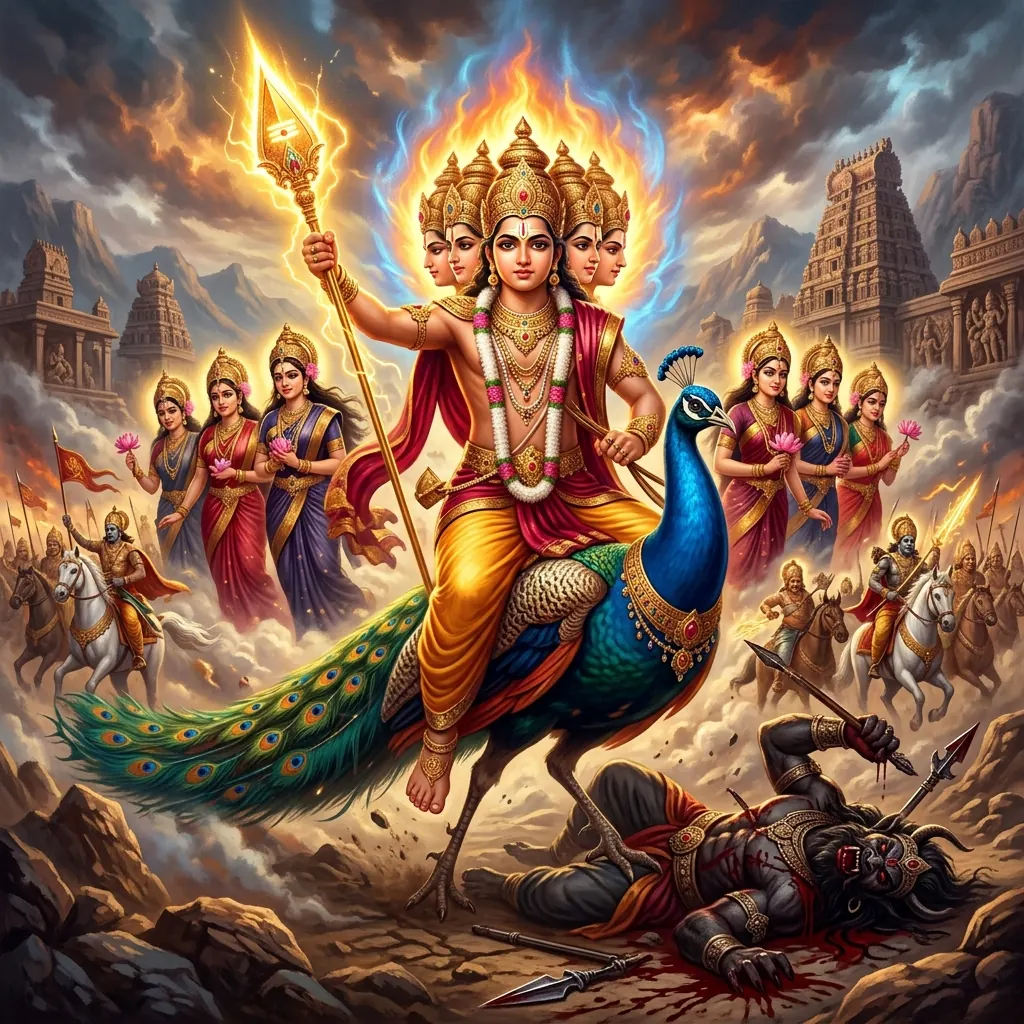
How the Krittikas Took Abhijit's Place
A star leaves the sky in envy of her elder sister, and the six Krittikas are raised into the empty station
In short
Six days after his birth, Skanda is anointed leader of the celestial armies, and everyone in the three worlds who has lost something comes to his camp to ask for it back. Six disowned wives of the rishis ask to be called his mothers; Indra reports that Abhijit, the younger sister of Rohini, could not bear her sister's seniority and has abandoned the sky, leaving a station empty; and the Krittikas are set in her place under the presidency of Agni. Then the mothers of all creatures come with a request Skanda cannot grant, and he settles instead the terms on which they may touch a child.
Told in the Vana ParvaSet in Himavat, Kamyaka Forest and Amaravati18 min read
Six Days Old and Lord of the Host
Markandeya had been days in the Kamyaka by then, and the sons of Pandu had learned to let him talk without interrupting. He was telling them the birth of the war god, and he had brought the account as far as the anointing.
Skanda was six nights old. That is the fact the whole of the rest depends on, and Markandeya kept putting it back in front of Yudhishthira so that he would not forget it. Six nights old, born of the Fire god, golden-eyed, dressed in a pair of clean red cloths so that he looked like the sun peering out from behind a mass of red clouds. The gods had offered him the sovereignty of the three worlds and he had refused it, telling Indra to go on being Indra, and had asked instead to be made the leader of the celestial armies, for the destruction of the Danavas and for the well-being of cows and brahmanas. So Indra had anointed him. The golden umbrella held over his head looked like a halo of blazing fire. The red cock his father had given him was set on the top of his chariot, where it looked like the image of the all-destroying fire, and Brihaspati had said the marriage hymns over him and Devasena, whom Brahma had appointed to be his bride before he was born.
"Understand what that means," Markandeya said. "A child not a week old had an army, a wife, a standard, and the ear of every god in heaven. And everyone in the three worlds who had ever lost something now knew exactly where to go and ask for it back."
They came almost at once.
Six women walked into the camp of the celestial forces on the White Mountain. They were ladies of high religious merit and austere vows, and they had nowhere else on earth or in heaven to be, because their husbands had put them out of their houses.
The Wives Who Were Cast Out
They were the wives of the seven great rishis, six of the seven, and the seventh had not come with them because nobody had ever accused her of anything.
The charge against these six was that they had given birth to Skanda. It was not true. What had happened was that Swaha, in love with the Fire god and unable to reach him, had taken the shape of one wife after another and gone to him in the shape she had taken, and the seed she carried away from him was what had at last become the child. The women themselves had been asleep in their own houses the whole time. But the rumour had gone out, and the rumour was the kind that fastens, and the rishis had believed it.
They stood in front of the six-day-old commander of the armies of heaven and told him so without any softening of it.
"Son, our godlike husbands have cast us out for no reason at all. Some people spread the rumour that we gave birth to you. They believed the story, grew furious, and banished us from our sacred places. Now you must save us from this disgrace. We want to adopt you as our son, so that by that kindness, mighty one, we may be granted lasting bliss. Repay in this way the debt you owe us."
Read the last line again, because it is the hinge of the whole scene. They were not begging. They were presenting an account. He had cost them their homes and their standing without ever meaning to, and they had come to collect what he owed. And they had worked out the only settlement that would answer, which was that the lie should be made true.
"Ladies of spotless character," Skanda said, "then be my mothers. I am your son, and you will gain everything you desire."
He was six days old and he had just acquired six mothers, none of whom had borne him. Where he was going to put them was not yet clear to anybody in that camp.
A Star That Went to the Woods
Indra had been standing by through all of this with something on his mind, and when the women had finished he made a sign that he wished to speak.
"What is it?" Skanda said.
Vasava, who is Indra, told him about a scandal in the sky.
"The lady Abhijit, Rohini's younger sister, is jealous of her seniority and has gone to the woods to practise austerities. I cannot find a star to take her place. May good luck be with you. Talk it over with Brahma and find a way to fill the place of this great asterism."
To follow that, one has to know what an asterism is in this reckoning. The nakshatras are not decorations. They are a fixed roster of stations along the moon's road, twenty-seven of them, each with a presiding lady and each with her turn at holding the sky, and the count is not a matter of taste. It was fixed at the creation and it was full.
Abhijit had walked out of it.
The reason she walked out is given in a single clause and it is one of the plainest things in the epic. Rohini was her elder sister. Rohini was the moon's beloved, the one he came back to, the one whose name is spoken first. Abhijit could not bear the seniority. Not the beauty and not the husband, which would at least be the ordinary complaint. The precedence. The order in which they were named. And rather than stand in the sky and be second for the rest of eternity she went down into the forest to burn it off with austerities, which is the one form of self-destruction the world calls holy.
So there was a hole in the roof of the world where a star had been, and the king of the gods, who could not sleep for it, had come to a child six days old and asked him to please go and speak to his grandfather about it.
Krittika Is Given the Place
The trouble with filling the vacancy was arithmetic.
Dhanishtha and the other asterisms had been made by Brahma at the beginning, and the number he had made was the number there was. There were no spare ladies waiting in reserve. Rohini herself had been serving as one of them, and with her included the roster stood complete, which is another way of saying that every star in the sky already had a station and none of them could be moved into Abhijit's without opening a second hole where the first had been closed.
The answer, when it came, was to raise something that had never been counted.
On Shakra's advice, Krittika was given a place in the heavens. That is the whole of the transaction as Markandeya gives it, and it is worth pausing on who Krittika is. She is not one lady. She is six, and in the telling she rises straight after the six cast-out wives of the rishis had been received as his mothers, the women in whose shapes Swaha had gone to the Fire god, and it is as the son of Krittika that he is known. They had lost their homes. They had no station. And now the six of them together were set up in the sky as one asterism in the place of the star that could not bear to be second.
That star is presided over by Agni, the Fire god, who was Skanda's father, and Markandeya says it shines as if with seven heads.
Six flames and the fire that fathered him. Anyone who has looked for the Krittikas on a clear night and counted them has been counting a household.
While that was being settled, Vinata came forward. She is the mother of Garuda.
"You are like a son to me," she said, "and have the right to offer me the funeral cakes. My son, I want to live with you always."
"So be it, and all honour to you," said Skanda. "Guide me with a mother's love. Your daughter-in-law will honour you, and you will always live with me."
That made seven mothers, and eight, and the queue had not moved.
The Mothers of All Creatures
Then the great mothers came, and they were not six women in trouble with their husbands. They were the powers that stand behind birth itself, and they had been waiting their turn in the line.
"The learned call us the mothers of all creatures," they said. "But we want to be your mothers. Honour us."
"You are all like mothers to me, and I am your son," Skanda said. "Tell me what I can do to please you."
He had said the same sentence to everybody who had come to him that day, and every time it had been answered with something simple. This time it was not.
"The ladies Brahmi, Maheswari and the rest were appointed mothers of the world long ago," they said. "Great god, we want them stripped of that rank and ourselves put in their place, so that the world worships us instead of them. And give us back our children, whom they took from us on your account."
There it is, and it took no time at all to get there. They wanted the office. They wanted the worship that goes with the office. And they wanted their children back, the ones taken from them and handed to the reigning mothers, and they had noticed and were pointing out that it was on his account that the transfer had been made.
Skanda gave them half of it and refused the half that mattered.
"You cannot have back what has once been given away," he said, "but I can give you other children if you like."
It is the answer of somebody who has already learned, six days into his existence, that a thing given cannot be called back without making the gift a lie, and that the only honest generosity left is new generosity. He was offering to make them mothers again from the beginning.
They did not want to begin again. They wanted what they had lost, and having been told they could not have it, they told him what they would take instead.
What the Mothers Asked to Be Allowed to Eat
"We want to live with you, take different shapes, and be able to eat the children of those mothers and of their guardians. Grant us this favour."
It is said in one breath, the way people say the thing they have been holding all along. They could not be the mothers of the world, so they would be the hunger that comes for the world's children, and they would do it in borrowed shapes so that nobody would see them coming, and they asked their new son to sign it.
He did not shout at them. What he said was worse.
"I can give you children," Skanda said, "but what you have just described is a very painful thing to hear."
That is the only judgment he passes, and he passes it as a description of his own state. Then he turned the request inside out and handed it back.
"May you prosper. All honour to you, ladies: give those children your protection."
Protect them. The same children. Nothing else about their standing changed, no lecture and no curse, only the object of the verb reversed, and by the courtesy in it they were left with nowhere to go but agreement.
"We will protect them as you wish, Skanda," they said. "May you prosper. But, mighty one, we want to live with you always."
That was the real petition, and it had been the real petition from the beginning. Not the office and not the children. To be near him. And so he gave them a settlement that has governed the sickroom and the birth chamber ever since.
"Until human children reach youth in their sixteenth year, you will trouble them in your various forms. And I will give you a fierce, inexhaustible spirit. With it you will live happily, worshipped by all."
Sixteen years, and after that the child is out of their reach. Within those years they may come. They are not to devour, they are to afflict, and they are also the ones who have promised to protect, so that the same powers that trouble a child are the ones a household prays to for that child, and the prayer is not a contradiction but the terms of the bargain.
The Thing That Came Out of Him
Then a fiery, powerful being came out of Skanda's body to devour the children of mortals, and it fell to the ground, senseless and hungry.
That is the sentence. It came out of him, it could not stand, and it was hungry. He had promised a fierce inexhaustible spirit and this was the spirit, born the way he had been born, out of fire, with nothing in its head but appetite. At Skanda's command that spirit of evil rose and took on a terrifying form, and good brahmanas call it Skandapasmara, the falling sickness of Skanda, which takes a child in the middle of a room and throws it down.
After that Markandeya named the rest of them, one by one, and the naming is the point, because a thing with a name can be addressed and a thing that can be addressed can be asked to go away.
Vinata, who had asked to live with him always, is the terrible Shakuni graha, the bird spirit.
The one the learned know as Putana Rakshasi is the graha called Putana. And another, hideous to look at, is the pisacha called Sita Putana, the pale Putana, and she causes miscarriage in women.
Aditi is also called Revati, and the evil spirit that comes from her is called Raivata, and it too afflicts children.
Diti, the mother of the Daityas, is called Muhkamandika, and that terrible creature loves the flesh of little children.
And the boys and girls said to have been fathered by Skanda himself are evil spirits that destroy the foetus in the womb. They are the Kumaras, and they are the husbands of those very ladies, and they seize children without warning.
Nine names so far and every one of them a household word in a house where a baby has died. There is no attempt anywhere in the passage to explain the deaths away or to say that they are deserved. The epic simply concedes that infants are taken, gives the takers faces and names and a season during which they are permitted to come, and moves on to the rest of the list.
Eighteen in the Lying-In Room
Surabhi, whom the wise call the mother of cattle, is ridden by the evil spirit Shakuni, and in her company he devours children on this earth.
Sarama, the mother of dogs, is in the habit of killing human beings while they are still in the womb.
And the mother of all trees, who lives in a karanja tree, is nothing like the others. She grants boons. Her face is calm, she is always kindly toward every creature, and those who want children bow down to her where she sits in that tree. In the middle of the worst list in the Vana Parva there is one seat under one tree where a woman who wants a child may go and be answered.
These eighteen spirits, Markandeya said, who love meat and wine, and others like them, always make their home in the lying-in room for ten days.
Ten days. Not forever and not at random. There is a period after a birth during which that room is understood to be crowded, and the customs that surround it, the lamps and the watching and the refusal to leave the mother alone, are the practical form of that belief.
Three more were named, and each is an explanation of a particular grief. Kadru enters the body of a pregnant woman in a subtle form and destroys the foetus there, and the mother gives birth to a Naga. The mother of the Gandharvas carries the foetus away, and that is why a woman's conception sometimes comes to nothing. The mother of the Apsaras removes it from the womb, and that is why the learned speak of conceptions that stand still, that neither grow nor come to anything.
Then the two who are wholly good. The daughter of the Divinity of the Red Sea nursed Skanda, and she is worshipped as Lohitayani in Kadamva trees. And Arya plays the same part among female beings as Rudra does among male ones. She is the mother of all children, and she is worshipped in her own right for their welfare.
Until children reach their sixteenth year these spirits work for evil, and after that, for good. That is the turn on which the whole catalogue rests. The same power that came for the child comes back to guard the man. They are appeased with burnt offerings, ritual baths, unguents and sacrifices, and above all by the worship of Skanda, and when they are honoured with due reverence they give men whatever is good for them, and valour, and long life.
The Spirits That Come After Sixteen
"And now," said Markandeya, "after bowing down to Maheshvara, I will describe the nature of the spirits that shape the destinies of men once they have reached their sixteenth year."
The list that follows is a physician's list. Every item in it begins with something the sufferer sees or smells or hears, and ends with the name of the thing that is doing it to him.
The man who sees gods, asleep or awake, soon goes mad, and the power behind those visions is called the celestial spirit.
When a person sees his dead ancestors while sitting at ease or lying in bed, he soon loses his reason, and that illusion is the work of the ancestral spirit.
The man who shows disrespect to the Siddhas and is cursed by them in return goes mad, and that is the Siddha spirit.
The spirit that makes a man smell sweet scents and taste different tastes when there is nothing near him to smell or taste, and torments him with them, is called the Rakshasa spirit.
The spirit through which the celestial musicians mingle with a human being's nature and drive him mad in no time is the Gandharva spirit. A man who is always tormented by Pishachas is under the Paisacha spirit. And when the spirit of the Yakshas happens to enter a man's body, he loses his reason at once, and that is the Yaksha spirit.
Then two that are laid at no one's door but the man's own. A man whose mind has been corrupted by vices goes mad in no time, and his illness must be treated by the methods laid down in the Sastras. And men go mad from confusion, from fear, and from seeing hideous sights, and there the cure lies in calming their minds.
There are three classes of these spirits. Some are playful, some are gluttonous, and some are sensual. Until a man reaches the age of seventy they go on tormenting him, and after that fever is the only evil spirit that afflicts living beings.
And all of them keep away from those who have mastered their senses, who are self-restrained, clean in their habits, god-fearing, and free from laziness and impurity.
"So I have described to you, king, the evil spirits that shape the destinies of men," Markandeya said to Yudhishthira, in a forest, in the last years of somebody else's quarrel. "You are devoted to Maheshvara, and they will never trouble you."
Dharma Lesson
Abhijit did not lose her place in the sky. She left it, because she could not bear to be named second, and the sky closed over her without argument. What fills the room she vacated is not a greater star but six cast-out women who had never been counted at all, raised for the plain reason that a child had taken them as his mothers. The epic sets envy of precedence and the unrecorded claim of a mother side by side and lets the reader see which one the heavens found easier to replace.