In short
Karna promises the Kuru captains that he will grind Partha, and Kripa and Ashwatthama tell him to his face that he cannot. Then Arjuna cuts down his brother Sangramajit with a crescent arrow, beats him twice in the open field, and reminds him of what he said and watched in the assembly at Hastinapura. Karna flees north, unconscious of where he is going.
Told in the Virata ParvaSet in Virata16 min read
The Boast Before the Cattle Were Counted
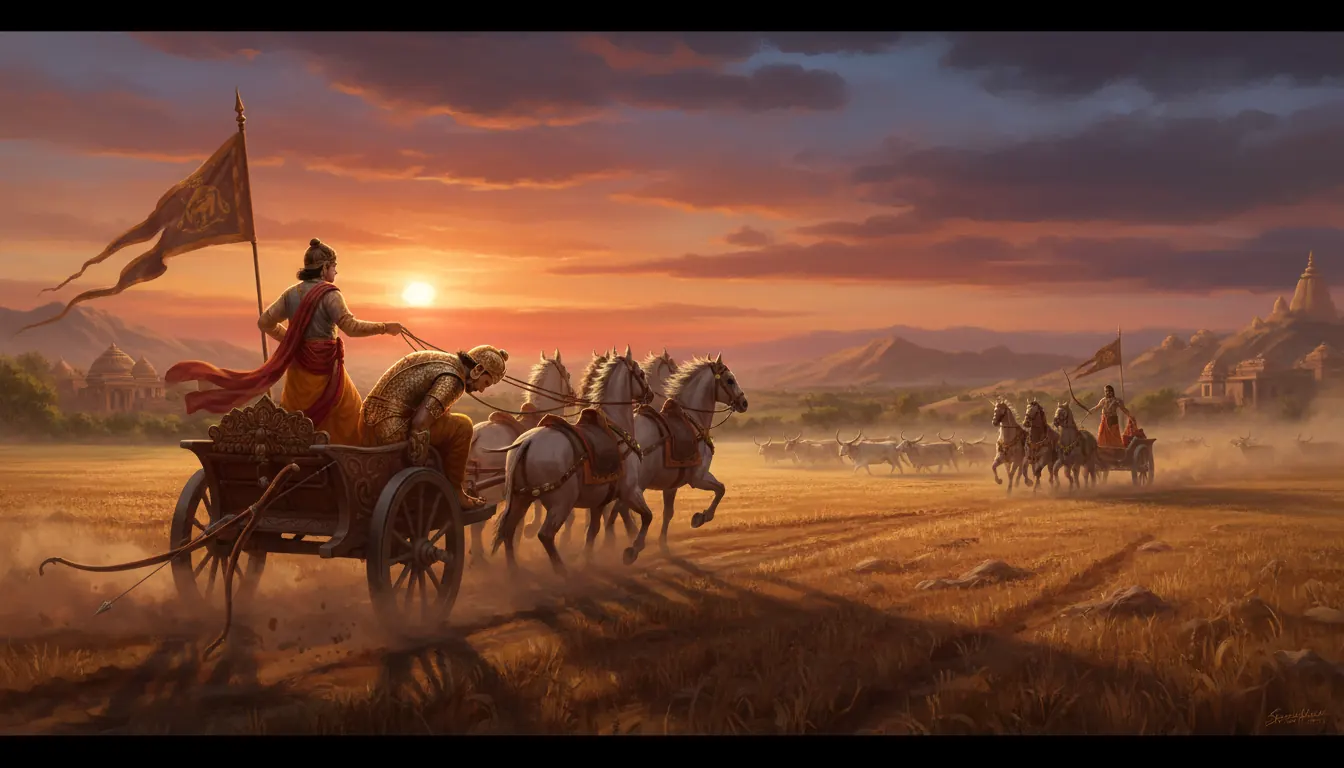
Vaishampayana said: The Kuru captains stood on the border of Matsya with sixty thousand stolen cattle behind them and a single chariot coming toward them out of the dust, and not one of them looked happy about it.
Karna looked at their faces and did not like what he saw there.
"I see all these blessed ones," he said, "looking alarmed, panic-struck, wavering and unwilling to fight. If the man who has come is the king of the Matsyas, or if it is Bibhatsu himself, I will resist him as the banks resist the swelling sea.
"Shot from my bow, these straight flying arrows are like gliding snakes and every one of them is sure of its aim. Loosed by my quick hands, these keen-edged arrows with golden wings will cover Partha all over the way locusts shroud a tree. When the bowstring comes back against my leather guards, men will hear a sound like a pair of kettle-drums.
"He has been at ascetic austerities for the last thirteen years. Bibhatsu will strike me only mildly today. The son of Kunti has become a brahmana full of good qualities, which makes him a fit person to take my shafts quietly, by the thousand.
"By killing Arjuna in this battle, I will pay off today the debt I promised long ago to Dhritarashtra's son, and which is a hard debt to repay. Who is there, among the gods or the asuras, who will stand in front of the straight arrows shot from my bow? Though he is as hard as Indra's thunderbolt, I will grind Partha the way a man torments an elephant with burning brands. I will take that unresisting Partha the way Garuda takes a snake.
"Today I will pluck out by the roots the long-standing dart in Duryodhana's heart, by throwing Arjuna down from his chariot. Let the Kauravas go away with this wealth of cattle if they wish, or let them stay in their chariots and watch me fight."
Kripa Tells Him to Take a Sedative
Kripa answered him first, and Kripa had taught both of them.
"Radheya, your crooked heart always leans towards war. You do not know the true nature of things, and you do not reckon with what follows from them.
"Consider who this is. Alone he saved the Kurus from the gandharvas. Alone he satisfied Agni. Alone he lived as a Brahmacharin for five years on the breast of Himavat. Taking Subhadra up on his chariot, alone he challenged Krishna to single combat. Alone he fought with Rudra, who stood in front of him as a forester. It was in this very forest that Partha rescued Krishna when she was being carried off. For five years he studied the science of weapons under Indra himself. Alone he defeated Chitrasena the king of the gandharvas and his invincible troops in a moment. Alone he overthrew the fierce Nivatakavachas and the Kalakhanjas, whom the gods themselves could not kill.
"What have you achieved single-handed, Karna, that resembles any of that?
"He who wishes to fight with Arjuna should take a sedative first. You want to draw the fangs of an angry snake of deadly poison by putting out your right hand and stretching out your forefinger. You want to ride a maddened elephant alone in the forest and go up to a boar with no hook in your hand. You want to rub yourself over with clarified butter, dress in silk, and walk through the middle of a blazing fire that is being fed with fat and tallow. Who would tie his own hands and feet, and hang a great stone round his neck, and try to cross the ocean swimming with his bare arms? What manliness is there in that?
"We have come ignorantly to the place where Partha lay concealed like fire hidden in a well. Do not act so rashly as to fight him alone. Let Drona and Duryodhana and Bhishma and yourself and Drona's son and myself fight him together. Six of us, standing carefully, with the troops arrayed in ranks, may be a match for him."
Fire Burns Mutely
Then Drona's son spoke, and he was not gentle about it.
"The cattle have not yet been won, Karna. They have not crossed the boundary. They have not reached Hastinapura. Why are you boasting?
"Truly heroic men have won many battles and gained enormous wealth and beaten hostile armies, and they do not say one word about their own prowess. Fire burns mutely. The sun shines mutely. The earth mutely bears creatures, both the moving and the still.
"In what single combat did you defeat Dhananjaya, or Nakula, or Sahadeva, although you robbed them of their wealth? In what battle did you defeat Yudhishthira, or Bhima, the foremost of strong men? In what battle did you conquer Indraprastha?
"What you have done, man of wicked deeds, is to drag that princess into the court while she was unwell and had one garment on her. You cut through the root of the Pandava tree, which was delicate as sandal. When you made the sons of Pandu into slaves out of a desire for wealth, do you remember what Vidura said?
"We see that men, and even insects and ants, show forgiveness in proportion to their power of endurance. The son of Pandu is not able to forgive the sufferings of Draupadi. Dhananjaya is coming here for the destruction of the sons of Dhritarashtra.
"Use the means now that you used in the match at dice. The same means by which you took Indraprastha. The same means by which you dragged Krishna into the assembly. Let this wise uncle of yours, this deceitful gambler Shakuni, the prince of Gandhara, fight now. The Gandiva does not throw dice like the Krita or the Dvapara. It shoots blazing keen-edged shafts by the myriad.
"Let the teacher fight, if he chooses. I will not fight with Dhananjaya. We are here to fight the king of the Matsyas, if he comes after his cattle."
Urge On the White Horses
Having thrown the host into disorder and recovered the cattle, and wanting to fight again, Arjuna turned toward Duryodhana.
The cattle were already running wild back toward the city of the Matsyas, and the Kuru captains, watching them go, understood that Kiritin had achieved what he came for. So they threw themselves on him all at once while he was moving on Duryodhana, division after division in order of battle with countless banners over them.
Arjuna spoke to the son of the king of the Matsyas, who was driving.
"Urge these white horses on by this road, as fast as they will go, with the golden bridles. Strive well. I want to get in among this crowd of Kuru lions. The Suta's son of wicked soul is as eager for a battle with me as one elephant is for another. Take me, prince, to the man who has grown so proud under Duryodhana's patronage."
And Uttara, with those great horses that had the speed of the wind and armour of gold on them, broke the array of chariots open and took the Pandava into the middle of the field.
Seeing it, four great chariot-warriors came out to help Karna, Chitrasena and Sangramajit and Satrusaha and Jaya, with arrows and long shafts, straight at the advancing hero.
Vikarna's Flagstaff
Arjuna began to burn that array of chariots with fiery arrows out of his bow, the way a conflagration takes a forest.
Vikarna came at him first, mounted, showering him with terrible shafts thick and long. Vikarna was the one Kaurava brother who had stood up in the dice hall and said aloud that what was being done to Draupadi was wrong, and had been shouted down for it. Arjuna cut his bow, which had a tough string and horns overlaid with gold, and then cut his flagstaff, and Vikarna, seeing his standard come down, took to flight at speed and was not pursued.
After Vikarna went, Satruntapa could not hold his anger, and began to afflict Partha with a perfect shower of arrows. Arjuna was in the middle of the Kuru array by then and half drowned in it. He answered Satruntapa with five shafts, killed his driver with ten more, and then put an arrow through him that was made to cleave the thickest coat of mail; and king Satruntapa fell dead on the field like a tree torn off a mountain-top by the wind.
And after that the well-dressed heroes around him began to waver and tremble like forests shaken by the wind that blows at the dissolution of the world, and they went down and measured their lengths on the ground, full-grown men in black steel mail decked with gold, like Himalayan elephants falling.
The Crescent Arrow and the Brother
Then Arjuna came to the chariot of Sangramajit, who was Karna's own brother, and killed the red horses yoked to it, and cut off the man's head with a crescent-shaped arrow while Karna was close enough to watch it happen.
The Kauravas, seeing what was about to follow, stood aside to look on, because everyone on that field had been waiting thirteen years for this particular meeting.
Karna came at him mustering all his prowess, like a huge elephant with its tusks out, like a tiger going at a bull. He put twelve shafts into Arjuna and more into every part of the horses and one through Uttara's hand. And Kiritin came at him the way Garuda of the variegated plumage comes down on a snake.
Both of them were the foremost of bowmen. Both were of great strength. Both were entirely capable of killing the other.
Arjuna was glad. He had the offender in front of him at last, and he made him and his horses and his chariot and his driver invisible under a frightful shower of arrows, so that the warriors of the Bharatas led by Bhishma, with their horses and elephants and chariots, were scattered and broken and began to wail aloud. And Karna, counteracting all of it with numberless arrows of his own, came burning back out into view with his bow, and the Kurus clapped their hands and blew their conchs and trumpets and beat their kettle-drums for him.
The Sun and the Moon Covered by Clouds
Karna sent out a great roar when he saw the tail of the monkey standing up on Arjuna's flagstaff and heard the creature on the standard yelling.
And Arjuna, harrying the son of Vikartana together with his horses and his chariot and his driver, poured a shower of arrows over him, and did it while casting his eyes deliberately across at the grandsire, and at Drona, and at Kripa, so that the three men who had just been arguing about whether Karna could do this could watch it being settled.
The two of them, standing on their chariots, made clouds of keen-edged arrows out of countless shafts, and to the men watching they looked like the sun and the moon covered over by clouds.
Karna, unable to bear the sight of him, pierced the four horses of the diadem-decked hero with whetted arrows, and struck his driver with three shafts, and his flagstaff with three more.
At that Jishnu, who wielded the Gandiva, came awake like a lion out of sleep and attacked Karna with straight-going arrows. He covered Karna's chariot with shafts the way the sun covers the worlds with its rays. Then, like a lion attacked by an elephant, he took some keen crescent-shaped arrows out of his quiver and drew the bow all the way back to his ear.
He pierced the Suta's son on every part of his body. He put whetted shafts with the force of the thunderbolt into Karna's arms and his thighs and his head and his forehead and his neck.
And mangled and afflicted by those arrows, Vikartana's son quit the van of the battle and took to flight, like one elephant beaten by another.
The Chariot Comes Back
That should have been the end of it for the day. It was not.
Arjuna went on through the rest of the army, and took on Kripa, and then Drona, and then Drona's son. He was still locked with Drona's son when Karna drew a great bow and twanged it, and Arjuna heard it, and saw who it was, and left Drona's son where he stood and drove straight at him.
He had waited thirteen years. He had not come to win a raid.
He pulled up in front of him, in the open, in front of both hosts, and spoke.
"The time has come, Karna, to make good that long-winded boast of yours in the middle of the assembly, that there is nobody equal to you in a fight. Today, fighting me in a terrible conflict, you will learn your own strength, and you will not look down on others again.
"Abandoning good breeding, you uttered a great many harsh words. What you are attempting now, I think, is very difficult. Do it now, son of Radha, fighting me in the sight of the Kurus. Make good what you said before in disregard of me.
"You watched the princess of Panchala outraged by villains in the middle of that court. Reap now the fruit of that act of yours. I was fettered then by the bonds of morality and held back from vengeance. See now, son of Radha, the fruit of that wrath, in the conflict at hand.
"Wicked wretch, we have suffered much misery in that forest for twelve full years. Reap today the fruits of our gathered vengeance. Come, Karna. Fight me. Let these Kaurava warriors of yours witness the conflict."
Your Words Exceed Your Deeds
Karna did not step back from it.
"Partha, accomplish in deed what you say in words. The world knows that your words exceed your deeds. You bore all that before because you could do nothing else. If we witness your prowess even now, we may acknowledge that it is true.
"And if your past forbearance was due to your being bound by the bonds of morality, then truly you are just as bound now, although you regard yourself as free. You have passed your exile in the woods in strict accordance with your pledge, and you have therefore been weakened by practising an ascetic course of life. How do you come to want a combat with me?
"Son of Pritha, if Shakra himself fought on your side I would feel no anxiety about putting out my strength. Your wish, son of Kunti, is about to be granted. Fight with me now, and see what I am."
And Arjuna answered him with the one sentence there was no reply to.
"Even now, son of Radha, you fled from a battle with me, and it is because of that that you are alive, though your younger brother has been killed. Who else, having seen his own younger brother killed in a battle, would himself run from the field, and then boast the way you are boasting, in front of good and true men?"
North, and Not Knowing Where
With that, Bibhatsu rushed at him and loosed a volley of shafts capable of going through a coat of mail.
Karna took the whole volley with great eagerness and answered it with a shower of arrows of his own, heavy as the downpour of the clouds, and his volley covered every side and pierced the horses and the arms and the leather guards of both of them.
Then Arjuna cut the strings of Karna's quiver with one straight sharp arrow. Karna took another arrow out of it and pierced the Pandava in the hand, so that his hold on the bow was loosened. Arjuna, mighty-armed, cut Karna's bow into fragments. Karna hurled a dart at him and Arjuna cut the dart apart in the air with arrows. The warriors who followed the son of Radha rushed in a crowd at Arjuna, and Partha sent every one of them to the abode of Yama with shafts out of the Gandiva.
Then Bibhatsu killed the horses of Karna with sharp tough arrows shot from a bowstring drawn to the ear, and they dropped down on the ground with the life gone out of them.
And taking one more sharp and blazing arrow full of great energy, the mighty son of Kunti pierced the breast of Karna. The arrow cleaved through his mail and went into his body. His vision went dark and his senses left him.
When he came back to himself he was in great pain, and he left the combat and fled in a northerly direction, and did not know where he was going.
And Arjuna and Uttara, standing in the chariot behind him, called after him as he went, and what they called was not kind.
That was the first time. It is worth marking, because of what everybody afterwards did with it. Karna would go on to be made a commander, and to be told again and again by Kripa and by Ashwatthama and by Bhishma himself, in council, in front of Duryodhana, that they had all watched him run at Matsya. He never had an answer for it. And on the seventeenth day of a much larger war, on a field far from any cattle, the two of them would meet for the last time, and one of them would be on the ground trying to lift a wheel out of the earth.
Dharma Lesson
Words spoken over a woman being dragged across an assembly hall are a debt, and debts of that kind are collected in the open where the same men can watch. Karna is not beaten by a curse or an accident here, but by the plain arithmetic of what he said and what he could do.