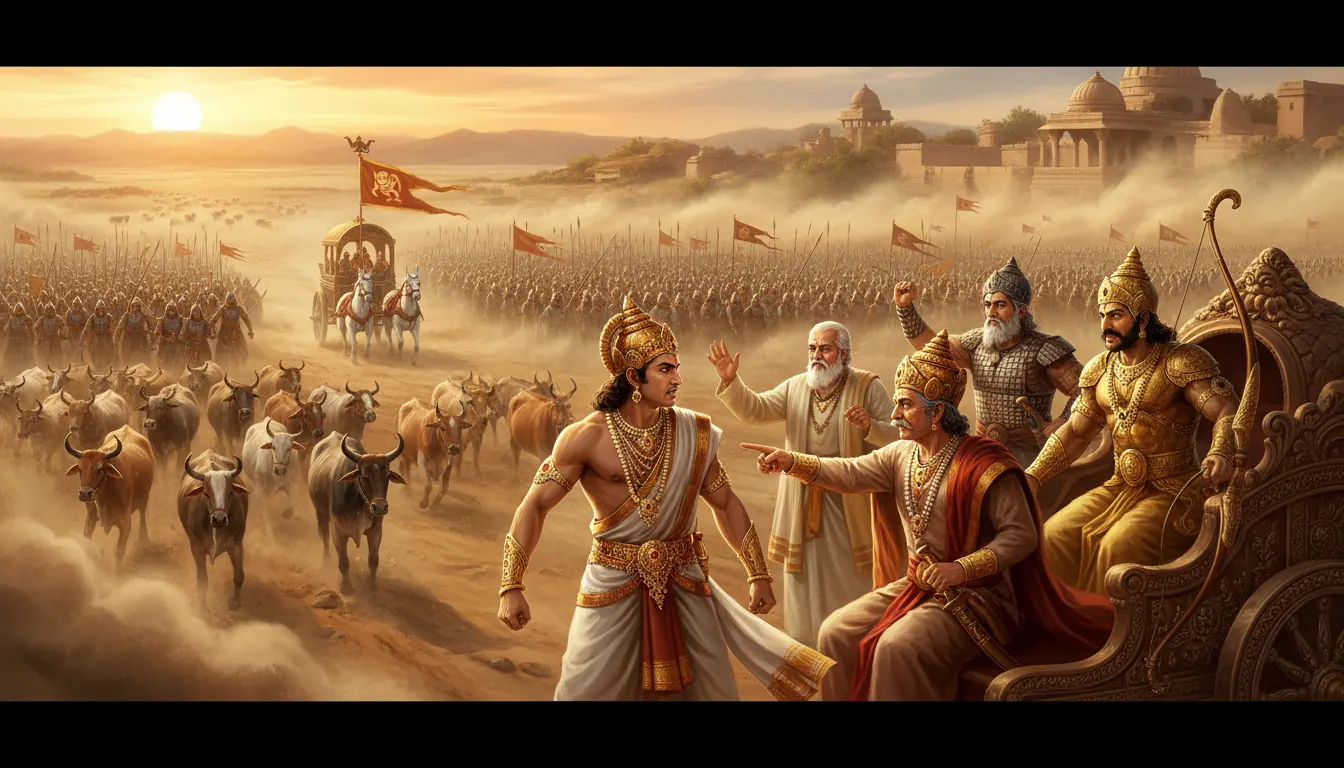
The Quarrel Before the Cattle
Ashwatthama tells Duryodhana what his kingdom is made of
In short
One chariot with a monkey banner comes on against the whole Kuru host, and the Kuru command falls apart arguing. Karna offers to hold Arjuna alone as a bank holds the sea; Kripa answers that battle is the last of the expedients. Then Drona's son turns on Duryodhana in front of the whole army and refuses to fight at all.
Told in the Virata ParvaSet in Virata and Indraprastha20 min read
The Rattle of One Chariot
The Kuru army had taken sixty thousand of Virata's cattle and was standing in the open country north of the Matsya capital, waiting for the herds to be driven clear, when they heard a bowstring.
It was one bowstring. It came from the direction of the burning ground, and the sound of it went across the plain like the collision of two great bulls, and the wind rose after it, and meteors fell. Birds came off the trees and could not hold their line in the air.
Drona had been a soldier for a very long time and he did not pretend that he had not understood it.
"From the rattle of that chariot," he said, "and from the way the clouds have covered the sky, and from the trembling of the earth itself, this warrior can be no one but Savyasachin. Look at us. Our weapons do not shine. Our horses are listless. Our fires, though fed with fuel, do not blaze up. All this is ominous."
"Omens," said Karna, from further along the line.
"All our animals are setting up a frightful howl, gazing toward the sun. The crows are perching on our banners. Those vultures and kites on our right portend a great danger. That jackal running through our ranks wails dismally, and see, it has got away unhurt. Every man here has his hair standing on end. Everything that gives light is pale, and beasts and birds look fierce. These omens foretell great slaughter among us." He turned to Duryodhana. "King, your ranks are thrown into confusion by these blazing meteors, and your animals seem to be weeping. You will be sorry when you see this army stricken by Partha's arrows. Send the cattle ahead. We should stand here, ready to strike, drawn up in battle order."
Across the field a single chariot came on toward the whole Kuru host, and on its staff was a golden banner with an ape on it, and the ape had a lion's tail.
The Thirteenth Year Is Still Running
Duryodhana turned on the three of them, Bhishma and Drona and Kripa, and he was already arguing before he began.
"Karna and I have both said this to our teachers before," he said, "and I say it again, because saying it once does not satisfy me. This was the pledge of the sons of Pandu: that if they lost at dice they would live in lands and forests for twelve years where we could know of them, and one more year unknown to us. That thirteenth year, instead of being over, is still running. Bibhatsu, who is still bound to live undiscovered, has appeared before us. And if Bibhatsu has come before the term of exile is at an end, then the Pandavas must pass another twelve years in the woods."
Nobody answered him.
"Whether they have forgotten, out of their desire for power, or whether the mistake is ours, Bhishma should work out whether the promised period is short or over. When something we want may or may not be won, there is always doubt about one outcome or the other, and what is decided one way often ends differently. Even moralists are puzzled when they judge their own acts.
"As for us, we came here to fight the Matsyas and to seize their cattle kept toward the north. If in the meantime it is Arjuna who has come, how are we at fault? We came on behalf of the Trigartas, who were overcome with fear and told us of the many wrongs the Matsyas had done them. It was agreed between us that they would seize the herds on the afternoon of the seventh lunar day, and that we would seize these at sunrise on the eighth, while the king of the Matsyas was away chasing the first herd. It may be that the Trigartas are now carrying off the cattle, or that they have been defeated and are coming to us. It may be that the king of the Matsyas has driven them off and is advancing on us at the head of his whole army. It may be some single leader of theirs, a man of mighty energy."
He looked along the line of chariots.
"But whether it is the king of the Matsyas or Bibhatsu, we must all fight him. That was our pledge. Why are all these great chariot warriors, Bhishma and Drona and Kripa and Vikarna and Drona's son, sitting in their chariots now, panic-stricken? Right now there is nothing better than to fight. So make up your minds. If, for the cattle we have seized, we must face the wielder of the thunderbolt himself, or even Yama, which of us is likely to get back to Hastinapura? Pierced by the enemy's arrows, how will the foot soldiers escape with their lives, running through the deep forest with their backs to the field, when even the cavalry may not escape?"
Ignore the Teacher
Karna answered him, and he did not answer the question that had been asked.
"Ignore the teacher," he said, "and make all the arrangements yourself. He knows the intentions of the Pandavas well, and he strikes terror into our hearts. I see that his affection for Arjuna is very great. At the mere sight of him coming, he sings his praises. Make sure our troops do not break. Everything is in confusion because Drona has heard the neigh of Arjuna's horses."
Drona said nothing at all.
"These troops have come to a distant land in the hot season, in the middle of this great forest. Make sure they do not fall into confusion and are not overcome by the enemy. The Pandavas have always been the teacher's special favourites. They have placed Drona among us, and he gives himself away by what he says. Who would ever praise a man on hearing only the neigh of his horses? Horses always neigh, whether walking or standing. The winds blow at all times. Indra also always showers rain. The roar of the clouds may frequently be heard. What has Partha to do with any of these, and why is he to be praised for them? All this on the teacher's part comes either from a wish to do Arjuna good, or from anger and hatred toward us."
Then he said the thing that Ashwatthama would remember for the rest of the afternoon.
"Teachers are wise and sinless and very kind to all creatures. They should never be consulted in times of danger. It is in luxurious palaces, and in assemblies, and in pleasure gardens, that learned men who can make speeches seem to belong. It is in an assembly, doing many wonderful things, that learned men find their place, or else where sacrificial vessels must be set out properly and washed. In studying the characters of men, in the science of horses and elephants and chariots, in treating the diseases of asses and camels and goats and sheep, in planning buildings and gateways, in pointing out what is wrong with food and drink, there the learned are truly in their own sphere."
Along the line the charioteers stopped pretending not to listen.
"Ignore learned men who praise the enemy's heroism, and make the arrangements that will destroy the enemy. Put the cattle in a safe place. Draw up the troops in battle order. Post guards in the right places, so that we can fight."
As the Banks Hold Back the Sea
"I see all these blessed ones," Karna went on, "looking alarmed and panic-struck and undecided and unwilling to fight. Whether the man who has come is the king of the Matsyas or Bibhatsu, I alone will hold him back, as the banks hold back the swelling sea.
"Shot from my bow, these straight flying arrows, like gliding snakes, never miss. Loosed by my quick hands, these sharp arrows with golden wings will cover Partha all over, like locusts covering a tree. Drawn hard against these winged arrows, the bowstring will strike my leather guards with a sound like a pair of kettledrums.
"He has been practising austerities for the last thirteen years. Bibhatsu will strike me only gently in this fight. The son of Kunti has become a brahmana full of good qualities, and so he is fit to receive quietly the arrows I shoot in thousands. This mighty bowman is famous across the three worlds, and I am in no way inferior to Arjuna. Let the firmament today seem to swarm with fireflies, from my golden arrows shot on all sides.
"By killing Arjuna in battle today, I will repay the debt, so hard to repay, that I promised long ago to Dhritarashtra's son. What man, even among the gods and the Asuras, could bear to stand in the face of the arrows shot from my bow? Though he is as hard as Indra's thunderbolt, I will surely grind Partha down, as men torment an elephant with burning brands, and seize the helpless Partha as Garuda seizes a snake.
"Struck by my javelin, the ape on top of his banner will fall to the ground today with terrible cries. The creatures that live in that flagstaff will be stricken by me and fly away in all directions. Today I will pull out by the roots the dart that has been lodged in Duryodhana's heart so long, by throwing Arjuna down from his chariot. Today the Kauravas will see Partha with his chariot broken, his horses killed, his valour gone, sighing like a snake."
He finished with a courtesy that was not one.
"Let the Kauravas go away as they please, taking these herds with them. Or, if they wish, let them stay in their chariots and watch me fight."
A Battle Is the Last of the Expedients
"Radheya," said Kripa, "your crooked heart always leans toward war. You do not know the true nature of things, and you do not think about what follows from them.
"The scriptures point to many kinds of means. Of these, those who know the past have held battle to be the most sinful. Military action can succeed only when the time and place are right. Here the time is wrong, and no good will come of it. Prowess shown at the right time and place does good; whether the time and place are right decides whether an act is timely. Learned men can never act on the ideas of a chariot-maker."
"Then let us stand here and be run down," said Karna.
"With all this in mind," said Kripa, "it is not wise for us to fight Partha. But let me say what he is, since you have offered to hold him alone.
"Alone he saved the Kurus from the Gandharvas. Alone he satisfied Agni. Alone he lived as a brahmacharin for five years on Himavat. Alone he took Subhadra up into his chariot and challenged Krishna to single combat. Alone he fought with Rudra, who stood before him in the form of a forester. It was in this very forest that Partha rescued Krishna, the princess of Panchala, while she was being carried away. It is he alone who for five years studied the science of weapons under Indra. Alone, defeating all enemies, he has spread the fame of the Kurus. Alone that scourge of his enemies defeated Chitrasena, king of the Gandharvas, in battle, and his invincible troops too, in a moment. Alone he overthrew the fierce Nivatakavachas and the Kalakhanchas, whom even the gods could not kill.
"What have you achieved single-handed, Karna, like any of the sons of Pandu, each of whom has subdued many lords of the earth alone? Even Indra himself is no match for Partha in battle. So whoever wants to fight Arjuna should first take a sedative.
"As for you, you want to pull the fangs of an angry snake full of deadly poison by stretching out your right hand and pointing your forefinger. Or, wandering alone in the forest, you want to ride a maddened elephant, and to go up to a boar with no hook in your hand. Or, smeared with clarified butter and dressed in silk, you want to walk through the middle of a blazing fire fed with fat and tallow. Who would bind his own hands and feet, tie a huge stone to his neck, and try to swim across the ocean with his bare arms? What manliness is there in that?"
Six Chariots and No More Boasting
"Only a fool," Kripa said, "without skill in weapons and without strength, would want to fight Partha, who is so mighty and so skilled. And think what we have actually done today. We deceived him dishonestly, and now he is free of thirteen years of exile: will that illustrious hero not wipe us out? We have blundered into a place where Partha lay hidden like fire hidden in a well, and we have put ourselves in great danger."
"You said we should not fight," said Duryodhana.
"I said it is not wise to fight him. But though no one can withstand him in battle, we should fight him, since we are here and the cattle are behind us. Only let it be done the way men do it who mean to live. Let our troops stand here in their armour, drawn up in ranks and ready to strike. Let Drona and Duryodhana and Bhishma and yourself and Drona's son and myself, all of us, fight with the son of Pritha."
He turned back to Karna and made the point once more, in case it had been missed.
"Do not be so rash as to fight alone, Karna. If we six chariot warriors stand together, we can be a match for that son of Pritha, who is set on fighting and is as fierce as the wielder of the thunderbolt. With our troops drawn up in ranks, and we great bowmen standing with care, we will fight Arjuna as the Danavas fight Vasava in battle."
It was, in its way, a complete answer. It conceded the battle, refused the boast, and told the assembled command that six of the greatest archers alive would be needed together to handle one dancing master in a borrowed chariot.
Fire Burns in Silence
Then Drona's son spoke, and he began with Karna, and he was not finished when he got to the end of him.
"The cattle have not yet been won, Karna," said Ashwatthama. "They have not crossed the border of their owner's kingdom. They have not reached Hastinapura. So why do you boast?
"Men of true heroism win many battles, gain enormous wealth and defeat enemy armies, and say not a word about their prowess. Fire burns in silence. The sun shines in silence. In silence the Earth bears all creatures, moving and unmoving."
He let that stand a moment in front of a man who had been talking for a quarter of an hour.
"The Self-existent has given the four orders such duties that each, by following them, may gain wealth without blame. A brahmana, once he has studied the Vedas, should perform sacrifices himself and officiate at the sacrifices of others. A kshatriya, living by the bow, should perform sacrifices himself but should never officiate at the sacrifices of others. A vaishya, once he has earned wealth, should have the rites laid down in the Vedas performed for himself. A shudra should always wait on and serve the other three orders. As for those who live by selling meat, they may earn wealth by means full of deceit and fraud.
"By always acting as the scriptures direct, the noble sons of Pandu won rule over the whole earth. And they always treat their elders with respect, even when those elders turn against them."
Up to that point every man had taken it for a lecture aimed at Karna. Then Ashwatthama turned his head and looked at the king.
The Gandiva Does Not Throw Krita or Dvapara
"What kshatriya," said Ashwatthama, "ever took delight in winning a kingdom with dice, as this wicked and shameless son of Dhritarashtra does? Who that is wise would boast of wealth won this way, by deceit and fraud, like a seller of meat?
"In what single combat did you defeat Dhananjaya, or Nakula, or Sahadeva, though you have robbed them of their wealth? In what battle did you defeat Yudhishthira, or Bhima, the strongest of the strong? In what battle did you conquer Indraprastha?
"What you have done, man of wicked deeds, is drag that princess into the court while she was unwell and wearing a single garment. You have cut the mighty root of the Pandava tree, a root as delicate as sandalwood. When, driven by greed for wealth, you made the Pandavas serve as slaves, do you remember what Vidura said to you?
"We see that men, and even insects and ants, forgive as far as their endurance allows. But the son of Pandu cannot forgive what Draupadi suffered. Surely Dhananjaya comes here to destroy the sons of Dhritarashtra. It is true that you put on a show of great wisdom and like to make speeches. But will Bibhatsu, that slayer of enemies, not wipe us all out? Whether he faces gods or Gandharvas or Asuras or Rakshasas, will Dhananjaya, Kunti's son, stop fighting out of panic? Whoever he falls upon in his anger, he will overthrow like a tree under the weight of Garuda. Greater than you in prowess, equal to the lord of the gods with the bow, equal to Vasudeva himself in battle: who would not praise Partha? Those who know the scriptures say that a disciple is in no way less than a son, and that is why the son of Pandu is Drona's favourite."
Then he pointed, in front of the whole army, at the man standing next to the king.
"Use now the means you used in the match at dice. The same means by which you took Indraprastha. The same means by which you dragged Krishna into the assembly. This wise uncle of yours, who knows the duties of the kshatriya order so well, this deceitful gambler Shakuni, the prince of Gandhara, let him fight now.
"The Gandiva, however, does not throw dice like the Krita or the Dvapara. It showers blazing, sharp arrows on its enemies by the myriad. The fierce arrows shot from the Gandiva, full of great energy and fletched with vulture feathers, can pierce even mountains. Yama, the destroyer of all, and Vayu, and the horse-faced Agni leave something behind. Dhananjaya in his anger never does.
"As you played at dice in the assembly aided by your uncle, so fight in this battle protected by Subala's son. Let the teacher fight, if he chooses. I, however, will not fight Dhananjaya. We are here to fight the king of the Matsyas, if he does indeed come after the cattle."
The Worst Calamity of an Army
So the Kuru command stood on that field with one chariot approaching, having quarrelled in public about a dice game, and it was Bhishma who had to put it back together.
"Drona's son speaks well," he said, "and Kripa is right too. As for Karna, he wants to fight only out of regard for the duties of the kshatriya order. No wise man can blame the teacher. My own view, however, is that we must fight, given both the time and the place.
"Why should a man not be bewildered when he faces five enemies as radiant as five suns, heroic fighters just come through hardship? Even those who know morality are bewildered where their own interests are concerned. What Karna said to you was only meant to raise our drooping courage."
Then he turned to the young man who had refused to fight.
"As for you, son of our teacher, forgive everything. The business at hand is very grave. Now that the son of Kunti has come, this is no time for quarrels. You and the teacher Kripa should forgive everything now. Like light in the sun, the mastery of all weapons resides in you. As beauty is never separated from Chandramas, so are the Vedas and the Brahma weapon both established in you. We often see the four Vedas living in one man and the qualities of a kshatriya in another. We have never heard of the two living together in anyone but the teacher of the Bharata race and his son. In the Vedantas, in the Puranas and in the old histories, who but Jamadagni could be Drona's superior? Son of our teacher, forgive. This is no time for division. Let us all unite and fight Indra's son, who has come. Of all the calamities that can strike an army, as wise men have listed them, the worst is division among the leaders."
"Bull among men," said Ashwatthama, "there is no need to say these just things in front of us. The teacher, filled with anger, had spoken of Arjuna's virtues. The virtues of even an enemy should be admitted, and the faults of even one's own teacher may be pointed out. So one should, as far as one can, declare the merits of a son or a disciple."
"Let the teacher grant his forgiveness," said Duryodhana, "and let peace be restored. If the teacher is with us, whatever needs doing will seem already done."
Then Duryodhana, assisted by Karna and Kripa and the high-souled Bhishma, pacified Drona.
"I was already appeased," said Drona, "by the words Bhishma, the son of Shantanu, spoke first. Let arrangements be made so that Partha cannot reach Duryodhana in battle, and so that king Duryodhana is not captured by the enemy through either his rashness or his poor judgment. Arjuna has certainly not revealed himself before the term of exile ended. Nor will he forgive what we have done today merely by taking back the cattle. Duryodhana had said so before, as I did. With that in mind, the son of Ganga should say what is true."
And so, with the ape banner coming up the field, the whole command turned to an old man and asked him for a calendar.
Dharma Lesson
An army whose captains do not respect the cause they serve is beaten before the first arrow. Ashwatthama will not lift a bow for a kingdom that was won at dice, and says so where every soldier can hear it. Bhishma names the real danger correctly: of all the calamities that can befall a host, the worst is division among its leaders.