Karna Takes the Field
The vow that kept him out of ten days of war, and the grief that brought him into it
In short
After Bhishma falls, the Kaurava host loses its nerve, and Sanjaya can only describe it in similes: a herd without a herdsman, a sky without stars, a boat in a tempest. The kings begin calling for Karna, who had sworn never to fight while Bhishma lived because the grandsire had graded him half a chariot-warrior in front of every king in the hall. Karna comes, mourns aloud with the army instead of comforting it, takes the dead man's burden on himself, and calls for his armour. Then he drives not to the front but to the bed of arrows, and asks Bhishma's permission to go against Arjuna.
Told in the Drona ParvaSet in Kurukshetra and Hastinapura17 min read
The Question Asked in the Night
Janamejaya was hearing the epic from the rishi Vaishampayana, and when the tenth day of the war had ended in the telling, the king stopped his teacher to ask about a father and a son.
"When he heard that his father Devavrata, of matchless vigour and might, had been killed by Shikhandi, the prince of the Panchalas, what did the powerful King Dhritarashtra do, twice-born rishi, with his eyes bathed in tears? His son had hoped to win sovereignty by defeating those mighty bowmen, the sons of Pandu, through Bhishma and Drona and the other great chariot-warriors. Tell me everything that the king of Kuru's line did after that chief of all bowmen had been killed."
Vaishampayana said that the blind king, hearing that his father had been killed, was filled with anxiety and grief and could find no peace of mind. He sat in Hastinapura brooding over that sorrow, and while he was brooding, Gavalgana's pure-souled son came to him once more.
Sanjaya was the king's charioteer and his eyes. Vyasa had given him a sight that could follow every horse and every arrow on that distant field, and he was the only man in the palace who came back each night with the truth in his mouth. That night he came from the camp to the city named after the elephant, and Dhritarashtra, downcast at the news of Bhishma's fall and still longing for his sons' victory, began to lament.
"After they had wept for the great-souled Bhishma of terrible prowess, what did the Kauravas do next, my son, driven on by fate? When that great-souled, invincible hero was killed, what did they do, sunk as they were in an ocean of grief? That swelling and formidable army of the Pandavas would strike the deepest fear even into the three worlds. So tell me, Sanjaya, what the assembled kings did after Devavrata, that bull of Kuru's line, had fallen."
"Listen with your whole attention, king," Sanjaya said, "while I tell you what your sons did."
A Herd Without a Herdsman
When Bhishma, whose prowess had never been checked, was killed, said Sanjaya, both armies stopped and reflected, each on its own. Thinking of the duties of the kshatriya order, they were filled with wonder and joy, and following those duties they all bowed together to that great-souled warrior, Kaurava and Pandava alike.
Then those tigers among men made him a bed with a pillow of straight arrows, and arranged for his protection, and stood about him talking pleasantly to one another, as men do at a funeral. They took leave of Ganga's son. They walked round him. Then they looked at one another with eyes red with anger, and, driven on by fate, went out once more against one another to fight.
To the blare of trumpets and the beat of drums the divisions marched. The best part of the day had already gone; they went out late, giving way to anger, their hearts stricken by fate, ignoring the words of the great-souled Bhishma, which had deserved to be accepted and which no one on that side had ever accepted. Because of your folly and your son's, Sanjaya told the king to his face, and because of the killing of Shantanu's son, the Kauravas and all their kings seemed to have been summoned by Death himself.
And then he ran out of plain speech and reached for pictures, one after another, because there was no single thing the leaderless host was like.
Without Devavrata the Kurus were like a herd of goats and sheep without a herdsman in a forest full of beasts of prey. That army looked like the sky stripped of its stars, or like the sky without its air, or like the earth with its crops blighted, or like a speech spoiled by bad grammar. It was like the Asura host of old after Vali had been struck down, like a beautiful young woman who has lost her husband, like a river whose waters have dried up, like a doe who has lost her mate and is surrounded by wolves in the woods, like a great mountain cave whose lion has been killed. With Ganga's son fallen, the Bharata army became like a frail boat on the open ocean, tossed by a storm blowing from every side.
The frightened kings and the common soldiers no longer trusted one another. They seemed, Sanjaya said, to be sinking into the lowest depths of the world.
The Name the Army Cried
Then the Kauravas remembered Karna.
All hearts turned to that foremost of all fighters, as the heart of a man in trouble turns to a friend who can help him, and the kings began to call out his name across the camp. Karna! Karna! The son of Radha, our friend, the son of a Suta, the one who is always ready to lay down his life in battle. He has not fought for these ten days, he and his followers and his friends. Send for him quickly.
He had been in the camp the whole time and had not lifted a bow, and the reason was an insult.
Before the war, when the warriors were counted and graded, Bhishma had gone through the Kaurava army naming each man a Ratha or a Maharatha or an Atiratha according to what he was worth in a fight. Karna, the son of the charioteer Adhiratha and king of Anga by Duryodhana's gift, the man who had learned his weapons from Jamadagni's son and would dare to fight Yama and Varuna and Indra, was ranked by the grandsire, before all the assembled kshatriyas, as an Ardha-ratha. Half a chariot-warrior. That was said of a man who is the equal of two Maharathas, and it was said in public, where every king in the hall could hear it.
Through anger caused by this, Karna had gone to Ganga's son and made his own arrangement.
"As long as you live, scion of Kuru's line, I will never fight. But if you succeed in killing the sons of Pandu in this great battle, I will retire into the woods, with Duryodhana's permission. And if, Bhishma, you are killed by the Pandavas and go to heaven, then I will kill, on a single chariot, all of those you rank as great chariot-warriors."
Duryodhana had approved it. So for ten days, while Bhishma killed a very large number of Yudhishthira's warriors and was killed in his turn, the best bowman in the army sat out of the battle keeping the terms of a quarrel.
Now the whole army wanted him at once, the way men who need to cross a river want a boat. Now, they said, is the time for him to show his prowess. He can save us from great dangers, as Govinda always saves the gods.
In the palace, Dhritarashtra sighed like a snake as he listened.
"When Bhishma, the refuge of the Kauravas, was killed, could Karna, that foremost of bowmen, fill the gap? And filling it, could he fill the enemy with fear? Could he make my sons' hopes bear fruit?"
I Regard All Other Heroes as Already Slain
Adhiratha's son had heard already. Knowing that Bhishma was dead, he came to the field of his own accord, eager to rescue his king's army from the distress it had fallen into, for it was like a boat sunk in the bottomless ocean. He came, Sanjaya said, like a brother, and like a father wanting to rescue his children.
The soldiers gathered where he stopped his chariot, and he spoke to them first about the dead man.
"Bhishma had firmness, intelligence, prowess, vigour, truth, self-control and every virtue of a hero, and celestial weapons too, and humility and modesty, gentle speech and freedom from malice. That ever-grateful Bhishma, that slayer of the enemies of brahmanas, in whom these qualities were as lasting as Lakshmi in the moon: now that Bhishma, that slayer of enemy heroes, has gone to his final rest, I count all other heroes as already dead."
It was not consolation. He was telling an army of frightened men that they were dead, and he was telling them why.
"Because all things are forever bound to work, nothing in this world lasts for ever. When Bhishma of the great vows has been killed, who would dare to say for certain that the sun will rise tomorrow? His prowess was equal to the Vasus'. He was born of the energy of the Vasus. That ruler of the earth has now gone back to the Vasus. So grieve for your possessions and your children, for this earth and the Kurus and this army."
He said it with a cheerless heart and with his eyes filled with tears, and the effect on the troops was immediate and total. Dhritarashtra's sons and all their soldiers began to wail aloud, and the tears they shed were as copious as their wailing was loud.
That was the whole of the first speech. The man who had come to save them had stood up in front of the army and mourned, and let them mourn with him, and had not yet said one word about what he intended to do.
Let This Burden Fall on Me
Then the terrible battle took shape again around them. The Kaurava divisions, urged on by their kings, raised loud shouts, and Karna turned from the weeping and spoke to the great chariot-warriors in words that delighted them.
"In this passing world everything is forever slipping toward the jaws of Death. When I think of that, I see that nothing lasts. But with all of you here, how could Bhishma, that bull among the Kurus, as immovable as a hill, be thrown down from his chariot?"
He let that stand. Then he went on.
"Now he lies on the ground like the sun himself fallen from the sky, and the Kuru kings can barely withstand Dhananjaya, like trees that cannot withstand the mountain wind. But now I will protect this helpless, downcast Kuru army, whose finest warriors the enemy has already killed, just as that great-souled man did. Let this burden now fall on me. I see that this universe does not last, since that foremost of heroes has been killed. Why then should I fear battle?"
He did not pretend the odds were good, and he named them one by one for men who had been staring at them for ten days.
"Yudhishthira has firmness, intelligence, virtue and might. Vrikodara is equal in prowess to a hundred elephants. Arjuna is young and is the son of the king of the gods. Not even the gods could easily defeat that army. That force, with the twins in it, each like Yama himself, with Satyaki and the son of Devaki in it, is like the jaws of Death. No coward who goes near it can come back alive."
And then the principle, which is the only argument he offered.
"The wise meet swelling ascetic power with ascetic austerity. In the same way force must be met with force. My mind is firmly set on opposing the enemy and protecting our side. I will not put up with this feud among kinsmen. When the troops are broken, the man who comes to rally them is a friend. I will either achieve this righteous feat worthy of an honest man, or give up my life and follow Bhishma. Holding fame to be the highest thing in the world, I will kill them in battle, or, killed by the enemy, sleep on the field."
There was no promise of victory anywhere in it. There was a man offering to stand where the dead man had stood, and to be killed there if that was what standing there cost.
Bring Me My Armour
Then he turned to his charioteer and began giving orders, and the orders run on and on, because a man arming after ten days of enforced idleness wants everything at once.
"Bring my armour and put it on me, my beautiful golden armour, bright and shining with jewels and gems, and my helmet bright as the sun, and my bows and arrows like fire or poison or snakes. Tie sixteen quivers to my chariot in their proper places, and fetch a number of fine bows. Make ready arrows and darts and heavy maces, and my conch inlaid with gold."
He described the standard in more detail than the weapons: cleaned with a fine cloth, hung with excellent garlands and a mesh of wires, made of gold, shining like the lotus, and bearing the emblem of the elephant's girth-rope.
"Bring me quickly some swift horses the colour of tawny clouds, well fed, bathed in water made holy with mantras, and decked with trappings of bright gold. Bring me a fine chariot decked with garlands of gold and set with gems, bright as the sun or the moon, equipped with everything needed. Bring very tough bows and bowstrings that strike hard, and large quivers full of arrows, and armour for my body. Bring every auspicious thing needed for setting out, vessels of brass and gold full of curds. Bring garlands of flowers and put them on the proper parts of my body. And let the drums be beaten for victory."
Then the destination, which he gave as an address.
"Charioteer, drive quickly to the place where Arjuna of the diadem is, with Vrikodara, and Dharma's son, and the twins. I will meet them in battle and either kill them or be killed by them and follow Bhishma. Even if all-destroying Death himself guarded Kiritin with unsleeping watchfulness, I would still meet him in battle and kill him, or go to Yama's abode by Bhishma's road."
So he mounted. The chariot was costly and very strong, with a fine pole adorned with gold, and the horses yoked to it were as swift as the wind, and the rattle of its wheels was like the rumble of clouds. The foremost of the Kuru chariot-warriors honoured him as the gods honour Indra. Full of boundless energy like the sun himself, handsome, shining with the splendour of fire, Karna set out with a large force behind him.
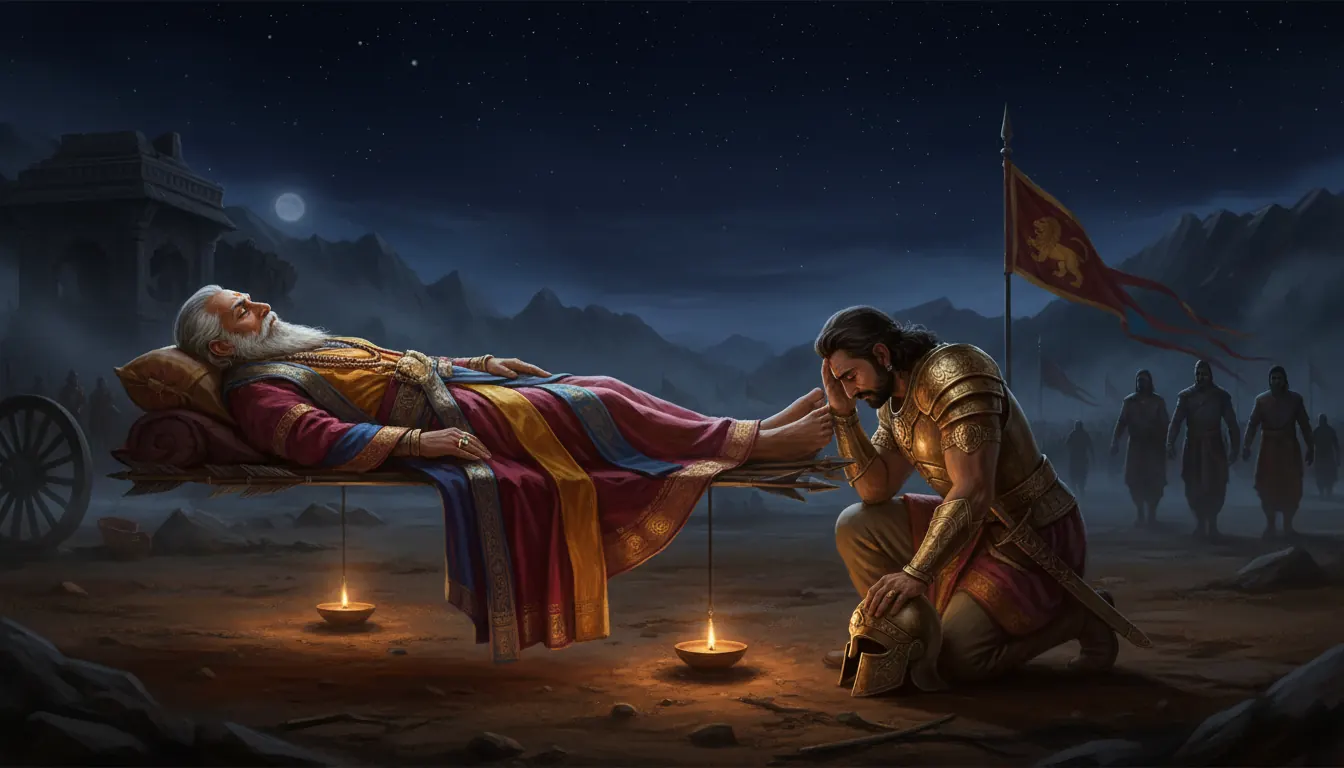
He did not drive to the front of the army. He drove first to the place where Bhishma had paid his debt to nature.
On Foot Among the Arrows
The grandsire lay where Savyasachin's celestial weapons had put him, covered with arrows that had poured in a stream as unbroken as the Yamuna, and Sanjaya, describing it, could not stop describing it either.
He looked like the vast ocean dried up by mighty winds. He looked like Mainaka, of unbearable energy, thrown down to the earth by the great Indra. He looked like the sun fallen from the sky, and like Indra himself after his defeat long ago by Vritra. That destroyer of kshatriyas, that hero of righteous soul, who had always been an island for those sinking in the bottomless ocean, lay on a hero's bed under Arjuna's arrows, and the hope of victory had gone out of Dhritarashtra's sons along with their armour and their peace of mind.
Karna climbed down from his chariot.
He came the rest of the way on foot, in great affliction, filled with grief and almost senseless, with his eyes troubled by tears, and when he reached the arrows he saluted the old man with joined palms and named himself, because Bhishma's eyes were closed.
"I am Karna. Blessings on you. Speak to me, Bharata, with holy and auspicious words, and open your eyes and look at me. Surely no man in this world enjoys the fruits of his good deeds, since you, venerable in years and devoted to virtue, lie struck down on the ground. I see no one else among the Kurus who is as able as you were at filling the treasury, at counsel, at drawing up troops in battle array, and in the use of weapons. He who had a righteous mind, who always protected the Kurus from every danger, has killed countless warriors and is going to the world of the Pitris."
The man on the arrows did not answer him yet, and Karna went on speaking into that silence.
Fire and Wind
He told the dying man what was coming, in the plainest terms anyone had used that day.
"From this day, chief of the Bharatas, the Pandavas in their fury will slaughter the Kurus as tigers slaughter deer. Today the Kauravas, who know the force of Gandiva's twang, will look on Savyasachin with terror, as the Asuras look on the wielder of the thunderbolt. Today the arrows of Kiritin will burn up the sons of Dhritarashtra as a raging fire of fierce flames burns up a forest. Wherever fire and wind sweep through a forest together, they burn every plant and creeper and tree. Beyond doubt Partha is like a surging fire, and beyond doubt Krishna is like the wind. At the blare of Panchajanya and the twang of Gandiva, all the Kaurava troops will be filled with fear. Without you, the kings will never be able to bear the rattle of the ape-bannered chariot."
And then the request he had walked across the field to make.
"Who among the kings, except you, can fight that Arjuna, whose feats are all superhuman? Superhuman was the battle he fought with the three-eyed Mahadeva, from whom he won a boon that no impure soul can win. That son of Pandu, who delights in battle, is protected by Madhava. Who can defeat the man you could not defeat, you who defeated Rama himself in battle, that fierce destroyer of the kshatriya race? I cannot endure that son of Pandu, and with your permission even I can kill him by the force of my weapons, that brave and fierce warrior who is like a snake of deadly poison and kills his enemies with a glance alone."
He stopped, standing among the arrows with his palms still joined, waiting for an old man who had called him half a chariot-warrior to open his eyes.
Dharma Lesson
Karna kept his word for ten days, and the word he kept was made in anger over a slight to his rank. A vow can be honoured perfectly and still be the wrong vow, and the cost of this one was paid by an army that needed him while he sat with his pride. What redeems him in this episode is not the fighting but the walking: he gets down off the chariot and covers the last distance to Bhishma on foot, and asks permission from the man who insulted him. Grief made him useful in a way that grievance never had.