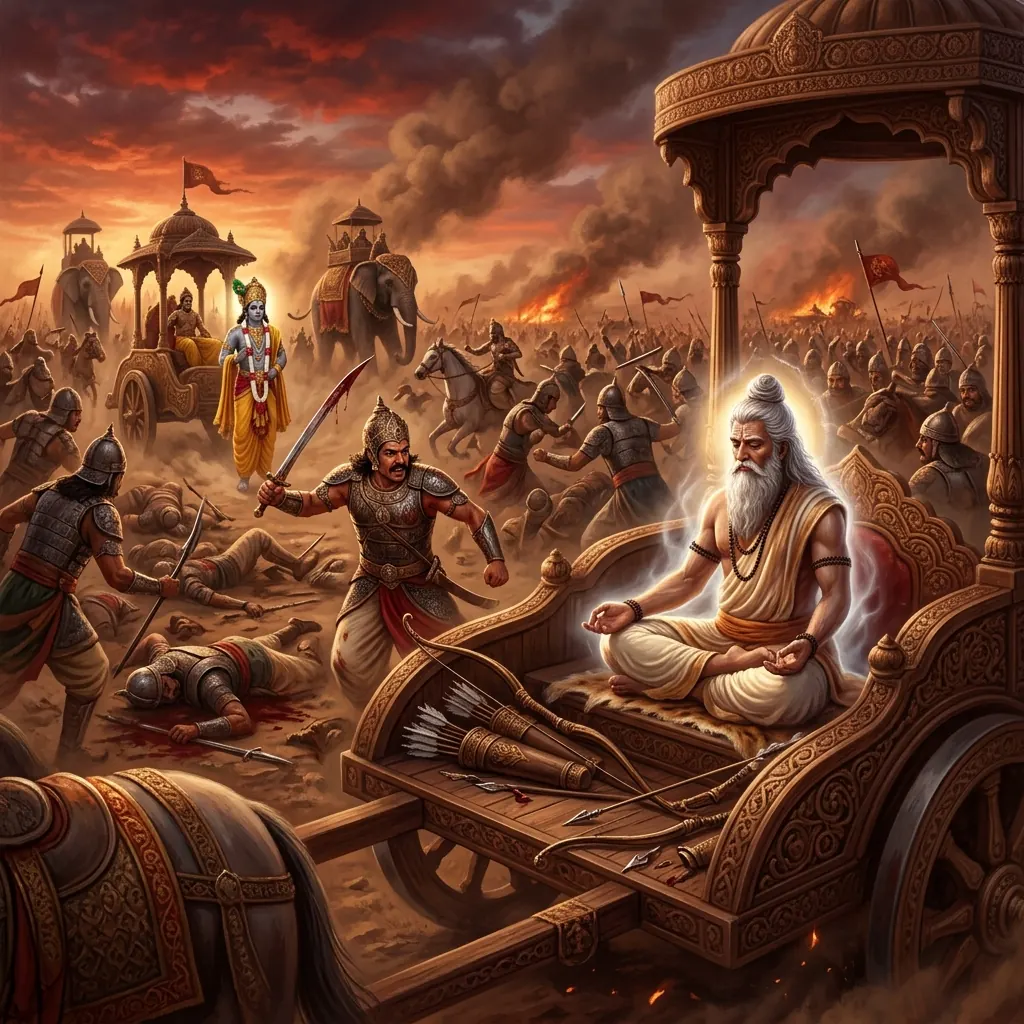
The Telling in the Rout
Ashwatthama rides back through a fleeing army to ask what happened, and Kripa has to tell him how Drona was killed
In short
With Drona dead at noon on the fifteenth day, the whole Kaurava army breaks and runs, captain by captain, until only Drona's son is still moving toward the enemy. Ashwatthama comes out of the fighting, sees the rout, and asks Duryodhana what has gone wrong. The king cannot make himself say it, so Kripa tells the boy the entire thing: the Brahma weapon, Krishna's advice to lay aside righteousness, the elephant named Ashwatthama, Yudhishthira's half-audible word, and the left hand that took his father's head.
Told in the Drona ParvaSet in Kurukshetra15 min read
The Sun Dropped Down Upon the Earth
Sanjaya was still telling the blind king what had happened at noon on the fifteenth day, and the part he had come to was not a battle at all. It was what an army does in the hour after its commander is killed.
"When Drona fell, king," he said, "the Kurus, battered by weapons, robbed of their leader, broken and routed, were drained of all their strength by grief."
They wailed. Their eyes filled with tears, their hearts filled with fear, and they saw their enemies getting the better of them and trembled again and again. Then they gathered round Duryodhana, because that was the only thing left to gather round. Covered in dust, shaking, staring blankly in every direction, their voices choked, they were like the Daityas of old after Hiranyaksha fell.
And Duryodhana, ringed by them all as if by small, frightened animals, could not bear to stay among them. He moved away.
It was past midday and no one had eaten or drunk since dawn. The men were scorched by the sun, faint with hunger and thirst, and utterly downcast. Sanjaya reached for images large enough to carry what they had watched, and used four of them one after another, because no single one would do. The fall of Bharadwaja's son, he said, was like the sun dropping down onto the earth. It was like the ocean drying up. It was like Meru being carried from its place. It was like the defeat of Vasava, the king of the gods, in his own heaven.
It was not a thing anyone could watch calmly, and the Kauravas did not watch it calmly. They fled in fear, and terror made them faster.
The man who had led them for five days, from the morning he took the command until this noon, lay on the floor of his chariot with no head on him, and nobody on that field could find the body afterward among the thousands of headless trunks.
The Roll of Those Who Ran
Sanjaya named them, one by one, the way he had named them going into battle. It is the same list read backwards.
Shakuni, the ruler of the Gandharas, saw Drona of the golden chariot killed and fled with the chariot warriors of his division, and Sanjaya notes that he ran much faster than the rest.
Karna fled in fear, taking his own vast division with him, all its standards retreating at speed.
Shalya, the ruler of the Madras, staring blankly about him, went with his division of chariots and elephants and horses.
Kripa, the son of Sharadvan, brahmana and teacher, who had been in the Kuru court longer than the king had been on the throne, fled crying, "Alas. Alas," and took with him his division of elephants and foot-soldiers, most of whom had already been killed.
Kritavarma of the Bhojas went, carried by his swift horses, with what was left of his Kalinga, Aratta and Bahlika troops. Uluka the gambler's son fled with a large body of foot. Dushasana, young and handsome and known for his courage, fled in great anxiety, surrounded by his elephants. Vrishasena took ten thousand chariots and three thousand elephants away with him. Susharma went, who had sworn with his brothers never to come back alive from a battle.
And Duryodhana fled, taking the remnant of the Samsaptakas whom Arjuna had not yet slaughtered.
Behind the captains the army came apart into single men. Some urged on their fathers, some their brothers, some their maternal uncles, some their sons, some their friends. With their hair loose and their armour unfastened they ran in such a way that no two of them could be seen running together. Others threw off their coats of mail entirely. They left their chariots and carriages, for all their ornaments, and went on horseback or on their own legs.
They called to each other as they went, "Wait. Wait. Do not run." Not one man who shouted it stopped running himself.
The Kuru army is utterly destroyed. That, Sanjaya said, was what everybody on the field believed.
The Alligator Against the Current
One chariot in that whole army was moving the other way.
Ashwatthama, Drona's son, had been fighting far off on another part of the field and knew nothing. While the exhausted troops streamed past him toward the camp, he went forward against them like a huge alligator pushing up against the current of a stream.
A fierce battle broke out between him and the warriors who met him: Shikhandi at their head, and the Prabhadrakas, and the Panchalas, and the Chedis, and the Kaikeyas, which is to say the best troops the Pandavas had, the ones nobody beat easily. He killed a great many of them. He got out of the press with difficulty, still moving, said Sanjaya, with the tread of a maddened elephant.
And when he was clear of it he looked around him and saw the Kaurava army running away, set on flight.
He could make no sense of it. Nothing had been lost. He himself had just come out of the thick of the Panchalas alive with their dead behind him. So he turned his horses and went looking for the king, and found Duryodhana, and drew up beside him, and asked the question of a man who has been out of earshot for an hour.
"Why are the troops running as if in fear, Bharata? They are running, so why do you not rally them for battle? And you yourself, king, do not seem to be yourself. Your army has fallen into this state because that lion among chariot warriors has been killed. None of them stays on the field, Kaurava, not even Karna at their head. In no battle before has the army run like this. Has some disaster struck your troops, Bharata?"
He had said it himself without knowing it. That lion among chariot warriors. He meant the loss of some commander down the line, some breach in the array. He was looking straight at the king and asking to be told, and he had already, in passing, spoken his own father's epitaph.
The King Could Not Say It
Duryodhana opened his mouth and found that he could not do it.
This was the man who had said everything else out loud in his life. He had called for Draupadi to be dragged into a hall of men. He had told Drona to his face that he was sparing the Pandavas out of affection. He had ordered the field lit with lamps at midnight so that the killing could go on. There was no cruelty he had ever been too delicate to name.
And now, said Sanjaya, that bull among kings found he could not bring himself to give the bitter news. He seemed to sink into an ocean of grief like a foundered boat. He looked at Drona's son standing on his chariot in front of him, waiting, and his eyes filled with tears.
It is worth being exact about why. Drona had died because of a lie, and the lie had been told about this man, this son, who was alive and unhurt and standing here asking what was wrong. The whole deceit had been built out of Ashwatthama's name. Duryodhana had not devised it and had not been able to prevent it, but he had watched it work, and he was the king in whose service the old man had gone into that battle at all.
Overcome with shame, he did what men in his position do. He turned to the eldest person present.
"Blessings on you," he said to Kripa, the son of Sharadvan. "Tell him, in front of the others, why the army is running like this."
In front of the others. He wanted witnesses to the telling, so that it would not be his own voice carrying it.
Kripa was the right man and the worst man for it. He was Ashwatthama's maternal uncle, Kripi's brother, and he had known Drona since the day Drona walked into Hastinapura with nothing. He was a brahmana and a teacher of princes, and he was old, and he had run from that field an hour ago crying alas.
In great anguish, again and again, he began to tell Drona's son how his father had been killed.
An Old Man Fighting Like a Youth of Sixteen
"We put Drona, the greatest of chariot warriors, at our head," Kripa said, "and began to fight the Panchalas alone."
He began where a soldier begins, with the order of battle. When the fighting started the Kurus and the Somakas closed with one another, roaring and striking one another down. And as it went on, the Dhartarashtras began to be thinned. Duryodhana's ranks were being eaten away, and Drona saw it, and in a rage called a celestial weapon into being.
"Your father, that bull among men, invoked the Brahma weapon and killed his enemies with broad-headed arrows by the hundred and the thousand."
Kripa gave his nephew the count, because the count was the honour of it. Driven by fate, the Pandavas and the Kaikeyas and the Matsyas and the Panchalas came up against that chariot and began to die there. With the Brahma weapon Drona sent a thousand brave warriors and two thousand elephants to Yama's realm.
Then he described the man doing it, and this is the sentence in the whole account that a son would keep.
"Dark-skinned, his grey hair hanging down to his ears, a full eighty-five years old, the aged Drona ranged over the battlefield like a youth of sixteen."
The Panchalas, though they burned for revenge, turned back from that fight. And when the enemy turned and partly lost their order, Drona invoked more celestial weapons and shone like the risen sun. He drove into the middle of the Pandava army with arrows for the rays that streamed from him, and he was, said Kripa, like the midday sun that no one can look at.
Scorched by him as if by the blazing sun, they lost heart, and their strength and their senses with it.
That is the position the story has to reach before the rest of it makes sense. Nobody was going to beat Drona that afternoon. Kripa took his nephew all the way to that point and stopped there, and then told him what was done about it.
Lay Aside Righteousness
"When the slayer of Madhu saw Drona's arrows tormenting them like this," Kripa said, "he wanted victory for the son of Pandu, and he said this."
He quoted Krishna to Krishna's enemy's son, on a battlefield, in front of the king. He did not soften a syllable of it.
"This greatest of all who bear arms, this leader of leaders, cannot be beaten in battle even by the slayer of Vritra himself. Sons of Pandu, put righteousness aside and look to victory, or Drona of the golden chariot will kill every one of you in battle. I think he will stop fighting if Ashwatthama falls. Let someone tell him, falsely, that Ashwatthama has been killed in battle."
The name was the weapon. Not a mantra, not an astra out of the Vedas that Drona himself had taught half the men on that field to draw. A word. His son's name, spoken by somebody he would believe.
Kripa reported the vote as well, which is a strange thing to include and the reason his account can be trusted. When he heard those words, Kunti's son Dhananjaya did not approve them. Arjuna, who had been Drona's best pupil and had a bow in his hand that his teacher had taught him to string, said no.
All the others, however, approved the advice.
And even Yudhishthira did, with some difficulty.
That clause carries the whole weight of what came next. The king of dharma agreed to it, but not easily, and not cleanly, and the difficulty he had is exactly the crack the lie went through afterward. He would not say a plain falsehood. So a plan that needed a plain falsehood had to be bent until it could be told by a man who would not tell one.
Then Bhimasena went to look for something that could carry the name, and found it, and killed it.
The Elephant of the Malava Chief
"Then Bhimasena, a little shamefaced, said to your father: Ashwatthama has been killed."
Kripa gave his nephew that detail too. The strongest man in the world came up to an old brahmana in the middle of a battle and told him his son was dead, and was embarrassed while he did it.
Drona did not believe him. He suspected the news was false. And then, said Kripa, your father, who loved you so dearly, asked Yudhishthira whether you were really dead or not.
He went to the one man on the field who did not lie. That was not weakness. It was the most reasonable thing anyone did that day. Everyone knew what Yudhishthira was, and Yudhishthira knew it best of all, and it was precisely because his word had never been broken that his word was worth stealing.
There was an elephant on that field, huge as a hill, belonging to Indravarman the chief of the Malavas, and its name was Ashwatthama. Bhima had killed it. Yudhishthira, gripped by the fear of telling a lie and at the same time eager for victory, looked at the dead animal and went to Drona and said:
"He for whom you bear arms, he whose face you live to look on, your ever-dear son Ashwatthama, has been killed. He lies dead on the bare ground like a young lion."
The king knew full well, said Kripa, how evil the consequences of a falsehood are, and he said those words to that best of brahmanas, adding the word elephant after Ashwatthama so that it could not be heard clearly.
The most careful man alive found a way to keep the letter of the truth and hand over everything else. He said the true word so quietly that it did not arrive, and the sentence that reached Drona's ear was the sentence Krishna had asked for.
When he heard that his son had fallen, the old man began to wail aloud, overcome with grief. He held back the force of his celestial weapons. He fought, but not as he had been fighting.
And Ashwatthama stood listening to this on his own chariot, alive, holding his own bow.
Seized With the Left Hand
"When the cruel son of the Panchala king saw him full of anxiety and almost out of his mind with grief," Kripa said, "he rushed at him."
Dhrishtadyumna had been born out of a fire for this. Drupada had bought him from the gods for the killing of Drona, and Drona had accepted the boy afterward as a pupil anyway and taught him what he knew, and both of them had lived every day since knowing how it ended.
So when the prince came at him through the smoke, Drona did not reach for a weapon. Knowing all truths about men and things, said Kripa, and seeing the prince who had been ordained to kill him, he gave up all his celestial weapons and sat down in Praya on the battlefield. Praya is the vow of a man who has decided to die where he sits and will neither eat nor move nor defend himself again. He put down the Brahma weapon and became, in the middle of a war, a brahmana at his prayers.
"Then Prishata's son seized Drona's head with his left hand and, ignoring the loud protests of all the heroes, cut it off."
Kripa did not spare himself the left hand. It is the unclean hand. The head of the teacher of the Kurus and the Pandavas was held by it like a thing being butchered.
Do not kill Drona. Those were the words that came from every side, from the Kauravas, who were his own troops, and from his enemies. And Arjuna jumped down from his chariot and ran toward Prishata's son with his arms raised over his head, saying it again and again: "You know the ways of righteousness. Do not kill the teacher. Bring him alive."
Forbidden by both armies at once, Dhrishtadyumna killed him.
"That is why the troops are all running away in fear," Kripa finished. "And for the same reason, sinless one, we ourselves, in deep gloom, are doing the same."
When he heard how his father had been killed, said Sanjaya, Drona's son became like a snake that has been trodden on. He blazed up in that battle like a fire fed with a great heap of fuel. He wrung his hands and ground his teeth and breathed like a serpent, and his eyes turned red as blood.
Dharma Lesson
The deceit that killed Drona was assembled out of small permissions. Krishna named the need, most of the council agreed, Yudhishthira agreed with difficulty, Bhima found an elephant to make the words technically true, and each man in that chain found a way not to call what he did a lie. Kripa's account is honest enough to record that Arjuna objected and was overruled, which is usually the only trace such a decision leaves. What none of them arranged was the last part, the left hand on the head of a praying man, and that is the part the son heard, and the part he answered.