The Meal He Chose to Eat
A king's banquet refused, a servant's supper accepted
In short
Arriving in Hastinapura as envoy, Krishna is honoured in Duryodhana's palace and offered a feast of every luxury, and refuses it in open court: an envoy eats only after his mission succeeds, and food from a house defiled by hatred does not deserve eating. He turns down the same offer from Drona, Bhishma and Kripa, and takes his meal at Vidura's plain table.
Told in the Udyoga ParvaSet in Hastinapura17 min read
Three Courtyards and a Golden Seat
He had spent the afternoon with his aunt Pritha, and when he came out of her rooms he went straight to Duryodhana's palace, which was furnished with great wealth and beautiful seats and looked from the outside like the house of Indra himself.
The orderlies did not stop him. Nobody in Hastinapura was going to be the man who stopped him. He crossed three spacious yards one after another and entered a mansion that stood up like a mass of cloud, high as the summit of a hill, and blazed.
Inside, Dhritarashtra's son sat on his throne in the middle of a thousand kings, with the Kurus all around him, and Dushasana on one side and Karna and Shakuni the son of Subala on their own seats near him. When Krishna came into the court Duryodhana rose from his seat with all his counsellors, to honour him, and the whole assembly rose after him.
Krishna greeted them. He greeted Dhritarashtra's sons and their counsellors and every king in that room according to their respective ages, which took a while, and got each one right. Then he took the seat they had made ready for him, which was gold and laid over with a carpet embroidered in gold.
And the Kuru king offered him the honours due to a guest: a cow, and honey, and curds, and water. Then he offered him the palaces of the city, and the mansions in them, and after that the kingdom, and the kings sitting round the walls worshipped this man on his gold seat who was shining like the sun in the middle of their court.
And then Duryodhana invited him to eat at his house, and Krishna said no.
The Question Asked Gently
Duryodhana did not shout. He was seated in the middle of the Kurus and he spoke in a gentle voice, with his eyes moving toward Karna as he spoke, and there was something else lying behind the words.
"Why, Janardana, will you not accept the food and the drinks and the robes and the beds that have all been prepared and kept ready for you? You have granted aid to both sides. You are engaged in the good of both parties. You are the foremost of Dhritarashtra's relations and much loved by him. And you know religion and profit fully and in all their details.
"So I want to hear, bearer of the discus and the mace, in front of all these kings: what is the true reason for this refusal of yours?"
It was a good question and it was asked in front of a thousand witnesses, which was the point of asking it. A guest who refuses food refuses the house. Every king in that room understood what had just been laid on the floor between the two of them, and not one of them moved.
The food itself had been got ready for days. There were viands of every kind that could be carried to Hastinapura on a cart or brought up a river, and drinks, and robes laid out folded, and beds made up for a man and his attendants in rooms that had been swept for them. Nobody could say the offer was thin. That was the trap in it. A meal like that, refused, becomes an insult that the refuser has to explain, and Duryodhana had asked for the explanation in the one place where it could not be given quietly.
An Envoy Eats Afterward
Krishna raised his right arm, and answered in a voice deep as thunder in cloud, in words that were clear and correctly pronounced and had not a single letter dropped out of them.
"Envoys, king, eat and accept worship only after the success of their missions. So, Bharata, when my mission has succeeded, you may entertain me and my attendants."
That was an answer a court could accept, and Duryodhana did not accept it.
"It is not right for you to behave toward us like this," he said. "Whether you succeed or do not succeed, we are trying to please you, because of the relationship you bear us. It seems, though, that all our efforts are wasted. Nor do we see the reason, best of men, why you will not accept a worship offered out of love and friendship. With you we have no hostility. With you we have no war. Think a little and you will see that words like these hardly suit you."
It was well said. It was, in fact, unanswerable, so long as the only question on the floor was hospitality. Kinship had been invoked, and friendship, and the absence of any declared quarrel between these two particular men, and every one of those things was true as far as it went.
So Krishna changed the question.
One Takes Another's Food When One Is in Distress
He cast his eyes over Dhritarashtra's son and over all his counsellors, and then he said it plainly.
"Not from desire, nor from wrath, nor from malice, nor for gain, nor for the sake of an argument, nor from temptation would I abandon virtue.
"A man takes another man's food when he is in distress. At present, king, you have not inspired love in me by any act of yours, and I have not been plunged into distress. Without any reason at all you have hated your dear and gentle brothers from the moment of their birth, and they have every virtue. This unreasonable hatred of yours for the sons of Pritha does you no credit. They are devoted to virtue. Who could injure them in the least?
"He who hates them hates me. He who loves them loves me. Know that the virtuous Pandavas and I have one soul between us.
"The man who follows the impulses of lust and wrath, and out of the darkness of his soul hates and seeks to injure one who possesses every good quality, is the vilest of men. That wrathful wretch of uncontrolled soul who, out of ignorance and avarice, hates his own kinsmen when they have every auspicious quality, can never enjoy his prosperity long. The man who, on the other hand, wins over good men by good offices, even if he bears aversion to them in his heart, enjoys prosperity and fame for ever.
"All this food is defiled by wickedness, and so I should not eat it. Only the food Vidura provides, I think, is fit for me to eat."
And having said that to a man who had never in his life been able to bear anything said against his own wishes, Krishna of the mighty arms got up and walked out of that blazing palace, past the thousand kings, and out through the three courtyards, and turned his steps toward the house of the son of a serving-woman.
The Table That Was Set for Him
They came after him to Vidura's house, and they came one after another, because each of them wanted it on the record that he had asked.
Drona came. Kripa came. Bhishma came. Bahlika came, and many of the Kauravas with them, and they stood in that plain doorway and said the same thing in more or less the same words.
"Vrishni, we place at your disposal our houses, with all the wealth that is in them."
And the slayer of Madhu, of mighty energy, answered them, "You may go away. I am much honoured by your offers."
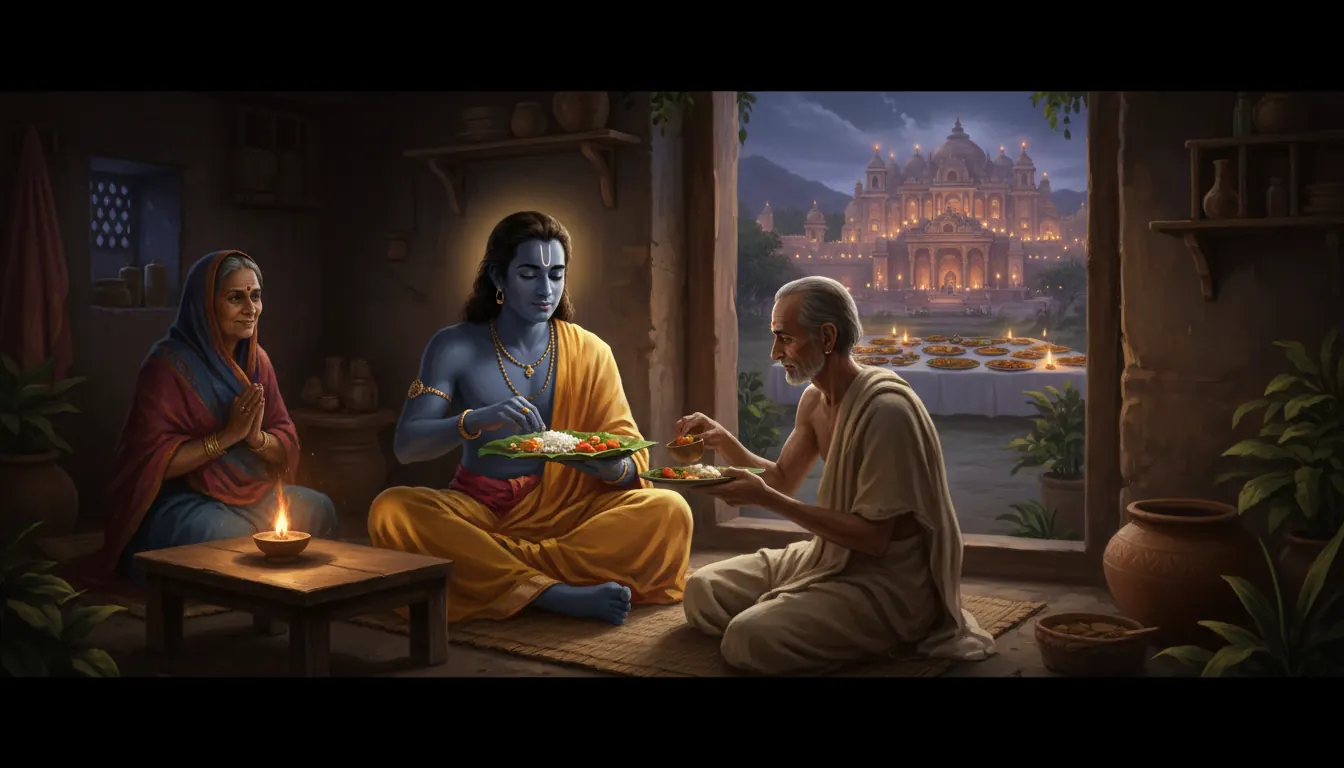
So they went away, all of them, the greatest men of the Kuru house, and the door closed, and Vidura entertained him with great care and with every object of desire that a modest household could produce. And Kunti set before him food that was clean and savoury and there was a great deal of it.
He did not begin with it. He took a portion of that food and gave it, with much wealth besides, to a number of brahmanas learned in the Vedas, and gratified them first. Then, with his attendants around him like Vasava in the middle of the Maruts, he sat down and dined on what was left of the clean and savoury food that Vidura had supplied.
There was no gold plate on that table. There was no carpet embroidered with gold. Nobody offered him a kingdom, or a palace, or the use of a city. He had refused the richest board in Bharatavarsha two hours earlier and he ate here without one word about it, and every man in Hastinapura heard about both meals before morning.
Of all the houses in that city he had chosen the one belonging to the man who had stood up in the assembly on the day of the dice and been shouted down for it. The choice said everything the refusal had said, and it said it without an argument, which is why it was remembered longer than the speech.
Vidura Speaks After Dark
When he had eaten and rested, Vidura said to him, in the night:
"Keshava, this coming of yours has not been well judged.
"Dhritarashtra's son transgresses the rules of both profit and religion. He is wicked and wrathful. He insults others while wanting honours for himself, and he disobeys the commands of the aged. He breaks the scriptures; he is ignorant, wicked of soul, already overtaken by fate, stubborn, and disposed to do evil to the very people who seek his good. His soul is possessed by desire. He foolishly regards himself as very wise. He is the enemy of all his true friends. He is suspicious, ungrateful, without any control over himself, a slave of his senses, irresolute in every act that ought to be done, and in love with sin.
"You will point out to him what is for his good, and he will disregard all of it, moved by pride and anger.
"He has great faith in Bhishma, and Drona, and Kripa, and Karna, and Drona's son, and Jayadratha, and because of them he never sets his heart on peace. He and Karna firmly believe that the Pandavas are incapable of even looking at Bhishma and Drona, let alone fighting them. He has assembled a huge army and regards his purposes as already achieved. He has concluded that Karna single-handed can defeat his enemies. He will never make peace.
"You wish to establish peace and brotherly feeling between the two parties. But know that all the sons of Dhritarashtra have concluded that they will not give the Pandavas what the Pandavas have a right to. With men so resolved, your words will certainly prove vain."
A Singer Before the Deaf
"Where words, good or bad, have the same effect," Vidura went on, "no wise man spends his breath for nothing, like a singer before the deaf. Your words in that assembly would command no more respect than a brahmana's among men who have no reverence for anything that deserves reverence.
"It does not seem proper to me, Krishna, that you should go into the midst of these wicked-minded wretches seated together. It does not seem proper to me that you should stand there and speak against wicked-souled, foolish, unrighteous men who are strong in number. They have never worshipped the aged. They are blinded by prosperity and pride and by the pride of youth and of wrath. They will not accept good advice from you or from anybody.
"He has mustered a strong force and he has his suspicions of you. Standing in the middle of his elephants and his chariots and his heroic infantry, with all his fears dispelled, that foolish man regards the whole earth as already conquered. He covets extensive empire without a rival, and what he has in his hand he regards as unalterably his.
"And consider who is sitting in that hall. All those kings are your enemies. Every one of them was stripped of his possessions by you before this. It is through fear of you that they have joined together with Karna and made their alliance with Dhritarashtra's sons, and they care nothing for their own lives and are delighted at the prospect of fighting.
"How, then, will you walk into the midst of so many enemies, of wicked souls, seated together?
"I know your manliness. I know the gods themselves cannot defeat you. But the love I bear you is equal to the love I bear the sons of Pandu, and it is out of that affection and that friendship that I say these things to you."
Why He Came
"What a man of great wisdom should say," Krishna answered, "what a man of great foresight should say, what one like you should say to a friend like me, consistent with virtue and profit and truth: that is what you have said to me, and you have said it as a father and a mother would. It is true, and worthy of approval, and consistent with reason.
"Listen now, Vidura, to why I came.
"I knew the wickedness of Dhritarashtra's son perfectly well, and the hostility of the kshatriyas who have sided with him, and I came to the Kurus anyway. Great is the merit earned by the man who liberates from the meshes of death the whole earth, with her elephants and her chariots and her horses, when she is overwhelmed by a dreadful calamity. And if a man striving to the best of his ability to perform a virtuous act meets with failure, I have not the least doubt that the merit of that act still becomes his. Those who know religion say also that if a man mentally intends a sinful act and does not commit it, the demerit of it is never his.
"I will sincerely try to make peace between the Kurus and the Srinjayas, who are about to be slaughtered. The calamity has its origin in the conduct of the Kurus, and it is directly due to the action of Duryodhana and Karna; the other kshatriyas are only following those two.
"The learned call a man a wretch who does not plead to save a friend who is about to sink into calamity. Striving to the best of his might, even to the extent of seizing him by the hair, a man should seek to pull a friend back from an improper act. He who does that, instead of incurring blame, reaps praise.
"And there is this. I have come so that unrighteous and foolish men may not say afterward that Krishna, though competent, made no attempt to restrain the angry Kurus and the Pandavas from slaughtering one another. I have come to serve both parties. Once I have tried for peace, I will escape the blame of all the kings.
"If they listen and reflect coolly, the peace I want will happen, and the Kauravas will be liberated from the meshes of death, and they will worship me for it. And if instead they seek to injure me, I tell you that all the kings of the earth united together are no more to me than a herd of deer standing in front of an enraged lion."
And having said this, he lay down on his soft bed and went to sleep.
The Morning He Went to Court
The night, lit with bright stars, passed away in that conversation between two men of great intelligence, and it passed against the wishes of Vidura, who had been listening to talk he did not want to see end.
At early dawn a band of choristers and bards with melodious voices woke Keshava with the sweet sound of conchs and cymbals. He rose from the bed and went through all the customary acts of the morning: cleansed himself with a bath, recited the sacred mantras, poured libations of clarified butter on the sacrificial fire, decked his person, and worshipped the rising sun.
And while he was still at his devotions, Duryodhana and Shakuni came to him and said, "Dhritarashtra is seated in his court with all the Kurus headed by Bhishma and with all the kings of the earth. They all ask for your presence, Govinda, as the gods in heaven long for the presence of Shakra." He greeted them both with sweet and courteous enquiries after their health.
When the sun had risen a little higher he summoned a number of brahmanas and gave them gifts of gold and robes and cows and horses. Then Daruka brought up his large blazing chariot, hung with rows of tinkling bells and harnessed with excellent horses, and it rumbled like a mass of cloud. Krishna walked round the sacred fire and the band of brahmanas, put on the gem called Kaustubha, and mounted.
Vidura followed on his own chariot. Duryodhana and Shakuni came behind on one chariot together. Satyaki and Kritavarma and the mighty chariot-warriors of the Vrishnis rode after them.
The broad street had been swept and watered. Cymbals played and conchs were blown. Young heroes went round his chariot, and thousands of soldiers in variegated dress marched ahead of him with swords and lances and axes, and five hundred elephants and chariots by the thousand came behind. Every citizen of the capital came out to look at him. The terraces and balconies were so thronged with women that the houses seemed on the point of coming down under the weight.
At the court gate his attendants blew their conchs and trumpets and filled the sky with the noise, and the assembled kings trembled with delight and the hair on their bodies stood up. He got down from the chariot and entered the hall with Vidura on one arm and Satyaki on the other, and overshadowed the splendour of all the Kurus as the sun overshadows lesser lights.
Dhritarashtra rose. Bhishma rose, and Drona, and after them a thousand kings. Vidura took a begemmed seat covered with a white deerskin, and set it so that it almost touched Krishna's. Before Krishna sat Karna and Duryodhana, together on one seat.
And when Govinda had taken his place, a perfect silence came down on that assembly, and nobody in it spoke a single word.
Dharma Lesson
Hospitality is not measured by the richness of the table but by the cleanliness of the hand that sets it. A man takes another man's food when he is in distress, and Krishna is not in distress and has not been made to love his host. He also says why he came at all: whoever will not try to pull a friend back from ruin shares the ruin.