What Kunti Sent Instead of Comfort
A mother counts her sons aloud, then tells them to fight
In short
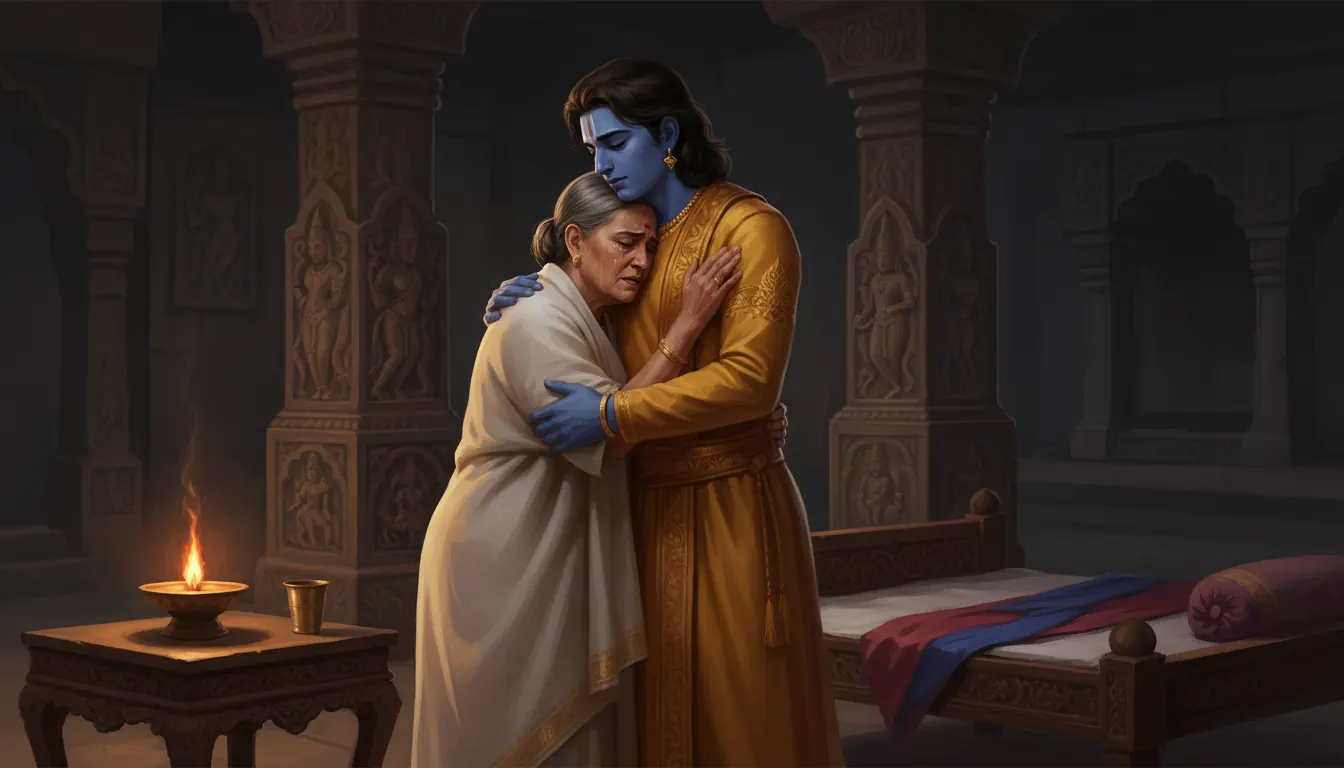
Before going to Duryodhana's palace, Krishna visits his aunt Pritha, who takes his neck in her arms and weeps. She goes through her sons one by one, asking how children woken by conches and flutes could sleep in a forest of tigers, and says the dice and the lost kingdom never grieved her as the sight of Draupadi in a single garment did. Then the lament turns into an order.
Told in the Udyoga ParvaSet in Hastinapura and Upaplavya16 min read
Her Arms Around His Neck
He came to her in the afternoon, after he had seen Vidura and before he went to Duryodhana's palace, and as he came into her rooms his face shone like the sun.
Pritha did not wait for the greeting. She put both arms round his neck and held on, and began to weep, because this was the man who had grown up with her children and had played beside them and gone hunting with them, and to look at him after so long was to look at all five of them at once. The tears came fast and she let them come.
Then the rites of hospitality were performed, and that greatest of warriors took his seat, and his aunt sat down opposite him with her face gone to ruin and her voice choking on itself, and began to talk.
"From their earliest years they served their elders with reverence," she said. "They were bound to one another in friendship. They were robbed of their kingdom by deceit and went away into hiding, though they deserved to live among friends and attendants. They had mastered both wrath and joy. They were devoted to brahmanas and truthful in speech. And those children of mine gave up a kingdom and every pleasure in it, and left their wretched mother behind, and went to the woods, and in going they tore out the very roots of my heart.
"They have suffered woe, Keshava, and they did not deserve any of it. Tell me how they lived in that deep forest, which is full of lions and tigers and elephants. They lost their father when they were infants. They were tenderly brought up by me. How did they live in that great forest without ever seeing either parent?"
The Children Woken by Conches
"From their infancy," she said, "the Pandavas were roused from their beds by the music of conchs and drums and flutes. At home they slept in high palace chambers on soft blankets and on the skins of the runku deer, and they were woken in the morning by the grunting of elephants and the neighing of horses and the clatter of chariot wheels, and by conchs and cymbals sounding together with the notes of flutes and lyres.
"At early dawn brahmanas honoured them with sacred hymns, and they in their turn honoured those who deserved it with robes and jewels and ornaments, and those illustrious twice-born men blessed them in return for the homage they received.
"That such men could sleep in the deep woods, which resound with the shrill and dissonant cries of beasts of prey, is a thing I can hardly bring myself to believe. They did not deserve that much woe.
"How could they, Janardana, who were woken by cymbals and drums and conchs and flutes, by the honeyed songs of singing women and the praises chanted by bards and reciters, be woken in a deep wood by the yelling of wild animals? Tell me how that was done. I have thought about it every night for thirteen years and I still cannot make the picture come."
She was asking about mornings. That was the shape her grief had taken. Not the battles they had fought or the hunger they had gone through, but the first minute of every day for thirteen years, and who had been there to hear them wake.
She Goes Through Them One by One
She began with the eldest, and she did it the way a woman counts over things she is afraid of losing.
"He is modest. He is firm in truth. His senses are under control and he has compassion for every creature. He has conquered both lust and malice and he always walks the path of the righteous. He has ably carried the heavy burden carried before him by Ambarisha and Mandhatri and Yayati and Nahusha and Bharata and Dilipa and Sivi the son of Usinara and the other royal sages of old. He is of excellent character and disposition, he knows what virtue is, and his prowess cannot be checked. He is fit to be king of the three worlds, because he has every accomplishment there is. He is the first of all the Kurus by law, in learning and in disposition. He is handsome and mighty-armed and he has no enemy.
"Tell me how he is. That Yudhishthira of virtuous soul, whose complexion is like pure gold. Tell me how he is."
Krishna did not answer, and she did not stop for him to. She had been holding these questions for thirteen years with nobody in that house to ask them of, and now that a man had come who had seen her sons within the month she was not going to spend the visit waiting for replies. She went to the next one.
The Second and the Third
"He has the strength of ten thousand elephants and the speed of the wind," she said. "He is mighty and always wrathful among the sons of Pandu. He always does good to his brothers and is therefore dear to them all. He is the one who killed Kichaka with all his relatives; who killed the Krodhavasas, and Hidimba, and Vaka; who in prowess is equal to Shakra and in might to the wind-god; who is terrible, and in wrath is equal to Madhava himself. He is the greatest of all who strike.
"And that wrathful son of Pandu, that scourge of foes, holds back his rage and his might and his impatience, keeps his soul in check, and obeys the commands of his elder brother. Speak to me, Janardana. Tell me how that Bhimasena is, whose very name is the truth about him, who has arms like maces, that mighty second son of Pandu.
"And Arjuna, who has two arms and always thinks himself better than his namesake of old who had a thousand; who shoots five hundred arrows in one stretch; who in the use of weapons is equal to King Kartavirya, in energy to Aditya, in mastery of his senses to a great sage, in forgiveness to the Earth, and in prowess to Indra himself. By his strength, slayer of Madhu, the Kurus won this vast empire among all the kings of the earth. No enemy who has met him in battle has escaped with his life. He is the conqueror of all and cannot be conquered by any. He is the refuge of the Pandavas as Vasava is of the gods.
"How is that Dhananjaya now, who is your brother and your friend?"
Madri's Sons, and the Woman Who Went With Them
"He is compassionate to all creatures, modest, skilled in mighty weapons, gentle and delicate and virtuous, and he is dear to me," she said. "That mighty bowman Sahadeva, that ornament of assemblies, young in years and devoted to the service of his brothers, who understands both virtue and profit, that high-souled and well-behaved son of mine whose nature his brothers always praise. Tell me about him. He serves his elder brothers so humbly, and me so reverently.
"And Nakula, who is delicate and youthful and brave and handsome; who is dear to his brothers and to everybody; who is their very life walking about in a separate body; who knows every mode of warfare and is a mighty bowman. Is that dear child of mine well in body and mind? He was brought up in every luxury and he did not deserve any woe. Shall I ever see him again? I am a woman who could lose her peace by losing sight of Nakula for the time it takes to wink, and here I am, still alive.
"And more than all my sons, Janardana, the daughter of Drupada is dear to me. High-born, of great beauty, gifted with every accomplishment, truthful in speech. She chose the company of her husbands and gave up the company of her sons. She left her dear children behind her and followed the sons of Pandu. She was waited on once by a large train of servants and adored by her husbands with every object of enjoyment. How is Draupadi now? She has five heroic husbands, all mighty bowmen, each equal to Agni in energy, and still woe has been the lot of Drupada's daughter.
"For fourteen long years I have not seen the princess of Panchala, who has herself been eaten by anxiety for children she has not seen for the same fourteen years. When a woman of her nature does not enjoy unbroken happiness, it seems to me, Govinda, that the happiness a person enjoys is never the fruit of that person's own acts."
The Grief That Outranked the Others
Then her voice changed.
"When I remember the forcible dragging of Draupadi to the assembly," she said, "then neither Bibhatsu nor Yudhishthira nor Bhima nor Nakula nor Sahadeva is an object of affection to me.
"I had never known a heavier grief than the one that pierced my heart when that wretch Dushasana, moved by wrath and greed, dragged Draupadi, who was in her period then and so wearing a single garment, into the presence of her father-in-law in that hall, and exposed her to the gaze of all the Kurus.
"King Bahlika was pierced with grief at the sight, and Kripa, and Somadatta; it is known. But of all those who were present in that assembly, it is Vidura whom I worship. Neither by learning nor by wealth does a man become worthy of homage. It is by disposition alone that a man becomes respectable. The character of the illustrious Vidura, a man of great intelligence and profound wisdom, adorns the whole world the way an ornament adorns the man who wears it.
"The loss of the kingdom did not grieve me. The defeat at dice did not grieve me. That the illustrious and beautiful princess of Panchala was dragged into that assembly wearing a single garment, and made to hear bitter words, grieved me most. What could be a greater grief to me than that? She was always devoted to kshatriya custom, and of great beauty, and she suffered that cruel treatment while she was unwell, and though she had powerful protectors she was then as helpless as if she had none.
"I had you for a protector, and Rama, and that mighty chariot-warrior Pradyumna. I had my sons, the invincible Bhima and the unretreating Vijaya, both alive. And I had still that grief to bear. It is certainly strange."
The Voice in the Lying-In Room
"In the matter of my present sorrows," she said, "I blame neither myself nor Suyodhana. I blame my father. As a rich man gives away a sum of money, my father gave me away to Kuntibhoja. I was a child playing with a ball in my hands, Keshava, and your grandfather handed me over to his friend. I was abandoned by my own father, and afterwards by my father-in-law, and I am stricken with woes that cannot be borne. What use is there in my being alive?
"Neither the loss of my husband nor the loss of wealth nor our hostility with the Kurus ever inflicted such rending pains on me as this separation from my children. What peace can my heart know when I do not see the wielder of Gandiva in front of me? For fourteen years I have not seen Yudhishthira, or Dhananjaya, or Vrikodara. Men perform the funeral rites of those who are missing a long time, taking them for dead. Practically speaking, Janardana, my children are dead to me, and I am dead to them.
"But hear this also, and then judge whether I am simply a woman weeping.
"On the night when Savyasachin was born, in the lying-in room, an invisible voice spoke to me. It said: this son of yours will conquer the whole world and his fame will reach the very heavens. Your son Dhananjaya will slay the Kurus in a great battle and win back the kingdom, and with his brothers he will perform three great sacrifices.
"I do not doubt the truth of that announcement. I bow to Dharma, who upholds the creation. If Dharma is not a myth, then you will surely accomplish everything that voice said.
"I never made any distinction between Dhritarashtra's sons and mine, so far as a mother's affection goes. By that truth, Krishna, I will surely see you and the Pandavas come safely out of this strife, with their foes slain and their kingdom recovered."
The Message She Sent Instead
"Now say this to them for me.
"Say to the virtuous King Yudhishthira: your virtue, son, is shrinking day by day. So act in such a way that your religious merit does not dwindle. Shame on those who live in dependence on others. Even death is better than a living got by meanness.
"Say to Dhananjaya, and to the ever-ready Vrikodara: the time has come for which a kshatriya woman brings forth a son. That is what she carries him for and what she raises him for, and this is the hour. If you let this time slip by without achieving anything, then, though all the world respects you now, you will only be doing what everyone will regard as contemptible. And if contempt touches you, I will abandon you for ever. When the hour comes, even life, which is so dear, should be laid down.
"Say to Madri's sons, who are always devoted to kshatriya custom: strive to win, more than life itself, the objects that can be got by prowess, since only what is won by prowess pleases the heart of a person who intends to live as a kshatriya lives.
"And go to Arjuna, the greatest of all who bear arms, the heroic son of Pandu, and say this to him: walk the path that Draupadi points out to you.
"You know, Keshava, that when they are inflamed with rage Bhima and Arjuna are each like the universal Destroyer and can slay the gods themselves. It was a great insult to them that their wife Krishna was dragged into the assembly and spoken to in such humiliating terms by Dushasana and by Karna. Duryodhana insulted Bhima of mighty energy in the very presence of the Kuru chiefs. I am sure he will reap the fruit of that behaviour, for once a foe has provoked Vrikodara he knows no peace, and he does not forget for a long while, not until he has wiped out the enemy and his allies."
What He Said to Her Before He Went
Then the friend of Partha comforted his paternal aunt, and he did it without contradicting one word she had said.
"What woman in the world is like you, aunt? You are the daughter of King Surasena, and by marriage you entered the line of Ajamida. You are like a lotus lifted out of one mighty lake and set down in another. Blessed with every prosperity and great good fortune, you were adored by your husband. The wife of a hero, you have given birth to heroic sons.
"You have every virtue and great wisdom, and it is fitting for you to bear both happiness and misery with patience.
"Your children have overcome sleep and languor, wrath and joy, hunger and thirst, cold and heat, and they always enjoy the happiness that heroes ought to have. Men of great effort and great might, your sons do not care for the comforts that satisfy the low and the mean. They pursue the happiness that heroes should pursue and are not satisfied like little men with mean desires.
"The wise enjoy or suffer whatever there is to be enjoyed or suffered. Ordinary persons desire an equable state of dullness with no excitement in it. Those who are superior desire either the acutest human suffering or the highest enjoyment that is given to man. The wise always delight in extremes. They find no pleasure in what lies between, and what lies between they regard as misery.
"The Pandavas and Draupadi salute you through me. They send word that they are well and they have asked after your welfare. You will soon see them lords of the whole world, with their foes slain and prosperity upon them."
Kunti, stricken with grief for her sons, drove away the darkness that had come over her mind, and answered him.
"Whatever you regard as proper to be done, mighty-armed one, let that be done, without sacrificing righteousness and without the least guile in it. I know what the power of your truth is and what your lineage is. I know the judgment and the prowess you bring to anything that concerns your friends. In our race you are Virtue itself. You are Truth. You are the embodiment of ascetic austerity. You are the great Brahma, and everything rests upon you. What you have said must therefore be true."
He said farewell to her and walked round her in reverence, and then Govinda of the mighty arms went out and set off for Duryodhana's mansion.
He carried two things out of that room. One was a lament that had lasted the better part of an afternoon and had named every one of her children and their wife and had counted the years twice. The other was four sentences to be delivered at Upaplavya, and not one of them asked anybody to come home safe.
Dharma Lesson
A mother's love is not always the voice that asks you to come home safe. Kunti spends an afternoon grieving over five men she has not seen in fourteen years, and then sends them word that the hour has come for which a kshatriya woman bears a son, and that she will disown any of them who lets it pass. Grief and duty were never separate things for her.