Kunti Knows Her Son
The mother who recognised Karna in the arena and stayed silent
In short
As Karna and Arjuna face each other in the tournament arena at Hastinapura, Kunti recognises the stranger by his natural mail and ear-rings and faints, and Vidura revives her with sandal-paste and water. She comes back to consciousness in time to watch her firstborn crowned king of Anga, insulted by Bhima as a charioteer's son, and defended by Duryodhana in a speech that argues its way to the truth without knowing it. She sees the marks on his body and knows exactly who he is, and she goes home without saying a word.
Told in the Adi ParvaSet in Hastinapura and Anga13 min read
The Assembly Divides
Vaishampayana was telling the whole of it to king Janamejaya, and he had come to the hour in the tournament at Hastinapura when the day stopped belonging to anybody.
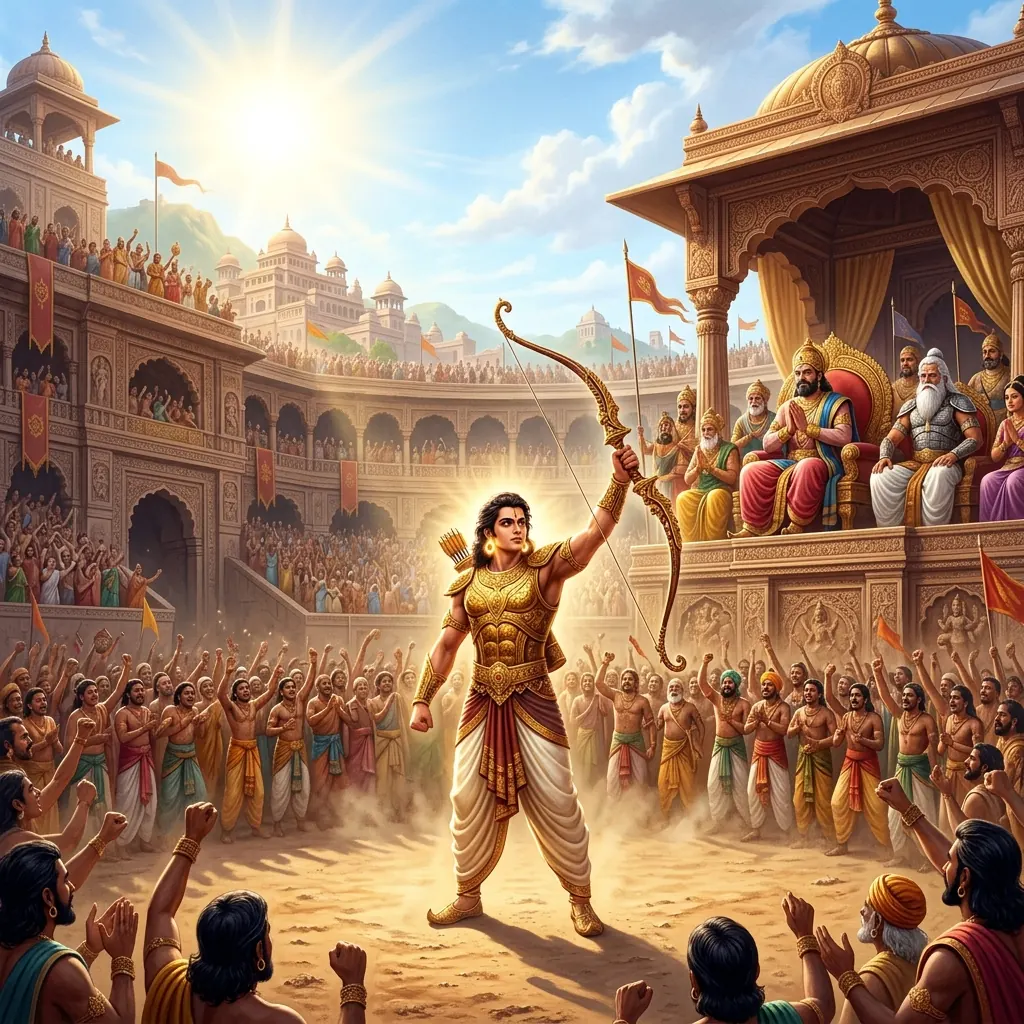
The lists had been laid out for Drona's pupils. The princes had shot and wrestled and driven, the crowd had roared for Arjuna, and then a stranger with a natural mail on his body and earrings in his face had walked in like a moving cliff and done everything Arjuna had done, and the two of them now stood at either end of the arena with their bows strung, waiting for permission to kill each other.
The sky took sides before the men did. Clouds full of lightning covered the sky, and the coloured bow of Indra appeared over the arena, shedding its bright rays. Rows of white cranes flew across, and the clouds seemed to laugh behind them. Indra was watching his son from up there out of love, and the Sun, seeing it, drove the clouds away from over his own child. So Phalguna stood deep in shadow, hidden under cover of cloud, and Karna stood surrounded by the rays of the Sun where everybody could see him.
On the earth the sides were plainer still. The son of Dhritarashtra placed himself beside Karna. Bharadwaja's son Drona, and Kripa, and Bhishma took their places with Partha. The assembly split down the middle, and Vaishampayana notes that the women in their galleries split with it, some of them calling for the boy they had watched grow up in the palace and some for the stranger who had come in out of nowhere with the sun on him.
And Kunti, daughter of Bhoja, understood what was happening, and fainted.
She was the only person in that arena who had counted the men on the sand and got two.
Sandal Paste and Water
It was Vidura who reached her.
He was the third of the brothers of that house, born to a waiting-woman and therefore never to be king, and the epic introduces him almost every time with the same phrase: versed in the lore of all duties. He was the man in the Kuru household who always knew what ought to be done next, and who was almost never asked. On this occasion nobody had to ask him. He came with the women attendants, and with their help he revived the unconscious Kunti, sprinkling sandal paste and water on her until she came back.
She opened her eyes on the same arena. Nothing had been fixed while she was away from it. Both of her sons were still standing there in their armour, and Vaishampayana sets down what happened in her with a flatness that is worse than any lament. When she came to herself and saw her two sons in armour, Kunti was seized with fear, but there was nothing she could do.
There was one thing she could have done. She could have walked out onto that sand in front of Bhishma and Drona and the whole city and said the sentence that would have stopped the fight, and she did not say it, and she would not say it until the eve of the war.
What stopped it instead was procedure. Kripa, the son of Sharadvan, who knew the rules that govern duels, asked the stranger for his lineage, the names of his father and mother, and the royal line he belonged to, because the sons of kings never fight men of no lineage. At that, Karna's face became like a lotus battered pale by the pelting rains of the monsoon. And Duryodhana, rather than let the question be answered, made him a king on the spot, and Anga was given away with parched paddy and flowers and water-pots and gold while the umbrella was held over his head.
Kunti sat in the gallery and watched her eldest son crowned by her second son's enemy, and said nothing.
The Man With the Staff
Then, while the cheering was still going on, an old man came into the lists.
His upper cloth was slipping off him. He was sweating and trembling, and he was leaning on a staff, and he was walking out across ground that had been cleared that morning for princes. This was Adhiratha, a charioteer in the service of the Kuru house, the man who had lifted a basket out of the river years before and found a child in it with armour growing on his body, and who had raised that child as his own son with his wife Radha.
He had heard what was being shouted in the streets. He had come to see it.
Karna saw him and put down his bow.
Vaishampayana is exact about the order of the movements, because the order is the whole of it. The new king of Anga left his weapon on the ground, and then, out of a son's reverence, he bowed his head. The head was still wet. The water of the inauguration was still standing in his hair.
The charioteer hurried forward. The first thing he did, before he said anything at all, was to cover his own feet with the end of his upper cloth, because bare feet are not brought into the presence of a crowned man, and the man being crowned was his boy. Then he called Karna, crowned and triumphant, his son. Then he embraced him, and in his overflowing love he wet that head with tears, so that the coronation water and the father's weeping were on the same hair and could not be told apart.
In an arena that had spent the whole afternoon trying to find out who this man was, the question had just been answered in public, in the plainest possible way, by the one person who could answer it.
And the arena watched the answer with great interest.
As Befits Your Race, Take the Whip
Bhimasena was the first to speak.
He had seen the charioteer, drawn the obvious conclusion, and found the thing funny. And he said, mocking, in a voice pitched to carry across an arena: "Son of a charioteer, you do not deserve to die in battle at Partha's hands. As befits your race, take up the whip, and be quick about it. And you are certainly not fit to rule the kingdom of Anga, lowest of men, any more than a dog deserves the butter set before the sacrificial fire."
It is worth being clear about what is in that speech, because the poem does not soften it. The first sentence is not an insult about birth alone. It is a ruling on who is worth killing. Bhima is saying that his brother cannot be permitted to fight this man because winning would be no honour, and losing would be a disgrace beyond measure, and either way the contest is beneath the family. The second sentence hands Karna a driver's whip in front of the city. The third puts him beside a dog nosing at the butter that has been set apart for the fire, which is the worst thing that can be said of a creature in a place where the fire is the centre of everything.
Karna did not answer it.
His lips trembled a little. He drew a deep sigh. And then he looked up, out of the ring of faces, at the god of the day in the sky.
That is all Vaishampayana gives him, and it is enough, because the man he was looking at was his father, and neither of them said so. He had one father holding his feet covered by a sheet and weeping on his head, and one father standing overhead in the sky where the whole world could see him and nobody would believe it, and between the two of them he stood in a borrowed crown with a whip being offered to him.
The Lineage of Heroes Is Unknown
Then, like a maddened elephant rising out of a bed of lotuses, mighty Duryodhana rose in anger from among his brothers.
"Vrikodara, you should not speak like that. Strength is a kshatriya's first virtue, and even a kshatriya of low birth deserves to be fought."
Then he made the argument, and it is one of the strangest speeches in the Adi Parva, because it is entirely correct and it is being made by the wrong man for the wrong reason.
"The lineage of heroes, like the source of a mighty river, is never known." Nobody can walk up a great river to the spring it came from. "The fire that covers the whole world rises from the waters," which is the submarine fire, the thing least like water there is, born out of the sea. "The thunderbolt that slays the Danavas was made from a bone of Dadhichi," so that the weapon Indra rules heaven with came out of the skeleton of a man who agreed to die for it. "The illustrious god Guha, who is made up of portions of all the other gods, is of unknown lineage. Some call him the son of Agni, some of Krittika, some of Rudra, and some of Ganga." The war-god himself has four different mothers, depending on whom you ask, and nobody thinks less of him for it.
Then he came down out of the sky and into the arena, where it stung.
"We have heard of men born brahmanas who became kshatriyas. Drona, our teacher, the greatest of all who bear arms, was born in a water-pot, and Kripa of the line of Gotama sprang from a clump of reeds."
The two men who had been running that tournament since sunrise were standing in earshot. One of them had been born into a pot. The other had been found in a patch of grass. Neither of them had a birth to boast of, and neither of them had asked Karna his until the crowd made it necessary.
Can a Doe Give Birth to a Tiger
With the general question disposed of, Duryodhana turned to the particular one, and he did it by looking straight at the five brothers.
"I know about your own births, princes of the Pandavas."
He left it there. He did not have to go on. Everyone in that arena knew that Pandu had been under a curse that made fatherhood fatal to him, and that his sons had come to Kunti from the gods, and it was a thing spoken of as a wonder and never as a doubt. Duryodhana had just put the wonder and the doubt in the same sentence and set it down in the middle of the sand, and then he walked away from it and went back to the man in the new crown.
"Can a doe give birth to a tiger, splendid as the Sun, with every auspicious mark, and born with armour and earrings on his body?"
He was arguing from the body. The armour was not put on; it had grown. The earrings were not gifts; they were part of the face. No charioteer's household in the world had ever produced such a thing, and therefore, said Duryodhana, whatever the old man with the staff believed, this was not a charioteer's son.
He was right. He had reasoned his way to the truth from the evidence in front of him, in public, at the top of his voice, and he had no idea what he had proved, and neither did anybody else who was cheering.
"This prince among men deserves to rule the world, not only Anga, by the strength of his arm and because I have sworn to obey him in everything. If there is anyone here who cannot bear what I have done for Karna, let him mount his chariot and bend his bow with his feet."
There was a confused murmur among the spectators, in favour of the speech. Nobody got into a chariot.
And in the gallery a woman heard a boy she had never raised described by his marks, one after another, until the list was complete.
Countless Lamps
The sun went down.
He had held the clouds off his son all afternoon, and when the light went the duel went with it, because no more could be done that day. So Prince Duryodhana took Karna by the hand and led him out of the arena, and the arena had been lit by then with countless lamps, and the two of them walked out through all of it together.
The Pandavas went home the other way, accompanied by Drona and Kripa and Bhishma.
The people came away arguing, as crowds do. Some named Arjuna as the victor of the day. Some named Karna. Some named Duryodhana, who had not shot a single arrow and had won more than either of them.
And Kunti walked back to the palace having recognised her son.
Vaishampayana says how she knew him: by the many auspicious marks on his body. The armour. The earrings. Whatever else there was on that body that a mother had looked at once, on a riverbank, before she put it in a basket and pushed it into the water. She had fainted when she saw them and she had been brought round with sandal paste and water, and now she had seen him made a king in front of the whole city, and Vaishampayana records her feeling in one clause and does not enlarge on it. Out of a mother's love, she was very glad.
That is the last thing the section says about her, and it is the measure of what the day cost. Her eldest son had been crowned, and she was glad. Her eldest son had been called a dog at the fire in front of ten thousand people, and she had sat still. Her youngest had stood on the sand with his bow strung to kill him, and she had said nothing to either of them.
Duryodhana, now that he had Karna, put away the fear of Arjuna's archery that had been eating at him for years. Karna set about pleasing his new friend with sweet words. Yudhishthira went to bed convinced that there was no warrior on earth like this man.
And Kunti went to her rooms and kept her mouth shut, and kept it shut through the dice and the exile and the war, until the day she came to a river to tell him herself, and by then it was too late for both of them.
Dharma Lesson
Kunti is given the one piece of knowledge that could have stopped the quarrel before it hardened, and she keeps it, and the epic does not excuse her for it. The reasons are real: a word from her would have unmade her own honour and her sons' claim, and there was no hour in that arena when speaking would have been safe. But the poem is careful to note that she was pleased when he was crowned, which means she had already begun taking the comfort of a mother without paying any of the cost. A truth withheld does not stay where it is put; it goes on gathering interest until someone has to pay it in full, and in this house the payment was made at Kurukshetra.