The Priest of Drupada
The envoy, the guarded answer, and the weapons laid out to catch a king's sons
In short
The morning after the swayamvara, Dhrishtadyumna tells his father what he saw from his hiding place in the potter's house, and Drupada sends his own priest to ask the strangers who they are. Yudhishthira answers courteously and reveals nothing, saying that every question was answered by the stringing of the bow. So the king lays out the wedding goods of all four orders in his hall and watches which ones the five men in deer-skins walk over to. Only when they stand among the swords and the coats of mail does Yudhishthira say aloud that they are the sons of Pandu.
What the Prince Saw From His Hiding Place
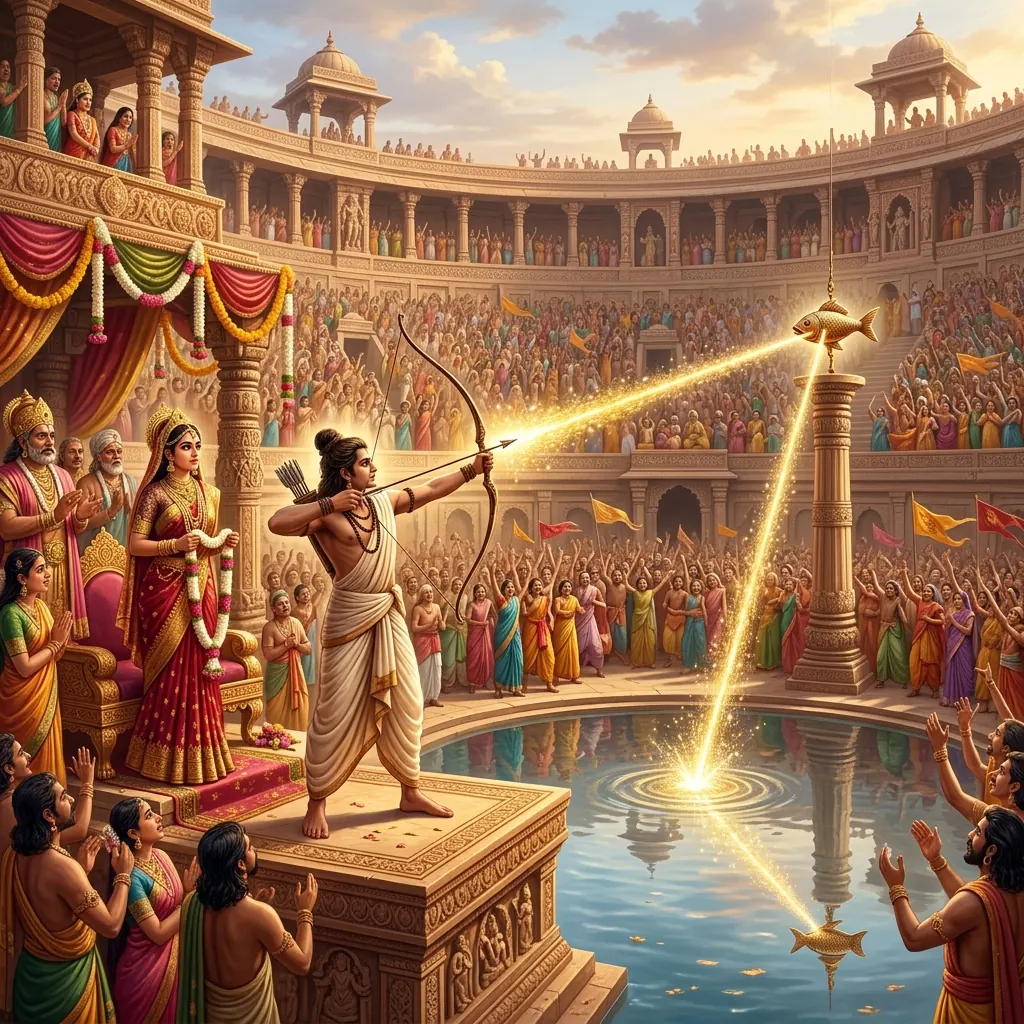
Vaishampayana was telling the story of the wedding, and he began it with a king who did not know whom his daughter had gone away with.
Drupada had spent the night asking it. Had a shudra taken Krishna, or a man of mean descent, or some tribute-paying vaishya, and set his dirty foot on a king's head? Had the wreath of flowers been thrown away on a graveyard? He had one hope and he had said it aloud to his son: that the man who took her was Partha, and that the sons of Vichitravirya's son were somehow alive after all.
Dhrishtadyumna, his son, had followed the two strangers out of the amphitheatre the evening before and hidden himself in a corner of the potter's house all night, and he came back in the morning with an answer, and he gave it cheerfully.
"Large red eyes," he said, "a deer-skin for clothing, and as handsome as a god. That is the young man who strung the bow and brought the mark down out of the air. The leading brahmanas crowded round him at once to honour him for the feat, and he stood among them, a man who could not bear the sight of an enemy, like Indra with his thunderbolt among the gods and the rishis.
"And Krishna followed him. She caught hold of his deer-skin and went after him cheerfully, the way a she-elephant follows the leader of a herd.
"Then the kings gathered there could not bear the sight of it, and they rose up in anger and came forward to fight. And another hero rose up. He tore up a great tree and rushed with it at that crowd of kings and struck them down right and left, like Yama himself cutting down living things.
"After that, father, the kings stood still and only watched. The two of them, like the sun and the moon, took Krishna between them and walked out of the amphitheatre."
He had followed where they walked, and that was the part his father needed to hear.
Five Men and a Lady Like a Flame
"They went into a potter's house on the edge of the town," Dhrishtadyumna said, "and in that house sat a lady like a flame of fire, who I think is their mother. Around her sat three more men of the finest kind, and each of them was like fire too.
"The two heroes came in and bowed down at her feet, and they told Krishna to do the same. Then they left her with the lady, and all five of them went out on their alms round, like brahmanas, and begged their food from door to door.
"When they came back, Krishna took the food they had begged, set aside a portion for the gods, and gave another portion to brahmanas. Of what was left she gave a share to that venerable lady and divided the rest among those five men. She took a little for herself and ate it last of all."
Then he told his father how they slept, because he had watched that too.
They laid themselves down on a bed of kusa grass with their deer-skins spread over it, and Krishna lay along the line of their feet, as a pillow for their feet, and did not grieve in her heart at it.
"And before they slept," said the prince, "they talked, in voices as deep as thunderclouds, about all sorts of things. Nothing in their talk sounded like vaishyas or shudras or brahmanas. It was all heavenly chariots and weapons, elephants and swords and arrows and battle-axes. There is no doubt, king, that they are bulls among kshatriyas, for they talked of nothing but war.
"I think, father, that our hope has come true. We have heard that the sons of Kunti all escaped from the fire in the house of lac. The way that young man shot down the mark, the strength it took to string the bow, and the way I heard them talking together prove it beyond doubt: they are the sons of Pritha, wandering in disguise."
Drupada heard his son out, and was overjoyed, and did not yet believe it.
The Priest at the Potter's Door
Being glad was not the same as being certain, so the king sent his priest.
A king's priest is not a messenger. He is the brahmana who keeps the fire of the household, who knows the ordinance for every rite the king will ever need, and who can be sent to a stranger's house without either party being shamed by the errand. Drupada directed him to find out who these men were, and whether they were the sons of the illustrious Pandu, and the old brahmana went down to the potter's house in the suburbs and applauded them all and delivered the king's message duly.
"You who deserve the first place in everything," he said, "Drupada, the boon-giving king of the earth, wants to know who you are. Since he saw the man who shot down the mark, his joy has known no bounds. Tell us about your family and your tribe. Set your feet on the heads of your enemies, and gladden the hearts of the king of Panchala and his people, and mine too."
Then he said the thing he had been sent to say, which was not a question at all.
"King Pandu was Drupada's dear friend, and Drupada thought of him as a second self. And all along Drupada had longed to give this daughter of his to Pandu as a daughter-in-law. Heroes of faultless looks, King Drupada has always cherished this wish in his heart: that Arjuna of the long, strong arms might marry this daughter of his with the proper rites. If that has now become possible, nothing could be better for Drupada, nothing more to his good, nothing more likely to bring him fame and merit."
Having said this, the priest remained silent and humbly waited for an answer.
He had told them, in the politest form available to him, that his master was hoping out loud for exactly the men he was looking at, and that if they were those men they had only to say so. Then he sat there with his hands in his lap and let the silence do the rest of the work.
The Answer That Answered Nothing
Yudhishthira did not answer him first. He turned to Bhima, who was sitting near.
"Bring this brahmana water to wash his feet, and the Arghya. He is King Drupada's priest, and so he deserves great respect. We should honour him with more than ordinary reverence."
Bhima did as he was directed. The priest accepted the worship offered him with a joyous heart and sat at his ease, and only then did Yudhishthira speak, and what he said was not one word about family or tribe.
"The king of the Panchalas set a special bride-price and gave his daughter away by the custom of his order, not freely. This hero met that price and won the princess. So King Drupada has nothing more to ask about the race, the tribe, the family or the character of the man who did that feat. All his questions have been answered by the stringing of the bow and the shooting down of the mark.
"This illustrious hero did exactly what the king required, and so carried Krishna off from among all the assembled kings. That being so, the king of the Lunar race should have no regrets, which can only make him unhappy without mending anything at all. The wish King Drupada has cherished all along will come true, for his lovely princess bears, I think, every auspicious mark.
"No weakling could have strung that bow, and no man of low birth, untrained in arms, could have shot down the mark. So the king of the Panchalas should not grieve for his daughter today. And no one in the world can undo the shooting down of that mark. So the king should not grieve over what must take its course."
It was a complete answer and it disclosed nothing. The terms had been set by Drupada, the terms had been met, and a man who sets a test has agreed in advance to accept whoever passes it. Every question the priest had brought had been answered already, Yudhishthira said, by the bow.
While he was still saying it, another messenger came in from the king of the Panchalas in great haste.
"The feast is ready."
The Chariots With Golden Lotuses
"For his daughter's wedding King Drupada has prepared a fine feast for the bridegroom's party," the messenger said. "Come when you have finished your daily rites. Krishna's wedding will take place there. Do not delay. These chariots decorated with golden lotuses and drawn by fine horses are fit for kings. Ride in them to the house of the king of the Panchalas."
Chariots adorned with golden lotuses, sent to a potter's yard, for men who had come back that evening with begged food in their hands. The invitation was a test in itself, and nobody in the yard said so.
Those bulls among the Kurus dismissed the priest, put Kunti and Krishna together on one of the chariots, mounted the splendid vehicles themselves and drove to Drupada's place.
Meanwhile the king had heard from his priest what Yudhishthira had said, and had understood exactly how much of it was an answer. So he prepared the only question that cannot be evaded, and he prepared it in the form of furniture.
To find out which order those heroes belonged to, he had ready a large collection of the things the ordinance requires for the wedding of each of the four orders. He set out fruits and sanctified garlands, for the brahmana. He set out cows and seeds and various implements of agriculture, for the vaishya. He gathered every article used in the other arts, and implements and apparatus of every kind of sport, for the shudra and for any man who might be neither one thing nor the other.
And then he laid out the fourth set.
Excellent coats of mail and shining shields. Swords and scimitars of fine temper. Beautiful chariots and horses. First-class bows and well-adorned arrows, and various kinds of missiles ornamented with gold. Darts and rockets and battle-axes and the various utensils of war. Among them all he scattered beds and carpets and fine things and cloths of various sorts, so that nothing in the room should look like a trap.
Then he waited to see what five strangers in deer-skins would walk over to.
What They Walked Over To
When the party reached Drupada's house, Kunti took the virtuous Krishna with her and went into the inner apartments of the king, and the ladies of the king's household with joyous hearts worshipped the queen of the Kurus, without yet knowing that she was one.
The men came in by the other door, and the whole court looked at them.
They had the sportive gait of the lion. They wore deer-skins for their upper garments. They had eyes like great bulls, broad shoulders, and long arms hanging down like the bodies of great snakes. The king and his ministers, his son, his friends and his attendants all looked at those splendid men, and all were overjoyed.
Then came the first small thing that was noticed.
Excellent seats had been set out, furnished with footstools, of a kind a beggar has no business sitting on. The five sat down on them without any awkwardness and hesitation, with perfect fearlessness, one after another according to the order of their ages. Men who are pretending do not sit like that, and men who are pretending do not know their own precedence so exactly that a whole room can read their birth order off the seating.
Well-dressed servants, men and women, and skilled cooks brought fine and costly food fit for kings on gold and silver plates. Those men dined and were well pleased. Nothing about the food surprised them either.
And after the dinner was over, they got up and walked into the room where the king's collection was laid out.
They passed over the fruits and the garlands. They passed over the cows and the seeds and the ploughs. They passed over the implements of the arts and the apparatus of sport, and the beds and the carpets and the cloths of various sorts, and they went to the far end of the hall and stood among the coats of mail and the shields and the swords and the bows, and began to look over the various utensils of war with interest.
Drupada's son, and Drupada himself, and all his chief ministers of state, stood watching them do it.
They understood that the sons of Kunti were all of royal blood, and they were overjoyed.
We Are Kshatriyas, King
Even then the king asked. He had watched them choose the weapons and he still wanted it said aloud, and he addressed Yudhishthira in the form used for brahmanas, because that was still, formally, what his guest was.
"Are we to know you as kshatriyas, or as brahmanas? Or are you gods disguised as brahmanas, roaming the earth, who have come here for Krishna's hand? Tell us truly, for we are full of doubt. Will we not be glad once our doubts are cleared away? Scourge of your enemies, have the fates been kind to us? Tell us the truth freely. Truth suits monarchs better than sacrifices and the building of water tanks. So tell us nothing untrue. When I have heard your answer, I will arrange my daughter's wedding according to the order you belong to."
He had put his own hand on the table. He had told them what the answer would be used for, and he had used the word monarchs of the man he was speaking to.
"Do not be troubled, king," Yudhishthira said. "Let your heart be full of joy. The wish you have cherished has come true. We are kshatriyas, king, the sons of the illustrious Pandu. I am the eldest of the sons of Kunti, and these are Bhima and Arjuna. It was these two, king, who won your daughter in that gathering of kings. The twins and Kunti are waiting where Krishna is. Bull among men, put grief out of your heart, for we are kshatriyas. Your daughter, king, is like a lotus that has only been moved from one lake to another. You are our revered elder and our chief refuge. I have told you the whole truth."
Drupada's eyes rolled in ecstasy, and for some moments, filled with delight, the king could not answer him at all. He checked his emotion with great effort and replied in proper words, and the first proper word he could find was a question about a fire.
He asked how they had escaped from the town of Varanavata. Yudhishthira told him in full detail how they had escaped from the burning palace of lac. Drupada heard it out and censured Dhritarashtra, that ruler of men, and gave every assurance to the son of Kunti, and that foremost of eloquent men then and there vowed to restore Yudhishthira to his paternal throne.
Tomorrow I Will Do What Is Proper
Kunti and Krishna and Bhima and Arjuna and the twins were commanded by the king to live there, and Yajnasena treated them with due respect. Then Drupada came to Yudhishthira with his sons, assured now by all that had happened, and asked for the wedding he had wanted for years.
"Mighty-armed one, let the Kuru prince Arjuna take my daughter's hand with the proper rites on this auspicious day, and so let him begin the usual opening rites of marriage."
"Great king," said Yudhishthira, "I will have to marry too."
Drupada took it for modesty about precedence. "If you wish, take my daughter's hand yourself with the proper rites. Or give Krishna in marriage to whichever of your brothers you like."
"Your daughter, king, will be the wife of us all together. That is what our mother has ordered. I am still unmarried, and so is Bhima among the sons of Pandu. Arjuna won this jewel of a daughter of yours. And this, king, is our rule: whatever jewel we win, we always share equally. So Krishna will be the wedded wife of us all. Let her take our hands one after another before the fire."
The king who had spent two days establishing that these men were of good birth now heard the eldest of them propose something no good family had ever done.
"Son of the Kuru line, the law allows one man many wives. But no one has ever heard of one woman with many husbands. Son of Kunti, you are pure and you know the rules of right conduct, so you must not do a thing that is sinful and against both custom and the Vedas. Why, prince, has your mind turned this way?"
"King, right conduct is subtle. We do not know its course. Let us follow the path the illustrious ones of former ages walked. My tongue has never spoken an untruth. My heart never turns to what is sinful. My mother commands this, and my heart approves it. So, king, it is entirely in keeping with virtue. Act on it without any scruple. Have no fear in this matter."
"Son of Kunti, you and your mother and my son Dhrishtadyumna must settle among yourselves what is to be done. Tell me what you decide, and tomorrow I will do what is proper."
So Yudhishthira and Kunti and Dhrishtadyumna sat down together to discuss it. And just at that time, in the course of his wanderings, the island-born came there.
Dharma Lesson
Drupada does not take Yudhishthira's word for anything, and he is right not to. He asks his question in the only language that cannot lie, by putting the goods of all four orders on the floor of his hall and letting five hungry strangers reveal themselves by what they find interesting after dinner. Birth in this story is not a claim made about a man but a habit visible in him, in how he sits down on a seat that is too good for him and in what his hands reach for when he thinks the examination is over. And when the answer finally comes in words, it comes only because Drupada has already earned it.