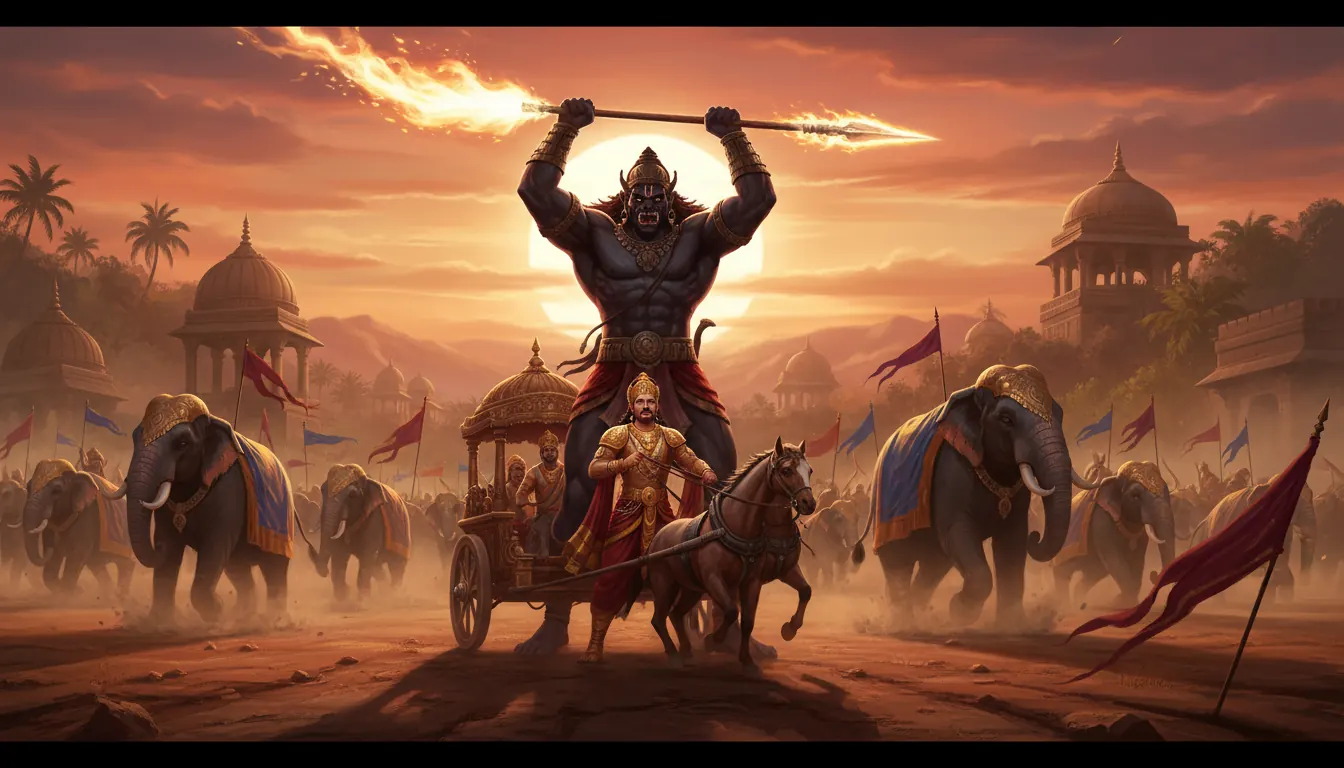
Kurukshetra Day 8: The Rakshasa's Hour
Iravan falls and Ghatotkacha answers for him
In short
Bhima kills eight sons of Dhritarashtra before noon and nine more after it, while Duryodhana hires the illusion-fighting rakshasa Alambusha, who beheads Arjuna's naga son Iravan far from his father. Ghatotkacha takes the revenge Arjuna cannot, breaking the Kaurava host with one illusion at sunset, and that night Duryodhana walks to Bhishma's tent with Karna's plan in his mouth.
Told in the Bhishma ParvaSet in Kurukshetra, Hastinapura and Pragjyotisha21 min read
The Horned Array
They had slept well, both armies, which was the strange thing about the eighth morning. The Kauravas and the Pandavas passed the night in sound sleep and then went out again to kill one another, and when the troops moved off the uproar was like the sea.
Duryodhana formed the array himself that day, with Chitrasena and Vivinsati and Bhishma and the son of Bharadwaja over the work. Bhishma took the van with the Malavas and the men of the southern countries. Next came Drona with the Pulindas and the Paradas, then Bhagadatta of Pragjyotisha with the Magadhas and the Kalingas, then Brihadbala king of the Kosalas, then the ruler of Prasthala with Kambojas and Yavanas in thousands, then Drona's son roaring like a lion, then Duryodhana with his brothers by the same mother around him, and Kripa closing the rear.
Yudhishthira looked at that and spoke to the man he had made generalissimo.
"Look at that array, great bowman. It is already formed, and it is like the ocean. Son of Prishata, form your own array against it at once."
Dhrishtadyumna formed the Sringataka, the horned array that breaks every array set against it. At the two horns he set Bhima and Satyaki with many thousands of chariots and horse and foot. Next to them stood Arjuna, with his white horses and Krishna at the reins. In the centre were Yudhishthira himself and the two sons of Madri. In the rear he placed Abhimanyu, and Virata, and the five sons of Draupadi, and the rakshasa Ghatotkacha.
Then the drums and the conches went, and the warriors looked at one another with unblinking eyes and called their own names across the gap before they closed. Then the arrows fell in showers like snakes with their mouths open, and the day began.
Eight Sons Before Noon
The Pandavas could not look at Bhishma that morning. He scorched the field like the sun, cutting the heads off their chariot warriors and leaving elephants standing paralysed like hills with nobody on them. One man in that army went at him and stayed there, and it was Bhima.
Bhima killed the grandsire's charioteer first, and the horses bolted off with the chariot behind them. Then he put a horseshoe-headed arrow through the neck of Sunabha, the king's brother.
Seven more brothers could not bear it. Adityaketu and Vahvasin, Kundadhara and Mahodara, Aparajita, Panditaka, and Visalaksha who was called invincible came out in their bright mail and pierced Bhima nine times and seventy and ninety and seven, and Bhima did not bear it either. Holding his bow in his left hand he took off Aparajita's fine-nosed head with one straight shaft and sent Kundadhara to the domain of Death. He shot Panditaka, and the arrow killed him and went on into the earth like a snake going home, and remembering his old grievances he cut off Visalaksha's head with three arrows, struck Mahodara in the chest, took Adityaketu's umbrella with one arrow and his head with the next, and sent Vahvasin after them.
That was eight sons of Dhritarashtra before the sun stood overhead, and the rest turned and ran, remembering a promise made about them in an assembly hall long ago and thinking it true.
Duryodhana went to Bhishma with his face wet.
"Bhimasena has killed my heroic brothers in battle, and our troops are giving way. You seem not to care about us. You behave as if you were only watching. Alas, what road have I taken? Look at my evil fate."
Bhishma's own eyes filled up when he heard it.
"I said this before, and so did Drona, and Vidura, and the famous Gandhari. You did not understand it then, my son. I have also made up my mind that neither I nor Drona will come out of this battle alive. Whoever Bhima sets his eyes on in battle, he will surely kill. So, king, summon all your patience and fight, with heaven as your goal."
In Hastinapura the blind king could not sit still under the account of it.
"When they saw my sons killed by one man, what did Bhishma and Drona and Kripa do in the battle?"
Sanjaya did not let that stand.
"Vidura spoke those words for your good, and you did not understand them then, and now they have come true. Vidura had said, 'Keep your sons away from the dice.' Like a dying man refusing the right medicine, you would not listen. At midday the Pandavas split into three bodies. Dhrishtadyumna and Shikhandi and Satyaki went at Bhishma alone; Arjuna went at the kings who followed your son; Abhimanyu and the son of Hidimbi and Bhimasena went at whatever was left, and Nakula and Sahadeva rode into the cavalry until the earth was strewn with horses. A river began to run through the middle of that field whose current was blood."
Arjuna's Other Son
Into the horse fighting came a young man with a great herd of horses behind him, gold on their heads and necks, moving so fast that they looked like swans crossing deep water. His name was Iravat. He was Arjuna's son, and almost nobody in either army had heard of him.
His mother was a daughter of the king of the nagas. Her first husband had been eaten by Garuda, and Airavat gave her to Partha, and Partha took her because she came to him wanting him. His uncle among the nagas threw the boy out, and he grew up in that region under his mother's protection. When he heard that his father had gone up to the region of Indra he went there too, and stood in that court with his hands joined and introduced himself the way a stranger does.
"I am Iravat. Blessings on you, my lord. I am your son."
Arjuna remembered the circumstances exactly as they had happened, and embraced him, and gave him one instruction only.
"When the battle comes, you must help us."
"Yes," the young man said, and went away, and now here he was.
His horses struck the Kaurava horses chest to chest, and both lines went down together with a sound like the swoop of Garuda. Then the six younger brothers of Subala's son rode out on fresh chargers, Gaya and Gavaksha, Vrishava, Charmavat, Arjava and Shuka, Gandhara men who were hard to beat, and broke into the cavalry of the Pandavas.
Iravat told his own men what to do about it. "Find whatever means you can to destroy these warriors of Dhritarashtra, with their weapons and their animals, every one."
They surrounded him with lances, and he pulled the lances out of his own body and struck the sons of Subala with them. Bathed in the blood running down his chest and back he got off his horse, drew his sword, took up a shield, and went at all six of them on foot. They rode around him and could not touch him. When they came close enough to try to take him alive he cut off their arms, and the arms with the gold on them fell in the dirt. Only Vrishava got out of it.
The Hired Illusionist
Duryodhana looked at the six of them lying there and sent for a rakshasa.
He was the son of the hermit Rishyasringa, a great bowman skilled in illusion, and he already hated the Pandavas on his own account for the killing of Vaka. Alambusha was his name.
"Look, hero," Duryodhana said, "at the harm the mighty son of Phalguni, a master of illusion, has done me by destroying my forces. You too can go wherever you will, and you are skilled in every weapon of illusion. And you hate Partha too. So kill this one in battle."
"Yes," said the rakshasa, and went off roaring with the remnant of the Kaurava horse behind him.
He began with two thousand riders that did not exist, and Iravat's men killed all two thousand and died doing it. Then the two of them were alone in the middle of a battle, like Vritra and Vasava.
Iravat cut the rakshasa's bow with his sword and cut each of his arrows into five pieces. Alambusha went straight up into the air, and Iravat went up after him, because he could change shape too and knew where the vital parts of a body are. He cut the rakshasa's limbs off, and did it again, and did it again. The pieces were reborn young. Age and form are matters of will with them.
Then Alambusha stopped playing, took a prodigious and fierce form, and reached out to take Arjuna's son in his hands.
And a naga came to Iravat, a relation on his mother's side, and swelled up mighty as Ananta and covered the rakshasa with nagas of every kind, so that he was buried in serpents.
Alambusha reflected for a moment. Then he became Garuda, and ate them.
When his mother's kinsman had gone down that throat, Iravat stood confounded in the air with nothing left to fight with, and the rakshasa killed him with a sword. The head came down on the field with the earrings still in it and the diadem on it, and it looked, Sanjaya said, like a lotus, or like the moon.
A long way off on the same field, Arjuna, not knowing that the son of his loins was dead, was cutting down king after king of the men who protected Bhishma.
The Debt Ghatotkacha Owed
The one who answered for Iravat was not his father.
Ghatotkacha, Bhima's son by the rakshasa woman of the forest, saw the head come down and let out a roar that shook the earth with its oceans and its mountains. Men in both armies felt their thighs shaking and the sweat come out on them, and the fighting stopped all over the field, the way it stops in a herd of elephants when a lion is heard.
Then he came on with a blazing spear up and a crowd of rakshasas around him, and Duryodhana rode out to meet him personally, with the king of the Vangas behind him and ten thousand elephants behind that king, huge as hills.
The rakshasas went into the elephants with darts and mallets, and with mountain summits and whole trees, and the beasts came apart. When that division had been thinned, Duryodhana rode into the rakshasas himself and shot four of the chief ones dead, Vegavat and Maharudra, Vidyujihva and Pramathin, one arrow each.
Bhima's son came at him for that, drawing a bow that lit up like lightning, and Duryodhana did not shake. Ghatotkacha spoke to him with his eyes red and his lower lip between his teeth.
"Today I will pay the debt I owe my fathers, and my mother too, whom your cruelty sent into exile for so long. You beat the sons of Pandu in that game of dice. You had Drupada's daughter Krishna dragged into the assembly while she was unwell and wearing a single garment, and you tormented her in every way, you wickedest of men. While she was living in her forest retreat, your friend the ruler of the Sindhus, that wicked wretch, persecuted her again, with no regard for my fathers. For these wrongs and others, you disgrace to your line, I will have my revenge today, unless you leave the field."
Then he covered the king of the Kurus with arrows the way rain covers a mountain.
The Elephant That Stood in the Way
Duryodhana bore that shower like an elephant standing under rain out of a clear sky, then sighed like a snake and put twenty-five sharp arrows into the rakshasa, until the blood ran down him like a bull elephant with its temples split.
So Ghatotkacha decided to kill the king. He took up a dart that would go through a mountain, blazing like a large meteor, and raised it.
The king of the Vangas saw it go up. He drove his own elephant in front of Duryodhana's chariot and stood there, covering the chariot completely with the animal's body, which is the whole of what that man did in this war. Ghatotkacha's eyes went red. He threw the dart at the elephant instead, and it died of that in great agony, and the king of the Vangas jumped down and landed on his feet as it fell.
Bhishma, far off, heard the roaring and went to Drona about it.
"These fierce roars from the rakshasas can only mean that Hidimbi's son is fighting King Duryodhana, and the king cannot stand against him. So go there, and blessings go with you, and protect the king. That is our highest duty."
It took a great many of them: Somadatta and Bahlika and Jayadratha, Kripa and Bhurishravas and Shalya, the princes of Avanti with Brihadbala, Ashwatthama and Vikarna and Vivinsati, and thousands behind them.
Ghatotkacha stood up in the middle of that like the Mainaka mountain, his kinsmen around him with clubs and mallets, and went to work on the arrivals one at a time. He cut the teacher's bow in half and brought down Somadatta's standard. He struck Vikarna at the shoulder joint and Vikarna sat down covered in his own blood. He put fifteen shafts through Bhurishravas so hard that they went through the armour and into the ground. He cut down Jayadratha's golden boar standard and then Jayadratha's bow, and pierced Brihadbala until that king sat down in pain. Then he turned round and found Shalya.
A Rout at Sunset
Yudhishthira heard the noise and read it correctly.
"The noise of that fiercely roaring rakshasa can only mean that he is fighting the mighty chariot warriors of the Dhartarashtra army. And I can see that the load is heavier than that bull among rakshasas can carry. The grandsire too, in his fury, is ready to slaughter the Panchalas, and Phalguni is fighting the enemy to protect them. Mighty-armed one, go and help Hidimbi's son."
Bhima went, frightening the kings on the road with his roaring, and behind him came Abhimanyu and the sons of Draupadi and Nila of the low countries and six thousand elephants. The dust off that advance was the colour of reddish smoke, and after it no man could tell his own side from the other.
Duryodhana turned on Bhima himself, cut his bow, and drove a shaft into his chest that left him holding his own flagstaff to stay upright. Drona shot Bhima twenty-six times; Bhima put ten arrows into Drona's left side and the old teacher sat down in his chariot and lost consciousness. Bhima came off his own chariot with the mace up and stood like a hill, and the Kaurava host looked at him and was afraid.
Then Ghatotkacha, who had been watching his father bleed, stopped fighting like a man and used what he was.
He put one fierce and awful illusion out over the whole field, and in it every soldier of the Kaurava army saw himself lying cut down on the ground, writhing, helpless, bathed in blood. They saw Drona flying, and Duryodhana and Shalya and Ashwatthama flying, and the kings killed and the horsemen cut down in thousands.
"Fight, do not fly away," Bhishma shouted at them, and Sanjaya shouted it with him at the top of his voice. "All this is rakshasa illusion in battle, applied by Ghatotkacha."
They did not believe it. Their senses were gone. The whole army of the Kurus ran for its tents at the hour of sunset with the Pandavas roaring behind it and blowing conches, and that was the eighth day settled.
Supratika, and the News for Arjuna
Duryodhana went to Ganga's son afterwards and told him the whole of it, his own defeat and the rakshasa's victory, and asked to be allowed to kill Ghatotkacha himself. Bhishma would not have it.
"In battle a man must protect himself, whatever happens. Your fight should always be with King Yudhishthira the Just, or with Arjuna, or with the twins, or with Bhimasena. A king keeps a king's duty before him, and strikes at a king. I, and Drona, and Kripa, and Drona's son, and Kritavarma and Shalya, and your brothers led by Dushasana, will all fight that rakshasa for your sake. Or if your grief is too great, let this man go against him."
He turned to Bhagadatta, king of Pragjyotisha, and gave him the work. "Go quickly, great king, against that invincible warrior. Your weapons are divine. In the old days you fought many battles with the Asuras. You are a match for that rakshasa in a great fight."
Bhagadatta went out on his elephant Supratika, the juice running down the animal in seven streams, throwing arrows off its head by thousands like Indra off Airavata. The king of the Dasharnas rode an elephant of his own at him, and Supratika took the charge like a continent taking the sea; then fourteen lances went through that other elephant's golden armour and it ran screaming back through the Pandava ranks.
Ghatotkacha threw a blazing dart at him and Bhagadatta cut it in half in the air. Then he threw a golden javelin of his own, calling "Wait, wait" as it went, and the rakshasa jumped up, caught it out of the air, put it across his knee, and broke it in front of all the kings.
Bhagadatta answered by killing Bhima's horses, cutting down his lion standard and wounding his driver Vishoka so badly that he sank down on the floor of the chariot, and Bhima came down onto the ground again with the mace. It was at that point that a chariot with white horses and Krishna driving it arrived at that part of the field, and Bhima, standing in the wreckage, told Keshava and Arjuna in detail about the slaughter of Iravat.
Vidura Saw It First
Arjuna heard it and sighed like a snake, and spoke to Krishna in the middle of the battle.
"There is no doubt that the great-souled Vidura, in his wisdom, foresaw this terrible destruction of the Kurus and the Pandavas. That is why he tried to stop King Dhritarashtra. Shame on the wealth for which such slaughter of kinsmen is being done. What will we gain, Krishna, by killing our own kinsmen gathered here? Alas, through the fault of Duryodhana and of Shakuni the son of Subala, and through the evil advice of Karna, the kshatriya race is being wiped out. Now I understand how wise the king was to ask Suyodhana for only half the kingdom, or else only five villages. Alas, even that was refused. When I see so many brave kshatriyas lying dead on the field, I blame myself. But the kshatriyas will think me powerless if I stop. That is the only reason I am fighting; otherwise this battle against my own kin disgusts me. Drive the horses on fast. There is no time to lose."
Keshava urged the white horses on, and the noise out of the Kaurava army as they saw him coming was like the sea at full tide in a gale.
In the afternoon Bhima found the sons of Dhritarashtra again. He felled Vyudoroska, and Kundalin the way a lion pulls down something smaller than itself, and then, getting the rest within reach, shot with care, and Anadhriti and Kundabhedin and Virata and Dirghalochana and Dirghavahu and Subahu and Kanykadhyaja came off their chariots one after another, looking, Sanjaya said, like mango trees in blossom falling. Drona covered him with arrows the whole time and could not stop him. Nine more sons went that afternoon: seventeen in the day.
By evening the two armies had come down to nails and teeth. Men caught one another by the hair and sent one another to Yama's house without a weapon between them. Then the darkness came, and the Kurus and the Pandavas drew their armies apart and went back to their tents.
The Lamps Along the Street
Four men sat up that night: Duryodhana, Shakuni, Dushasana, and the son of the suta. The question was how the sons of Pandu could be beaten, and the king answered it first.
"Drona, Bhishma and Kripa, and Shalya and Somadatta's son, are not holding back the Parthas. I do not know why they behave this way. None of them kills the Pandavas, and the Pandavas are destroying my forces. So I am growing weaker, Karna, and my weapons are running out. I cannot see how I will ever strike them down."
"Do not grieve, chief of the Bharatas," Karna said. "I will do what you want. Let Shantanu's son Bhishma withdraw from the great battle soon. Once Ganga's son has laid down his weapons, I will kill Partha and all the Somakas with him, before Bhishma's very eyes. I give you my word, king. The truth is that Bhishma shows mercy to the Pandavas every day. He is proud of his prowess and he loves a fight. Why would he defeat the Pandavas all together, when that would end the battle? So go to his tent at once and ask that revered old man to lay down his weapons."
"Dushasana," the king said to his brother, "see that everyone who walks in my train is dressed at once."
So they dressed him, and Dushasana held the horse for him himself. He went down the camp street in clean vestments with sandal paste of the hue of the Bhandi flower on him, his brothers behind him. Men stood along the way holding lamps of gold fed with fragrant oil, so that he rode like the moon with the planets blazing about him, and he heard the voices of men from many countries who had come there to die for him.
At Bhishma's quarters he got down, went in, saluted the old man and sat on a golden seat with a rich coverlet. Then he joined his hands, his eyes filled with water, and his voice went out of his control.
"Under your protection we dared to think we could defeat the very gods and Asuras, with Indra at their head. So what are the sons of Pandu to us? Son of Ganga, have mercy on me. Kill the brave sons of Pandu as Mahendra killed the Danavas. 'I will kill all the Somakas and the Panchalas and the Karushas, and the Kekayas with them': those were your words to me. Make them true. If you are sparing the Pandavas out of kindness to them, or out of hatred for my unhappy self, then let Karna fight. He will defeat the Parthas with all their friends and kinsmen."
Then he shut his lips and said nothing further, and waited for the answer, which came on the morning of the ninth day.
Dharma Lesson
A grief that is not allowed to stop for its dead will find someone else to spend itself on. Arjuna was fighting elsewhere when his son was killed and learned of it only from his brother, and the debt was paid by a nephew who had older debts of his own. What a war teaches its youngest fighters is not restraint but the arithmetic of revenge.