The Grandsire Names the God
Duryodhana asks why he keeps losing and gets a theology instead
In short
Beaten badly, Duryodhana comes to Bhishma's tent at night and asks the only question he cares about: who are the Pandavas relying on. Bhishma tells him to make peace, then answers with the day on Gandhamadana when Brahma saw a blazing chariot in the sky, recognised Narayana in it, and sang the hymn that named him. The answer ends where Krishna is, and Duryodhana goes to sleep unchanged.
Told in the Bhishma ParvaSet in Kurukshetra and Gandhamadana17 min read
A Blind King Asks What Science They Have
"When I hear of those feats of the sons of Pandu, which the gods themselves could not achieve," Dhritarashtra said, "my heart fills with fear and wonder. Day after day I hear of my sons being humiliated. What penances have they performed, Sanjaya? What boon have they won? What science do they know, that like the stars in the sky they never wane? Tell me truly why the sons of Pandu cannot be killed and mine can. I am like a man trying to swim the deep ocean with his two arms."
"Listen carefully, king," Sanjaya said, "and let what you hear go to your heart. None of this comes from incantation. None of it is illusion of any kind. They have invented no new terrors. They are strong, they fight by fair means, and everything they do, even guarding their own lives, they do in keeping with the moral way. They never give up a battle, and they never take their eyes off righteousness. And where righteousness is, there victory is. That is the whole of it.
"Your sons are cruel and given to mean acts, and that is why they are being worn down. They did many deceitful things to the Pandavas, and the Pandavas swallowed all of it and said nothing. Now let your sons eat the fruit of it, which is like poison. You will eat it too, elder brother of Pandu, because no one who wished you well could wake you. Vidura forbade you. Bhishma forbade you. Drona forbade you. I forbade you. You put the medicine aside like a sick man who has decided he knows better.
"But you asked me for the true cause of the Pandava victory, and there is an answer to that, and it is not mine. Duryodhana asked the grandsire this very question. He asked it at night, with his brothers beaten, and he asked it humbly. Listen, king, and I will tell you what was said."
The Question He Actually Wanted Answered
He came to the tent after dark, when the counting of the dead was still going on outside it, and his heart, Sanjaya said, was confused with grief. He had watched his brothers driven off the field in front of the whole army, and he had come to the one man who had never lied to him about anything.
"Drona, and yourself," Duryodhana said, "and Shalya, and Kripa, and Drona's son, and Kritavarma the son of Hridika, and Sudakshina the ruler of the Kambojas, and Bhurishravas, and Vikarna, and Bhagadatta of great prowess. Every one of them is counted a mighty chariot-warrior. Every one of them is high born. Every one of them is ready to throw his life away in this battle. In my opinion these men are a match for the three worlds put together. All the warriors of the Pandava army together cannot stand up to your prowess alone.
"So a doubt has arisen in me, and you must explain it, because I am asking you. Who is it? Whom are they relying on, that they beat us over and over?"
He wanted a name he could put a weapon in front of. He wanted to be told that some king or some counsellor was the hinge of it, so that he could send Drona at the hinge in the morning.
Bhishma did not answer the question in the shape it was asked.
Make Peace With Them
"Listen to what I am going to tell you, son of Kuru's race," Bhishma said. "I have told you the same thing a great many times and you have never once done what I said.
"Make peace with the Pandavas. I believe that is good for you and good for the world. Enjoy this earth with your brothers around you. Be happy. Please the people who wish you well and give some joy to your own kinsfolk. I cried myself hoarse over this before the war and you did not listen, and you always slighted the sons of Pandu, and now all of that has caught up with you."
Duryodhana said nothing, and waited, because none of that was new and none of it was the answer.
"Now hear also why they cannot be killed," the old man said. "There is not, there was not, and there never will be a being in all the worlds who could defeat the sons of Pandu, because they are protected by the one who carries the bow called Saranga.
"I will not argue it with you. I will tell you an ancient history, which sages who had mastered their souls recited to me, and you may do with it what you like."
Outside the tent the surgeons were still working and the drums had stopped. Bhishma began to talk about a mountain.
The Chariot in the Sky Over Gandhamadana
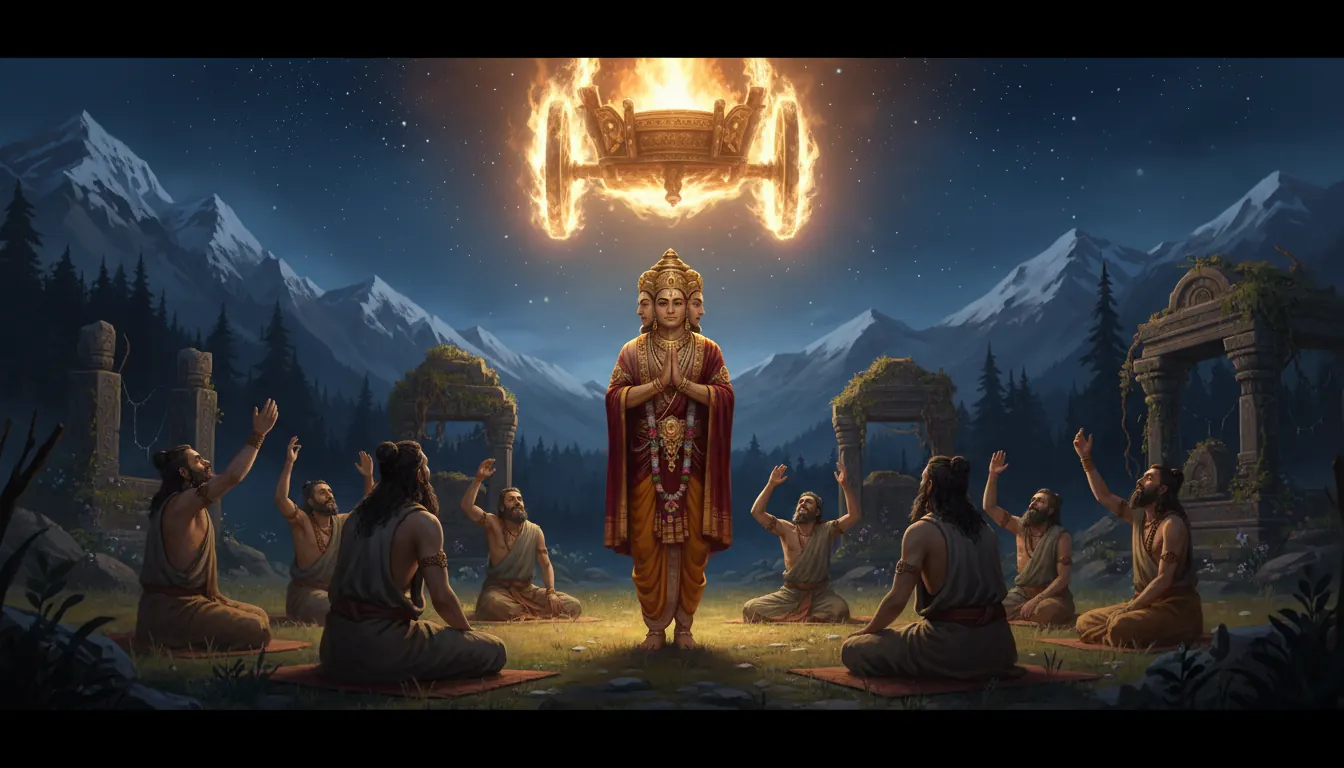
Long ago all the gods and all the rishis went up together onto the mountains of Gandhamadana and waited respectfully on the Grandsire. Brahma sat at his ease among them, the Lord of all creatures with the whole assembly of heaven around him, and there was nothing above him in any direction.
Then he saw a chariot standing in the sky, blazing with radiance.
He did not ask who it was. He found out by meditation, which is the way that Brahma finds things out, and once he had learned everything about it, he calmed his heart, joined his hands and bowed to the highest Divine Being.
The rishis and the gods saw the form shown in the sky and stood up with their hands joined too, their eyes fixed on it, because it was the wonder of wonders and because the Creator of the universe was on his feet in front of it.
And Brahma, first among all who know Brahman, worshipped him duly and then spoke.
"You are the Glory of the Universe, for that is your form. You are the Lord of the Universe. You whose protection reaches through all of it, you whose work is the Universe, you whose soul is mastered, you are the Supreme Master. You are Vasudeva. So I seek refuge in you, the soul of Yoga and the highest Divinity."
The Hymn of the Grandsire of the Worlds
"Victory to You, the Supreme God of the Universe. Victory to You, always at work for the good of the worlds. Victory to You, Lord of Yoga, all-powerful, before Yoga and after it. Victory to You, Lord of the Lords of the Universe, with the lotus springing from your navel and your large, wide eyes.
"Lord of the Past, the Present and the Future, victory to You, gentleness itself, the sun of suns. Home of countless qualities, victory to You, the refuge of all things. You are Narayana. You are beyond understanding. Victory to You who carry the bow called Saranga.
"Great Snake. Huge Boar. First Cause. You of the tawny locks, victory to You, the Almighty. You of the yellow robes, Lord of the main and the lesser points of the compass, whose home is the Universe, Infinite, Undecaying, the Manifest and the Unmanifest, immeasurable Space, victory to You, deep, giver of every wish, without end.
"The goddess Earth is your two feet. The main and the lesser directions are your arms, and the heavens are your head. I am your form. The gods are your limbs. The Sun and the moon are your two eyes. Austerity and Truth born of morality are your strength. Fire is your energy, the wind is your breath, and the waters have sprung from your sweat. The twin Ashvins are your ears and the goddess Saraswati is your tongue. The Vedas are your knowledge, and this Universe rests on you.
"Lord of Yoga and of Yogins, we do not know your extent, your measure, your energy, your prowess, your might, or your origin. The rishis, the gods, the Gandharvas, the Yakshas, the Rakshasas, the Pannagas, the Pishachas, human beings, beasts, birds and reptiles, all of these I created on Earth through Your grace.
"So, you of the large eyes, take birth in the race of Yadu. To establish righteousness, to slay the sons of Diti, to uphold the Universe, do what I have asked. Divide Yourself into portions and take birth among human beings."
Who Was That
"Then the glorious Deity answered Brahma in a soft deep voice," Bhishma said. "He said only this: 'Through Yoga, sire, I know everything you wish. It will be just as you wish.' And with that, he vanished then and there.
"And the gods and the rishis and the Gandharvas, who had been standing all that while with their hands joined and their eyes raised, were filled with wonder and curiosity, and they all asked the Grandsire the obvious question.
"'Who is that, Lord, whom you yourself worshipped so humbly and praised in such high words? We want to hear it.'
"And the Grandsire answered them sweetly. 'He who is called TAT. He who is Supreme. He who exists now and will exist for all time. He who is the highest Self, the Soul of beings, the great Lord. I was talking with him, ever joyful as he is, you bulls among gods. For the good of the Universe I asked the Lord of the Universe to take birth among mankind in the family of Vasudeva. I said to him: take your birth in the world of men to slay the Asuras.
"'The Daityas and Rakshasas of fierce form and great strength who were slain in battle have been born again among men. The glorious and mighty Lord will take birth in a human womb and live on the Earth with Nara beside him. Those ancient and best of rishis, Nara and Narayana, cannot be defeated in battle by all the gods together, and when they are born together in the world of men, fools will not know them.
"'He from whose Self I, Brahman, the Lord of the whole Universe, have sprung, that Vasudeva is worthy of your worship. He bears the conch, the discus and the mace, and you must never slight him as a mere man, best of gods. A man of foolish mind is called a wretch if, out of contempt, he speaks of Hrishikesha as only a man. People say that whoever does not know that Divine person, the Soul of all moving and unmoving things, from whose navel the first lotus sprang, labours in darkness. Whoever slights the wearer of the diadem and the Kaustubha gem sinks in thick darkness.'"
I Take You for a Wicked Rakshasa
"When he had said this to the gods and the rishis, long ago," Bhishma went on, "the Grandsire dismissed them all and went back to his own home, and the gods and the Gandharvas and the Munis and the Apsaras went up to heaven full of delight.
"This is not a thing I have invented tonight. I heard it from rishis of cultured soul talking in their assembly. I heard it from Rama the son of Jamadagni, and from Markandeya of great wisdom, and from Vyasa, and from Narada. When men like these say that Vasudeva is the Eternal Lord, the Supreme God of all the worlds, the great Master from whom Brahman himself sprang, tell me why men should not adore and worship him."
Then he turned it on his grand-nephew, and did not soften it.
"Sages of cultured soul forbade you before this. They told you: never go to war with Vasudeva, who carries a bow, nor with the Pandavas. In your folly you could not grasp what they were telling you.
"So I take you for a wicked Rakshasa. You are wrapped in darkness too. That is why you hate Govinda and Dhananjaya the son of Pandu. Who else among men would hate the divine Nara and Narayana?
"This one is Eternal and Unfading, pervading the whole Universe, Unchanging, the Ruler and Creator and Upholder of all, and the truly Existent. He upholds the three worlds. He is warrior, He is Victory, He is Victor, and He is the Lord of all nature. Where Krishna is, there righteousness is; and where righteousness is, there victory is. It is by the Yoga of his Supreme Excellence that the sons of Pandu are upheld. Victory will surely be theirs. He gives them a mind set on righteousness, and strength in battle, and He protects them from danger. The one you asked me about is known by the name of Vasudeva."
His Origin and His Glory
Duryodhana had listened to all of it and had taken from it the one thread that interested him.
"In all the worlds Vasudeva is spoken of as the Supreme Being," he said. "I want to know, Grandsire, his origin and his glory."
"Vasudeva is the Supreme Being," Bhishma said. "He is the God of all Gods, and no one higher than him, the lotus-eyed one, is to be seen. Markandeya speaks of Govinda as the Most Wonderful and the Most High, as the All-being, as the All-soul, as the Highest Soul, as the Supreme male Being.
"Water, Air and Fire, these three, He created. That Divine Master created this Earth. That Supreme Being lay down on the waters and slept there in Yoga, made up of every kind of energy. From his mouth He created Fire, and from his breath the Wind. From his mouth He created Speech and the Vedas. So He created first the Worlds, and the gods along with the many classes of rishis, and He created the decay and death of all creatures, and their birth and growth as well. He is the Doer and He is the Deed.
"He created Sankarshana, the first-born of all creatures. He created the divine Shesha, who is called Ananta and who upholds all creatures and the Earth with her mountains. From the secretions of his ear sprang the great Asura called Madhu, fierce and of fierce deeds, who meant to destroy Brahman, and that Supreme Being slew him. Because he slew Madhu, the gods and the Danavas and human beings and rishis call Janardana the slayer of Madhu.
"He is the great Boar. He is the great Lion. He is the Three-stepped Lord. He is the Mother and the Father of all living creatures. From His mouth He created the brahmanas, from His two arms the kshatriyas, from His thighs the vaishyas, and from His feet the shudras. The man with whom Krishna is pleased wins regions of bliss that never run out. Whoever seeks the protection of Keshava in a place of fear becomes happy and rich in every kind of prosperity. Knowing this truly, Bharata, Yudhishthira has sought the shelter of Keshava with his whole soul, the Lord of Yoga and the Lord of the Earth."
What the Sages Called Him
"Now hear from me, king, this hymn that Brahman himself spoke, and that the twice-born rishis and the gods passed on to men on Earth in days gone by.
"Narada described you as the Master and Lord of the god of gods and of all the Sadhyas and the gods, and as one who knows the nature of the Creator of the worlds. Markandeya spoke of you as the Past, the Present and the Future, the sacrifice of sacrifices and the austerity of austerities. The glorious Bhrigu said of you that you are the God of the gods, that yours is the ancient form of Vishnu. Dvaipayana said of you that you are Vasudeva of the Vasus, the one who set up Shakra, the God of gods and of all creatures. Long ago, when creatures were being created, the sages spoke of you as Daksha, the Father of creation. Angiras said that you are the creator of all beings. Devala said of you that the unmanifest all is your body, the manifest is in your mind, and the gods come from your breath.
"Your heads fill the heavens. Your two arms hold up the Earth. In your belly are the three worlds, and you are the Eternal Being. That is how men raised high by asceticism know you. For royal sages of generous mind who never retreat from battle and hold morality as their highest end, you, slayer of Madhu, are the only refuge.
"Now you have heard the truth about Keshava, both in brief and in detail. Turn your heart in love to Keshava."
The King Goes Back to His White Bed
"When he heard that sacred story," Sanjaya said, "your son began to hold both Keshava and those mighty chariot-warriors, the sons of Pandu, in very high regard indeed."
And Bhishma, who had been watching the boy's face the entire time, said the same thing to him once more, in case any of it had gone in.
"You have now heard the truth about the glory of the great-souled Keshava, and of Nara, which is what you asked me. You have heard why the two of them were born among men. You have heard why those heroes are invincible and have never been defeated, and why no one can kill the sons of Pandu in battle. Krishna loves them dearly.
"That is why, king of kings, I say: make peace with the Pandavas. Master your passions and enjoy the Earth with your mighty brothers around you. If you slight the divine Nara and Narayana you will certainly be destroyed."
When he had said that, Sanjaya told Duryodhana's father, the old man fell silent. He dismissed the king. He went into his tent. And the king first worshipped the glorious grandsire, then walked back across the camp to his own tent and lay down on his white bed to sleep the night through.
He had asked who the Pandavas were relying on, and he had been given the name, and the origin, and the hymn, and the plain sentence at the end of it that where Krishna is there is victory. He went to sleep and in the morning he did not sue for peace.
When the night had passed and the sun had risen, the two armies came at each other again, each rushing in close ranks towards the other, burning with rage and eager to defeat it. The array that Bhishma guarded on every side that day was in the shape of a Makara. Your father, king, that foremost of chariot-warriors, went out ahead of it with a large force behind him, exactly as he had gone out the day before.
Dharma Lesson
A man who asks how to win rarely wants to hear that he is on the wrong side. Duryodhana received a true and complete answer to his question, admired it, honoured the man who gave it, and did nothing about it. Knowing where righteousness lies is worth nothing if you have already decided where you will stand.