Flowers, Incense, and Lamps
The goddess Earth tells Krishna what a household owes each day, and Shukra tells Bali which flowers belong to which beings
In short
Yudhishthira asks Bhishma for the whole duty of the householder, and Bhishma answers with the discourse the goddess Earth once gave to Krishna: the daily fire, the offerings set down for Yama, Varuna, Soma, Prajapati, Dhanvantari and Indra in their quarters, the guest who is gone by morning, and the food put on the ground at dawn and dusk for dogs, outcastes and birds. Asked next about the gift of light, Bhishma recites the talk of Manu and the gold-complexioned rishi Suvarna on the breast of Meru, and through them the older talk of Shukra and the Asura king Bali. Shukra traces flowers back to the first creepers, explains why a flower is called sumanas, and sets out which blossoms, which incense and which lamps belong to the deities, the Nagas, the Yakshas, the spirits and to men.
Told in the Anushasana ParvaSet in Kurukshetra and Mount Meru17 min read
What the House Owes Before Anyone Eats
The talk had come round from umbrellas and sandals to the house that gives them away.
"Best of the Bharatas," Yudhishthira said, "tell me all the duties of a householder, and everything a man should do to prosper in this world."
It is worth noticing what the king was asking for. Not the way of the forest recluse, and not the discipline of the man who has renounced everything. The ordinary way. The house with a fire in it and a door that people knock at, which was the life Yudhishthira was about to go back to when the grandsire finished dying.
"On this subject, Bharata," Bhishma said, "I will tell you the old story of Vasudeva and the goddess Earth."
Vasudeva is Krishna, who was sitting within hearing of the arrow bed while this was said. Once, having sung the praises of the goddess Earth, he had put to her the very question that Yudhishthira had just put to Bhishma.
"Once a man has become a householder," Krishna had asked her, "what should I, or someone like me, do, and how will those deeds bear good fruit?"
"Madhava," the goddess Earth said, "a householder should worship the rishis, the gods, the Pitris and men, and he should perform sacrifices. And learn this from me as well: the gods are always pleased by sacrifices, and men are pleased by hospitality. So the householder should please them with the things they want. Deeds like these, slayer of Madhu, please the rishis too."
Then she began on the day itself, and the first rule in it is about the man's own stomach.
Before he has eaten anything himself, the householder should tend his sacred fire and make his offerings every day, fasting until they are done. Such acts please the gods. Every day he should offer food and water, or fruits, roots and water, to please the Pitris. The Vaiswadeva offering should be made with boiled rice, with offerings of clarified butter to Agni, to Soma, and to Dhanvantari, the physician of the gods. The offerings to Prajapati, lord of creatures, should be kept separate from the rest.
The Offerings and the Quarters
Then the goddess Earth gave Krishna the plan of the house as the gods stand around it, and it is best read as what it is, a map.
The sacrificial offerings should be made in due order: to Yama in the Southern region, to Varuna in the Western region, to Soma in the Northern region, to Prajapati within the homestead, to Dhanvantari in the North-eastern region, and to Indra in the Eastern region. Food should be offered to men at the entrance of the house.
"These, Madhava," she said, "are known as the Vali offerings."
The word covers every one of them, and the rest of the rule concerns where each portion is set down and at what hour. The Vali should be offered to the Maruts and to the deities in the interior of one's house. To the Viswedevas, the all-gods, it should be offered out in the open air. To the Rakshasas and the spirits the offerings should be made at night, which is when they walk, and not before.
What is left over does not simply become the family's dinner. After these offerings, the householder should make offerings to brahmanas; and if no brahmana is there, the first portion of the food should be thrown into the fire. There is no arrangement under which the first portion stays in the house.
The order is fixed again for the day a man feeds his ancestors. When a man wants to offer Shraddha to his ancestors, then once the Shraddha rite is over he should satisfy his ancestors and then make the Vali offerings in their proper order. Next he should make offerings to the Viswedevas. Then he should invite brahmanas, and then give a proper meal to the guests who have come to his house.
"This, prince, is how guests are satisfied," the goddess said.
And because a great deal in the household life turns on the word, she stopped and defined it. He who does not stay in the house long, or who, having come, goes away after a short time, is called a guest.
Not a friend. Not a relation who has settled in. The man passing through, who will be gone by morning and will never be in a position to return the meal, is the one the whole arrangement is built around.
The Householder Eats Last
There is a sentence the goddess put into the householder's mouth, and it is to be said aloud every day.
To his teacher, to his father, to his friend and to a guest, a householder should say, "This is what I have in my house to offer you today." And he should offer it, every day. Whatever they ask him to do, he should do. That is the established custom.
It is a declaration of stock, made by a man who is not permitted to know in advance how much of it will be left to him.
"The householder, Krishna," the goddess Earth said, "should eat last of all, after he has offered food to every one of them."
There are guests who are to be met with more than food. With offerings of Madhuparka, the mixture of honey and curds that is set before a person of honour, the householder should worship his king, his priest, his teacher and his father-in-law, and Snataka brahmanas, those who have finished their studies and bathed at the end of them, even if one of them should stay in his house for a whole year. The year is stated so that nobody can plead that the visit has gone on too long.
And then, at the bottom of the list, where the house meets the street.
In the morning as well as in the evening, food should be offered on the ground to dogs, to Swapachas, who are the men of the lowest birth, whom nobody else will feed, and to birds. This is called the Vaiswadeva offering, and it carries the same name as the offering of boiled rice into the sacred fire.
"The householder who performs these rites with a mind unclouded by passion," she said, "wins the blessings of the rishis in this world, and after death he reaches the heavenly worlds."
Bhishma let that stand for a moment on the field.
"Mighty Vasudeva heard all this from the goddess Earth and did as she said," he said. "You should do the same. By doing these duties of a householder, king, you will win fame in this world and reach heaven after death."
The man who had been given the kingdom was being told that his first office in it was to put a dish of food on the ground at his own door, twice a day, for whatever came.
Two Men on the Breast of Meru
"What is the gift of light, best of the Bharatas?" Yudhishthira asked. "How did it begin? What merit does it bring? Tell me all of this."
"On this subject, Bharata," Bhishma said, "people tell the old story of the conversation between Manu, lord of creatures, and Suvarna."
Suvarna was an ascetic of the old days, and his name is a description. His complexion was like that of gold, and so he was called the gold-complexioned. He was of pure lineage and good behaviour and excellent accomplishments, and he had mastered all the Vedas, and by what he had made of himself he surpassed many men who had been born higher than he was.
One day this learned brahmana saw Manu, the lord of all creatures and the first of men, and went up to him. They exchanged the usual courtesies. Both of them were men who held firmly to the truth. They sat down together on the lovely breast of Meru, that great mountain of gold, and there they talked of the great-souled gods and the twice-born rishis and the Daityas of ancient times, as two learned men will when they have the whole day and the whole of the past in front of them.
Then Suvarna asked his question.
"Please answer one question of mine, for the good of all creatures. Lord of all creatures, we see the gods worshipped with gifts of flowers and other sweet scents. What does this mean? How did the custom begin? And what merit does it bring?"
Manu did not answer out of his own authority. He went back further.
"On this subject people tell the old story of the conversation between Shukra and the great-souled Vali."
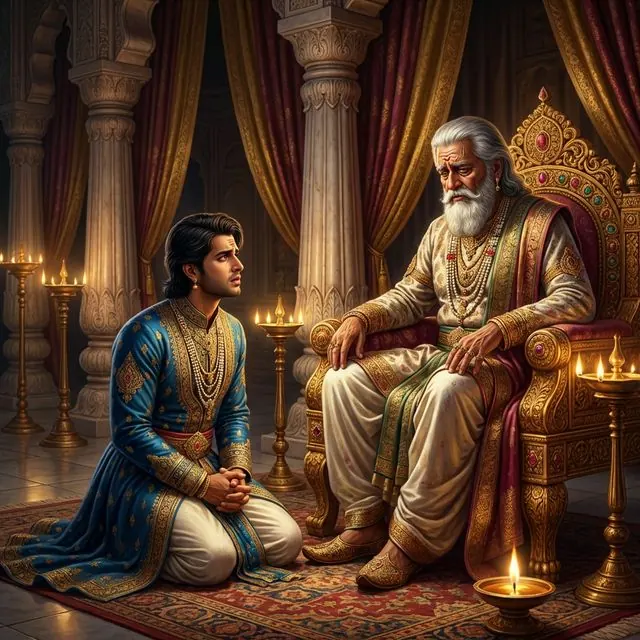
Shukra of Bhrigu's line is the teacher of the Asuras, and Bali the son of Virochana was in those days ruling the three worlds. Shukra came to his court, and the chief of the Asuras, who was famous for the lavish gifts at his sacrifices, honoured the descendant of Bhrigu with the Arghya, offered him a seat, and sat down himself only after his guest was seated. Then the Daitya king put to him the same question that Suvarna would one day put to Manu.
"Greatest of all who know Brahma, what is the merit of giving flowers and incense and lamps?"
Why Flowers Are Called the Good-Minded
Shukra began before flowers existed.
"Penance came into being first," he said. "Dharma came afterwards. In the time between, many creepers and herbs sprang up."
Innumerable were the species of them, and all of them have Soma for their lord, because the moon governs everything that grows and is cut and grows again. Some of these creepers and herbs came to be regarded as Amrita and some as Poison, and others that were neither the one nor the other formed a third class.
He defined the two by what they do to a man rather than by what they are made of. Amrita is whatever brings the mind instant pleasure and joy. Poison is whatever tortures the mind with its smell. Amrita is highly auspicious and Poison is highly inauspicious, and all the deciduous herbs, everything that sheds and renews itself, are Amrita. Poison is born of the energy of fire.
"Flowers gladden the mind and bring prosperity," Shukra said. "That is why men of righteous deeds gave them the name Sumanas."
Sumanas is the ordinary word for a flower, and it means the good-minded, or that which puts the mind in a good state. The whole doctrine of the gift is folded into the name. When a man in a state of purity offers flowers to the gods, the gods are pleased with him, and because they are pleased they give him prosperity. The gods to whom a worshipper offers flowers while calling out their names are pleased by the devotion in the act.
Then he set out the grounds on which flowers are to be told apart, because the rest of the teaching depends on being able to tell them apart.
The deciduous herbs are of many kinds and have many kinds of power, and they should be classed as fierce, mild and potent. Flowers themselves are of many sorts. Some are wild. Some come from trees that grow among people's houses. Some come from trees that will never grow unless they are planted in well-tilled soil. Some are from trees growing on mountains. Some are from trees without thorns, and some from trees with thorns. Fragrance, beauty of form, and taste may each of them offer further grounds of classification.
And the scent that flowers yield, he said, is of two kinds only, agreeable and disagreeable. Everything that follows is decided by that.
Which Flowers Belong to Whom
Then Shukra assigned the flowers of the world to the beings of the world, and the rule in every case is that a creature is given what it is like.
Flowers with a pleasant scent should be offered to the gods. The flowers of thornless trees are mostly white, and such flowers are always welcome to the gods. Flowers that grow on mountains and in valleys, pleasant to smell and to look at, should also be offered to the gods, sprinkled with sandal paste and presented as the scriptures prescribe.
A wise man should offer garlands of water flowers, the lotus and the like, to the Gandharvas and the Nagas and the Yakshas.
Plants and herbs with red flowers, a sharp smell and thorns are prescribed in the Atharvana for every kind of spell meant to harm enemies. That is stated plainly and without apology, and it is a warning as much as a permission: a man who gathers those has declared what he is about.
Flowers of fierce potency, painful to touch, growing on thorny trees and plants, and either blood-red or black, should be offered to evil spirits and unearthly beings.
Such flowers as gladden the mind and heart, as are very agreeable when pressed, and as are of beautiful form, are worthy of being offered to human beings.
And there is one prohibition. Such flowers as grow on cemeteries and crematoria, or in places dedicated to the deities, should not be brought and used for marriage and other rites that have growth and prosperity for their object, nor for acts of dalliance and pleasure in secrecy. What has been given already, or has grown out of the ground where the dead are burnt, cannot be given a second time to the living.
Then Shukra explained why the same flower does different work in different hands.
"The gods are pleased by the scent of flowers," he said, "the Yakshas and Rakshasas by their sight, the Nagas by their touch, and human beings by all three, scent, sight and touch."
Men alone get the whole of a flower. And flowers offered to the gods please them at once, and the gods can bring anything about merely by wishing it. Pleased, they please their worshippers in turn. Honoured, they let their worshippers enjoy every honour. Ignored and insulted, they ruin and consume those vilest of men.
The Smoke and the Lamp
"Next I will tell you the merit of the rules for giving incense," Shukra said.
Incense is of many kinds, some auspicious and some inauspicious. Some is made of resins, the gum that a tree weeps. Some is fragrant wood set alight. And some is artificial, made by hand from various things mixed together. Its scent, as with flowers, is of two kinds, pleasant and unpleasant.
Then the assignments. All resins except that of the sallaki tree are pleasing to the gods, and of all resins the best is guggula. Of all the Dhupas of the Sari class aloe wood is the best, and it is very pleasing to the Yakshas, the Rakshasas and the Nagas. The resin of the sallaki, and others of that class, are much loved by the Daityas, which is a thing Bali could verify in his own hall. Dhupas made from the resin of the sal and the deodar, mixed with various strong-smelling spirits, are prescribed for human beings. Such Dhupas please the gods, the Danavas and the spirits at once. Beyond these there are many other kinds that men burn merely for pleasure or enjoyment, and those are not part of the ordinance. All the merit said to come from offering flowers comes equally from the gift of incense that gives pleasure.
"Now I will speak of the merit of giving lights," he said, "and of who may give them, at what time and in what way, and what kind of lights they should be."
Light is energy and fame, and it rises upward. So the gift of light increases the energy of the man who gives it. There is a hell called Andhatamas, the blind darkness, and the season when the sun travels south is also counted as dark. To escape that hell and the darkness of that season, a man should give lights while the sun is travelling north, and the good praise those who do. It is because of the lights offered to them that the gods have their beauty, energy and radiance, and it is because they never offer lights that the Rakshasas have the opposite.
Bhishma, who was waiting on the arrows for the sun to turn north before he would let himself die, was reciting this to a king who would have to light the lamps after him.
The Ghee, the Crossroads, and the First Portion
The rules for lamps are exact, and several are prohibitions. No one should envy the giver of lights. Lights should not be stolen, nor put out when someone else has given them. A man who steals a light goes blind and gropes through darkness in the next world. A man who gives lights shines in the heavenly worlds like a row of lamps.
Of all lights the best are those that burn ghee, and next those fed with oil pressed from the fruits of deciduous herbs. A man who wants to prosper should never burn fat, or marrow, or the fluid of creatures' bones for light. A lamp fed on a killed thing is not a lamp.
And Shukra named the places, all of them places where a stranger might be walking in the dark: where paths come down from mountains, on roads through forests and wild country, under sacred trees standing among people's houses, and at crossroads. The man who gives lights brings light to his whole line, becomes pure in soul, and after death joins the company of the shining bodies in the sky.
Then he came back to the food, with a definition that has teeth in it.
"Unscrupulous, wicked men who eat without first serving brahmanas and gods and guests and children," he said, "should be known as Rakshasas."
So one should first offer the cooked food to the gods, worshipping them with senses restrained, and should offer the Vali with head bowed in reverence. The gods live on the food that householders offer, and they bless the houses where offerings are made. The Yakshas and Rakshasas and Pannagas, guests, and all the homeless live on it too, and the Pitris draw their nourishment from it. Pleased, they repay the giver with long life and fame and wealth.
Clean food of agreeable scent and appearance, mixed with milk and curds, should be offered with flowers to the deities. The Valis offered to Yakshas and Rakshasas should be rich with blood and meat, with wines and spirits accompanying them, and adorned with coatings of fried paddy. Valis mixed with lotuses and Utpalas are very agreeable to the Nagas. Sesame seeds boiled in raw sugar go to the spirits and other unearthly beings.
"In just this way," Bhishma said, "the learned Kavi of Bhrigu's line taught Vali, the chief of the Asuras. Manu then told that teaching to the rishi Suvarna. Suvarna in turn told it to Narada. And the celestial rishi Narada told me the merits of these acts. Now that you know their merits, my son, do them."
Dharma Lesson
The whole teaching is arranged so that nothing in the house is eaten first by the man who owns it. The fire, the fathers, the quarters, the brahmana, the passing stranger, the dog and the man of the lowest birth all take their portion before the householder sits down, and the lamps he is told to light are set at mountain descents and forest roads and street crossings, where the only person they help is somebody he will never meet. Shukra's catalogue of flowers looks at first like fastidiousness about garlands, but the principle under it is that each being is given what suits it and nothing is offered carelessly. A man who keeps these rules for a year has spent that year handing things outward, and the merit claimed for him is only the natural shape of a life lived that way.