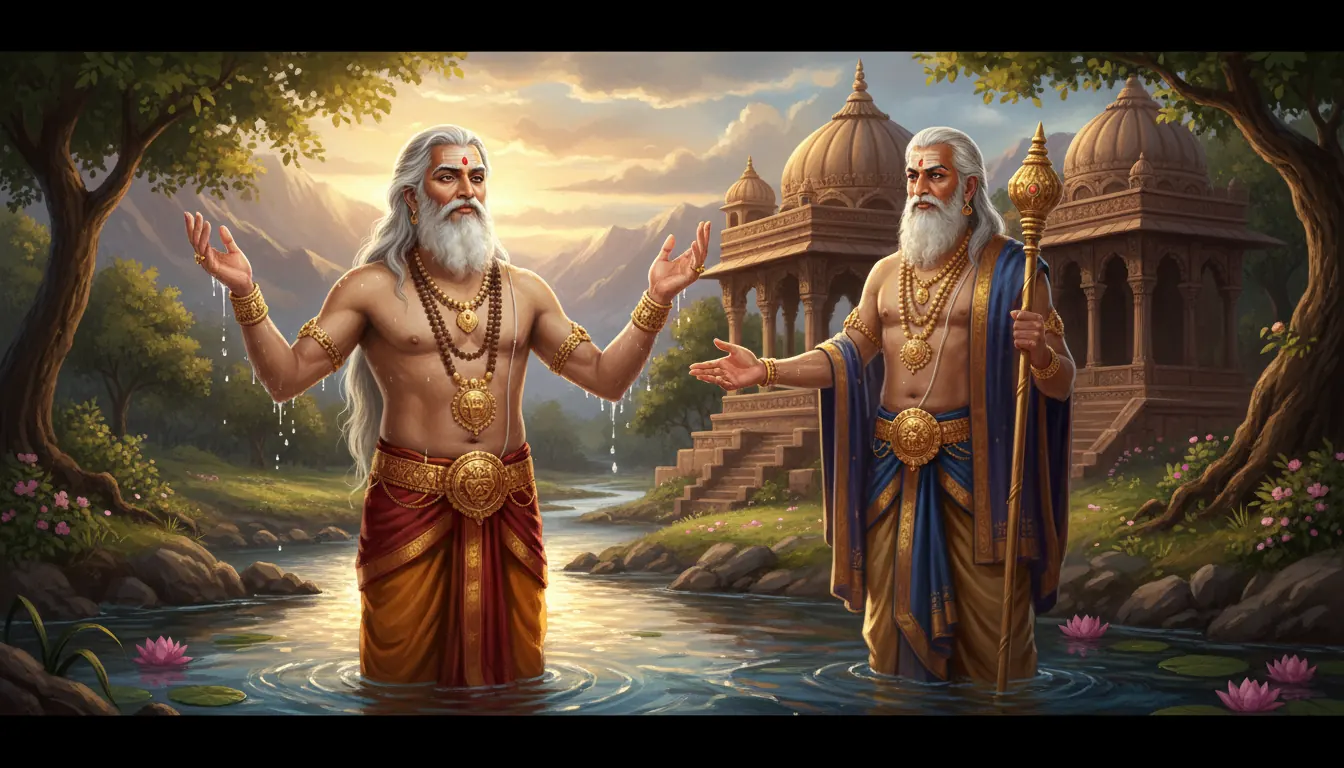
Rules for a Long Life
Bhishma sets out the conduct of an ordinary day, and how brothers should hold together
In short
Yudhishthira asks why men die young when a hundred years are allotted to them, and Bhishma answers that the cause is neither penance nor drugs but conduct. He lays out the whole shape of a day, from waking in the Brahma Muhurta to the last meal, with rules for the road, for speech, for food, for bathing and sleep, for the old and the poor who come to the door. He ends by telling the eldest of five brothers how an elder should govern younger brothers and how the younger should live under him.
Told in the Anushasana ParvaSet in Kurukshetra23 min read
A Hundred Years, and Why Men Do Not Get Them
The grandsire had been answering questions for a long time by then. He lay on the bed of arrows at Kurukshetra, waiting for the sun to turn north, and every morning the king and his four brothers came out from the camp and sat down on the ground around him, and Yudhishthira asked whatever was left to ask.
That morning the question was about the length of a life.
"It is said that a man is given a lifespan of a hundred years," Yudhishthira said, "and considerable energy and might. Why then, grandsire, do human beings die even when they are very young? By what is a man's life shortened? Is it by penances, or Brahmacharya, or silent recitation of sacred Mantras, or drugs? Is it by his acts, or his speech?"
He had watched a great many men die young in that place, and none of them had run out of energy or might.
"It is by conduct that one gains long life," Bhishma said, "and it is by conduct that one gains wealth and prosperity. Indeed, it is by conduct that one gains the fame that rests on great achievements, both here and hereafter. The man whose conduct is improper or wicked never gains a long life. All creatures fear such a man and suffer at his hands."
Not penance. Not mantras. Not drugs. Conduct, which is to say the ordinary shape of a man's day, repeated until it has made him.
Then the list of the shortlived, and it is not the list a soldier would have made. Those who are atheists. Those who do no acts at all. Those who disobey their teachers and break the commands of the scriptures. Those who do not know their duties and so do not observe them. Those who break every restraint become shortlived here and go to Hell hereafter.
And against them, the sentence to carry away.
"Even men with no accomplishments at all live for a hundred years if they hold to propriety and righteousness of conduct, and have faith, and are free from malice. The man who is free from wrath, who is truthful in speech, who never harms any creature in the universe, lives for a hundred years."
Then, without any change of tone, he came down from that height to a handful of small ugly habits, which is the method of the whole discourse.
"The man who is always breaking up little clods of earth, or tearing up the grass that grows under his feet, or biting off his nails with his teeth, or is always impure, or very restless, never gains a long life."
The Hour Before Dawn
Then he laid out the day itself, beginning where the day begins.
One should wake at the hour known as the Brahma Muhurta, the last watch before dawn, and lying there in the dark one should think of both religion and profit, dharma and artha together, neither one alone. Getting up from bed, one should wash the face and the mouth, and with the hands joined in an attitude of reverence say the morning prayers. So too, when evening comes, one should say the evening prayers, keeping silent with other people meanwhile.
"The rishis won long life by worshipping at the two twilights with great regularity," Bhishma said. "So one should keep silent and say one's prayers regularly at the two twilights."
He was strict about it. As for those brahmanas who do not say their prayers at the two twilights, a righteous king should set them to do the work ordained for shudras. A man who will not do the work of his order may be given the work of another.
There is a rule about the sun that goes with the twilights. One should never look at the rising sun, nor at the setting sun, nor at the sun when he is in eclipse, nor at his image lying in water, nor at midday when he stands on the meridian. The eye is not to be spent on the thing the prayer is addressed to.
On rising from bed, one should first salute one's parents and one's teachers and the other elders who deserve respect. "By doing so," said Bhishma, "one gains long life."
In the forenoon one should dress the hair, apply collyrium to the eyes, wash the teeth, and worship the deities. The tooth-stick is to be used with the speech restrained, and cast off when it is done with, and a new one taken every day. One should never be in bed when the sun is up. If a man fails on any day to be up with the sun, he should perform an expiation for it.
One should not worship the deities without having first washed the teeth. And until one has worshipped the deities, one should not go to see anybody at all, except one's teacher, or someone old in years, or someone righteous, or someone wise.
The morning belongs to the gods and the old. Everyone else can wait until the man is fit to be seen.
On the Road
The rules for the road are the rules of a man who has spent his life among crowds and knows what the street does to the careless.
One should not set out on a journey at early dawn, nor at midday, nor in the evening twilight, nor with a companion who is unknown, nor with a shudra, nor alone. One should never go alone on a journey to foreign parts, nor proceed alone to any place at night. Before evening comes, one should be back at one's house and remain within it.
Then the rule of giving way, which is the whole of courtesy in a single line.
"When going along a road, one should always stand aside and make way for a brahmana, for cows, for kings, for an old man, for someone weighed down with a burden, for a pregnant woman, or for someone who is weak."
Look at the company that list keeps. The king and the cow and the pregnant woman and the porter under his load are all given the road by the same gesture, and the man who steps aside does not get to choose which of them deserves it.
When one meets a large tree that is known, one should walk round it. When one comes upon a spot where four roads meet, one should walk round that too before pursuing the journey. And at midday, or at midnight, or at night in general, or at the two twilights, one should not go to the place where four roads meet at all.
When an old man goes along the road, one should always follow him instead of walking ahead of him.
There are rules of the same kind for what a man puts on before he goes out. One should never wear sandals or clothes that have been worn by another, nor the upper garment for covering the lower limbs, nor a piece of cloth that has no side fringes. When one goes to bed one should wear a different piece of cloth, and when making a journey a different piece again, and when worshipping the deities a different piece again.
The garlands should be white, not red, and a garland once worn is not to be taken off the body, nor worn over the outer garments.
"A garland of gold," Bhishma added, "can under no circumstances become impure."
Wordy Shafts
Then he came to speech, and the old man who had been shot full of arrows some weeks earlier chose his image with care.
"One should never pierce others with wordy shafts. Indeed, one should never say anything cruel. Wordy shafts fall from the mouth. Pierced by them, the victim grieves day and night. The wise man should never shoot them to pierce the vitals of other people."
Then the comparison, and there is nobody on that field better placed to make it.
"A forest, pierced with shafts or cut down with the axe, grows again. But the man who is pierced by words unwisely spoken suffers wounds that fester and lead to death. Barbed arrows and Nalikas and broad-headed shafts can be drawn out of the body. Wordy shafts cannot be drawn out, for they lie embedded in the very heart."
He was lying on a bed made of the extractable kind while he said it.
Out of that principle came the particulars. One should not taunt a person who lacks a limb, or who has a limb too many, or who has no learning, or who is miserable, or ugly or poor, or who has no strength. One should avoid censuring and slandering others, and all kinds of deceitful behaviour. One should never utter such words as trouble other people, or as are inauspicious, or as are sinful. One should never indulge in slandering others, nor in self-reproach either, for slander is sinful whether of others or of oneself.
One should avoid atheism, slandering the Vedas, censuring the deities, malice, pride, arrogance and harshness. One should never speak ill of brahmanas. One should not point at the stars with the fingers. If asked, one should not say what the lunation is on a particular day, for by telling it a man's life is shortened.
And the rod is not to be taken up in anger to beat another. Only the son or the pupil, it has been said, can be mildly chastised, and that for the purposes of instruction and nothing else.
"The man who wants his own good," Bhishma said, "should never provoke the wrath of others against himself."
The Four Directions of a Meal
The rules of eating are the longest part of the whole discourse, and Bhishma went through them without hurrying, because a man eats twice a day for a hundred years and there is no other act he will perform so often.
Wash the feet before sitting down. "One who washes one's feet before sitting down to one's meals lives for a hundred years." Wash the mouth three times with water before eating, and three times again after. Eat in a seated posture, never walking, never with the food placed on the bare ground, never without an upper garment wrapped around the body, never making any noise, never finding fault with the food that is set down. Eat silently, and always leave a remnant of what was placed before you. Having finished, mentally touch fire.
Then the four directions, which the text gives as a plain table of rewards.
He who eats with his face turned eastwards gains long life. By eating with the face turned southwards a man acquires great fame. By eating with the face turned westwards he acquires great wealth. By eating with the face turned northwards he becomes truthful in speech.
The guest comes before the man of the house. The man of intelligence should first offer water and then food to one that has become his guest, and only after having served the guest should he sit to his own meal. And of the friends who sit down in the same line with him: "He who sits down to dinner in a line with friends and eats any food himself without sharing it with his friends is said to eat deadly poison." Nor should one eat anything without giving a portion of it to people who are gazing longingly at the food.
The forbidden things are named. Flesh of animals not slain in sacrifice. The flesh of the back. The flesh of goats, of cows, and of the peacock. Dried flesh and all flesh that is stale. Salt taken up with the hand. Curds and flour of fried barley at night. Any food in which a hair is detected. Any food eaten at the Shraddha of an enemy. Any food eaten in doubt. Any dish shared from one plate with another man, even if the other is of one's own rank.
Samyava and Krisara and meat and Sashakuli and Payasa should never be cooked for oneself alone. Whenever they are cooked, they should be offered to the deities.
One should eat once in the morning and once after evening, and abstain from everything in the interval.
Bed, Bath, and the Tirthas of the Hand
He went on to the care of the body, where the smallness of the rules is the point of them.
Sleep. One should never sleep with the head turned towards the north or the west. One should not lie down upon a bedstead that is broken or rickety, nor sleep on a bed without having examined it first with the aid of a light, nor sleep lying crosswise, nor naked. Sleep at daytime shortens life. To sleep after the sun has risen shortens life. They who sleep at either of the twilights, or at nightfall, or in a state of impurity, have their lives shortened. At the evening twilight one should not sleep and should not study and should not eat, but should collect the senses for meditation without doing any act at all.
Bathing. One should never bathe naked. One should never, while bathing, repeatedly dip the head in water, for by so doing a man shortens his life, and one who has bathed by dipping the head should not afterwards apply oil to the body. One should not let the limbs be rubbed or pressed after bathing, nor smear unguents without having first bathed, nor wave the cloth in the air to dry it, nor on any account use the water that another has used. After bathing one should use perfumes mixed with water, and unguents made of Priyangu, sandalwood, Vilwa, Tagara and Kesara.
Purity. One should never touch these three things of great energy while one is in an impure state: fire, a cow, and a brahmana. By observing this rule a man acquires longevity. Nor should one, while impure, cast the eyes on the sun, the moon, and the stars. One should never touch another's head, for it is said in the scriptures that the life-breaths are all concentrated in the head, and one should never strike another on the head, nor seize another by the hair. One should never teach or study while impure. When a storm rises or a bad smell fills the air, one should not think of the Vedas at all.
"Those who know ancient history recite a Gatha that Yama sang long ago," Bhishma said. "He who runs while impure, or studies the Vedas in that state, loses his Vedas and shortens his life."
Even the hand is mapped. Between the tip and the root of the thumb lies the sacred Tirtha called Brahma. On the back of the little finger is the Deva-tirtha. The space between thumb and forefinger discharges the rites of the Pitris.
Three That Carry Poison
Then came the rule about who must never be slighted, and it is the sharpest thing in the discourse.
"One who wishes to live long should never slight or insult any of these three, however weak or wasted they may seem: the brahmana, the kshatriya, and the snake. All three carry deadly poison."
He graded them. The snake, if angry, burns the victim with only a glance of its eyes. The kshatriya too, if angry, burns the object of his wrath with his energy as soon as he sees him. The brahmana is stronger than either, and destroys not only the object of his wrath but his whole race as well, and does it not by vision alone but by thought. "So the wise man should treat these three with care."
With the teacher there is no argument at all. One should never dispute with one's teacher. If the teacher becomes angry he should always be pacified by paying him due honour. "Even if the teacher is entirely wrong," Bhishma said, "one should still follow and honour him. Without doubt, slanderous words against the teacher always eat away the lives of those who speak them."
With the old there is a physical reason given, and it is a strange and memorable one.
"The life-breaths of a young man go upwards when an old and venerable person comes to his abode. He gets them back by standing up and properly saluting the guest."
Something leaves the young man when age walks in at his door, and the only way to get it back is to rise. Old men should always be saluted. On seeing them one should offer a seat with one's own hand, and after the old man has taken his seat one should then sit down oneself and remain with the hands joined in reverence.
The house has its own duties. A kinsman who happens to be old, or a friend who happens to be poor, should be established in one's house and his comforts looked after as if he were a member of the family, and by doing this a man acquires both fame and long life.
Even the creatures that come in are read as signs. Pigeons settled in a house bring blessings, and so do parrots, both male and female. If fireflies and vultures and wood-pigeons and bees enter a house or seek residence in it, acts of propitiating the deities should be performed, for these are creatures of evil omen, as are ospreys.
A Wife, Sons, and the Sixty-Four Kalas
The last stretch of the discourse is about founding a household and then handing it on.
A wise man should marry a maiden born in a high family, with auspicious marks, and of full age, one who is agreeable and handsome and accomplished in many kinds of skills. One should wed in a family that is higher than one's own or at least equal to it. A woman who lacks any limb should be avoided, and one that has any malformation, and one of the same Pravaras, and one born in the race to which one's own mother belongs, and one born in a family in which there has been epilepsy or leprosy or a succession of early deaths.
Then the children. Having children by her, and so carrying on his line, a man should hand his sons over to a good teacher to gain general knowledge and also knowledge of the particular customs of the family. The daughters should be given in marriage to intelligent young men of respectable families. The sons should be established, and a portion of the family inheritance given to them as their provision.
"One should never seek to injure women," Bhishma said. "Spouses should always be protected. Malice always shortens life."
And a man is not finished learning when he marries. He should attend with great care to the Vedas and to the science of arms, and to the practice of riding an elephant, a horse and a war-chariot. He should acquire the science of reasoning, the science of words, the science of the gandharvas, and the sixty-four branches of knowledge that are called Kala. Every day he should hear the Puranas and the Itihasas and the life-stories of high-souled persons. One should always obey the commands of one's mother and father and teacher, without judging at all whether those commands are beneficial or not. And when the period ordained for the domestic mode of life has been passed, one should enter the life of a forest recluse.
Then he gathered the whole morning back into the word he had started from.
"Understand that conduct is the root of prosperity. Conduct increases fame. It is conduct that prolongs life. It is conduct that destroys all calamities and evils. Conduct has been called higher than all the branches of knowledge. Whatever I have left untold you should hear from people well versed in the three Vedas. The Self-born Brahman himself has said that one should show compassion to all orders of men."
The Eldest and the Younger
Yudhishthira had one more question, and of all the questions he asked on that field it is the one that was most plainly about himself.
"Tell me, chief of Bharata's line, how the eldest brother should behave towards his younger brothers, and how the younger brothers should behave towards their eldest brother."
Four men were sitting there listening to him ask it.
"Son, always behave towards your younger brothers as their eldest brother should," Bhishma said. "You are always the eldest of all these brothers of yours. The high conduct a teacher should always show towards his disciples, you should show towards your younger brothers. If the teacher has no wisdom, the disciple cannot possibly behave towards him in a respectful or proper way. If the teacher is pure and noble in his conduct, the disciple too comes to conduct of the same kind."
Then the practical advice, which is the opposite of what a man in authority usually wants to hear.
"The eldest brother should at times be blind to the acts of his younger brothers, and though he is wise, should at times act as if he does not understand what they do. If the younger brothers are guilty of any wrongdoing, the eldest brother should correct them by indirect ways and means."
And he explained why the correction must be indirect, and the reason has nothing to do with tenderness.
"If there is good understanding among brothers, and the eldest brother tries to correct his younger brothers by direct or open means, their enemies, son of Kunti, who are pained to see such good understanding, set about dividing the brothers and stirring up dissension among them."
A public reproof between brothers is a gift handed to whoever is watching. There had been a man watching that family for a very long time who would have known exactly what to do with such a gift.
"It is the eldest brother that enhances the prosperity of the family or destroys it entirely," Bhishma said. "If the eldest brother is senseless and wicked in his behaviour, he brings about the destruction of the whole family. The eldest brother who injures his younger brothers is no longer regarded as the eldest, forfeits his share of the family property, and deserves to be restrained by the king. A family into which a sinful person is born becomes subject to every evil. The birth of such a person serves no useful purpose, like the flowers of the cane."
No Senior Equal to the Mother
Having said what the eldest owes, he said what he may keep.
If the eldest brother makes any acquisition without using the paternal property, and by going to a distant place, he may keep that acquisition without giving any share of it to his younger brothers. Such among the brothers as are wedded to evil acts forfeit their shares, and in that case the eldest may take the whole of the Yautuka property and give them none of it. If unseparated brothers desire, during the lifetime of their father, to portion the family property, the father should give equal shares to all his sons. And if the eldest brother is sinful in his acts and has no accomplishments of any kind, he may be disregarded by his younger brothers.
Then Bhishma set a limit on all of it.
"If the wife or the younger brother is sinful, her or his good must still be looked after. Those who know the power of righteousness say that righteousness is the highest good."
The property may be withheld. The care may not.
Then the ladder of seniority, counting upwards.
"The Upadhyaya is higher than even ten Acharyas. The father is equal to ten Upadhyayas. The mother is equal to ten fathers, or even to the whole earth. There is no senior equal to the mother. Truly, she surpasses everyone in the reverence due to her."
And at the top of the ladder, where the count runs out, the rest of the family arranges itself.
"After the father has ceased to breathe, the eldest brother should be regarded as the father. It is the eldest brother who should give them their means of support, and protect and cherish them. All the younger brothers should bow to him and obey his authority, and depend on him just as they depended on their father while he was alive."
There was one more distinction to draw.
"So far as the body is concerned, it is the father and the mother that create it. But the birth the Acharya gives is regarded as the true birth, and it is truly unfading and immortal besides."
Then the last words of the answer, and they are about women again, and they close the circle.
"The eldest sister, chief of Bharata's line, is like a mother. The wife of the eldest brother is also like a mother, for the younger brother is nursed by her in infancy."
The king sat on the ground with his brothers around him, the eldest of them, the father of them now, and said nothing at all.
Dharma Lesson
The epic keeps its largest claim for its smallest instructions. A man is not made long-lived by austerities but by the ordinary shape of his day, by which way he faces at a meal, whether he steps aside for a burdened stranger, whether he swallows the cruel sentence he had ready. Bhishma puts the biting of nails beside adultery and the wordy shaft beside the barbed arrow, and he does it lying on arrows that could at least be pulled out. The rules for brothers follow the same logic: a family is not destroyed by one great betrayal but by an elder who corrects in public what he should have mended in private.