In short
Asked in the Kamyaka woods to speak of the greatness of kshatriyas, Markandeya tells three small stories instead of a battle. Two kings block a road neither will concede until Narada finds the right measure. A brahmana asks Yayati not for cattle but for the feelings the cattle will be given with. And a king who whips a beggar cannot then send him away empty.
Told in the Vana ParvaSet in Kamyaka Forest, Sivi (Usinara) and Pratishthana16 min read
After the Greatness of Brahmanas
Markandeya had just finished telling them how Indra himself once went to the ascetic Vaka Dalbhya and asked what the sorrows of the deathless were, and what their joys; and how Vaka had answered that the sorrow is to live long enough to watch families lose their dignity and fools prosper and the learned suffer, and that the joy is a little food cooked in one's own house, earned by one's own hands, shared first with a guest.
The fire had burned down while he spoke. The sons of Pandu sat around it in the Kamyaka woods, five men with no revenue and no city, and when the sage stopped there was a silence in which each of them was doing his own arithmetic.
"You have told us of the greatness of brahmanas," they said at last. "Now we want to hear of the greatness of royal kshatriyas."
Markandeya understood what was being asked. It was not really a question about kings in general. It was a question from a man who had ruled and did not rule, who had once poured out gifts at a great sacrifice before an assembly of the whole earth, and who now had nothing in his hands to give anybody.
"Listen, then, to the greatness of royal kshatriyas," the great rishi said. "I will not give you a battle. I will give you three small things that happened to three kings, and each of them turns on the same hinge. A road too narrow for two chariots. A question nobody had ever thought to ask at an audience. And a beggar who was struck with a whip. Judge for yourselves, afterwards, what the greatness of a kshatriya consists of."
Two Chariots on One Road
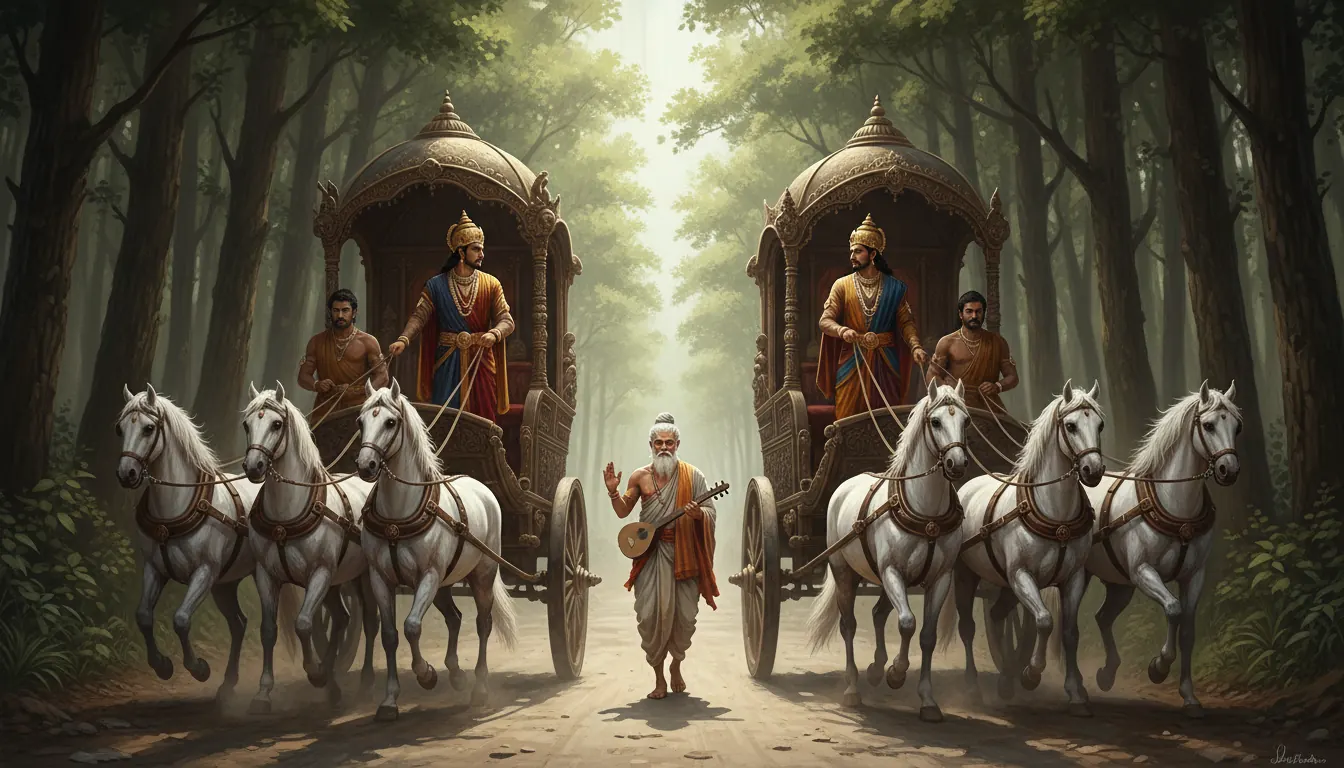
There was a king of the Kuru line named Suhotra (said Markandeya) who went to visit the great rishis, stayed with them as long as he liked, and was driving home along the road in his chariot.
And coming the other way in his own chariot was King Sivi, the son of Usinara.
The road at that place would not take two chariots abreast. Each came in sight of the other and each drew rein, and when they were near enough for speech each saluted the other exactly as befitted his age, without a word out of place, with the whole courtesy of two houses that had never quarrelled. Then they sat where they were.
Neither man moved his horses aside.
It is worth understanding what was in the balance, because it was not vanity, or not only vanity. The road belongs by the old rule to the better man, and to yield it is to say aloud, in front of both retinues and both drivers, that the other is your superior. Suhotra had a lineage that ran back into the Kuru line and deeds behind him that men recited. Sivi's name was already a byword in the west for a man who gave. Each of them looked across at the other and saw, with perfect clarity, his own equal.
So the horses stood and shook their heads, and the wheels did not turn, and the sun moved on and the shadows of the two chariots swung slowly round on the dust, and neither king would insult the other by suggesting that either of them ought to give way.
Why Do You Stand Blocking Each Other
Just then Narada came along the road, as Narada does, on his way to somewhere else.
The heavenly rishi looked at the two chariots nose to nose and the two kings sitting in them with the reins in their hands, and he asked the plain question. "Why are you both standing here blocking each other's way?"
Both of them answered him together, and neither was ashamed of the answer.
"Holy one, do not say that," they said. "There is nothing disorderly here. The sages of old laid down the rule, and the rule is that the road should be given to the one who is superior, or to the one who is more able. That is the whole law of the road, and we are keeping it. But we two who stand blocking each other's way are equal in every respect. Judged fairly, neither of us is the greater. We are not refusing to give way out of pride. We cannot give way without telling a lie."
It was, Markandeya observed, a very fine difficulty, and it could only have arisen between two good men. Two bad men would have fought over the road. One bad man and one good man would have settled it in a moment, because the bad one would have taken it. It took two men of quality to bring the traffic of a whole kingdom to a stop.
Narada considered them. Then he did not give a judgment. He recited three verses.
Three Slokas in the Dust
"King of the Kuru line," said Narada, "the wicked man is wicked even to the gentle. And the gentle man is gentle and honest even to the wicked.
"The honest man is honest even with the dishonest. Why, then, should he not be honest with the honest?
"And the honest man counts a service done to him as if it were a hundred times greater than it is. Is this not the way even among the gods?"
He let them turn the verses over. The rule of the road had asked which man was superior, and neither king could find a measure that separated them: not birth, not conquest, not sacrifice, not the number of brahmanas fed at their gates. Narada had quietly changed the measure. He was not weighing what the two men had done. He was weighing what each of them did with a kindness he received. And on that scale a difference showed at once, because one of these two kings had a known habit of counting a small service done to him as a hundredfold debt, and paying it back at that rate.
"Surely it is the royal son of Usinara," said Narada, "whose goodness is greater than yours."
He was not finished. "Conquer the mean with generosity, the liar with truth, the evil-doer with forgiveness, and the dishonest with honesty. You are both large-hearted men. Let one of you stand aside, as these slokas point the way."
And having said that, Narada became silent. He named no penalty and gave no order. He had simply put the correct question into the road, where both of them could see it.
The Yielding
Suhotra climbed down from his chariot.
He did not argue with the verdict, and he did not sulk into it either, which is the commoner way of accepting a judgment one has lost. He walked the full circle round Sivi's chariot from left to right, the round that men walk about a shrine or a teacher, and while he walked he spoke aloud the achievements of the son of Usinara, one after another, so that his own drivers and his own men and Sivi's men all heard the list from his mouth and not from the mouth of a herald.
Then he gave him the way, and mounted, and went on in his course.
"That," said Markandeya, "is how Narada described the high blessedness of royal kshatriyas."
Yudhishthira said nothing, and Bhima, who had been listening with his chin on his fist, said, "He came off better than the one who won."
"He did," the sage agreed. "Consider what it cost him. He had lost nothing but a road, and the road was going to be his again in an hour when the other chariot had passed. What he was asked to give up was the pleasure of thinking himself first, in public, in front of men who served him. Kings have gone to war rather than pay that. He paid it in the time it takes to walk once round a chariot, and he paid it with interest, praising the man he had been beaten by."
"And Sivi?" said Yudhishthira. "What did Sivi do?"
"Sivi drove on," said Markandeya. "That is the part men forget when they tell it. He was given the road by the ruling of a heavenly rishi, in the open, before witnesses, and there was nothing whatever for him to do with the victory except take it and go. A man who has just been declared the better of two good kings is standing in the most slippery place there is. Sivi did not make a speech. He did not send after Suhotra with gifts to soften it, which would have been a second insult wearing the dress of courtesy. He accepted what he had been judged to be worth, and drove home, and that was the last anybody heard of the matter until Narada told it."
The Brahmana Who Asked for a Feeling
Here is another story (said Markandeya).
One day King Yayati, the son of Nahusha, was sitting on his throne with the citizens all about him, hearing whatever the day brought, and there came before him a brahmana who was collecting wealth to pay his teacher's fee.
"King," he said, "I ask you for wealth for my teacher, under the terms of my covenant."
Yayati had heard men beg in every form the language allowed. He had not heard that one. "Holy one," he said, "tell me what your covenant is."
And the brahmana said, "King, in this world, when people are asked for alms, they feel contempt for the one who asks. The thing is given, and the giver's face has already said what he thinks of me. So I have made a rule for my begging. I ask you, king: with what feelings will you give me the thing I ask for, the thing I have set my heart on?"
There was no precedent for this. He had not asked how much. He had not asked for cattle or land or gold. He had asked to be told, before anything changed hands, what would be going on behind the king's eyes while it did; and he had made the answer to that question the condition of taking the gift at all.
The court waited to see whether the king would be angry.
Yayati's Four Answers
The king answered him the way a man answers who has thought about the thing before and not only now.
"When I have given something away, I never boast of it," said Yayati. "I never listen to requests for things that cannot be given. I do listen to requests for things that can be given, and giving them always makes me happy. A brahmana who asks me for a gift is always dear to me. I am never angry with anyone who begs from me, and I am never sorry for having given something away.
"I will give you a thousand cows."
So the brahmana received his thousand cattle from the king, and went away.
Markandeya let that one sit for a moment before he opened it. "Count what he said, son of Kunti. Four things, and only the last of them is about the cows. He does not boast afterwards, which means the gift is not a purchase of reputation. He does not entertain requests that cannot be met, which means he will not flatter a man with a hope he intends to disappoint. He is glad while he gives, which means the beggar is not being made to pay in humiliation for the cows he receives. And he is never sorry afterwards, which means the thing is truly gone out of him and not merely out of his treasury.
"The brahmana had come a long way for a teacher's fee, and he could have got cattle from a worse man than Yayati. What he would not take from a worse man was the look on his face. That is the whole of the covenant. A gift is measured not by what leaves the giver's hand but by what is in his face while it goes."
The Vow That Was Never Spoken
There were once two kings (said Markandeya) named Vrishadarbha and Seduka. Both were versed in morals and in the weapons of attack and defence, and each knew the other well.
And Seduka knew one thing about Vrishadarbha that the world did not know, because Vrishadarbha had never said it out loud. From his boyhood the man had held to an unspoken vow: that he would give brahmanas no other metal save gold and silver. Nothing baser than those two would go out of his hand to a brahmana, ever, on any pretext. He had never announced it. A vow that is announced is half spent already in the announcing.
Now a brahmana who had finished his study of the Vedas came to Seduka, gave him his blessing, and asked him for wealth for his teacher.
"Give me a thousand horses," he said.
Seduka looked at him and did his own arithmetic. "I cannot give you this for your teacher," he said. "So go to King Vrishadarbha. He is a most virtuous king. Go and ask him, and he will grant your request. That is his unspoken vow."
Mark the shape of that. Seduka could not or would not find a thousand horses. But he knew a man who had sworn never to hand a brahmana anything but gold and silver, and he sent a brahmana to that man to ask for horses. He called Vrishadarbha highly virtuous and said plainly that he would grant the request, and whether he meant it as praise or as a test, the text does not say. Either way he sent the brahmana into the space between two things that king held to: the vow, and the rule that a brahmana who asks must not be sent away empty. And it cost Seduka nothing.
The Whip and the Day's Revenue
So the brahmana went to Vrishadarbha, stood before him, and asked him for a thousand horses.
And the king, when he was asked, struck the brahmana with a whip.
"I have done nothing wrong," cried the brahmana. "Why do you attack me like this?" And he drew breath, and he was on the very point of pronouncing a curse, which is the one weapon a penniless man carries and the reason kings are careful with beggars.
The king spoke first, and what he said was not an apology. "Brahmana, do you curse a man for not giving you what you ask? Is that how a brahmana should behave?"
The curse stayed unspoken. "King of kings," the brahmana said, "Seduka sent me to you, and that is why I have come."
And there it was, the whole design of it, laid out on the floor of the hall in one sentence: the other king, the errand, the impossible ask, and the man who had walked into the middle of it for a teacher's fee and had been whipped for his pains.
Vrishadarbha did not curse Seduka, and he did not send for the horses he had sworn he would never give.
"I will give you, here and now, whatever tribute comes to me before the morning is over," he said. "How can I send away empty-handed a man I have whipped?"
And with that he gave the brahmana the whole of that day's revenue, and it was worth more than a thousand horses.
The vow held. The brahmana went home richer than his errand. And the only man who paid anything in the transaction was the king who had lifted the whip.
The Measure of the Three
"Three kings," said Markandeya, "and not a battle among them.
"One was asked to give up a road, and gave it up, and walked round the man he had conceded to, praising him aloud so that nobody could mistake the concession for a defeat. One was asked what his face would be doing while his hand was open, and answered so exactly that the answer is worth more than the thousand cows that followed it. And one struck a beggar in the temper of the moment, and then would not let the blow stand as the last thing between them, and emptied a day's revenue of a kingdom to cover a stroke of a whip.
"Not one of them was measured by what he owned. Suhotra had a road, Yayati had cattle, Vrishadarbha had gold and silver and a day's tribute. What was weighed in every case was the thing they did with the moment when it would have cost them nothing to be a little smaller."
Yudhishthira sat with his hands on his knees and did not answer at once. He had given away more than any of the three of them, once, at a sacrifice where the earth's kings had queued to bring him tribute, and none of it was in his hands any more.
"Then a man with nothing may still be measured," he said.
"He is measured more closely than the others," said Markandeya. "And of that son of Usinara who would not lie about his own worth on the road, there is one thing more to tell. The gods in heaven heard how good he was, and did not believe it, and came down in the shape of two birds to find out."
But that story he kept for the next evening.
Dharma Lesson
A gift is measured not by what leaves the giver's hand but by what is in his face while it goes. The road, the thousand cows and the day's revenue all cost their owners something, but what was actually weighed in each case was the moment when it would have been free to be a little smaller.