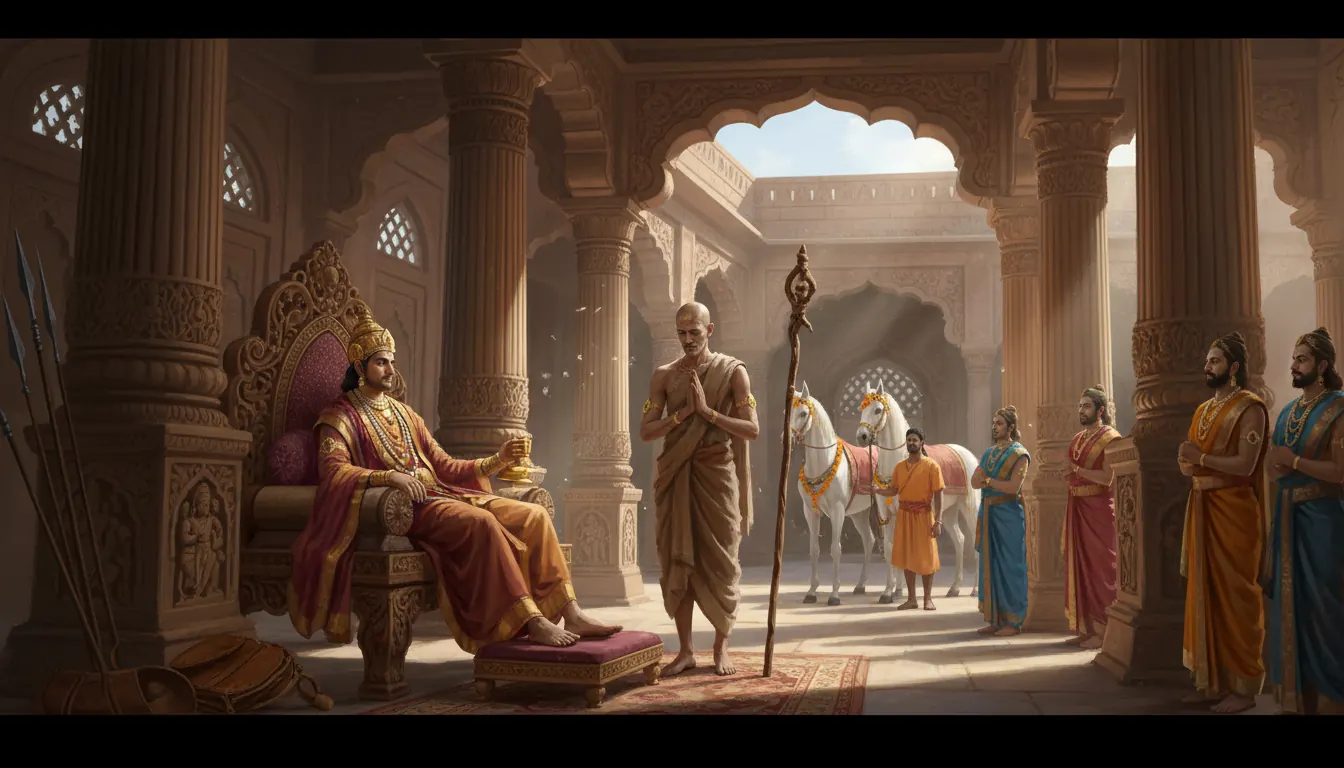
The Horses of Vamadeva
A loan not returned, and two kings undone by the same refusal
In short
King Sala borrows the sage Vamadeva's Vami mares to run down a deer, then decides that jewels of that quality are not fit for a brahmana to own. A month of polite requests fails, the argument hardens, and four rakshasas cut the king into four parts. His brother Dala refuses more violently still, and is made to shoot his own son, ten years old, instead.
Told in the Vana ParvaSet in Kamyaka Forest, Kosala and Forest Hermitage16 min read
The Curse a Father Laid on His Grandsons
Markandeya had just finished telling the Pandavas how king Parikshit of the Ikshvakus came to marry a frog-king's daughter, and how the frog-king, giving her away, had turned on his own child in anger.
"Since you have deceived many kings with this untruthful behaviour of yours," he had said to her, "your children will be disrespectful to brahmanas."
Yudhishthira sat with that. Around him in the Kamyaka the evening was closing; Bhima was mending a bowstring by the fire, Draupadi had stopped moving, Arjuna and the twins had come in from the water, and Dhaumya their priest was listening with the particular stillness of a man who knows what a curse of that kind costs.
"Holy one," said Yudhishthira, "a curse spoken over a bride in a moment of temper. Did it fall on anybody?"
"It fell on two kings and a boy of ten," said Markandeya. "She bore three sons to Parikshit. Sala, and Dala, and Vala. When they were grown, their father installed the eldest of them on the throne, set his heart on asceticism, and went into the forest. What follows begins with nothing worse than a hunt."
The Deer That Could Not Be Caught
King Sala was out hunting one day in the Ikshvaku country when he started a deer and went after it in his chariot, and the deer stayed ahead of him.
"Drive faster," said Sala.
"Do not set your heart on it," said the charioteer. "You will not catch this deer. If Vami horses had been yoked to your chariot, then you might have taken it."
The king turned round in the chariot. "Tell me all about Vami horses," he said, "or I will kill you."
The charioteer said nothing at all. He was a man standing between two fires. He was frightened of the king, who was armed and beside him and in a temper. He was also frightened of Vamadeva, and of what a brahmana of that stature does to a man who steers a king's greed toward his property. He kept his mouth shut and hoped it would pass.
Sala drew his scimitar and held it where the man could see it. "Tell me at once," he said, "or I will kill you."
So, being afraid of the nearer of the two dangers, as men are, the charioteer told him.
"The Vami horses are Vamadeva's," he said. "They are as fleet as the mind."
The king put up the sword. "Drive to the asylum of Vamadeva," he said, and the deer, which nobody was chasing any more, went off into the trees and out of the story entirely, having done its work.
A Loan With One Condition
They came to the hermitage and the king went in and made his request like a man who expects to be given what he asks for, which is not the same thing as a man who asks.
"Holy one, a deer that I struck is getting away from me. Please make it possible for me to take it. Grant me your pair of Vami horses."
Vamadeva looked at him and made the loan. He did not ask why a king who could not run down a deer with his own teams needed to run down that particular deer at all. He did not point out that the animals in question were beyond price and that no ascetic in the forest would be able to replace them. He gave a guest what the guest asked for, which is what a hermitage is for, and he attached to it the single condition that any lender attaches.
"I give you my pair of Vami horses," he said. "But when you have done what you need, you must return my Vami pair soon."
The mares themselves were the plain sort of miracle that the forest occasionally produces and nobody in a city believes in until it goes past them. They were his. He had them, and they were fleet as the mind, and he did not expect to see their like again.
The condition was said once, in plain words, in front of the charioteer, and the king agreed to it, and took his leave of the rishi, and had the two mares yoked to his chariot. There was no ambiguity anywhere in the transaction. That is worth holding on to, because in a very little while a great many people are going to argue about what a brahmana is entitled to own, and none of them will be arguing about what was actually said in that clearing.
What He Said Once They Were Clear of the Trees
The mares went as he had been told they went. The chariot came up on the deer as if the deer were standing still.
And before he had even taken it, before the loan had been in his hands for the length of a morning, Sala had come to a settled opinion about the horses under his hands, and he said it out loud to his charioteer, and there is no sign in it of a man wrestling with anything.
"Brahmanas do not deserve to own these jewels among horses," he said. "They must not be returned to Vamadeva."
Then he ran down the deer and killed it, and drove home to his capital, and had the Vami pair led into the inner apartments of the palace, which is where a man puts a thing he intends to keep and does not intend to explain.
It is a small theft. That is the whole point of it. Two animals, borrowed with a witness, worth nothing to the kingdom and everything to the man who bred them. Sala did not steal them because he was poor or desperate or cornered. He stole them because he had worked out a principle under which they were better in his hands than in the hands of their owner, and a man who has found a principle for his theft is far more dangerous than a man who merely wants the thing.
A Month, and Then a Disciple at the Gate
In the hermitage, Vamadeva waited and made excuses for him, the way an owner does.
"The prince is young," he thought. "He has got hold of an excellent pair of animals and he is enjoying himself with them and has not sent them back. What a pity it is."
He gave him a month. Then he called one of his disciples.
"Go, Atreya," he said, "and tell the king that if he has finished with the Vami horses, he should return them to your teacher."
Atreya went to the capital and delivered it exactly as he had been instructed, politely, in the phrasing of a man who is still assuming a misunderstanding. The king heard him out and answered without any embarrassment at all.
"This pair of horses deserves to be owned by kings," said Sala. "Brahmanas do not deserve to own jewels of such value. What business have brahmanas with horses? Go back contented."
Atreya carried that back through the forest and repeated it word for word to his teacher, standing in front of him with nothing in his hands, and at that sad news the heart of Vamadeva filled with wrath. Notice what the king had not said. He had not said the horses were dead, or lamed, or lost. He had not said he needed them a while longer. He had said that the man who bred them was of the wrong sort to have them, which is an answer that leaves the owner nothing at all to reply to except the insult. It had taken a month and one polite request to turn a loan into a quarrel about who was fit to own what, and once a quarrel takes that shape it is no longer about the horses.
The Sage Comes in Person
So Vamadeva went to the capital himself and asked the king for his horses to his face, and the king refused him to his face, and then the two of them argued it out in front of the court.
"Lord of earth, give me my Vami horses," said Vamadeva. "With them you accomplished a task you could not otherwise have accomplished. Do not, king, by breaking the customs of brahmanas and kshatriyas alike, bring on yourself death by the terrible noose of Varuna."
"Vamadeva," said the king, "here is a pair of excellent bulls, well trained and docile, the proper animals for brahmanas. Take them, great rishi, and go with them wherever you like. Indeed, it is the Vedas themselves that carry men like you."
"King, the Vedas do carry men like us," said Vamadeva. "But that is in the world hereafter. In this world, animals like these carry me, and men like me, and everybody else besides."
"Then let four asses carry you," said the king, "or four mules of the best kind, or four horses with the speed of the wind in them. Go with those. This pair of Vami horses deserves to be owned by kshatriyas. So understand that they are not yours."
Not yours. The word had shifted while nobody was looking. A month ago they had been the rishi's horses lent for an afternoon, and now, in an argument that had generated its own heat, they had become a thing that had never belonged to him.
Cut Into Four Parts
Then Vamadeva staked his own life on the truth of what he was.
"King, terrible vows have been ordained for brahmanas," he said. "If I have lived by them, then at my command let four fierce and mighty rakshasas, terrible to look at, with bodies of iron, hunt you down to kill you, and cut your body into four parts and carry them away on their sharp lances."
The king matched him oath for oath, which is the answer of a man who has entirely stopped listening.
"Let those who know you, Vamadeva, for a brahmana who in thought, word and deed wants to take life, take up bright lances and swords at my command and lay you and your disciples low before me."
"King," said Vamadeva, "when you took my Vami horses, you said, I will return them. So give me back my Vami horses, and you will be able to save your life."
"The pursuit of deer has not been ordained for brahmanas," said the king. "I punish you for your untruthfulness. And from this day, by obeying all your commands, I will reach the worlds of bliss."
"A brahmana cannot be punished in thought, word or deed," said Vamadeva. "The learned man who by ascetic austerity comes to know a brahmana for what he is will not fail to rise to prominence in this world."
And when he had said this, four rakshasas of terrible aspect stood up out of the air with lances in their hands and came for the king.
Sala saw them coming and did not offer the horses. He shouted instead, to the hall, to his family, to whoever was in earshot, the last argument he had.
"If all the descendants of Ikshvaku's line, if my brother Dala, if all these vaishyas acknowledge my rule, then I will not give up the Vami horses to Vamadeva, for these men can never be virtuous."
He was still saying it when they killed him. They took him apart into four parts as their master had specified and carried the pieces away on their lances, and the lord of the earth lay on the floor of his own hall, and his brother inherited a kingdom and a quarrel in the same hour.
The Second King and the Poisoned Arrow
The Ikshvakus, learning that their king had been slain, installed Dala on the throne. Vamadeva let them finish the ceremony and then walked into the kingdom and asked the new monarch the same question.
"King, all the sacred books declare that men should give to brahmanas. If you fear sin, give me the Vami horses now, without delay."
Dala did not argue about the ownership of horses. He had watched what arguing had done to his brother, and he had drawn a different lesson from it than the one that was available.
"Bring me an arrow from those I have kept," he said to his charioteer, "one that is handsome to look at and tempered with poison, so that pierced by it Vamadeva may lie in pain and be torn by dogs."
"I know, king," said Vamadeva, "that you have a son ten years old, called Senajita, born to you by your queen. Driven by my word, kill that dear boy of yours without delay, with your frightful arrows."
The king had already shot. The arrow of fierce energy left his bow aimed at the sage, and it went where the sage had sent it, and it killed the prince in the inner apartments of the palace, in the same rooms where his uncle had once stabled two borrowed mares.
Word came out to the hall. Dala heard it standing there with the bow in his hand.
"Men of Ikshvaku's line," he said, "I will do you good. I will slay this brahmana today and grind him to pieces. Bring me another arrow of fierce energy. Lords of earth, see my prowess now."
"That arrow of terrible aspect, tempered with poison, which you are aiming at me," said Vamadeva, "you will not be able to aim, ruler of men, nor even to shoot."
And the king stood in front of his court with the second arrow nocked and could not make his hands do it. He said so out loud, because there was nothing else left to say.
"Men of Ikshvaku's line, see, I cannot shoot the arrow I have taken up. I cannot bring about the death of this brahmana. Let Vamadeva, who is blessed with a long life, live."
The Queen Spends Her Boon
"Touch your queen with this arrow," said Vamadeva, "and you may purge yourself of the sin of attempting the life of a brahmana."
So they brought her out, the mother of the boy who had been killed that hour in the inner rooms, and the king did as he was directed and touched her with the arrow. It is a strange rite, and nothing in the telling softens it: the woman who had lost the most was made the instrument by which the man who had cost it was cleaned. She stood still for it. Nobody asked her first. And then the queen, whose son was dead and whose husband had killed him and whose brother-in-law had been cut into four parts over two horses, spoke to the sage. She did not ask for the boy back. She did not curse anyone.
"Vamadeva," she said, "let me be able to guide this wretched husband of mine properly, day after day, with words that do him good. And let me always wait on and serve the brahmanas, and by that win the sacred worlds hereafter."
Vamadeva looked at her for a while.
"Lady of beautiful eyes," he said, "you have saved this royal line. Ask for a boon beyond compare; I will grant you whatever you ask. And rule, princess, faultless one, over these kinsmen of yours and this great kingdom of the Ikshvakus."
He was offering her the throne, and she had earned it more honestly than either brother, and she did not take it.
"This, holy one, is the boon I seek," said the queen. "That my husband may now be freed from his sin, and that you may give your thought to the welfare of his son and his kinsmen. That is the boon I ask, foremost of brahmanas."
"So be it," said the muni.
And king Dala became glad, and bowed down to him with reverence, and gave him his Vami horses.
The Price of Two Mares
Markandeya let the fire settle before he drew it together.
"Count what the two horses cost, son of Kunti, and count it in the order it was paid. A charioteer was threatened with a sword for knowing something. A loan was given on one plain condition and broken before the borrower was out of sight of the man who lent it. A month of silence. One polite disciple sent and sent away. One king dead on his own floor with his last breath spent insisting that the men of his house would back him. A second king who never disputed the horses at all and reached straight for poison, and a boy of ten years killed in his own rooms by his father's hand and his father's arrow.
"And then, at the end of all of it, the person who ended it was the one person in the story who had done nothing whatever to start it. She was given the kingdom of the Ikshvakus and refused it, and asked instead that her husband's sin be lifted off him. Two men had argued for months about who deserved to own a pair of mares, and it was the queen who paid the bill, and paid it in the only currency that was left."
Yudhishthira, who had lost a kingdom for a thing he had done himself and had taken his brothers and his wife into the woods with him, sat and looked at the fire.
"Sala did not want to be a thief," he said at last. "He wanted to be right."
"That is the whole of it," said Markandeya. "A man who steals and knows it may give the thing back in the morning. A man who has reasoned out why the owner was never fit to own it will go to his death holding it, and take his household with him. And the horses went back to the hermitage in the end regardless, which they would have done in a single afternoon, at no cost to anybody, if the king had simply kept his word."
Dharma Lesson
A small theft defended on principle grows into a family's ruin. Sala did not want to be a thief; he wanted to be right, and a man who has reasoned out why the owner was never fit to own the thing will go to his death holding it and take his household with him. It is usually somebody who did not commit the wrong, in this case a queen who had just lost her son, who has to pay to end it.