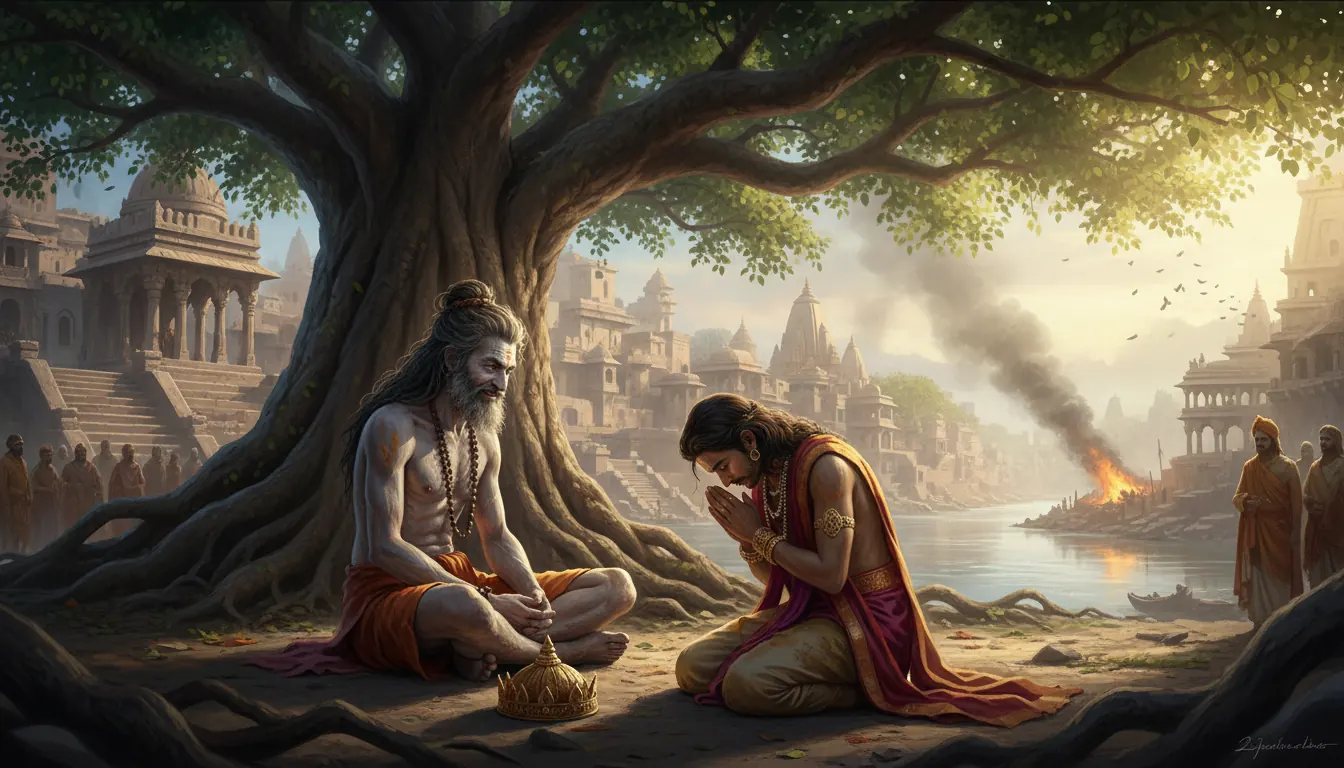
The Naked Priest of Varanasi
How a king outbid Indra for a brother nobody wanted
In short
Yudhishthira asks whose gold lies heaped on the northern mountain. Vyasa tells him of King Marutta, dropped by his priest Brihaspati because Indra had bought the man's loyalty, who finds Brihaspati's discarded brother raving naked in Varanasi, identifies him with a corpse at the gate, and endures mud and spittle to win the priest who charmed Indra down to drink.
Told in the Ashvamedhika ParvaSet in Kashi, Munjavat and Mount Meru29 min read
The King Asks Whose Gold It Was
"Righteous one, sinless one, I want to hear the story of the royal sage Marutta. Tell it to me."
Krishna Dvaipayana had come to the bank of the Ganga with an answer to a question nobody had put to the king directly. The horse sacrifice would need gold, and there was none. The treasury had gone into the war, and the war had eaten it, and the men who might have refilled it were ash on the plain at Kurukshetra. Vyasa had said there was gold in the north, on a mountain, heaped and abandoned where it lay after a sacrifice performed in a former age. And Yudhishthira, who had been sitting for days with his hands open in his lap like a man who has forgotten what they are for, did not ask how far the mountain was. He asked who the king had been.
"In the Krita age," said Vyasa, "Manu was lord of the earth and held the sceptre. His son was Prasandhi. Prasandhi's son was Kshupa, and Kshupa's son was that lord of men, King Ikshvaku. Ikshvaku had a hundred sons of outstanding piety, and he made every one of them a king. The eldest, Vinsa, became the model for all bowmen. Vinsa's son was the fortunate Vivinsa, and Vivinsa had fifteen sons, all of them powerful archers, respectful to brahmanas, truthful, gentle, and always kind in speech.
"The eldest of those fifteen was Khaninetra, and he oppressed all his brothers. He conquered the whole kingdom and rid it of every trouble, and then he could not keep it, because the people were not pleased with him. They deposed him and made his son Suvarcha king in his place, and their hearts were glad when it was done.
"Suvarcha had watched his father lose an empire, and he learned from it. He was devoted to brahmanas, he spoke the truth, he lived purely, he kept his senses and his thoughts in check, and he always worked for the good of his people. And because he was forever doing good, his treasure and his vehicles dwindled away. When his treasury was empty, the vassal princes swarmed around him and began to harass him."
Yudhishthira looked up at that.
"They could not slay him," Vyasa said. "His power was established in righteousness, and righteousness cannot be taken by siege. But he reached the extreme of misery along with his citizens, and at the end of it he blew upon his hand with his mouth, and out of that breath there appeared a supply of forces. With them he vanquished every king along his borders, and from that circumstance men have called him Karandhama ever since.
"His son, born at the beginning of the Treta age, was the equal of Indra himself. Not even the immortals could defeat him, and every king of that time was under his rule. That son was Avikshit: righteous, devoted to sacrifice, master of his senses. In energy he was like the sun, in patience like the Earth herself, in intelligence like Brihaspati, and in calm like the mountain Himavat. He performed hundreds of horse sacrifices, and the mighty and learned Angiras himself served as his priest.
"And Avikshit's son outdid his father. His name was Marutta. He had the strength of ten thousand elephants and was like a second Vishnu. When the wish came to him to hold a sacrifice, he went north of Himavat to Mount Meru and had thousands of shining golden vessels made there. Goldsmiths made basins and pans and seats beyond counting. He performed the rites on a huge hill of gold, and the sacrificial ground lay close by."
Two Sons of Angiras
"How did that king become so powerful?" Yudhishthira said. "How did he come by so much gold? And where is all that wealth now, reverend sir, and how can we get hold of it?"
"The many children of the Prajapati Daksha, the Asuras and the Celestials, were rivals," Vyasa said, "and in the same way the two sons of Angiras were rivals. The elder was Brihaspati, a man of great energy. The younger was the ascetic Samvarta, his equal in vows. They were brothers of one house and one father, and they were rivals, and Brihaspati harassed Samvarta again and again.
"There is no account of how long it went on. What is recorded is how it ended. Worn down by his elder brother's harassment, Samvarta gave up his wealth and went into the woods with nothing to cover his body but the open sky.
"At that time Vasava, having defeated and destroyed the Asuras and won the sovereignty of heaven, chose as his priest Angiras's eldest son Brihaspati, the best of brahmanas. Now Angiras had once been the family priest of King Karandhama. But the son took the higher house."
Vyasa let that sit a moment before he went on, because the whole of the story turned on it.
"Marutta, master of the earth, was pure and accomplished in every perfection, and the ocean-girdled earth herself was drawn to him. He was always defying the lord of the gods, and Vasava defied Marutta in turn, but for all his efforts Shakra could not get the better of him. Unable to bring him to heel, Indra rode out with the gods around him, sent for Brihaspati, and put the matter plainly.
"'Brihaspati, if you want to please me, do not act as priest for Marutta, either in his rites for the gods or in his rites for the ancestors. I hold sovereignty over the three worlds, while Marutta is only lord of the earth. You have been priest to the immortal king of the gods, brahmana. How can you think of serving as priest to Marutta, a man who must die? I wish you well. But take my side or the side of King Marutta. Leave him, and come over to me gladly.'
"Brihaspati thought for a moment. Then he said: 'You are the Lord of all creatures, and the worlds rest on you. You destroyed Namuchi, Vishvarupa and Vala. You alone hold all the prosperity of the gods, and you uphold both earth and heaven. I have served as your priest, greatest of the gods. How could I serve a mortal prince? Listen to me. Even if the god of fire stops giving heat, or the earth changes its nature, or the sun stops giving light, I will never go back on what I have said.'
"Hearing this, Indra let go of his jealousy, praised Brihaspati, and went back to his own palace."
A Rebuff, and a Rishi on the Road
News of the compact travelled, as such news does, and it reached Marutta while his sacrificial materials were still being counted into their baskets. He had already conceived the whole rite in his mind. He went to Brihaspati anyway.
"Holy ascetic," he said, "I mean to perform the sacrifice you once proposed to me, following your instructions, and I want you to be the officiating priest. I have gathered the materials. You are our family priest. Take them and perform the sacrifice yourself."
"Lord of the earth," said Brihaspati, "I do not want to perform your sacrifice. The Lord of the gods has made me his priest, and I have promised him that I will be."
"You are our hereditary family priest," Marutta said, "and for that I hold you in great respect, and I have earned the right to your help at my sacrifices. So it is only right that you should officiate at mine."
"I have been priest to the Immortals. How can I be priest to mortal men? Whether you go or stay, I tell you, I no longer serve as priest to anyone but the Immortals. I cannot be your priest now, mighty-armed king. Choose anyone you like to perform your sacrifice."
There was no argument to make against that, and Marutta did not make one. He became confused with shame and went home, and his mind was oppressed with anxiety on the road, and on the road he met Narada.
The king stopped and saluted him with his hands clasped together.
"Royal sage, you do not look easy in your mind," Narada said. "Is all well with you? Where have you been, sinless one, and what has troubled you so? If you are willing to tell me, open your heart, and I will do everything I can to set your mind at rest."
"I needed a priest for my sacrifice," Marutta said, "so I went to the priest of the Immortals, Brihaspati, the son of Angiras. He would not accept. After being turned away by him I have no wish to go on living, for his casting me off like this has stained me with sin."
Narada did not console him. He gave him an address.
"There is another son of Angiras, a virtuous man named Samvarta, who wanders naked through every corner of the earth, to the astonishment of every creature. Go to him, prince. If Brihaspati will not officiate at your sacrifice, the mighty Samvarta will, if you can win his favour."
"Your words have given me new life. But tell me where I can find Samvarta, how I can stay near him, and how I must behave so that he does not cast me off. For if he turns me away too, I do not want to live."
The Corpse at the Gate of Varanasi
"He longs to see Maheshvara," Narada said, "and so he wanders about as he pleases in the city of Varanasi, dressed like a madman. You will not find him by asking. This is how you will find him.
"When you reach the city gate, you must set a dead body down somewhere near it. The man who turns away at the sight of the corpse is Samvarta. Once you know him, follow wherever that powerful man chooses to go, and when at last you find him in some lonely place, fold your hands and beg for his protection.
"If he asks who told you about him, tell him that Narada did. And if he asks you to go after me, tell him without hesitating that I have entered the fire."
Marutta agreed, paid his respects to the sage, took his leave, and went to Varanasi.
He did exactly what he had been told. He found a dead man and laid the body at the gate of the city, and he waited beside it in the crowd like a person with no business there, which was, at that moment, the truth about him.
As it happened, that brahmana came through the city gate at that very moment.
At the sight of the corpse he turned sharply away.
That was the whole of the sign, and it lasted less than a breath, and Marutta took it. The son of Avikshit went after him with his hands folded, following in his footsteps through the streets in the hope of being taught by him. And when at last he had him alone, the naked man turned round and covered the king of the earth with mud and ashes and phlegm and spittle.
Marutta did not wipe his face. He kept his hands clasped, and he followed, and he went on trying to appease the man who was fouling him. That is what the text says he did, and it does not say it took courage, and it does not say how long it went on, only that it went on until Samvarta himself was tired.
At last, worn out, the brahmana came to the cool shade of a spreading sacred fig tree, and there he stopped and sat down to rest.
The king stood in front of him, filthy, with his hands still clasped.
The Bargain Under the Fig Tree
"How do you know who I am, and who sent you to me? Tell me the truth, if you want me to do you any good. If you speak the truth, you will have everything you desire. If you lie, your head will split into seven pieces."
"Narada told me, as he was passing on his way, that you are the son of our family priest," Marutta said, "and when I heard it my heart turned to you with the greatest joy."
"That is the truth. He knows I perform sacrifices. Now tell me where Narada is living at present."
"That prince of heavenly sages told me about you and commended me to your care, and then he entered the fire."
Samvarta was very pleased. "I could do all that too," he said.
And then, raving like a lunatic and scolding the king with rude words, he tried a last time to be rid of him.
"Something is wrong with my brain. I always act on whatever whim takes me. Why are you so set on having your sacrifice performed by a priest as odd as I am? My brother is quite able to officiate at sacrifices. He has gone over to Vasava and performs his sacrifices for him. Have him perform yours. My elder brother took away by force everything in my house, my household gods and the patrons I sacrificed for, and has left me nothing but this body. And since he deserves every respect from me, I cannot possibly officiate at your sacrifice without his permission. Go to Brihaspati first and get his permission, then come back to me, and only then will I officiate."
"I did go to Brihaspati first," Marutta said. "He wanted Vasava's patronage and did not want me as his patron. He said, 'I have won the priesthood of the Immortals, and I do not want to serve mortals. Besides, Shakra has forbidden me to officiate at Marutta's sacrifice. He told me that Marutta, now that he is lord of the earth, is always trying to rival him.' And your brother told the Slayer of Vala: So be it. Believe me, best of ascetics, I went to him gladly, and he refused to be my priest. He turned me away through no fault of mine, and now I want to spend everything I own to have you perform this sacrifice, and to outdo Vasava through the merit of your work."
"I can certainly do all you want," Samvarta said, "as long as you agree to do everything I ask of you. But I expect that Brihaspati and Purandara, when they hear that I am performing your sacrifice, will be furious and will do everything they can to harm you. So promise me you will stand firm, so that I can keep calm and stay steady myself. For if I lose my temper with you, I will burn you and your whole family to ashes."
"If I ever abandon you, may I never reach the blessed worlds for as long as the mountains stand and the thousand-rayed sun gives heat. If I abandon you, may I never find true wisdom, and stay forever caught up in the things of this world."
"For myself," said Samvarta, "I have no wish to pile up wealth or sacrificial fees. I will simply do what both Indra and my brother would hate. I will certainly make you Shakra's equal, and I tell you truly, I will do what you want."
The Gold on Munjaban
"High in the Himalaya mountains there is a peak called Munjaban," Samvarta said, "where the adorable Lord of Uma is always at his austerities. There the mighty god lives with his consort, trident in hand, surrounded by wild goblins of many kinds. He goes wherever his whim takes him, and lives in the shade of the giant forest trees, or in the caves, or on the rugged peaks.
"There the Rudras and the Sadhyas, the Viswedevas and the Vasus, Yama and Varuna and Kubera with all his attendants, the spirits and the goblins, the two Ashvins, the Gandharvas, the Apsaras, the Yakshas, the heavenly sages, the Sun-gods and the gods of the winds, all worship the lord of Uma. There the adorable god plays with Kubera's wild and playful followers, eerie, ghostly figures.
"That mountain glows with its own light, as bright as the morning sun, and no creature looking with ordinary eyes of flesh can make out its shape. There is neither heat nor cold there. The sun does not shine and the winds do not blow. No one there suffers old age, hunger, thirst, death or fear.
"And all around that mountain lie mines of gold, as bright as the rays of the sun. Kubera's attendants, eager to serve him, guard those mines against intruders with their arms raised.
"Go there, and win the favour of that adorable god."
Then he gave the king the names to say, and there was no end to them: Sarva and Bhava and Rudra, Sitikantha and Kapardi and Karala, Tryambaka and Sthanu and Girisa, Harikesa and Vamana and Munda, Pinaki, Mahayogi, Bhutapati, Pashupati, Umapati, Vishvarupa, Virupaksha, Mahadeva, and a hundred more besides, until the naming itself was the penance.
"There you must bow down to that god and ask for his protection. If you humble yourself before the great-souled Mahadeva of mighty energy in this way, you will win that gold. That is how those who go there succeed in getting it."
Marutta went and did as he had been told, and he made superhuman preparations for his sacrifice, and craftsmen made golden vessels for it.
Word of what was coming down off the mountain reached heaven before the sacrifice began.
When Brihaspati heard that Marutta's wealth outshone even that of the gods, he was deeply grieved. The thought of his rival Samvarta prospering made him ill. The colour left his face, his body wasted away, and the priest of the Immortals went about the city of heaven looking like a man with a wasting disease, until the lord of the gods came to hear of it.
Agni Carries the Message
"Do you sleep well, Brihaspati?" Indra said. "Are your servants good to you? Are you working for the good of the gods, and do the gods look after you?"
"I sleep well in my bed, Lord of the gods. My servants are to my liking. I always work for the good of the gods, and they treat me well."
"Then where does this pain come from, of mind or of body, and why are you so pale and changed? Tell me who has hurt you, and I will kill them all."
"I have heard that Marutta is going to hold a great sacrifice, with splendid gifts, and that Samvarta is going to be his officiating priest. I do not want him to officiate at that sacrifice."
"You have everything you could wish for," Indra said. "You are the priest of the gods, you know all the sacred hymns, and you have risen above death and old age. What can Samvarta do to you now?"
"A rival's prosperity always hurts," said Brihaspati. "That is why you and your gods hound the Asuras and all their kin, and kill the most prosperous among them. That is why I am so changed, at the thought of my rival prospering. So, Indra, stop Samvarta and King Marutta by any means you can."
Indra turned to the fire. "Jataveda, go to King Marutta and present Brihaspati to him. Tell him that Brihaspati will officiate at his sacrifice and make him immortal."
Agni set out on his errand, laying waste to every forest and tree on his way, like a mighty wind roaring and whirling wherever it likes at the end of winter, and Marutta saw him coming down.
"Look, I see the fire-god himself come in bodily form today," the king said. "Muni, offer him a seat and water, and a cow, and water to wash his feet."
"I accept your offerings of water, a seat, and water for my feet, sinless one," said Agni. "I come as Indra's messenger, on his orders. He has sent me to present Brihaspati to you. Let this priest of the gods perform your sacrifice and make you, a mortal, immortal. If Brihaspati is your priest, you will conquer all the worlds where men live, and the heavenly worlds, and all the highest worlds that Prajapati made, and even the whole kingdom of the gods."
"This twice-born brahmana, Samvarta, will perform my sacrifice," Marutta said, and he joined his palms in salutation towards Brihaspati as he said it. "And I put it to Brihaspati, with respect, that having served Mahendra as priest, it would not look well for him to serve mortal men now."
Samvarta had been listening from the altar ground.
"You must never come here like this again to present Brihaspati to Marutta," he said to the fire. "I warn you, Pavaka, if you do, I will lose my temper and burn you with my fierce and evil eyes."
And Agni, afraid of being burned up, went back to the gods trembling like the leaves of an Aswattha tree.
What the Fire Reminded Indra Of
"Did you go and present Brihaspati to Marutta as I told you?" Indra said. "What did that sacrificing king say to you, and did he accept my message?"
"Marutta would not accept your message," Agni said. "When I pressed him, he clasped Brihaspati's hands and said again and again that Samvarta would be his priest. He also said that he did not want the worlds of men, nor the heavenly worlds, nor the highest worlds of Prajapati, and that if he did want them, he would accept your terms."
"Go back to that king and give him this message from me. If he does not obey it, I will strike him with my thunderbolt."
"Let the king of the Gandharvas go as your messenger, Vasava," said Agni, "because I am afraid to go there myself. Samvarta was furious, and he told me in a rage: I will burn you with my fierce and evil eyes if you come here again for any reason."
"Jataveda, it is you who burn everything else, and there is no one who can burn you to ashes. The whole world is afraid to touch you. What you say is not to be believed."
"You have won rule over heaven and earth and the sky by the strength of your own arms," said Agni. "And yet how did Vritra, long ago, manage to take the kingdom of heaven away from you?"
Indra did not like the question.
"I can bring my enemies to their knees, and I can shrink a mountain to the size of an atom if I choose. But because I do not accept an offering of Soma from an enemy, and because I do not strike the weak with my thunderbolt, Vritra seemed to win against me for a time. What mortal can live in peace once he has made an enemy of me? I banished the Kalakeyas to the earth, drove the Danavas out of heaven, and put an end to Prahlada's existence in heaven."
"Do you remember," Agni said, "how long ago, when the sage Chyavana officiated at Saryati's sacrifice with the twin Ashvins and took the Soma offering for himself, you flew into a rage and struck Chyavana hard with your thunderbolt? That brahmana, in his anger, used the power of his austerities to seize your hand and hold it fast, thunderbolt and all. And in his rage he created a terrible enemy for you, the Asura named Mada, who could take any shape. One of his huge jaws rested on the earth and the other reached up to heaven. He had a thousand sharp teeth that stretched over a hundred yojanas, and four great tusks, thick and shining like pillars of silver, that stretched over two hundred. And when he came after you grinding his teeth, his terrible spear raised, you shut your eyes in fear, in front of everyone watching, and folded your hands and begged the great sage for protection.
"The might of brahmanas is greater than the might of kshatriyas. No one is more powerful than brahmanas. And because I know well how powerful brahmanas are, I do not want to come into conflict with Samvarta."
"It is true," said Indra. "The might of brahmanas is great, and no one is more powerful. But I can never calmly put up with the insolent pride of Avikshit's son, and so I will strike him with my thunderbolt."
The Gandharva and the Storm
The gandharva Dhritarashtra came into the sacrificial enclosure with the sky already going the colour of a bruise behind him.
"Lord of men, I am Dhritarashtra the Gandharva, and I have come to give you Indra's message. Listen to what the great-souled lord of all the worlds has to say to you. That god of unfathomable deeds said only this: Accept Brihaspati as the officiating priest at your sacrifice, or, if you refuse what I ask, I will strike you with my terrible thunderbolt."
Marutta answered him without getting up.
"Purandara, and you Viswedevas and Vasus and Ashvins, you all know that in this world there is no escaping the consequences of betraying a friend. It is a great sin, as great as killing a brahmana. So let Brihaspati serve as priest to Mahendra, the supreme god, the highest, the wielder of the thunderbolt. Samvarta will be my priest. Neither Brihaspati's words nor yours appeal to me."
"Listen, lion among princes, to the terrible war-cry of Vasava roaring in the sky," said the Gandharva. "Mahendra will hurl his thunderbolt at you, for certain and in plain sight. Think of your own good, for now is the time to do it."
The roar came. The king turned to the naked man at the altar and did not pretend to be brave.
"This rain-cloud hanging in the air means Indra must be close by now. Prince of brahmanas, I come to you for shelter. Take this fear of Indra out of my mind. The Wielder of the thunderbolt is coming, filling all ten directions with his terrible, superhuman light, and the men assisting at this sacrifice are terrified."
"Your fear of Shakra will soon be gone," Samvarta said. "I will take away this terrible distress with my magic. Be calm and do not be afraid that you will be overpowered. You have nothing to fear from the god of a hundred sacrifices. I will use my binding spells, and none of the gods' weapons will do them any good. Let lightning flash in every direction, let the winds drive into the clouds and pour down rain, let the waters flood the sky, and all the flashes there are will come to nothing. Let Vasava pour down rain and hurl his terrible thunderbolt wherever he likes, riding the floods to destroy you. The god Vahni will protect you in every way."
"The dreadful crash of the thunderbolt and the howling of the winds are terrible to my ears," Marutta said. "My heart is shaken again and again, brahmana, and I have no peace of mind left."
"Your fear of this thunderbolt will leave you soon. I will drive off the thunder with the help of the winds. Put all fear out of your mind and choose a boon from me, whatever your heart desires, and I will make it happen for you."
The king had the whole of heaven's armoury pointed at his head, and one wish, and this is what he asked for.
"I want Indra to come to this sacrifice in person, all of a sudden, and accept the offering made to him, and I want all the other gods to come too, take their own shares of the offerings, and accept the Soma poured out for them."
The Soma He Had Sworn Not to Drink
"By the power of my spells I have drawn Indra here to this sacrifice in person," Samvarta said. "Look, king: Indra is coming with his horses, worshipped by the other gods, hurrying to this sacrifice."
The storm did not break. It parted. The lord of the Devas, with the other gods around him, came down in his chariot drawn by the finest horses to the altar of Avikshit's son and drank the Soma of that peerless king. And the king rose with his priest to receive him, and welcomed the lord of the Devas with all the highest honours the Sastras prescribe.
"Welcome, Indra," said Samvarta. "Your presence here, wise one, has made this sacrifice glorious. Slayer of Vala and Vritra, drink again of this Soma I have pressed today."
"Look kindly on me," said Marutta. "I bow to you. Your presence has made my sacrifice complete and blessed my whole life. Surendra, this excellent brahmana, the younger brother of Brihaspati, is performing my sacrifices."
"I know your priest," Indra said. "He is this ascetic of great energy, Brihaspati's younger brother, and it was at his call that I came to this sacrifice. I am well pleased with you, king, and my anger against you is gone."
And then Samvarta asked for the one thing he had wanted from the beginning, which was not gold.
"Prince of the Devas, if you are pleased with us, give all the directions for this sacrifice yourself. Set out the gods' portions yourself, so that the whole world may know that you did it."
So Shakra himself gave orders to all the gods: to put up the assembly hall, and a thousand well-furnished rooms as fine as a painting, to finish quickly the massive and lasting staircase by which the Gandharvas and the Apsaras would climb up, and to fit out the part of the sacrificial ground set aside for the Apsaras' dancing like Indra's own palace in heaven. The famous dwellers of heaven carried out his orders, and the king of the gods stayed and worked as an assistant at the sacrifice of a mortal.
A red bull was offered on the altar to the Fire-god, and a duly consecrated blue bull with a variegated skin to the Viswedevas. The gods themselves collected the food. Samvarta ascended the altar, looking radiant as a second embodiment of the blazing fire, and poured the oblations of clarified butter with the incantation of the sacred hymns. And the slayer of Vala first drank the Soma juice, and then the assembly of the other gods drank after him.
When the gods had gone home well pleased, Marutta piled up heaps of gold in many places and gave that vast wealth away to the brahmanas, and he looked as glorious as Kubera. He filled his treasury with every kind of wealth, and then, with his spiritual teacher's leave, went back to his kingdom and went on ruling the whole realm out to the shores of the sea.
"That was how virtuous that king was," Vyasa said, "at whose sacrifice so vast a heap of gold was gathered. And now, prince, you must gather that gold, worship the gods with the proper rites, and perform this sacrifice."
Yudhishthira was delighted to hear it, and sent for his ministers, and held consultation after consultation about the road north.
Dharma Lesson
A patron who leaves you for a richer client has not taken your worth away with him. The outcast brother nobody would employ can still bring the king of heaven down to the altar, and the king who kept his word through mud and spittle got the priest that gold could not buy.