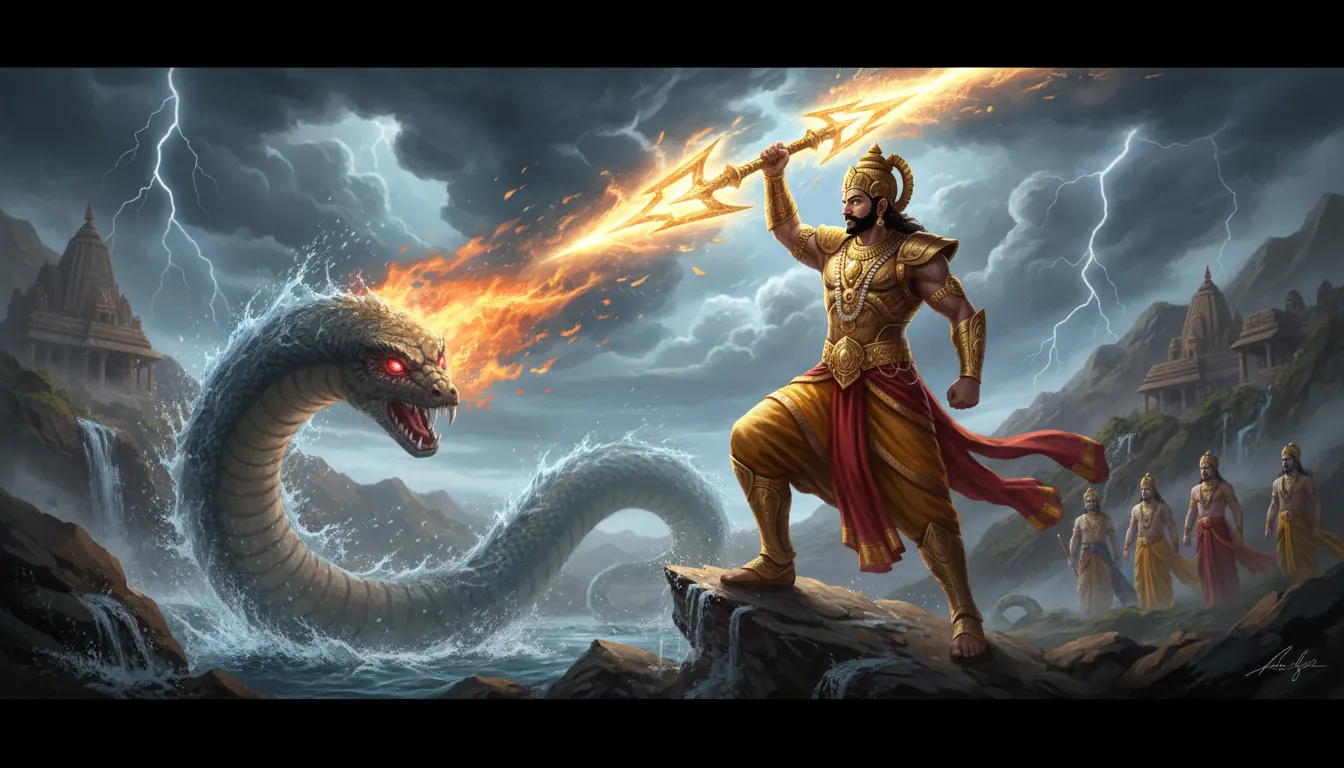
The Battle No One Else Can Fight
Krishna names the enemies still living in Yudhishthira's flesh
In short
Krishna tells the grieving Yudhishthira how Vritra, driven from the earth, hid in water, then light, then wind, then ether, and at last inside Indra's own body, where he had to be killed with an invisible bolt. He then names the war the king has left, which has no allies and no weapons, and recites the song in which Desire boasts of every virtue it can wear.
Told in the Ashvamedhika ParvaSet in Hastinapura, Amaravati and Kurukshetra16 min read
The Man Who Had Won
Vyasa finished speaking about the gold on the mountain, and nobody on the bank of the Ganga said anything, and the king went on sitting exactly as he had been sitting.
He had won. That was the difficulty. There was no enemy left in the field, no claim outstanding, no assembly in which anyone would rise to dispute his right. He had been given back everything that had been taken from him and it had arrived in his hands looking like something else. Vaishampayana says that the son of Pritha was troubled in mind, bereft of his relatives, his kinsmen killed in battle, and that he looked as downcast as the sun darkened in eclipse, or a fire smothered by its own smoke.
It was Krishna who spoke next, because he was the only man there who could say the next thing without softening it.
"All crookedness of heart leads to destruction," he said, "and all uprightness leads to Brahman. If this, and only this, is what all true wisdom is about, then what can a troubled mind do to one who understands it?"
Yudhishthira did not answer.
"Your Karma has not yet been wiped out," Krishna said, "and your enemies have not been subdued. You do not yet know the enemies still lurking in your own flesh."
That was the sentence the king heard. It was put to him as a plain report of fact, the way a scout reports that a force has been sighted on a road, and it named a war he had not been told he was fighting.
"I will tell you truly, as I heard it," Krishna said, "the story of the war of Indra with Vritra, as it took place. It is not the war that is sung. It is the other one. Listen, and count how many times the enemy is driven out and how many times he is destroyed, for they are not the same number."
The Demon in the Earth
Long ago, Krishna said, the Earth herself was enveloped by Vritra.
He did not stand on her and he did not besiege her. He took her in, the way damp takes a wall, and he drew out the earthly matter that is the seat of all odour, and pulled that property out of her into himself.
What men noticed first was the smell. Bad odours rose on all sides, in the villages and on the roads and in the houses of the pious, and no one could say where they came from or what had gone wrong, only that the world had begun to smell like something spoiled. That was the whole of the visible damage. A quality had been stolen out of creation and the theft announced itself as a stench.
The Performer of a hundred sacrifices was furious at this, and he hurled his thunderbolt at Vritra.
It struck. That is worth saying plainly, because in this story every blow lands. Deeply wounded by the thunderbolt of mighty Indra, Vritra did not die and did not flee upward and did not turn and fight. He entered into the waters.
"Watch what he does," Krishna said. "He is not defeated when he is struck. He is moved. Each blow of that thunderbolt is perfectly successful and each blow drives him one step further in."
With the waters seized by Vritra, their liquid property left them. Rivers ran and lakes stood full and the property that makes water water had gone out of them into the thing that had taken shelter there.
At this Indra flew into a great rage and struck him again with his thunderbolt.
Water, Light, Wind, and the Ether
Struck by the thunderbolt of all-powerful Indra, Vritra went into the Jyoti, the luminous matter, and drew out its inherent property. Once Vritra had overwhelmed the luminous matter, colour and form were lost. Fires burned without looking like fire. The eye opened on a world that had nothing in it for the eye.
The wrathful Indra again hurled his thunderbolt at him.
Wounded again by Indra of immeasurable power, Vritra suddenly entered the Vayu, the gaseous matter, and made off with its inherent property. The wind moved and could not be felt. Touch was gone out of the world.
Indra was filled with wrath once more and flung his thunderbolt at him.
Wounded by the mighty one, he overwhelmed the Akasa, the ether, and took away its inherent property, and sound was destroyed. There was no longer anything for the ear to do.
"Consider what the king of the gods has accomplished," said Krishna. "He has driven his enemy out of earth, out of water, out of light, out of wind, and out of ether. There is no element left in which the thing can be pursued. Every campaign has been a victory and there are fewer places to stand after each of them than there were before.
"That is the shape of the war a man wages against what he wants. He drives it out of his hands and it goes into his speech. He drives it out of his speech and it goes into his silences. He drives it out of his silences and it goes where the thunderbolt cannot be aimed without wounding the one who throws it."
The god of a hundred sacrifices, in great anger, struck him with the thunderbolt once more.
The Bolt That Could Not Be Seen
Struck again by mighty Indra, Vritra suddenly entered Shakra's own body and took away its essential attributes.
There was nowhere further to go and there was no further blow to be struck, and the lord of the three worlds stood in his own heaven with his weapon in his hand and his enemy inside his ribs. Overtaken by Vritra, Krishna said, he was filled with great illusion. Everything he looked at he saw wrongly. He could not tell what was his own thought and what had been put into him.
And there was no shame in it, and no one laughed, and the one thing that happened in heaven at that hour was that an old ascetic came and sat with him.
"We have heard," Krishna said, "that when Indra was in that state, Vasishtha brought him back to his senses with the Rathantara hymn."
That is all the account gives, and it is a great deal. The lord of the celestials, undone by an enemy he could not point at, needed one man to sit near him and chant steadily until the illusion thinned enough for him to think.
And then the god of a hundred sacrifices killed Vritra inside his own body with his invisible thunderbolt.
"Not the thunderbolt that is seen," Krishna said. "The other one. The bolt that has no flash and makes no crash of air, that can be brought down inside a body without splitting it. There is no other weapon that reaches where the enemy had gone.
"Understand, prince, that Shakra told this religious mystery to the great sages, and they in turn told it to me. It was not told as the tale of a victory. It was told as an account of where the last enemy is always found."
Two Kinds of Sickness
"There are two kinds of illness," Krishna said, "physical and mental. They come from the body and the mind acting on each other, and neither ever arises without the two working together. An illness that arises in the body is called physical, and one that has its seat in the mind is called mental.
"The cold and the warm humours, which are phlegm and bile, together with the windy humour, are the basic changes that arise in the physical body. When these humours are evenly spread and present in the right proportions, they are said to be signs of good health. The warm humour is eased by the cold, and the cold by the warm. A physician who sees a fever does not ask the fever to be reasonable. He puts the opposite quality into the body and waits.
"So too with the other kind. Sattwa, Rajas and Tamas are the attributes of the soul, and the learned say that when they are present in the right proportions the mind is healthy. But if any of the three gets the upper hand, a remedy is prescribed to restore the balance.
"Happiness is overcome by sorrow, and sorrow by pleasure. Some people, when they are sad, like to recall past happiness. Others, when they are happy, like to recall past sorrow."
He let that stand a moment, because the king was doing neither.
"But you, son of Kunti, want to recall neither your sorrows nor your happiness. What else is there, then, that you want to recall, apart from this delusion of sorrow? Or perhaps, son of Pritha, it is simply your own nature that has overpowered you now."
That is a hard thing to be told by a friend before his brothers and the sages: that the grief is not being fed by any particular memory, and that a man who will not name the thing he is mourning may be mourning nothing, and may simply be built that way.
The Things You Are Not Remembering
Then Krishna listed for him, one after another, the memories he was not brooding on, which is a strange kind of comfort and was meant to be.
"You do not want to call to mind the painful sight of Krishna standing in the assembly hall with only one piece of cloth to cover her body, while she was in her season, in front of all the Pandavas.
"Nor is it right for you to brood over your departure from the city, your exile with an antelope hide for a robe, and your wanderings in the great forest. Nor should you dwell on what Jatasura put you through, or the fight with Chitrasena, or your troubles with the Saindhavas.
"Nor is it proper, son of Pritha, conqueror of your enemies, for you to recall Kichaka kicking Draupadi during the part of your exile spent in complete concealment. Nor the fight between you and Drona and Bhishma."
They were laid out like a muster roll, and there were thirteen years of them, and every one of them had been survived. The point was not that the injuries were small. The point was that not one of them was what the king had his face turned toward. He was sitting by the river in a kingdom he had won, refusing to look at anything in particular, and calling the refusal grief.
"The time has now come," Krishna said, "for you to fight the battle every man must fight alone with his own mind. So, chief of Bharata's race, you must now prepare to take up the struggle against your mind, and through inner withdrawal and the merit of your own Karma you must reach the far side of what is mysterious and beyond understanding."
A War Without Missiles
"In this war," said Krishna, "you will need no missiles, no friends, no attendants. The battle you must fight alone, single-handed, has now come to you."
The king had commanded seven divisions. He had a brother who could break a chariot with his hands and another who had brought down the grandsire of the house, and an ally beside him who had driven the horses of the greatest bowman living. Every one of them was there on the riverbank. Not one of them could be sent into this.
"And if you are defeated in this struggle," Krishna said, "you will find yourself in the most wretched state. If you know this, son of Kunti, and act on it, you will succeed. Knowing this wisdom and the destiny of all creatures, and following the conduct of your ancestors, rule your kingdom as you should."
It is worth noticing what he did not prescribe. He did not tell the king to go into the woods. He told him to govern.
"Salvation does not come from giving up external things," he said. "It comes from giving up the things that pander to the flesh. As for whatever virtue and happiness belong to a man who has renounced only outward things while staying wrapped up in his passions and the weakness of his flesh, let our enemies have that.
"The man who renounces the world and goes to live as a recluse in the forest, eating wild roots and whatever else he finds, but still craves the good things of the world and is enslaved by them, may be said to carry death in his mouth. Watch closely, Bharata, and learn the nature of your enemies outside and within. He who can see the nature of the eternal reality can rise above the hold of the great fear."
The Word of Two Letters
"The word with two letters is Mrityu," Krishna said. "Death. The word with three letters is Saswata, the eternal.
"The feeling that this or that thing is mine, the state of being enslaved by worldly objects, is Mrityu. The absence of that feeling is Saswatam. And these two, Brahman and Mrityu, king, have their seats in the souls of all creatures, and there, unseen, they certainly wage war on each other without ceasing."
This was aimed, and the king knew where.
He had walked over a field on which his own people lay in windrows and he had counted them as a thing done to him, and every one of those deaths had been counted twice, once as a loss to the house and once as a debt against himself. The word for that arithmetic is mine. Mine were the brothers, mine the sons, mine the kingdom bought at that price, and mine the guilt, and mine, mine, mine, until the whole eighteen days had been folded up and put inside one man to be carried.
"And if it is true, Bharata, that no creature is ever destroyed," Krishna said, "then a man does not become guilty of a creature's death by piercing its body.
"What can the world do to a man who wins sovereignty over the whole earth, with all its moving and unmoving creation, and does not become attached to it or lost in enjoying it? People do not approve of the conduct of those who are lost in worldly desires. And there is no act without a desire at its root, and all desires are, as it were, limbs and offshoots of the mind. So wise men, knowing this, subdue their desires.
"What the soul desires does not lead to piety and virtue. The restraint of desire is the root of all true virtue."
The Song Desire Sings
"To illustrate this truth," Krishna said, "the sages versed in ancient lore recite the Gathas called the Kamagita. Listen to them in full, Yudhishthira, for it is Desire himself who speaks in them, and he is not modest."
And this is what Desire says.
"No creature can destroy me without the proper means. If a man knows my power and tries to destroy me with weapons, I destroy him with those same weapons and appear again. If he tries to destroy me with sacrifices and many gifts, I deceive him by appearing in his mind as the most virtuous of all moving creatures. If he tries to wipe me out by mastering the Vedas and the Vedangas, I outwit him by seeming to his mind to be the very soul of virtue among unmoving creatures.
"If a man whose strength is truth tries to overcome me by patience, I appear to him as his own mind, so he never notices that I exist. If a man of austere practices tries to destroy me by asceticism, I take the form of asceticism in his mind, and so he never knows me. And as for the learned man who tries to destroy me in order to win salvation, I dance and laugh in the face of that man so intent on salvation.
"I am the everlasting one, without an equal, whom no creature can kill or destroy."
There is no counter-song. The Gathas end there, with Desire still standing, and the only answer the teaching offers is the one Krishna gave next.
"So you too, prince, turn your desires toward Virtue, and that way you will win what is good for you. Prepare, then, to perform the horse sacrifice properly, with gifts, and other sacrifices of great splendour. Do not let grief overpower you again at the sight of your friends lying dead on the battlefield. You cannot see the men killed in this battle alive again. So perform magnificent sacrifices with gifts, and win fame in this world and the perfect way hereafter."
The enemy in the flesh had been given a name, a voice, and a full account of his costumes, and had not been promised to the king as slain. Only the campaign had been declared, and the horse was to be sent out in the spring.
Dharma Lesson
The enemy driven out of the world does not die, it moves inward, and every blow that succeeds only drives it one step further in. The last campaign of a victorious king is fought alone, without allies or weapons, against a desire that has learned to imitate his virtues.