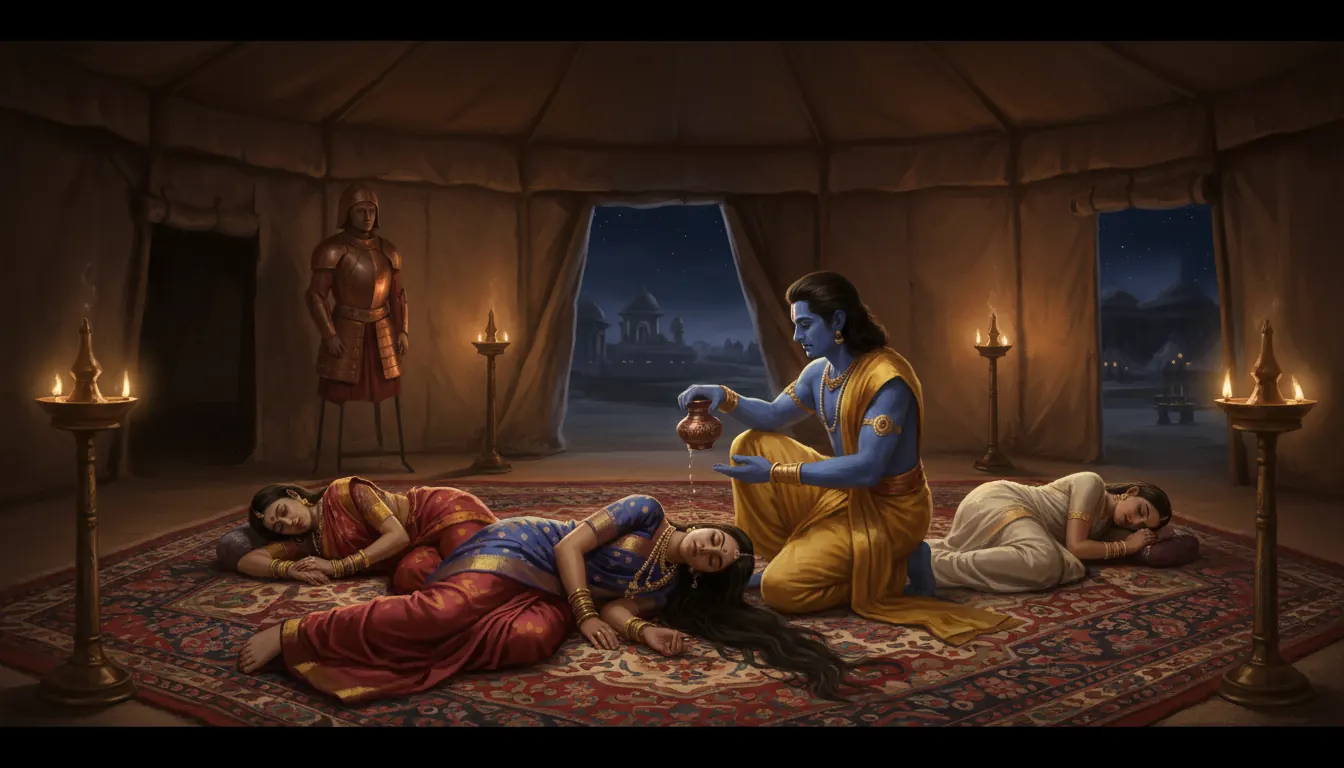
Portents Before the Fourteenth Day
The night the sky and the rivers answered Arjuna's vow, and the morning ritual of a king
In short
On the night after Arjuna swears to kill Jayadratha before sunset, neither he nor Krishna sleeps, and the world reacts: dry winds, a headless trunk and a mace on the disc of the sun, thunder out of a cloudless sky, an earthquake, a swollen sea and rivers running backwards. Arjuna sends Krishna to console Subhadra and Uttaraa with words that are soothing and also true, and Krishna promises them the head of the Sindhu king by tomorrow evening. At dawn in the other tents Yudhishthira wakes to drums, bathes, prays silently facing east, worships the fire, and gives gold and horses and cattle to nine thousand brahmanas before receiving Krishna and beginning the fourteenth day.
Told in the Drona ParvaSet in Pandava Camp, Kurukshetra and Syamantapanchaka20 min read
Two Men Who Did Not Sleep
Sanjaya was telling the whole of it to a blind man in a hall at Hastinapura, and the part he had come to was a night.
The thirteenth day of the war was over. Abhimanyu, the son of Arjuna and Subhadra, sixteen years old, had gone alone into the wheel array that morning and had not come out of it, and Jayadratha the ruler of the Sindhus had stood in the mouth of that formation and held four Pandava brothers out of it while the boy was killed inside. In the evening Arjuna had come back to a camp that would not look at him, and had learned why, and had sworn in the hearing of Krishna and of all the kings that before the sun set on the following day he would fell the head of the ruler of the Sindhus on the earth, and that if he failed he would enter blazing fire.
The vow was made, and there was nothing left to do until morning. This is what Sanjaya said about the hours in between.
"Both Vasudeva and Dhananjaya," he said, "were so full of sorrow and grief that they got no sleep that night, and kept sighing like two snakes."
That is the whole account of the two of them. No speech, no plan, no comfort taken from each other. Two men lying awake and breathing hard in the dark, one of whom had lost his sister's son and one of whom had lost his own, and between them a promise with a sunset attached to it.
And the gods were watching, and the gods were frightened.
Knowing that Nara and Narayana were enraged, said Sanjaya, the gods with Vasava at their head grew very anxious, wondering, What will come of this?
These are the two eternal rishis, born together in age after age, who had come down into this world as the man with the bow and the man who drove his horses. Heaven knew who they were. Heaven had seen them angry before. And heaven, which knows the end of most things, did not know the end of this one, and said so out loud.
The Trunk and the Mace on the Sun
The first thing that went wrong was the wind.
Fierce winds began to blow, and Sanjaya gives them two qualities, both of them bad. They were dry, and they warned of danger. Not the wind that comes before rain and is a mercy on men who have been fighting in armour all day. The other kind, blowing across a plain that had a hundred thousand dead on it and would have more tomorrow.
Then the sun.
A headless trunk and a mace appeared on the disc of the sun. That is what the text says, and it does not explain it, and it should not be explained away. The men of both camps looked up at the light, and standing on it, dark against it, were two shapes. A body with no head on its shoulders. And a mace, which is a club for breaking bones.
There is no army in the world that could see that and not know what it was being told.
And though the sky was cloudless, loud claps of thunder were heard again and again, with flashes of lightning.
Read the words in front of that. Though the sky was cloudless. The thunder was not weather. There was nothing overhead for it to come out of, and it came anyway, cracking across an empty sky with the lightning going with it, and the horses in the picket lines of both armies would have been screaming.
Then it went into the ground. The earth with her mountains and her waters and her forests shook: the three least movable things a person ever sees, all of them in motion together. The seas, where the Makaras live, heaved and swelled. The ocean is this poem's standing image for whatever is too large to be disturbed, and that sea rose, on coasts hundreds of miles from Kurukshetra, before any runner could have carried the news there.
And the rivers ran backwards, against their usual course.
That is the one to stop at. A river running backwards is the plainest statement the physical world is capable of making that an order has been reversed, that what was going one way is now going the other, and that nothing downstream can rely on what used to come to it. A river ran past the Pandava camp, the Hiranvati, and men had been washing blood off their hands in it all week.
Portents here are not decoration. They are the ordinary machinery of the world reacting to a load put into it, and the load had gone in at dusk, when a man laid his hand on his weapons and swore by truth.
What the Animals Did
The last of the omens were in the bodies of the living.
The lips of chariot warriors and horses and men and elephants, upper and lower, began to tremble. All four ranks of a battlefield are inside that sentence, the great chariot fighters at the top and the foot soldiers under them and the animals under both, and every one of them was doing the same small involuntary thing at the same moment. Not shaking with fear, which a man can hide, and not weeping, which a man can wipe. The lips moving on their own, on the faces of kings and on the muzzles of horses, in the lamplight of the tents, where everybody could see it happening to everybody else.
Then the beasts.
As if to delight the cannibals, says Sanjaya, and foretelling a great increase in the population of Yama's kingdom, the animals passed urine and dung and gave loud cries of woe.
The cannibals are the rakshasas and the carrion eaters who follow an army and eat what it leaves behind, and they are the only parties in this whole account who are pleased. The great increase in the population of Yama's kingdom is the poet's phrase for what would be counted the next evening, and it is worth reading twice, because it is a census. The kingdom of the dead was about to receive an intake large enough to be described as growth.
And the animals, who had no idea what a vow was, knew.
When they saw these fierce omens that made the hair stand on end, and heard as well of mighty Arjuna's fierce vow, all the warriors of the Kaurava army were deeply shaken.
That is the sentence the whole passage has been built toward. The omens by themselves might have been argued over by the priests in the morning. The vow by itself might have been laughed at, since one man had undertaken to reach, through eleven divisions of troops, a king whom Drona himself had been assigned to protect. But the two things arrived in Duryodhana's camp on the same night, and together they were not arguable, and the men on that side lay awake as well.
Go and Comfort My Sister
In the middle of all this, Arjuna did the one thing nobody would expect of a man who has just sworn to die tomorrow if he fails.
He thought about the women.
The mighty-armed son of Pakasasana, which is to say the son of Indra, turned to Krishna and gave him an errand.
"Go and comfort your sister Subhadra and her daughter-in-law. Comfort that daughter-in-law and her companions as well, Madhava. Comfort them, lord, with gentle words, but words that are true."
Look at the condition attached to it. Gentle words, but words that are true. He is not sending Krishna to tell them a kind story. Subhadra is Krishna's own sister and Arjuna's wife and the mother of the dead boy. The daughter-in-law is Uttaraa, the princess of Virata, married to Abhimanyu at the end of the exile and carrying his child, and she has been a widow for a few hours. Arjuna, who has grief enough of his own to make him useless in that tent, will not have those two consoled with anything that is not so.
At these words, said Sanjaya, Vasudeva went to Arjuna's quarters with a heavy heart.
That is the other detail not to walk past. Krishna is not going in there as a comforter who is himself untouched. Abhimanyu was his nephew. He had been away on the far side of the field with Arjuna, drawn off by the samsaptakas, on the morning the boy was surrounded, which means that of all the men in that camp he and Arjuna are the two who were not there, and both of them know it.
He went with a heavy heart, and he began to comfort his sister, who was sunk in grief at the death of her son.
All Creatures Have One End
"Lady of the Vrishnis," said Krishna, "do not grieve for your son, you or your daughter-in-law. Gentle one, all creatures have one end, and Time has ordained it."
He began where such an argument has to begin, with the fact that death was not something that happened specially to Abhimanyu, and then he moved at once to the thing that did happen specially to Abhimanyu, which was the manner of it.
"Your son has met the end that befits a hero of proud lineage, and above all a kshatriya. So do not grieve. By good luck this mighty chariot warrior, wise and as brave as his father, has died as a kshatriya should, and met the end that heroes long for."
By good luck. He says it to the mother, on the night of the death, and he means it, because he is speaking from inside a code in which a man of that order who dies in his armour going forward has drawn the best of the lots available to him.
Then he told her where the boy had gone, and what other men pay to get there.
"He defeated countless enemies and sent them to Yama, and he himself has gone to the eternal worlds of the righteous, where every wish is granted. Your son has reached the end the righteous reach by penance, by brahmacharya, by knowledge of the scriptures, and by wisdom."
Four hard roads are named there, and each of them is the labour of an entire lifetime. Penance. The celibate discipline of a student. The mastery of the scriptures. And wisdom, which is the one that cannot be worked for directly at all. Abhimanyu was sixteen and had finished none of them, and he had arrived where they arrive, in a single afternoon.
"You are the mother of a hero, the wife of a hero, the daughter of a hero, and kin to heroes," said Krishna. "Do not grieve for your son, who has reached the highest end."
He was naming her four times over. Every one of the four was true of her, and not one of them was any use to her that night.
The Head on the Outskirts of Samantapanchaka
Then he stopped consoling her and told her what was going to happen instead.
"Beautiful lady, the wretched ruler of the Sindhus, who killed a child and did this sinful thing, will pay for his arrogance, he and his friends and kinsmen, as soon as this night is over. Even if he takes refuge in Indra's own house, he will not escape Partha's hands. Tomorrow you will hear that in battle the head of the ruler of the Sindhus has been cut from his body and sent rolling on the outskirts of Samantapanchaka."
Samantapanchaka is the old name of the ground they were all camped on, the tract that Parashurama once filled with five lakes of blood, and every man in both armies knew what had been done there and by whom. Krishna is telling a bereaved mother that by tomorrow evening the head of the man responsible for her son will be lying on that field, and he is telling her the name of the field.
Then he went back to the boy, and gave her the only thing that was actually hers to keep.
"Your son has gone to heaven, that broad-chested, mighty-armed crusher of chariot warriors, never turning back. Drive this fever from your heart. He was obedient to his fathers and to his mother's kin, and that heroic, mighty chariot warrior did not fall until he had killed thousands of enemies. Comfort your daughter-in-law, queen. Do not grieve too much, lady of the kshatriyas. Put away your grief, daughter, for tomorrow you will hear such welcome news."
Never turning back. It is the word this poem keeps for the men who do not come back out of a formation. It is a compliment, and it is also what killed him.
And at the end Krishna staked his cousin's vow the way a man stakes a wager he has no intention of losing.
"What Partha has vowed must be done. It cannot be otherwise. What your husband sets out to do never stays undone. Even if all human beings and snakes and Pishachas, all the wanderers of the night and the birds, and all the gods and the Asuras come to the aid of the ruler of the Sindhus on the battlefield, he will still cease to exist tomorrow, and they with him."
The King Wakes to Drums
Krishna went from that tent to his own, and in the middle of the night he woke his charioteer Daruka and gave him his orders for the morning, and while the two of them were talking the night passed away.
Then Sanjaya turns the account over to another tent entirely, and to a man who has not been mentioned for some time, and who is about to be described in more detail than any battle in this parva receives.
King Yudhishthira woke up.
He was woken the way the eldest of a royal house is always woken. The Paniswanikas and the Magadhas and the Madhuparkikas and the sutas delighted that bull among men with songs and music. Dancers began their dance. Sweet-voiced singers sang sweet songs in praise of the Kuru race. And skilled musicians, each well trained on his own instrument, played on Mridangas and Jharjharas and Bheris and Panavas and Anakas and Gomukhas and Adamvaras, on conchs, on loud Dundubhis, and on many other instruments besides. That noise, deep as the roar of the clouds, touched the very heavens, and it woke the king out of his sleep.
Having slept happily on his excellent and costly bed, says Sanjaya, the king awoke.
Slept happily. On the night when Arjuna and Krishna were lying awake sighing like snakes, and when nobody else in the Pandava camp closed their eyes either, the man in whose name the war was being fought slept well. The poet says it without a word of comment and leaves it lying there for whoever wants to pick it up.
Then the king rose from his bed and went to the bathroom to do what had to be done. And a hundred and eight servants came in to him, dressed in white, freshly washed themselves, and all of them young, carrying golden jars filled to the brim.
A hundred and eight. On the fourteenth morning of a war that had already taken his grandsire and his nephew, the household counted out the auspicious number and did not vary it by one.
The Bath and the Fire
Seated at his ease on a royal seat, wearing a thin cloth, the king bathed in several kinds of water, fragrant with sandalwood and purified with mantras.
The order of it is worth having in full, because the text gives it in full. First strong, well-trained servants rubbed his body with water in which many kinds of medicinal herbs had been soaked. Then he washed with adhivasha water, scented with various fragrant things. Then a long piece of cloth for the head, as white as the feathers of a swan, which had been kept loose in front of him beforehand, and he tied it round his head to dry the water. Then sandal paste smeared over the body, and floral garlands, and clean robes.
Then the mighty-armed son of Kunti sat facing the east with his palms joined and, as the righteous do, said his prayers silently.
Silently. That is what the text's word means here. The drums had stopped and the servants had gone out, and the king of the Pandavas sat facing the sunrise with his palms together and said nothing aloud at all.
Then, in all humility, he went into the room where the sacred fire was kept blazing. He worshipped the fire with sticks of sacred wood and with offerings of clarified butter made holy by mantras, and he came out again.
Nothing in any of this is unusual, and that is the entire point of it. This is what the man did every morning of his life. He did it in Indraprastha when he was an emperor and the kings of the earth were paying him tribute. He did it in the forests for twelve years with nothing to pour but what the forest gave him. He did it in Virata's palace in the borrowed shape of a dice-playing brahmana who could not be seen praying like a king. And he did it on the fourteenth morning at Kurukshetra, with his brother under a vow of death and the sun already coming up over a field on which he had lost a son and a grandsire and the better part of an army, in exactly the same order, without hurrying any part of it.
Nine Thousand Brahmanas
Then that tiger among men entered a second chamber, and there he found the brahmanas waiting for him.
They were bulls among brahmanas, learned in the Vedas, self-restrained, purified by Vedic study and by vows, and every one of them had taken the bath that completes a sacrifice. They were worshippers of the Sun, and there were a thousand of them. Besides them there were eight thousand others of the same kind.
Nine thousand men in one camp on a morning of battle, fed and housed and kept there for exactly this, which says as much about how the Pandava army was run as any muster roll could.
The son of Pandu had them pronounce blessings in clear voices, and to have them do it he gave them presents. The list is given plainly and it should be read plainly. Honey. Clarified butter. Auspicious fruits of the best kind. To each man a nishka of gold. To each a hundred horses decked with ornaments. Costly robes, and whatever other presents pleased them. And cows that gave milk at a touch, with their calves beside them, their horns cased in gold and their hoofs in silver.
Then he walked round them all, keeping them on his right, which is the salutation a man makes to whatever he holds holy.
And coming out he saw and touched the things that are set in a king's path on a morning that matters. Swastikas, bringers of good fortune. Nandyavartas made of gold. Floral garlands. Water-pots. Blazing fire. Vessels full of sun-dried rice. The yellow pigment prepared from the urine of the cow. Curds and clarified butter and honey. Auspicious birds. And auspicious, well-dressed maidens, standing where he would pass them.
He touched each thing in its turn. A man who has been told that this will be the best or the worst day of his life touches gold and grain and fire and the horns of cattle and walks on, and none of it is superstition exactly. It is a king performing, in front of his whole household, the act of expecting the day to go well.
The Seat of Gold and the Man at the Door
In the outer chamber the attendants brought him a seat.
It was of gold and round, set with pearls and lapis lazuli, covered with a very costly carpet with another fine cloth spread over that, and it was the work of the divine craftsman himself. The great-souled son of Kunti sat down on it, and the servants brought him all his bright and costly ornaments. He put them on one by one, until his beauty, says Sanjaya, was enough to deepen the grief of his enemies.
Then they began to fan him with white yak-tails as bright as the moon, each with a handle of gold, and the king shone like a bank of clouds charged with lightning. The bards sang his praises. The heralds recited his glories. The singers sang to that delight of the Kuru race, and in a moment the voices swelled into a great noise.
And then, underneath the singing, something else came up.
The clatter of chariot wheels. The tread of horse-hoofs. The tinkle of elephants' bells, and the blare of conchs, and the tread of men, until the very earth seemed to tremble with it.
That was the army getting up. The fourteenth day had already started outside the walls of the tent while the last of the ornaments were being fastened on inside it.
Then one of the guards of the doors came in. Sanjaya troubles to describe him, and he is nobody, and he gets a whole line to himself: in armour, young, wearing earrings, his sword hanging at his side. He came into the private rooms, knelt on the ground, bowed his head to the king, who deserved every honour, and told the royal son of Dharma that Hrishikesha was waiting to be shown in.
Yudhishthira gave his servants one order.
"Let an excellent seat and an Arghya be kept ready for him."
So Krishna was brought in and seated on a costly seat, and the king welcomed him with the usual courtesies and worshipped him as was due. Neither of them said anything yet about Jayadratha. The water for the guest's hands was poured first, because that is the order things are done in, and then the day that Arjuna had sworn away could begin.
Dharma Lesson
The epic never treats an oath as a private matter. When Arjuna binds himself to a sunset, the wind dries, the sea rises and the rivers turn, because a promise of that weight is a load laid on the world and not only on the man who made it. Set against the omens is Yudhishthira's morning, unchanged from the mornings of his exile: the bath, the silent prayer facing east, the fire, the gifts to the brahmanas, each thing touched in its own order. One brother meets a terrible day by swearing something enormous and the other by doing the small ordinary duties exactly right, and the poem gives them equal room.