The Shape of Ghatotkacha
Sanjaya describes the rakshasa's body, chariot and host as he charges Karna at midnight
In short
On the fourteenth night of the war Dhritarashtra stops the narration and asks for a description: what did Ghatotkacha look like, what chariot did he ride, what horses, what bow. Sanjaya gives him the whole inventory, from the blood-red eyes and the gold diadem to the eight-wheeled chariot covered in bear-skins with a living vulture on its standard. Then the portrait moves, and Ghatotkacha and Karna fight through half the night, illusion against celestial weapon. Karna burns the rakshasa host and catches a thunderbolt in his bare hands, and Ghatotkacha vanishes promising to come back.
Told in the Drona ParvaSet in Kurukshetra16 min read
The Blind King Asks for a Description
The fourteenth day of the war had run past sunset and nobody had called a halt. Torches went up on both sides, thousands of them, carried by foot-soldiers and tied to the necks of elephants, and the fighting went on in that unsteady light. Into it came Ghatotkacha, the son Bhima had fathered on the rakshasa woman Hidimbi, who had just cut the head off the rakshasa Alambusha, thrown it into Duryodhana's chariot, and gone looking for Karna.
At this point in the telling the blind king stopped his charioteer.
"How did that battle go," Dhritarashtra said, "when Vikartana's son Karna and the rakshasa Ghatotkacha met at dead of night? What did that fierce rakshasa look like then? What kind of chariot did he ride, and what were his horses like, and his weapons? How big were his horses, and the standard on his chariot, and his bow? What kind of armour did he wear, and what was on his head? I am asking you: describe all of it, Sanjaya, for you are skilled at telling."
It is worth noticing what the old man wanted. Not the outcome. He had a fair idea of the outcome already, and the whole of the epic is arranged so that he keeps being told things he would rather not hear. What he asked for was a portrait, itemised: face, belly, teeth, hair, armour, headgear, chariot, horses, banner, bow. A man who has never seen anything asks for measurements, because measurements are the one part of a description that survives the journey into a dark head.
So Sanjaya, who was on the field and saw all of it, put the battle down for a moment and gave him the inventory he asked for.
He began with the eyes.
The Shape of Him
"His eyes were blood-red," Sanjaya said, "and Ghatotkacha was gigantic."
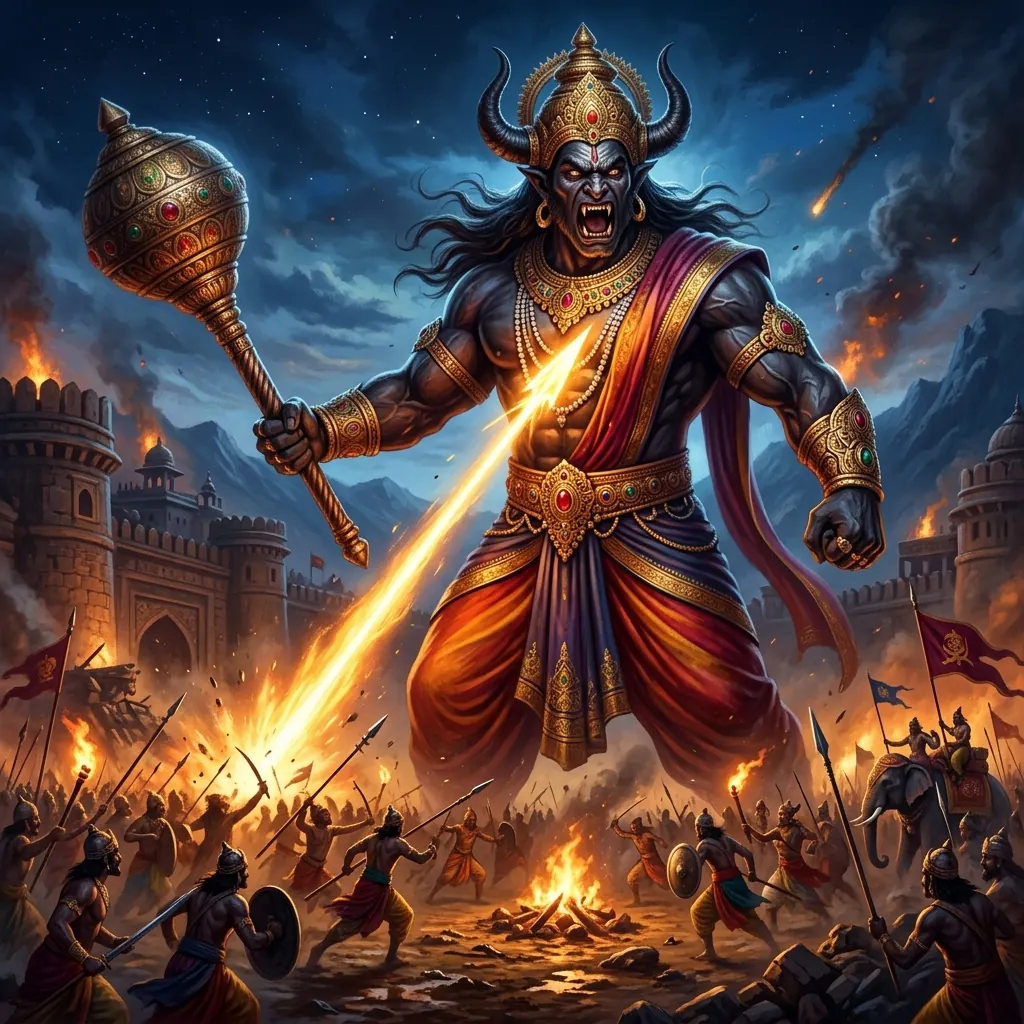
His face was of the hue of copper. His belly was low and sunken. The bristles on his body all pointed upwards. His head was green. His ears were like arrows. His cheek-bones stood high. His mouth was large, extending from ear to ear, and his teeth were keen, four of them high and pointed. His tongue and his lips were very long and coppery. His brows ran far out to the sides. His nose was thick. His body was blue and his neck was red.
Tall as a hill, he was terrible to look at.
Sanjaya keeps going, because Dhritarashtra had asked for all of it. Gigantic frame, gigantic arms, gigantic head, and great strength in them. Ugly, and hard-limbed. The hair of his head tied up on top in a frightful shape. Large hips, a deep navel. And then one line that a lesser describer would have left out, because it spoils the simple picture of a monster: of gigantic frame, the circumference of his body, however, was not great. He was enormous and he was not fat. He was built like something that would move fast.
The ornaments on his arms were proportionate. That is the second correction to the picture. This was not a beast that had wandered out of a forest; this was a prince, and he was dressed like one. He wore Angadas on his arms. On his breast a cuirass sat like a circle of fire on the breast of a mountain. On his head was a bright and beautiful diadem of gold, every part of it proportionate, and shaped like an arch. His earrings were bright as the morning sun. His garlands were gold and exceedingly bright. Over all of it he had a gigantic armour of brass of great brilliance.
The son of Hidimbi came into the night battle looking like a hill on fire, wearing his father's people's jewellery on a body that belonged to his mother's.
Eight Wheels and a Vulture
Then the chariot, which Dhritarashtra had asked about specifically.
It was hung with a hundred tinkling bells, and numerous blood-red banners waved on its standard. It was of prodigious proportions, of the measure of a nalwa, which is to say it was measured in the units used for fields rather than for vehicles. It was covered with bear-skins. It was equipped with every kind of mighty weapon. It had a tall standard and it was adorned with garlands, and it ran on eight wheels, and the clatter it made resembled the roar of the clouds.
His horses were like maddened elephants, red-eyed, terrible to look at, of many colours, with great speed and might. They did not tire. They had long manes, and they neighed again and again as they carried him.
His driver was a rakshasa with terrible eyes and a fiery mouth and blazing earrings, holding the reins, which were bright as the rays of the sun. With that driver, Sanjaya said, Ghatotkacha came to battle like Surya coming with his driver Aruna. It is a startling comparison to make about a man-eater at midnight, and Sanjaya makes it without apology: the sun and his charioteer, arriving in the dark.
Set up on the chariot was a very tall standard that touched the heavens, so that the whole equipage looked like a high mountain with a mighty cloud wrapped around it. On the standard perched a carnivorous and awful vulture with a blood-red body. Not a device, not an emblem worked in cloth. A living bird that ate the dead, riding to the field on the pole where other men flew a lion or a palm tree.
And the bow. He came forcibly drawing it, and its twang resembled the thunder of Indra. Its string was very hard. It measured a dozen cubits in length and one cubit in breadth. The shafts he filled every point of the compass with were each the size of the axle of a chariot.
That was what came at Karna on the night that was so destructive of heroes.
Two Hills of Chalk
Standing proudly in that chariot, Ghatotkacha stretched the bow, and the sound of it was like roaring thunder. The Kaurava troops trembled, Sanjaya told the king, like the surging waves of the ocean. All your troops, he said, were terrified of him.
Karna watched the thing come and, as if smiling, withstood him speedily.
That is the sentence, and it is the reason the rest of this episode is a contest and not a slaughter. Every king on that field had just seen the head of Alambusha thrown at Duryodhana's feet. Every one of them had watched the Kuru host break and run at dead of night, throwing down their torches as they went. Karna looked at the same thing they were looking at and moved toward it from close quarters, like an elephant going against an elephant, or the leader of one bovine herd against the leader of another.
The collision that took place between them, Sanjaya said, resembled that between Indra and Shambara.
Each took a formidable bow of loud twang and struck and covered the other with powerful shafts. With straight arrows sped from bows drawn to their fullest stretch they mangled each other, piercing coats of mail that were both made of brass. With darts of the measure of axles, and with shafts, they went on mangling each other like a couple of tigers with their teeth, or a couple of elephants with their tusks. They pierced each other's bodies. They aimed at each other. They scorched each other with clouds of arrows until neither could any longer be looked at.
With their limbs pierced and mangled and their bodies bathed in streams of blood, the two of them looked like two hills of chalk with rivulets running down their breasts.
Both struggled with everything they had. Neither could make the other tremble. For a long time that nocturnal combat continued equally, and Sanjaya says the two of them seemed to sport in it, making life itself the stake.
The twang of Ghatotkacha's bow frightened friends and foes alike. And at that time, king, Karna could not prevail over Ghatotkacha.
The Rain of Rocks
Seeing that he could not prevail, Karna, the greatest master of weapons there was, called up celestial weapons.
Ghatotkacha saw the astra coming and answered it in his own currency. He invoked his rakshasa illusion, and was suddenly seen surrounded by a large force of terrible-looking rakshasas armed with lances and large rocks and hills and clubs. He came on with a mighty weapon uplifted in his hands like the Destroyer of all creatures himself holding his fierce and fatal club, and the kings there were struck with fear.
Then he roared, and the roars were a lion's, and the elephants of that army passed urine where they stood. Every combatant on the field trembled.
Then the rain began. On all sides there fell a thick shower of rocks and stones, poured incessantly by rakshasas who, because it was now midnight, had become stronger than they had been at dusk. That is a rule of the world the epic simply states and does not argue: these creatures gain strength as the night deepens, and the Kauravas were fighting them in the deepest part of it. After the stones came iron wheels, and Bhusundis, and darts, and lances, and spears, and Sataghnis, and axes, falling without a break.
At the sight of that fierce and terrible battle, all the kings, and your sons, and the fighters, fled in fear.
Only one among them did not. Karna, proud of the power of his weapons and feeling a noble pride, did not tremble, and with his shafts he destroyed the illusion that Ghatotkacha had called up. The host of stone-throwers went out like a lamp.
Ghatotkacha, filled with rage at seeing it dispelled, began to shoot deadly shafts at the Suta's son with the whole of his strength. They went through Karna's body, bathed in his blood, and entered the earth behind him like angry snakes going into their holes.
Then Karna, filled with rage himself and possessed of great lightness of hand, got the better of him and pierced him with ten shafts in the vital parts.
Ghatotkacha felt that. It is the first time in this battle the text says he felt great pain.
The Wheel of a Thousand Radii
What he reached for then was a celestial wheel of a thousand radii, its edge sharp as a razor, possessed of the splendour of the morning sun and decked with jewels and gems. Bhimasena's son hurled it at the son of Adhiratha, meaning to end him with it.
Karna cut it to pieces in the air with his shafts. It fell down baffled of its object, Sanjaya said, like the hopes and purposes of an unfortunate man.
A gold-decked mace went next, whirled and thrown. Karna cut that too and it fell. Then Ghatotkacha soared into the sky, roaring deep like a mass of clouds, and poured down a shower of trees on him out of the air, and Karna pierced him where he hung, the way the sun pierces a mass of clouds with his rays.
Then Karna went to work on the equipment his king had asked about in such detail.
He killed all the horses. He cut the eight-wheeled chariot into a hundred pieces. And then he poured arrows on the rakshasa himself like a cloud pouring torrents of rain, until there was not two fingers' breadth of space anywhere on Ghatotkacha's body that was not pierced with a shaft. He looked, Sanjaya said, like a porcupine with its quills erect. So completely was he covered in arrows that from where the narrator stood, nobody could see the horses any longer, or the chariot, or the standard, or Ghatotkacha.
And then, out of that, he destroyed Karna's celestial weapon with a weapon of his own, and went back to fighting by illusion alone.
Showers of shafts began to fall out of the sky from a source nobody could see. The rakshasa assumed a fierce form and set about stupefying the Kauravas. He put out many fierce and grim heads and used them to devour the celestial weapons of the Suta's son as they came.
Then, with a hundred wounds on him, the gigantic body seemed to lie cheerless on the field, as if dead, and the Kaurava bulls raised a loud shout of joy.
It lasted about as long as such shouts usually last.
Wait a Little, Suta's Son
He was seen again on all sides at once, careering in new forms.
He was prodigious, with a hundred heads and a hundred stomachs, looking like the Mainaka mountain. Then he was about the measure of a thumb, moving sideways through the air, then swelling upward like the surges of the sea. He tore through the earth and rose out of it, and dived back into the water. Seen here, he was next seen somewhere else entirely. Then he came down out of the sky and was simply standing there, in armour, in a chariot decked with gold, having travelled through earth and heaven and all the points of the compass in the time it takes to say so.
He brought that chariot up close to Karna's, with his earrings swinging, and spoke to him without any fear at all.
"Wait a little, Suta's son. Where can you go and keep your life, if you run from me? Today, on this battlefield, I will cure you of your wish to fight."
Then he soared into the sky and laughed aloud, with his eyes red like copper in his anger, and began to strike Karna the way a lion strikes a prince of elephants, pouring down arrows each the size of an axle. He poured that shower of arrows on Karna, that bull among chariot warriors, like a cloud pouring rain on a mountain, and Karna destroyed the whole of it from a distance.
So Ghatotkacha made himself invisible and became a high mountain instead, with many summits and tall trees on them, and out of that mountain there issued, without stopping, streams of lances and spears and swords and clubs. It stood in the sky like a mighty mass of antimony, raining iron.
Karna was not at all agitated. Smiling, he invoked a celestial weapon, and the mountain was cut apart and destroyed.
Then the rakshasa became a blue cloud with a rainbow in it and poured down stones, and Karna, whom men also called Vrisha, aimed the Vayavya weapon, the weapon of the wind, and blew the cloud out of the sky.
So Bhimasena's son laughed loudly and called up one more illusion, the largest yet: himself coming on fearlessly in the middle of a great host of rakshasas that resembled lions and tigers and infuriated elephants in prowess, some on elephants, some in chariots, some on horseback, all armed with many kinds of weapons and wearing many kinds of armour and ornament. He looked, in the middle of them, like Vasava surrounded by the Maruts.
The Thunderbolt He Caught in His Hands
He pierced Karna with five shafts and roared until the kings were frightened. Then he shot an Anjalika weapon and cut off the bow in Karna's hand together with the arrows that were already leaving it.
Karna took out another bow, capable of bearing a great strain, as large as Indra's own, and turned it on the sky-ranging rakshasas. Gold-winged arrows that killed their enemies went into that broad-chested host, and it was thrown into turmoil like a herd of wild elephants attacked by a lion. He destroyed them with their horses and their elephants and looked, Sanjaya said, like Agni consuming all creatures at the dissolution of the world, and afterwards like Maheshvara in heaven when he had burnt the triple city of the Asuras.
Among all the thousands of kings on the Pandava side there was not one who could so much as look at Karna then, except Ghatotkacha. Inflamed with rage he looked like Yama himself, and from his eyes flames seemed to come out like blazing drops of oil off a pair of burning brands.
He struck his palm against his palm and bit his lower lip, and appeared once more in a chariot his illusion had made, drawn by asses that were the size of elephants and had the faces of Pishachas.
"Take me to the Suta's son," he told his driver.
Then he hurled at Karna an Asani of Rudra's workmanship, terrible, furnished with eight wheels.
Karna put his bow down in his chariot, jumped to the ground, caught the thunderbolt in his hands, and threw it back. Ghatotkacha had already come down off his chariot. The Asani burnt that chariot to ashes with its horses and driver and standard, then pierced the earth and vanished into it, and the gods were filled with wonder. All creatures applauded the man who had caught it, and Karna climbed back up and shot again.
Struck like a mountain under torrents of rain, Ghatotkacha thinned away off the field like vapour melting in the sky, and then divided himself into many, and there came onto the ground lions and tigers and hyenas, snakes with fiery tongues, birds with iron beaks, and rakshasas and Pishachas and Yatudhanas and wolves and leopards of frightful face, all howling, all running at Karna to eat him.
He shot every one of them through with terrible shafts that drank their blood, finished the illusion with a celestial weapon, and killed Ghatotkacha's horses, which fell in his sight with their backs cut and their limbs broken.
The son of Hidimbi went invisible again. Out of the empty air over the torches he said one thing to Karna before he went.
"I will destroy you very soon."
Dharma Lesson
A blind king asks for a monster and is given a prince. Sanjaya answers the question exactly as it was put, and the answer keeps refusing the shape the question wanted: the huge body is not gross but lean, the man-eater wears Angadas and a golden diadem, and his charioteer is compared to Aruna, who drives the sun. What the Kauravas were afraid of that night was not an animal. It was a kshatriya's son doing a kshatriya's work with his mother's gifts, and being hated for having them.