In short
Yudhishthira asks whether a man is truly the doer of his own acts, and Bhishma answers with the meeting of Indra and the bound Prahlada. Stripped of the three worlds and sitting in an empty chamber, the asura argues that no personal agent exists, since acts undertaken for one's own benefit plainly fail. Having no foe and no friend and coveting nothing, he says grief has nothing in him to hold. Indra worships him and goes home.
Told in the Shanti ParvaSet in Kurukshetra and Hiranyapura15 min read
Is the Man the Doer?
"In this world, Bharata," said Yudhishthira, "acts good and bad cling to a man in order to bear fruit, to be enjoyed or endured. But is the man to be regarded as their doer, or not? Doubt fills my mind on this question. I want to hear it in detail from you, grandsire."
He had reason to ask. He had come off a field where a hundred thousand men had done what they intended and got what nobody intended, and he was sitting beside an old man who had been the finest soldier in the world and was now pinned to the ground by arrows shot from behind a woman. If a man is the doer of his acts, then the king who was speaking had killed his own kinsmen. If he is not, then something else had, and it would be a great relief to know its name.
Bhishma did not answer with a doctrine. He answered with a story, which is his habit.
"On this subject the old story is told of a conversation between Prahlada and Indra. The chief of the Daityas, Prahlada, was unattached to all worldly things. His sins had been washed away. Though he was born in the lineage of the Daityas, he had great learning."
"I know who Prahlada was," said Yudhishthira.
"You know who he was when he was winning," said Bhishma. "This is afterwards."
The Prisoner in the Empty Chamber
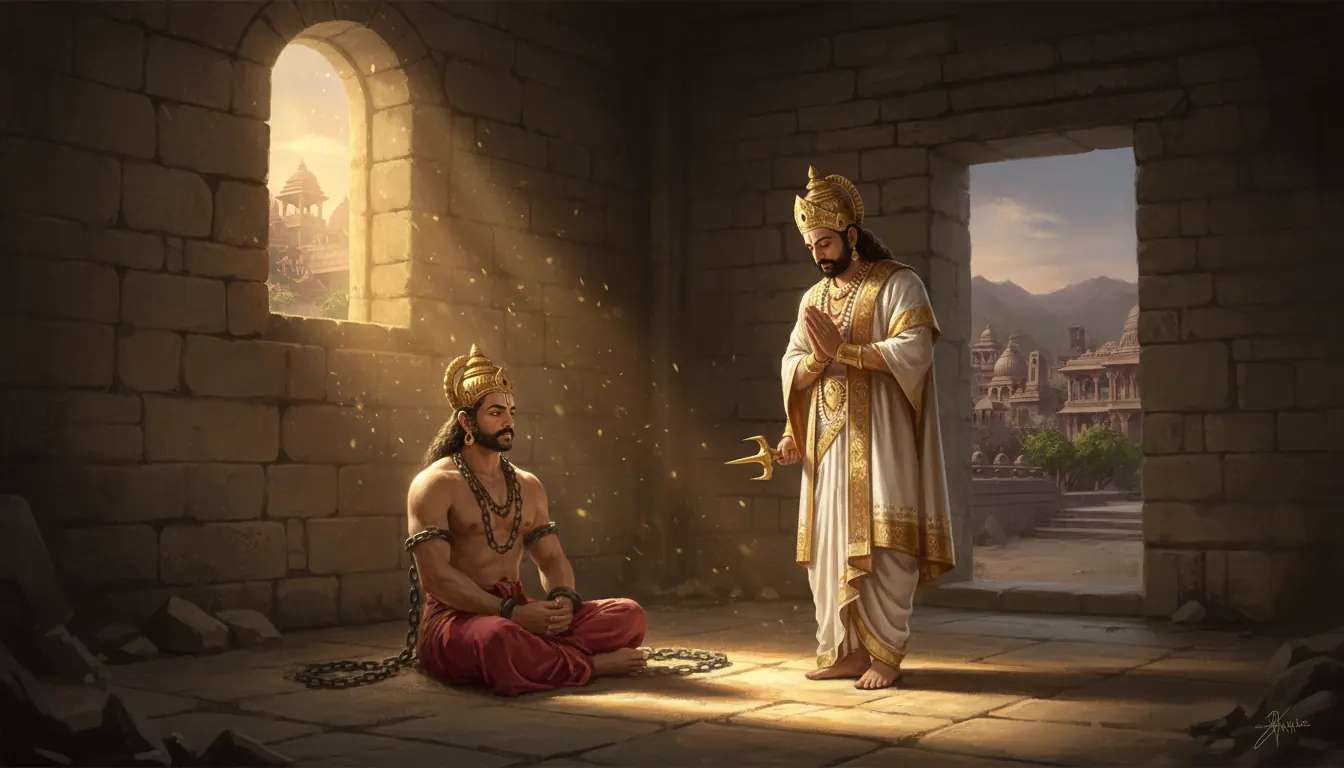
"Free from delusion and pride," said Bhishma, "always keeping to the quality of goodness, and devoted to various vows, he took praise and blame alike. Self-restrained, he was passing his time in an empty chamber.
"Understand what those last words mean before you go further. He had held the three worlds. He had had a court, and armies, and the tribute of everything under the sky. Now there was a room with nothing in it and a man sitting in the room, and that was the whole of his establishment.
"He knew the origin and the destruction of all created things, moving and unmoving, and he was never angry at what displeased him and never rejoiced at gaining what was pleasant. He looked with an equal eye on gold and a clod of earth."
"That is easily said of a man who has neither," said Yudhishthira.
"It is," Bhishma agreed. "It is also easily said of a man who has both. The difficulty is to say it of a man who has just stopped having gold and started having earth, in that order, in the same lifetime, and to have it be true. That is the case before us.
"Steadily engaged in the study of the Soul and in winning Emancipation, and firm in knowledge, he had reached settled conclusions about the truth. He knew what is highest among all things and what is not. He knew everything and saw everything. And he was sitting one day in a solitary chamber with his senses under complete control.
"That is a long description, and I have given you the whole of it on purpose. Every item in it is a thing that a man in his position could have claimed for himself falsely, and would have been believed, because who was left to contradict him? He said none of it. It is said of him.
"And it was then that Shakra approached him."
The Victor Comes to Wake Him
The king of the gods came in person, and Bhishma was careful to say why. He came wanting to awaken him.
That is a strange errand for a conqueror. Indra had beaten this man. He had taken the three worlds off him, put him in cords, and left him with an empty room. He had every reason to stay away and none at all to come. He came because something about the prisoner had got under his skin and would not come out, and he could not name it, and the only way to find out was to go and ask.
"King," said Shakra, "I see in you, lasting and settled, all the qualities by which a person wins the esteem of all. Your understanding seems like a child's, free from attachment and aversion. You know the Soul. What do you think is the best means of attaining knowledge of the Soul?"
Then he stopped being polite and said the thing he had come to say.
"You are bound in cords now. You have fallen from your former position. You have come under the power of your foes and been stripped of your prosperity. Your present state might well cause grief. Yet how is it, Prahlada, that you do not grieve? Is it, son of Diti, because you have gained wisdom, or because of your fortitude? Look at your misfortunes, and yet you seem happy and at peace."
He had listed the man's ruin item by item, in front of him, in his own prison. It was not cruelty. It was an accounting, and the accounts did not balance, and Indra wanted them explained.
There are only two ways a defeated king sits quietly, and the king of the gods knew both of them. Either he has understood something, or he has hardened himself and is enduring by force, and the second kind can be broken by naming the losses one at a time, which is what Indra had just done. Prahlada did not flinch at any of the items. So it was the first kind, and Indra had no idea how it worked.
Two Kinds of Men and What Bewilders Them
Pressed in this way by Indra, the chief of the Daityas, who had reached settled conclusions about the truth, replied in sweet words that showed great wisdom. He did not begin with his chains. He began a long way behind them.
"He who does not know the origin and the destruction of all created things," said Prahlada, "is bewildered because of that ignorance. But he who knows these two things is never bewildered.
"All kinds of things, existent and non-existent, come into being or cease because of their own nature. No personal effort is needed to bring this about. And since there is no personal effort, it is clear that there is no personal agent producing all that we perceive."
Indra had come to ask why a beaten man was not grieving, and was being told, before anything else, that there was no such thing as an agent anywhere in the universe.
"But though in reality the person never does anything," Prahlada went on, "yet through the influence of Ignorance a sense of being the doer spreads over him. He who regards himself as the doer of acts good or bad has a wisdom that is corrupted. Such a person, in my judgment, does not know the truth."
There was no complaint in it, and that is what unsettled his visitor. A prisoner who says he is not the author of his own downfall is usually excusing himself. This one was not excusing anything. He was making a general statement about everybody in the room, and one of the two people in the room had just conquered the universe.
If the Person Were Really the Doer
"Consider the proof," said Prahlada. "If, Shakra, the being called person were really the doer, then all the acts he undertook for his own benefit would certainly succeed. None of them would fail.
"Is that what you observe? Even when people struggle their hardest, we do not see them keep off what they do not want and gain what they do want. What, then, becomes of personal effort?"
He put it as a question, and it is a question with no answer in it. Every man who has ever wanted anything has strained after it with everything he had, and the thing has come or not come by some rule of its own that took no notice of the straining.
"And in the case of some," said Prahlada, "we see that without any effort of their own they keep off what they do not want and gain what they want. This, then, must be the work of Nature.
"Again, we see some people in strange situations. Though they have superior intelligence, they have to beg for wealth from others who are coarse in feature and have little intelligence."
Any man who has stood in a hall and watched a clever man beg from a stupid one knows the picture. If achievement followed effort and merit, that scene could not occur, and it occurs every day in every kingdom.
"Indeed, when all qualities, good or bad, enter a person at the urging of Nature, what ground has anyone to boast of what he possesses? All these flow from Nature. This is my settled conclusion. Even Emancipation and knowledge of self, according to me, flow from the same source."
He had shut the last door as he went out of it. A man arguing that achievement is not his own usually keeps one thing back for himself, and the thing he keeps is his wisdom. Prahlada handed that over with the rest. The composure Indra had come across the worlds to ask about was not, by its owner's account, an accomplishment of its owner either.
The Crow That Announces the Food
"In this world," Prahlada continued, "all fruits, good or bad, that cling to people are regarded as the result of acts. I will tell you fully about acts. Listen.
"As a crow, while eating some food, announces that food to the rest of its kind by cawing again and again, in the same way all our acts only announce the signs of Nature."
That is the whole of the teaching in one bird. The crow is not deciding to announce anything. It has found food, and the noise comes out of it, and other crows arrive. Nobody watching would say the crow had performed an act of generosity, or of folly, or of anything. It is simply what a crow does when there is food, and the cawing tells you what a crow is.
"He who knows only the transformations of Nature, and not Nature herself, who is supreme and exists by herself, is bewildered because of his ignorance. But he who understands the difference between Nature and her transformations is never bewildered. All existent things have their origin in Nature.
"Once one is certain of this, one will never be touched by pride or arrogance."
And there, at last, was the answer to the question Indra had come with, though it had arrived by a road nobody could have predicted. Pride and grief are not two conditions. They are one error read from two ends. The man who cannot boast about his rise also cannot be broken by his fall, because he never held the deed to either of them.
Nothing in Me for Grief to Hold
"Since I know the origin of all the laws of morality," said Prahlada, "and since I know how unstable all things are, I cannot grieve, Shakra. All this has an end.
"Without attachments, without pride, without desire and hope, freed from all bonds and detached from everything, I am passing my time in great happiness, watching the appearance and disappearance of all created things."
In a bare room, in cords, watching things appear and disappear, and calling it great happiness. Indra said nothing.
It is worth noticing what he did not say. He did not say that he had been wronged, or that the cords were unjust, or that the war had gone against him by some trick. He did not say that he had been a good ruler and deserved better. He did not mention the war at all. The subject of his own defeat, which was the only subject his visitor had raised, simply did not come up in his reply, because in the account he was giving there was nobody it could have happened to.
"For one who is wise, self-restrained and contented, who is without desire and hope, and who sees all things by the light of self-knowledge, there is no trouble or anxiety, Shakra.
"I have no affection or aversion for either Nature or her transformations. I do not see anyone now who is my foe, nor anyone who is my own."
The king of the gods was standing in front of him as he said it, and was included in it. He was not being forgiven, which would have been a kind of victory for him. He was being told, without heat, that the category of enemy had gone out of use.
"I never covet heaven, Shakra, or this world, or the lower regions. It is not that there is no happiness in understanding the Soul. But the Soul, being detached from everything, cannot enjoy happiness. So I desire nothing."
Heaven was the thing Indra had. This world was the thing Indra had taken. The lower regions were what was left to a defeated asura. The prisoner had just named all three of them and declined all three.
The Conqueror Asks to Be Taught
Then the king of the gods did the thing that makes this an old story worth repeating rather than an argument between two people who disliked each other.
"Tell me, Prahlada," said Shakra, "the means by which this kind of wisdom may be attained, and this kind of tranquillity made one's own. I beg it of you."
He had come in as a captor with a question meant to unsettle a captive. He was now asking to be given something, and using the word that suppliants use.
Prahlada answered him plainly, and there was nothing mysterious in the list.
"By simplicity, by watchfulness, by cleansing the Soul, by mastering the passions, and by serving one's elders, Shakra, a person succeeds in attaining Emancipation."
Five things, and four of them are ordinary discipline, and the fifth is sitting at the feet of old men and listening.
And then he took even that back, or rather he set it in its place, because he was not going to end by handing his visitor a method and calling it an achievement.
"But know this: one gains wisdom from Nature, and tranquillity too comes from the same cause. Indeed, everything else that you perceive comes from Nature."
So the doing is to be done, and the doer is still not the doer. Prahlada did not soften the contradiction or explain it away. He set the two halves down side by side and let his questioner carry them out of the room.
Indra Worships the Lord of the Daityas
"When the lord of the Daityas had spoken," said Bhishma, "Shakra was filled with wonder, and commended those words with a cheerful heart. Then the lord of the three worlds worshipped the lord of the Daityas, took his leave and went to his own abode."
Every word of that is worth weighing. He was filled with wonder, not with envy. He commended the words with a cheerful heart, and there was nothing in them that was comfortable for him. Then, having worshipped him, he asked leave to go, of a man in chains, in a room the visitor could have walked out of at any moment.
He left him bound. That should be said, because the story does not pretend otherwise. Nothing was restored. There was no reversal, no unbinding, no return of the three worlds. The most powerful being in the universe came, listened, bowed, and went home to the palace he had won, and behind him the chamber was as empty as before and the man in it was as content.
"That is my answer to your question, Yudhishthira," said Bhishma. "You asked whether a man is to be regarded as the doer of his acts. Here is a man who says he is not, and who was not saying it in order to escape the reckoning for anything, since he had already paid the whole of it.
"The one who believes he is the author of his fortune must also be the author of his ruin, and will be crushed by the second belief exactly as far as he was inflated by the first. Prahlada put down both at once, and what was left could not be reached by any misfortune, because there was nothing in him for a misfortune to take hold of.
"Indra had the three worlds and went away wanting something. Prahlada had a room, and did not."
Dharma Lesson
Pride and despair are the same mistake read from two ends, since both require a man to believe he is the author of what happened to him. Prahlada gives up the credit for his rise and is therefore untouched by the bill for his fall. The conqueror leaves the room wanting something, and the prisoner does not.