In short
A reciter of the Gayatri refuses to leave his body for heaven, and King Ikshvaku, arriving on pilgrimage, refuses the fruits of the recitation he himself solicited. While the two stand deadlocked, two ill-dressed men come in arm in arm, quarrelling over a gift of a cow, and force the king to judge. His ruling convicts him, and the litigants reveal who they are.
Told in the Shanti ParvaSet in Kurukshetra and Himavat20 min read
The Dispute You Mentioned in Passing
Bhishma had let a thing drop in the middle of a longer answer, the way a man does when he has told a story so often that he forgets his listener has not heard it, and Yudhishthira had been holding on to it ever since.
"You mentioned," the king said, "the dispute between Time, Mrityu, Yama, Ikshvaku and a brahmana. Please tell me the story in full."
It is a strange list of litigants. Three are the powers that carry every creature out of the world, one is a king of the solar line, and one is not named at all.
"On this subject," Bhishma said, "people tell the old story of what passed between Surya's son Ikshvaku, a certain brahmana, Time and Mrityu. Listen, and I will tell you what happened, what they said to one another, and where it took place."
He was careful about the place, which is a thing an old man is careful about.
"There was once a brahmana of great fame and devout conduct. He was a Reciter. He was very wise and knew the six Angas well. He was of the Kushika line, the son of Pippalada, and through his austerities he had gained a spiritual insight into the Angas. He lived at the foot of Himavat and was devoted to the Vedas."
A Reciter is not a sacrificer, not a teacher, not an ascetic who stands in water. He says a mantra, silently, and then says it again, and his whole religion is the repetition. This one had chosen the Gayatri.
A thousand years passed over his head while he kept his vows and fasts.
The Goddess Who Was Not Answered
At the end of that thousand years the goddess showed herself to him.
Savitri, who is the mother of the mantra he had been saying, stood in front of the man who had been saying it, and told him the sentence that every ascetic in the world is working toward.
"I am pleased with you."
And the brahmana went on reciting the sacred mantra, kept silent, and did not say a word to the goddess.
He did not break off. He had a count to keep, and the goddess of the verse could stand there until he had finished, and she did. She felt compassion for him and was deeply pleased, and she, the mother of the Vedas, praised the recitation he was engaged in.
Only after finishing the day's portion did he stand up, and bend his head, and prostrate himself at her feet.
"By good luck, goddess, you are pleased with me and have shown yourself to me. If you really are pleased with me, the boon I ask is that my heart may delight in recitation."
"What do you ask, twice-born rishi?" she said. "What wish of yours shall I fulfil? Tell me, best of Reciters, and everything will be as you wish."
He was being offered anything, by the goddess of the verse, after a thousand years of earning it, and what he asked for was more of the same work.
"Let my desire to go on reciting grow stronger every moment. And, auspicious goddess, let my mind sink ever more completely into Samadhi."
"Let it be as you wish," she said sweetly. And then, wanting to do him good, she told him what was coming, so that he would not be surprised by it.
"You will go to the region of Brahma, which is uncreated and free from every flaw. I am leaving now, but what you have asked of me will come about. Go on reciting with a restrained soul and close attention. The god Dharma will come to you in person. Time, Mrityu and Yama will also come before you. There will be a dispute here between them and you on a question of right conduct."
Then she went back to her own home, and the brahmana kept on reciting for a hundred celestial years more, restraining anger, controlling himself, devoted to truth and free from malice.
I Will Not Cast Off This Body
When that observance was complete, Dharma was pleased with him and showed himself to him.
"Twice-born one, look at me: I am Dharma. I have come here to see you. You have won the reward of the recitation you have been engaged in. Listen and I will tell you what that reward is. You have won all the blessed regions that belong to gods and men alike. You will rise above all the homes of the deities. So, ascetic, give up your life breath and go to whatever regions you please. By casting off your body you will win many blessed regions."
It is the standard settlement. The man has earned heaven, heaven is entered by dying, therefore die.
"What do I want with these blessed regions you speak of?" said the brahmana. "Dharma, go wherever you please. I will not, mighty lord, cast off this body, which knows a great deal of happiness and misery."
He had named the terms of his own body correctly and then kept it anyway. Not a body of bliss. A body in which things go well and badly by turns, and he wanted that one.
"Your body certainly ought to be cast off," said Dharma. "Rise to heaven. Or tell us what else would please you, sinless one."
"I do not want to live in heaven itself without this body of mine. Leave me, Dharma."
"Do not set your heart on your body. Cast it off and be happy. Go to regions that are free of the quality of Passion. Once you are there, you will never have to feel any misery."
"Most blessed one, I take great pleasure in recitation. What need have I of those eternal regions you speak of? I do not want to go to heaven even with this body of mine."
That is the third refusal, and it gives the whole away. He was not clinging to his flesh and he was not afraid of dying. He did not want the prize. He had come to like the work better than the wages, which was the exact boon he had asked the goddess for, and this was what it looked like when it was paid out.
"If you do not want to cast off your body," said Dharma, "then look, twice-born one: here come Time, Mrityu and Yama, all approaching you."
Water for the Feet of Death
The son of Vivaswat, Time and Mrityu came up together, the three who snatch all creatures from the earth, and each made his announcement.
"I am Yama. I tell you that a high reward awaits you for these penances, so well performed, and for the devout life you have led."
"You have won a high reward, equal to the course of recitation you have finished," said Time. "The time has come for you to rise to heaven. I am Time, and I have come to you."
"You who know what is right," said Mrityu, "know that I am Mrityu herself, in my true form. I have come to you in person, sent by Time, to carry you away."
And the brahmana greeted them like guests.
"Welcome to Surya's son, to great-souled Time, to Mrityu and to Dharma. What can I do for you all?"
Then, at that meeting, he gave them water to wash their feet and the usual offerings of the Arghya, and he was deeply pleased, and he asked them again, "What can I do for you all with whatever power I have?"
There is a great deal in that. Four powers had come to take him out of the world, and he treated their arrival as a call at a poor man's door, and did the small sequence a householder does: water, then the offering, then the question. He was not defying them and not negotiating. He had simply not accepted that this was a summons, and nothing in the etiquette of the three worlds let them correct him.
And it was exactly at that moment, with Death sitting on the ground having her feet washed, that a fifth person walked into the clearing.
A King Who Does Not Know the Word Give
King Ikshvaku, who had set out on a pilgrimage to the holy waters and shrines, came to the spot where the deities were gathered.
He did not know what he had walked into and it made no difference to his manners. The royal sage bowed his head, paid homage to them all, and asked after the welfare of each one. And the brahmana gave the king a seat, water to wash his feet and the usual Arghya, exactly as he had given them to Death a moment before.
"You are welcome, great king. Tell me all your wishes. Tell me what I may do for you with whatever power I have."
"I am a king," said Ikshvaku. "You are a brahmana who keeps the six well-known duties. I cannot ask. I will give you some wealth. That is the known custom. Tell me how much I should give you."
"There are two kinds of brahmanas, king, and righteousness too is of two kinds: devotion to work and withdrawal from work. As for me, I have given up accepting gifts. Give presents to those whose duty it is to accept them. I will not accept any gift. Instead, I ask you: what would be for your good? What can I give you? Tell me, and I will do it by the power of my penances."
So the giver had been refused, and the man who never accepts had turned round and offered.
"I am a kshatriya," said the king. "I do not know how to say the word Give. The only asking we know is to say: Give us battle."
"You are content to keep the duties of your order," said the brahmana. "In the same way, I am content with the duties of mine. There is little difference between us. Do as you please."
"You were the first to speak, when you said, I will give you whatever I can. So I am asking you. Give me the fruits of this recitation you have completed."
"You were boasting that your words only ever ask for battle," said the brahmana. "Why then do you not ask me for battle?"
"It is said that brahmanas are armed with the thunder of speech, and that kshatriyas have the strength of their arms. So, learned brahmana, this war of words has broken out between you and me."
Neither Will Take What the Other Offers
"Take the highest fruit of the recitations I have completed," said the brahmana. "Take half of that fruit, without any hesitation. Or, if you like, take the whole fruit of my recitations."
And the king, who had asked for exactly this a minute earlier, drew back from it.
"May you be blessed. I do not need the fruits of your recitations that I asked for. Blessings on your head. I am about to leave you. But tell me what those fruits are."
"I do not know what fruits I have won. But I have given you the fruits I gained by recitation. Dharma, Time, Yama and Mrityu here are witnesses to the gift."
That is the sentence that shut the door. Four powers stood there named as witnesses to a completed gift, and so, in the record of the universe, the transfer had already happened.
"What good will the unknown fruits of your observances do me?" said the king. "If you will not tell me what they are, let them stay yours, for I certainly do not want them."
"I will not accept any other word from you. You said, Give. I said, I give. I will not make those words false. Keep to the truth. Be calm. If you refuse to keep my word, king, your sin of falsehood will be great."
And then the Reciter, who had kept silent through all those years of recitation, argued, and it turned out that a man who says one verse for that long has thought about what a word is.
"We have heard that once upon a time Truth and all religious observances were placed on a pair of scales. When both were weighed, the pan that held Truth was seen to be the heavier. Why, king, do you want to do something stained with falsehood? Why would you make false your own words, Give me, which you spoke? A person who does not give after promising, and one who does not accept after asking, are both stained with falsehood."
"To fight and to protect are the duties of kshatriyas," said the king. "It is said that kshatriyas are givers. How then can I take anything from you?"
"I never pressed you. I did not come to your house. You came here yourself and asked me. Why then do you not take?"
Dharma offered to settle it. Heaven itself arrived in embodied form and offered to settle it, and the king sent Heaven away. Neither man moved: two righteous persons deadlocked over which of them was to be allowed to be generous.
Two Men With Their Arms Round Each Other
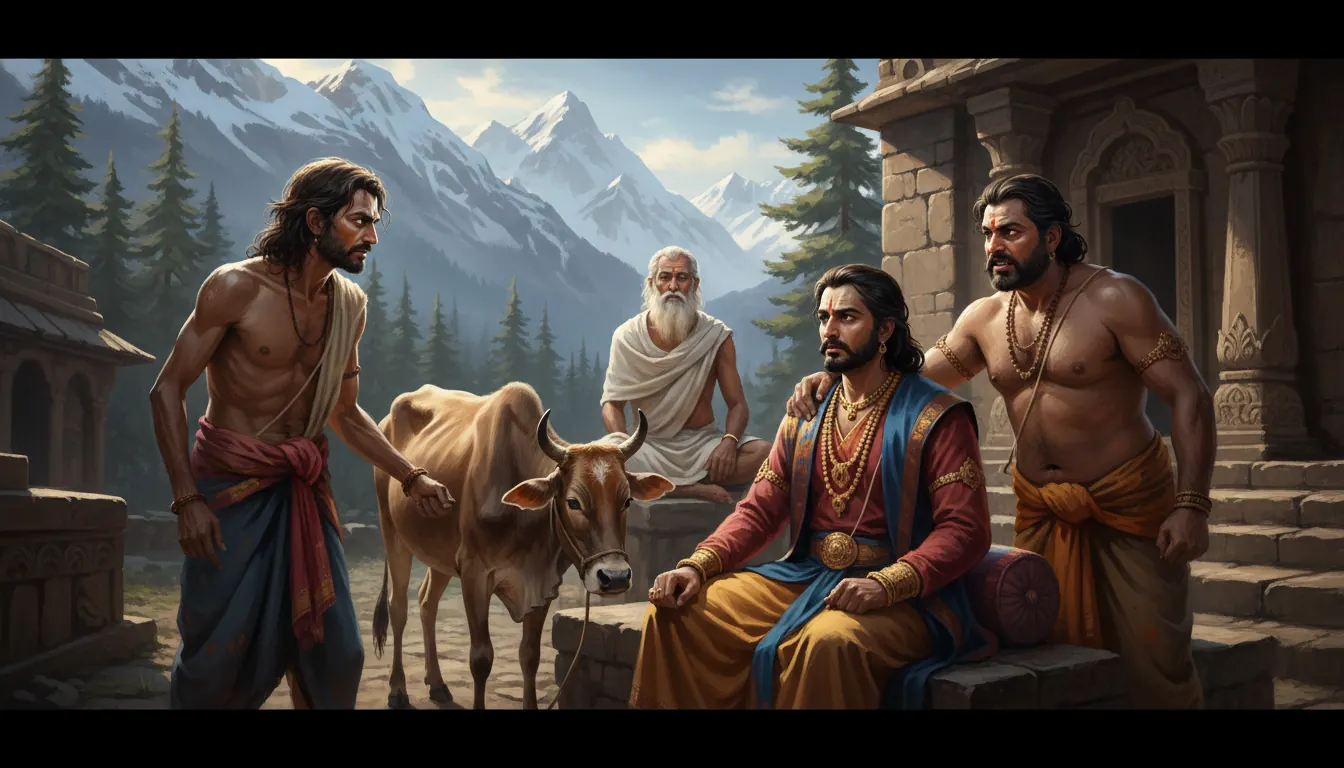
At this point two very ungainly-looking men arrived.
Each had his arm upon the other's shoulder. Both were ill-dressed. And they were quarrelling, in the loud undefended way of men who have been at it down the whole length of a road, and they came into a clearing where four deities and a king and a thousand-year ascetic were standing in silence, and did not notice any of them.
"You owe me nothing. It is I who owe you."
"That is not true. I am the one in your debt."
"If we are going to argue like this, here is the king who rules over people."
They were growing very heated, and then both of them turned on Ikshvaku at once, and what they asked him for was not a favour.
"King, see to it that neither of us is stained with sin."
That is the phrase they chose, in front of a man who had just spent an hour refusing a gift on the ground that taking it would stain him. Nobody remarked on it. A dispute had been brought to a king, and there is no provision anywhere for a king to say that he is busy.
"King, I owe my companion Vikrita the merit of the gift of a cow," said the first of them. "I am willing to pay off that debt. But this Vikrita refuses to be repaid."
"King, this Virupa owes me nothing," said the other. "He is telling a lie that looks like the truth."
A falsehood with the appearance of truth. Neither of them was what he appeared, and the king had no way of knowing it.
"Tell me, Virupa, what it is that you owe your friend here," said Ikshvaku. "I mean to hear you, and then do what is right."
One Cow, and Then Two
"Listen carefully, king, to the whole matter in detail.
"Some time ago this Vikrita, to win merit, gave a fine cow to a brahmana devoted to penances and to the study of the Vedas. I went to him, king, and begged him for the reward of that act. And Vikrita, with a pure heart, made me a gift of that reward.
"Then, to purify myself, I did some good deeds. I also bought two kapila cows with their calves, both of which gave plenty of milk. And I gave those two cows, with the proper rites and true devotion, to a poor brahmana who lived by gleaning.
"Since I once accepted the gift from my companion, lord, I want to repay him here and now with twice the reward."
The arithmetic is exact, and that sort of accounting is done by only two kinds of people: the very scrupulous, and the ones building a trap. Vikrita gave one cow and earned the merit of it. Virupa asked for that merit and was given it. Then Virupa bought two brown cows in milk, with calves at foot, and gave them in due form to a brahmana living on gleanings. Two for one, and he wants it recorded that he is handing back double.
"Things being so, best of men, which of us two is innocent and which is guilty, in your judgment? We have come to you arguing about this. Whether you judge rightly or wrongly, settle us both in peace. If my companion here will not take back from me a gift equal to the one he gave me, you will have to judge patiently and set us both on the right path."
The king had spent the afternoon refusing to take what a brahmana was pressing on him. He listened to the case, did not hear his own name in it, and gave judgment.
I Think You Deserve Punishment
"Why will you not accept repayment of the debt that is owed to you?" the king said to Vikrita. "Do not delay. Accept what you know is your due."
"This man says he owes me," said Vikrita. "I tell him that what I gave, I gave away. So he owes me nothing. Let him go wherever he likes."
"He is ready to give to you. But you are unwilling to take. That does not seem right to me. I think you deserve punishment for it. There is little doubt about that."
There it is. A king of the solar race, standing between a brahmana whose gift he had refused for an hour and a stranger in rags, had just ruled that a man who will not accept what is offered deserves to be punished by the crown.
"I made him a gift, royal sage," said Vikrita. "How can I take it back? If I am guilty in this, then pronounce the punishment."
"If you refuse to take when I am ready to give," said Virupa, "this king will certainly punish you, for he upholds justice."
"He asked me, and I gave him what was mine. How can I take it back now? You may go away. You have my leave."
And the brahmana of the Kushika line, silent through the whole of it, spoke at last, and needed one sentence.
"You have heard what these two said, king. Now take, without hesitation, what I have pledged to give you."
The king heard it land.
"This matter is as deep as a bottomless pit," he said. "Where will this Reciter's stubbornness end? If I do not accept what this brahmana has given, how can I escape being stained with a great sin?"
He turned to the two disputants and dismissed them, and there was something worn in the way he did it.
"Go, both of you, each with what you wanted. I must see that the duties of kingship entrusted to me do not come to nothing. It is settled that kings must keep the duties laid down for them. But to my misfortune, the duties prescribed for brahmanas have taken hold of my wretched self."
We Two Are Desire and Wrath
"Accept, king. I owe it to you," said the brahmana. "You asked for it, and I am pledged to give. But if you refuse to take, I will certainly curse you."
"Shame on the duties of kings, if this is where they lead in the end," said Ikshvaku. "Still, I will take what you give, for this reason alone: so that the two paths of duty may be made exactly equal. Here is my hand, which was never before held out to accept a gift. Now it is held out, to accept and also to give. Give me what you owe me."
"If I have won any fruits by reciting the Gayatri, accept them all."
And the water was poured, as it is poured over the palm at every gift that has ever been made in that country.
"Look, best of brahmanas, these drops of water have fallen on my hand," said the king. "I too want to give to you. Accept my gift. Let there be equality between us."
Then Virupa spoke, and he was not speaking as a man in rags any more.
"Know, king, that we two are Desire and Wrath. It was we who led you to act this way. You have made a gift in return to the brahmana. Let you and this twice-born man be equal in the blessed regions of the next world. This Vikrita does not really owe me anything. We appealed to you for your own sake.
"Time, Dharma, Mrityu and we two have tested everything about you, right here in front of you, by stirring up this friction between you and that brahmana. Go now, as you choose, to the blessed regions you have won by your deeds."
The debt had never existed. The cow had never needed repaying. The two of them had staged a quarrel in front of a king because there was no other way to find out what that king actually believed, and the friction they were sent to produce was not between them at all. It was between Ikshvaku and the Reciter, and neither man could see it from inside.
So they set the same question in front of him wearing somebody else's clothes, and he answered it in a sentence. A man who refuses what is offered deserves punishment. Having heard himself say it, he could not go on.
"I have now told you," said Bhishma from the arrows, "how Reciters win the fruits of their recitation, and what their end is."
But that was not what he had told, and Yudhishthira, who had been sitting in the sand being lectured on kingly duty for weeks, would have known it. He had been told that Desire and Wrath do not come to a man as desire and wrath. They arrive ill-dressed, arm in arm, arguing about somebody else's cow, and ask him to be fair.
Dharma Lesson
A judge who rules honestly on a stranger's quarrel has already ruled on his own. Ikshvaku spent an afternoon refusing what a brahmana pressed on him and then declared, of a man in rags, that refusing an offered payment deserves punishment. Desire and Wrath do not arrive as desire and wrath; they arrive arguing about somebody else's cow and ask you to be fair.