When Forgiveness Is Not a Virtue
An angry queen quotes an asura grandfather at a patient king
In short
At Dvaitavana, Draupadi tells Yudhishthira that only four men in Hastinapura failed to weep when he walked out in deer-skin, and that his patience is read as weakness. She quotes Vali's question to Prahlada and the answer that neither constant forgiveness nor constant force is meritorious. Yudhishthira replies that anger kills even teachers.
Told in the Vana ParvaSet in Dvaitavana17 min read
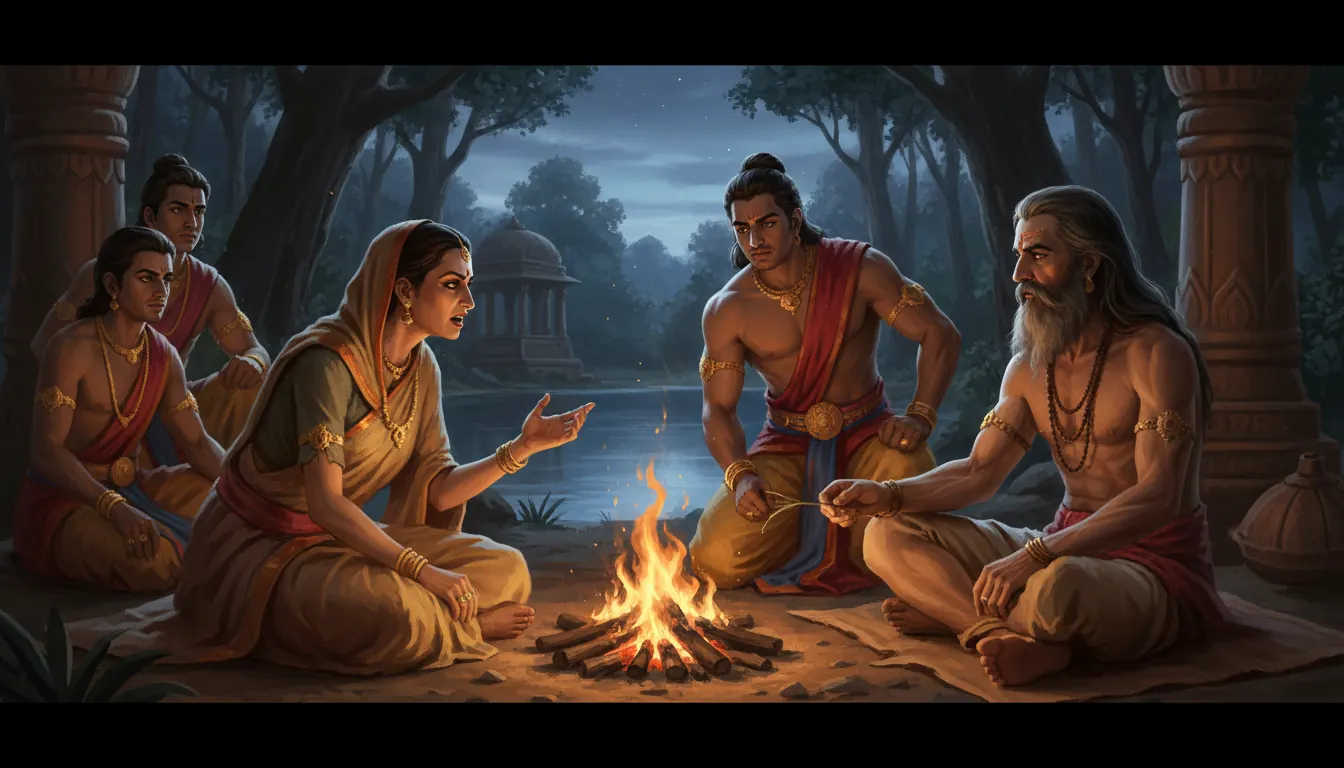
Evening at Dvaitavana
Vaishampayana said: In the woods, in the evening, the sons of Pritha sat with Krishna of the dark skin and talked, and their talk was full of sorrow and grief.
She was handsome and she was well informed, and she was dear to her lords and devoted to them, and it was she who broke the quiet.
"That sinful, cruel, wicked-minded son of Dhritarashtra certainly feels no sorrow for us," Draupadi said to Yudhishthira. "He sent you into the woods dressed in deer-skin, and me with you, and he feels no regret at all. The heart of that wretch of evil deeds must be made of steel, that he could stand there and speak such harsh words to you, his virtuous eldest brother. You deserve every happiness and never such misery as this, and he has brought you to it, and he sits with his friends and rejoices."
She had been waiting some days to say it. The camp was quiet, the fires of the brahmanas were burning at a distance under the trees, and her husbands were where she could see all five of them at once, which had a good deal to do with what came next.
Only Four Did Not Weep
"Bharata," she said, "when you put on deer-skin and set out for the woods, only four people in that whole city did not shed tears."
She counted them for him on her fingers, and she got them right, and there were exactly four.
"Duryodhana. Karna. The evil-minded Shakuni. And Dushasana, that bad and fierce brother of Duryodhana. Apart from these, best of the Kurus, all the other Kurus were filled with sorrow and shed tears."
Four men out of a whole city. It is a fact worth holding on to, because it tells you what kind of quarrel this was. The city had wept. The elders had wept. Bhishma had wept, and Drona, and Vidura, and the women at the windows, and the men in the street. The whole apparatus of the Kuru house had stood there in tears while four men did the thing it was weeping about, and not one of the weepers had put out a hand.
Draupadi had watched all of it from inside the procession, and she had drawn the conclusion that tears are cheap, and that a house full of people who are sorry is not the same as a house with anyone in it who will act.
The Ivory Seat and the Kusa Grass
"When I see this bed of yours and remember what you had before, I grieve for you, king, for you deserve no sorrow and were brought up in every luxury.
"I remember that seat of ivory in your court, decked with jewels. Then I look at this seat of kusa grass, and grief consumes me. I saw you surrounded by kings in your own hall. What peace can my heart know now that I no longer see you so? I saw your body bright as the sun and smeared with sandal paste; now I see it smeared with mud and dirt, and grief robs me of my senses. I saw you dressed in silken clothes of pure white, and now I see you in rags.
"Food of every kind, pure food, was carried out of your house on plates of gold for brahmanas by the thousand. You gave the best of food to ascetics, both the homeless and those living in their own homes. Living in your mansion, you filled plates by the thousand with food of every kind, and worshipped the brahmanas and granted their every wish. What peace, great king, can my heart know now that I no longer see all this?
"And these brothers of yours, young and decked with ear-rings, used to be fed by cooks with sweet food prepared with skill. Now I see them all, who deserve no sorrow, living in the woods on whatever the woods may yield. My heart knows no peace."
She was not making a list of luxuries. She was making a list of the gifts he could no longer give, which was the wound that would actually reach him, and she knew it.
Why Does Your Anger Not Blaze
Then she turned the question on him, and asked it once for each man in the camp, and would not let it go.
"When you think of Bhimasena here, living in sorrow in the woods, does your anger not blaze up, even now, when the time has come? He does everything unaided. He is ready to kill all the Kurus in battle. He bears all this sorrow only because he is waiting for you to keep your promise.
"This Arjuna, though he has only two hands, is as quick of hand as that Arjuna who had a thousand arms. He is like Yama himself at the end of the Yuga. It was by the power of his weapons that all the kings of the earth were made to wait on the brahmanas at your sacrifice. That tiger among men is worshipped by gods and Danavas alike: why are you not indignant to see him so troubled? From a single chariot he defeated gods and men and serpents. He took their treasures from the kings of the earth by force. In a single burst he can shoot five hundred arrows. Why does your anger not blaze at the sight of him in exile?
"Why does it not blaze at the sight of Nakula, so fair and strong and young, the finest of all swordsmen? Why do you forgive the foe when you see Madri's son, the handsome and brave Sahadeva? And why do you forgive him when you see me in exile, I who was born in the race of Drupada, the sister of Dhrishtadyumna, the daughter-in-law of the illustrious Pandu, and the devoted wife of heroes?
"Truly, best of the Bharatas, you have no anger in you, or your mind would be moved at the sight of your brothers and of me. They say there is no kshatriya in the world without anger. In you I now see the proverb proved wrong. The kshatriya who does not show his energy when the moment comes is always despised by every creature."
Vali's Question
"On this subject," Draupadi said, "people cite the ancient story of the conversation between Prahlada and Vali, the son of Virochana."
And it should be noticed what she was doing, because it is not a small thing. She was arguing dharma with the man reputed to know the most of it in the world, and she did not argue from her own grievance. She reached for an authority, and the authority she reached for was an Asura: Prahlada, chief of the Asuras and the Danavas, of great wisdom and well versed in the mysteries of the science of duty, whose righteousness was so unarguable that even the gods conceded it.
"One day Vali asked his grandfather this question. 'Sire, is forgiveness the greater virtue, or might and energy? I am puzzled about this. Enlighten me, for I am asking you. You know every duty, so tell me truly which of the two is better. I will strictly obey whatever you command.'
"And his wise grandfather, who knew every conclusion, answered the whole question for the grandson who had come to him to settle his doubt.
"'Know these two truths for certain, child,' said Prahlada. 'Might is not always a virtue, and forgiveness is not always a virtue either.'"
Yudhishthira was listening. He had been listening from the beginning, and he had not interrupted once, and a lesser man would have stopped her at the word Asura and asked what a chief of the Danavas could possibly teach the son of Dharma. He let her go on, because he had noticed what she had chosen. Prahlada had been on the losing side of everything. Yet he had once judged against his own son rather than speak a falsehood for him, and his righteousness was questioned by no one on either side. If any authority in the three worlds had earned the right to say where patience stops being a virtue, it was that one.
The Man Who Always Forgives
"'The man who always forgives suffers many evils,'" Draupadi went on, in Prahlada's words. "'Servants and strangers and enemies all despise him. No creature ever bows to him. That is why, child, the learned do not praise a constant habit of forgiveness.
"'The servants of a man who always forgives despise him and fall into many faults. These mean-minded men also try to take his wealth from him. Base servants take for themselves his vehicles, his clothes, his ornaments and his apparel, his beds and his seats, his food and his drink and everything else he uses. They do not give others the things their master tells them to give. Nor do they even worship their master with the respect that is his due. And contempt in this world is worse than death.
"'Child, sons and servants and attendants, and even strangers, speak harshly to the man who always forgives. Those who despise a man of endlessly forgiving temper even desire his wife, and his wife too grows ready to do as she pleases. And servants who love pleasure, if they never receive even light punishment from their master, fall into every sort of vice, and the wicked always harm such a master. These and many other faults cling to those who always forgive.'"
It is a hard passage, and she recited it without softening a word of it, in a forest camp, to a husband who had lost a kingdom by not saying no.
The Snake in the House
"'Now listen, son of Virochana, to the faults of those who never forgive,'" she continued, and she gave that side its full weight too, because Prahlada had.
"'The man of wrath, wrapped in darkness, who by his own energy always inflicts every kind of punishment on people whether they deserve it or not, is bound to be cut off from his friends because of that energy of his. Relatives and strangers alike hate him. Because he insults others, he loses his wealth and reaps contempt, sorrow, hatred, confusion and enemies. In his anger the man of wrath punishes others and gets harsh words in return. He is soon stripped of his prosperity, and even of his life, to say nothing of friends and relatives.
"'The man who turns his might on his benefactor and his enemy alike frightens the whole world, as a snake that has found shelter in a house frightens the people who live there. And what prosperity can a man have when the world is afraid of him? People always strike at him when they find a weak spot.
"'So men should never show might in excess, nor forgiveness on every occasion. One should use might and show forgiveness each at its proper time. The man who forgives at the proper time, and is harsh and mighty at the proper time, finds happiness both in this world and in the next.'"
The Occasions of Forgiveness
"'Now I will set out in detail the occasions for forgiveness, as the learned have laid them down, which everyone should always observe. Listen to me as I speak.
"'A man who has done you a service should be forgiven even if he does you a grave wrong, in memory of his earlier service. Those who have offended out of ignorance and folly should also be forgiven, for learning and wisdom are not always easy for a man to attain. Those who have offended you knowingly and then plead ignorance should be punished, even if their offences are trivial. Such crooked men should never be pardoned. Every creature's first offence should be forgiven. The second should be punished, even if it is trivial. But if a man offends against his will, it is said that his plea should be examined with careful enquiry, and he should be pardoned.
"'Humility can overcome might, and humility can overcome weakness. There is nothing humility cannot accomplish. So humility is truly fiercer than it seems. A man should act with regard to place and time, taking account of his own strength or weakness. Nothing undertaken without regard to place and time can succeed. So always wait for place and time. And sometimes offenders should be forgiven out of fear of the people. These are declared to be the times for forgiveness. On any other occasions, might should be used against those who do wrong.'"
Then Draupadi stopped quoting, and applied it, which was the whole reason she had begun.
"So I believe, king, that the time has come for you to use your might. Against those Kurus, the greedy sons of Dhritarashtra, who always harm us, this is not the time for forgiveness. You must use your might. The humble and forgiving man is despised, while the fierce persecute others. He is truly a king who uses both, each in its time."
Anger Kills Even Teachers
"Anger is the slayer of men," Yudhishthira said, "and it is also what makes them prosper. Know this, wise one: anger is the root of all prosperity and of all adversity. The man who holds his anger in check prospers. The man who always gives way to it reaps adversity from that fierce anger of his.
"We see in this world that anger is the cause of the destruction of every creature. How then can someone like me give way to a thing so destructive of the world? The angry man commits sin. The angry man kills even his teachers. The angry man insults even his superiors with harsh words. The angry man cannot tell what should be said from what should not. There is no deed an angry man will not do, and no word he will not say. In anger a man may kill one who does not deserve to be killed, and worship one who deserves to be killed. The angry man may even send his own soul to the realm of Yama.
"Seeing all these faults, the wise master their anger. And when I reflect on all this, daughter of Drupada, my anger is not roused.
"A man who does not strike back at someone whose anger has been roused saves both himself and the other from a great danger; in fact he may be called the physician of both. And if a weak man, persecuted by others, foolishly grows angry with men stronger than himself, he brings about his own destruction, and for one who throws his life away like that, deliberately, there are no worlds to gain hereafter.
"Lady of fair hips, the angry man does not see things as they truly are. The angry man does not see his way, nor does he respect anyone. Those whom the learned regard as having true force of character are surely those whose anger is only outward show. A man overwhelmed by anger does not easily gain generosity, or dignity, or courage, or skill, or the other qualities that belong to real force of character.
"The ignorant always take anger for energy. It is not. By giving up anger a man can show true energy, whereas it is very hard for an angry man to show his energy at the right time. Men of learning and true insight say that a man has force of character when his wisdom can master his rising anger. Truth is better than untruth, and gentleness better than cruelty. How then can someone like me, even to kill Duryodhana, show an anger that has so many faults in it, an anger the virtuous banish from their souls?"
Forgiveness Is the Earth
"If there were no men as forgiving as the earth," he went on, "there would be no peace, only endless strife born of anger. If the injured returned their injuries, if a man punished by his superior punished his superior in return, the result would be the destruction of every creature. If a man who has been spoken to harshly answers in the same words; if fathers kill sons, and sons fathers; if husbands kill wives, and wives husbands; then how, Krishna, can any birth take place in a world where anger rules like this? For creatures are born out of peace. And it is because there are men in the world as forgiving as the earth that creatures have their life and their prosperity.
"The glorious and forgiving Kashyapa sang verses on this. Forgiveness is virtue, forgiveness is sacrifice, forgiveness is the Vedas, forgiveness is the Shruti. Forgiveness is Brahma, forgiveness is truth, forgiveness is stored ascetic merit, and it is forgiveness that holds the universe together. Forgiveness is the might of the mighty. How, Krishna, can people like us give up a thing in which Brahma and truth and wisdom and the worlds are established?"
Then he named the men he was counting on, and the list is the whole of his policy.
"Our grandsire, the son of Shantanu, will worship peace. Krishna the son of Devaki will worship peace. The teacher Drona will speak of peace, and Vidura called Kshatri; Kripa and Sanjaya will preach it too; and Yuyutsu, and Drona's son, and our grandsire Vyasa, every one of them speaks always of peace. Urged toward peace by these men, king Dhritarashtra will, I think, give us back our kingdom. But if he gives way to temptation, he will meet destruction. A crisis has come in the history of the Bharatas, lady, and this has been my settled conclusion for some time.
"Suyodhana does not deserve the kingdom, and that is why he has not been able to gain forgiveness. I deserve the sovereignty, and that is why forgiveness has taken hold of me."
Draupadi heard him out, and she was not consoled, and she did not pretend to be.
"I bow down to Dhatri and Vidhatri," she said, "who have clouded your mind like this."
And the fire burned lower, and neither of them had moved the other, and both of them had been right, and there were still twelve years to go.
Dharma Lesson
Neither forgiveness nor force is a virtue in itself; the whole of the art is knowing which one the hour is asking for. Prahlada teaches that the man who forgives always is robbed in his own house and the man who is fierce always is feared like a snake in the rafters, and both lose everything they were trying to keep.