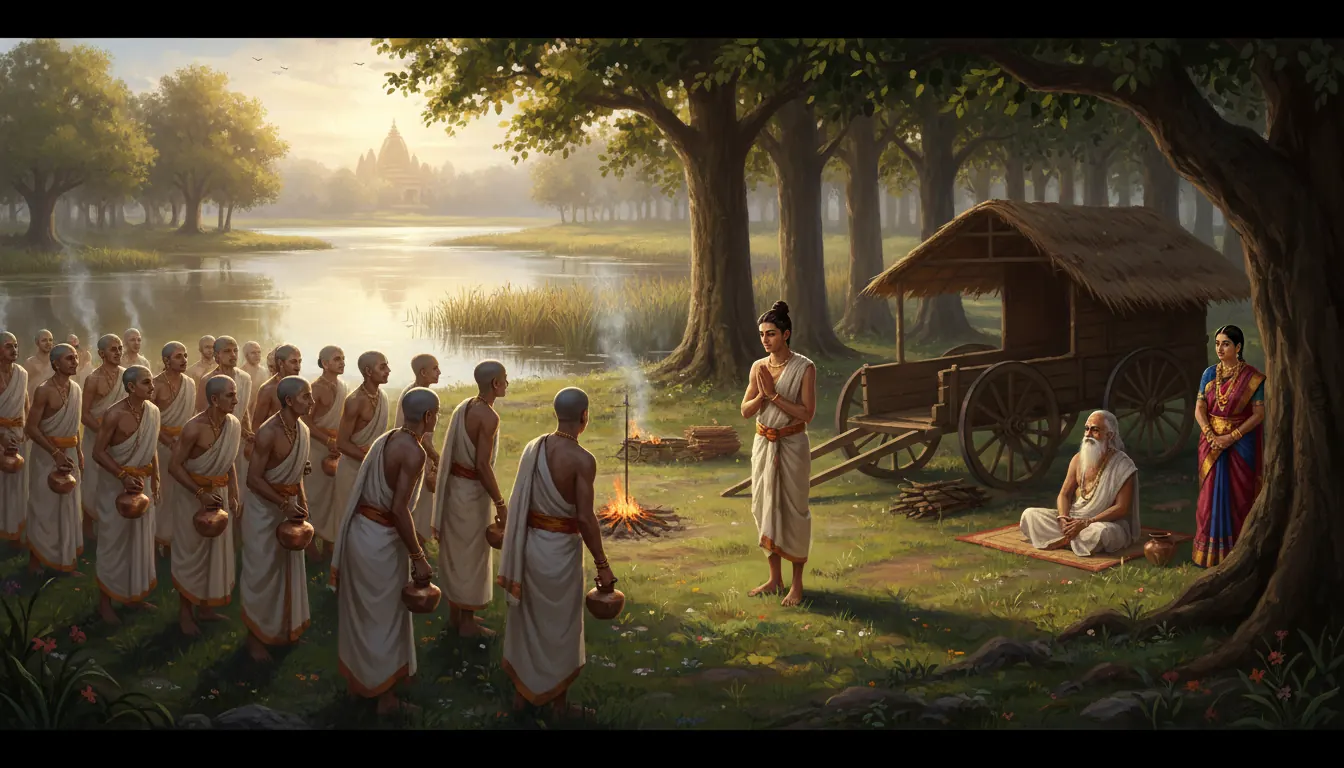
The Court of Sages at the Dvaita Lake
An exile that filled up with brahmanas instead of soldiers
In short
Settled among the sala trees by the Saraswati, the Pandavas watch their camp turn into a hermitage. Markandeya arrives and smiles while everyone else grieves, because he is remembering Rama on the Rishyamuka hills. Then Vaka of the Dalbhya line tells Yudhishthira why brahma energy joined to kshatra energy is fire fed by wind, and what King Vali lost.
Told in the Vana ParvaSet in Dvaitavana, Saraswati and Rishyamuka Mountain17 min read
The Sala Woods by the Saraswati
Fallen on hard times, said Vaishampayana, those princes found at last a pleasant place to live in that forest. The Dvaita woods stood thick with sala trees, and the Saraswati ran along the edge of them, and the five brothers who were like so many Indras began, in that place, to move as men move who have decided to live somewhere rather than merely to pass through it.
Yudhishthira set himself to the one work that cost him nothing and was all he had left to spend. Every yati and every muni in that forest, every principal brahmana who had followed them out of the kingdom or was already settled on those shores, he sought out and honoured with offerings of excellent fruits and roots. Bhima brought in what the deeper woods gave. Arjuna kept the camp in meat and the bowstring busy. Draupadi, who a season before had been waited on by a household of women in Indraprastha, learned instead the order of a hermitage kitchen and the number of guests it must feed before nightfall.
And Dhaumya, their priest, a man of great energy, who was like a father to those princes, did not let the calendar of a royal house lapse merely because the house was gone. He performed for them the rites of Ishti and the Paitreya offerings to the fathers, there in the great forest, at the proper hours, with whatever the forest gave. The smoke of a Kuru sacrifice went up over the sala trees as though the Kuru sacrificer still had a hall to raise it in.
It was a kingdom of a kind. It had no revenue, no army and no wall. What it had, and what began that season to gather to it in numbers no one had planned for, was brahmanas.
A Guest of Blazing Splendour
Into that camp one morning walked a guest, and the ascetics of the Dvaita woods rose for him as one man.
He was the old rishi Markandeya, full of intense and abundant energy, revered by the celestials and by the rishis of men, and carrying about him the splendour of a blazing fire. He had outlived more kingdoms than the Kurus could name. He had seen the waters close over the world and open again. Where other visitors to the Pandava camp came bringing pity or news, this one came the way weather comes, without any particular errand, having simply arrived at the place where he now was.
Yudhishthira, that bull of the Kuru race, went out and paid him homage in the full form, as though the bark cloth on his own shoulders were still the silk of a consecrated king, and Markandeya let him do it, because a man who has given up everything else should not also be made to give up his manners.
Then the muni sat down among the ascetics, and looked about him at the company.
He saw Yudhishthira in the middle of it, thinner than a king should be. He saw Bhima, who could not sit still, and Arjuna, whose hands kept going to a bow that was not in them. He saw Draupadi seated among the wives of hermits.
And that illustrious, all-knowing muni, of unrivalled energy, seeing them there among the ascetics, smiled.
Why Do You Alone Smile
Yudhishthira saw the smile, and it went into him like a splinter.
He had grown used to the faces of the forest. Every ascetic who looked at him wore the same expression, the careful softened look that people put on for the bereaved, and he had learned to bear it. He had not learned to bear this.
"All these ascetics are sorry to see me here," he said, and he said it quietly, which was how his anger came out. "Why is it that you alone smile, as if in glee, in front of them?"
The old man did not stop smiling, but he leaned forward and put the matter straight at once.
"Child, I too am sorry, and I do not smile in glee. Nor is my heart filled with pride born of joy. Seeing this calamity of yours today, I remembered Rama, the son of Dasaratha, who was devoted to truth. That is what you saw on my face. It was not amusement. It was recognition."
The camp went quiet. Dhaumya set down what he was holding. The rishi of many ages had come among them speaking of a prince as men speak of a neighbour, and it was suddenly plain to everyone sitting there that when this guest said in days of old he did not mean it as a figure of speech.
"Tell it," said Yudhishthira.
The Bowman on the Rishyamuka Hills
"That same Rama," said Markandeya, "lived in the woods with Lakshmana at his father's command. Son of Pritha, I saw him long ago, roaming with his bow on the top of the Rishyamuka hills."
He let the sentence stand by itself for a moment, so that they could see it: a hill of red rock somewhere far to the south, and on the crest of it a man with a bow, walking the way exiles walk, which is to say without any particular destination and very fast.
"The illustrious Rama was like Indra himself, and like the lord Yama, and like the slayer of Namuchi. He was equal to Shakra in prowess and invincible in battle. There was no army standing in the world that could have kept him out of his own city, and no man living who could have taken his kingdom from him by force. And yet that sinless one had to live in the forest at his father's command, accepting it as his duty, and to roam the woods giving up all pleasures."
Then the muni said the thing he had come, without knowing it, to say, and he would say it again and again before he was done.
"So let no one act unrighteously, saying, I am mighty."
Yudhishthira had heard, in a hall in Hastinapura, exactly that argument made the other way. Might is mine, therefore this is lawful: it had been said with the dice still warm, and it had emptied his house. He had had no answer for it then. He sat now in bark cloth and listened to a man who had watched the son of Dasaratha walk into a forest for the sake of a word given by a father, and who did not appear to think that the strong had ever, in any age, won the argument.
The whole of that southern story, the demon king and the burnt city and the wife carried off over the sea, this same sage would tell him in a later year of the exile, sitting in another forest. On this first morning he gave only the one image, and the sentence he hung upon it.
Might Is Mine
"Kings Nabhaga and Bhagiratha and others," Markandeya went on, "conquered this sea-bounded world by truth, and afterwards, child, won all the worlds hereafter. By truth, mark the word. Not by cavalry. The earth was theirs because they had never once said a false thing to it. So let no one act unrighteously, saying, I am mighty."
"And, greatest of men, the virtuous and truthful king of Kashi and Karusha was called a mad dog for giving up his lands and his riches. Consider what that costs. A man does the right thing at the price of everything he owns, and the reward the world hands him is a name that follows him down the road, and children repeating it. He kept the right thing anyway. So let no one act unrighteously, saying, I am mighty."
Bhima shifted where he sat. It was not a story that suited him, and he did not trouble to hide it.
"Best of men, son of Pritha, the seven righteous rishis blaze in the sky because they kept the ordinance laid down by the Creator himself in the Vedas. Look up tonight, above the lake, and count them. They are not in the sky because they were formidable. They are in the sky because they kept a rule that nobody was in a position to enforce upon them. So let no one act unrighteously, saying, I am mighty."
The ascetics around the fire had begun, without arranging it, to say the refrain with him, the way a congregation comes in on a line it knows. By the fourth repetition it had stopped being a saying and become something more like a drumbeat under the whole afternoon.
The Elephants Keep the Law
Then the old man pointed away from kings altogether, out past the fire and the sala trunks, toward the country where the wild herds came down to drink.
"Look, king, at the mighty elephants, huge as mountain cliffs and armed with tusks. They do not break the laws of the Creator, greatest of men. There is not a creature in this forest better armed than they are, and not one of them has ever concluded from its tusks that the order of the world is a suggestion. So let no one act unrighteously, saying, Might is mine.
"And look at all the creatures acting according to their kind, as the Creator ordained. The kite does not graze. The deer does not hunt. Every living thing here keeps within the shape it was given, and the whole forest holds together because of it, and only one animal in creation looks at its own strength and decides that the shape does not apply to it. So let no one act unrighteously, saying, Might is mine."
He turned back to Yudhishthira, and for the first time his voice changed.
"Son of Pritha, in truth and virtue, in good conduct and in modesty, you have surpassed all creatures, and your fame and your energy are as bright as fire or the Sun. You are firm in your promises, illustrious one. Once you have lived through this painful exile in the woods, you will snatch your blazing prosperity back from the Kauravas, king, by your own energy."
It was not comfort and he did not offer it as comfort. He offered it as a fact about a road already surveyed, spoken by a man who had watched a great many roads to their ends.
Then the great rishi rose. He saluted Dhaumya, and saluted all the Pandavas, and having said those words to Yudhishthira, who sat among the ascetics with his friends, he set out towards the north and did not look back.
The Lake That Became a Second Brahmaloka
While the illustrious son of Pandu continued to dwell in the Dvaita woods, that great forest became filled with brahmanas.
They came in ones and in families, from hermitages upriver and from settlements nobody in Hastinapura had ever charted, and they came for the reason that men have always come to a place: because the man living there fed them and did not ask them for anything. The camp that had been a defeat spread out along the water until it was a district.
And the lake within that forest, always ringing with Vedic recitation, became sacred like a second world of Brahma. In the grey before dawn it began, one voice and then twenty, and the sounds of the Yajus and the Riks and the Samas and the other words uttered by the brahmanas went out across the water and came back off the far shore, and it was a great delight to hear.
And there was another sound in it that belonged to no hermitage. Out beyond the trees, at the same hour, the sons of Pritha were at their practice, because Arjuna held that a hand goes soft in thirteen years unless it is kept, and so the recitation of the Vedas came mingled every morning with the twang of the bows of the sons of Pritha. Chant and bowstring, one over the other, the whole length of the shore.
It produced a union of the brahmana and the kshatriya customs that was highly beautiful, and there was no other place in the world just then where you could hear it.
Vaka Speaks at the Homa Hour
One evening the rishi Vaka, of the Dalbhya family, spoke to Yudhishthira the son of Kunti as he sat among the rishis.
"Look, chief of the Kurus, son of Pritha. The homa hour has come for these brahmanas devoted to austerities, the time when all the sacred fires are lit."
He said it as a man says look, and they looked. All down the shore, in the blue part of the evening, the fires were going up one after another, each in its own square of swept ground, each with a man standing over it, and the smoke lay along the water without lifting.
"All these men of strict vows, under your protection, are performing the rites of religion in this sacred place. The descendants of Bhrigu and of Angiras, along with those of Vasishtha and of Kashyapa. The illustrious sons of Agastya. The offspring of Atri, all of excellent vows. In fact all the finest brahmanas of the whole earth are now gathered with you."
Yudhishthira looked where the old man was pointing and understood something he had not until that moment counted. He had come into this forest with four brothers, a wife, a priest and a following of servants. He had not brought these. They had come. Every line of the great teachers of the world had put a fire down on this shore, and had done it inside the borders of a man who owned nothing and could protect nobody by force.
"Listen, Kuru prince born of Kunti," said Vaka. "Listen, you with your brothers, to the words I speak to you."
Fire Aided by the Wind
"As fire aided by the wind consumes the forest," said Vaka of the Dalbhya line, "so brahma energy mingling with kshatriya energy, and kshatriya might mingling with brahma power, would consume all enemies once they gathered force.
"Understand what I am telling you. It is not that a king ought to be pious. It is that these two powers are of one kind, and were made to be joined, and are half of themselves apart. Fire alone burns a hearth. Wind alone moves the grass. Put them together and they take a forest from end to end. Child, whoever wishes to conquer this world and the next for a long time should never want to be without brahmanas. A king kills his enemies once he has found a brahmana who knows both religion and worldly affairs, and is free of passion and folly."
Then he gave them the proof, and he did not take it from the histories of the Kurus, or of any human house at all.
"King Vali, cherishing his subjects, practised the duties that lead to salvation, and knew no other means in this world than brahmanas. That is why every desire of Virochana's son, the asura, was always fulfilled, and his wealth never ran out. He had the whole earth. An asura held the entire earth, and held it lawfully, and was not begrudged it, because of the manner in which he held it.
"Having won the whole earth with the help of the brahmanas, he met his destruction when he began to wrong them."
The fire crackled. Nobody said anything. It was a very old story and every man on that shore knew how it ended, with a dwarf, and three paces of ground, and a king put down under the world.
"He did not lose it to a stronger army," said Vaka. "There was no stronger army. He lost it the day he decided that what he had gained by honouring men could be kept by leaning on them."
Honoured as the Rishis Honour Indra
"This earth, with all her wealth, never honours for long as her lord a kshatriya who lives without a brahmana," said Vaka. "But the sea-girt earth bows to the one who is ruled by a brahmana and taught his duties by him. Like an elephant in battle without its driver, a kshatriya without brahmanas loses strength."
That one landed. They had all seen it on a field: the great animal still enormous, still armoured, still capable of anything, and nobody on its neck, and how quickly the thing became a danger to its own side.
"The brahmana's insight has no equal, and the kshatriya's might has no equal either. When the two combine, the whole earth gladly yields to them. As fire becoming mightier with the wind consumes straw and wood, so kings with brahmanas consume all foes. An intelligent kshatriya, in order to gain what he has not and to increase what he has, should take counsel of brahmanas.
"So, son of Kunti, to gain what you do not have, to increase what you have, and to spend what you have on proper ends and people, keep with you a brahmana of good name, who knows the Vedas and has wisdom and experience. Yudhishthira, you have always held the brahmanas in high regard. That is why your fame is great and blazes through the three worlds."
Then all the brahmanas who were with Yudhishthira paid honour to Vaka of the Dalbhya line, and were greatly pleased to hear him praise Yudhishthira. And Dvaipayana was there, and Narada, and Jamadagnya and Prithusravas; and Indradyumna and Bhalaki and Kritachetas and Sahasrapat; and Karnasravas and Munja and Lavanaswa and Kashyapa; and Harita and Sthulakarana and Agnivesya and Saunaka; and Kritavak and Suvakana and Brihadashva and Vibhavasu; and Urdharetas and Vrishamitra and Suhotra and Hotravahana. These, and many other brahmanas of strict vows, then honoured Yudhishthira as the rishis honour Purandara in heaven.
He had lost the hall, the throne, the revenue and the army. He sat on the ground in bark cloth by a forest lake, and the assembly that rose to honour him was the one court in the world that Duryodhana had not thought to win at dice, and could not have taken if he had.
Dharma Lesson
A king stripped of his army keeps whatever he has spent his life honouring, and Yudhishthira in bark cloth still commanded the one court that could not be taken from him. Might is never the argument that settles a thing: Rama walked into the forest though no army could have kept him from his city, and Vali held the whole earth until the day he leaned on the men who had given it to him.