Why Vishvamitra Was Born to Be a Brahmana
How a mother's swap made a brahmana of one line and a warrior of the other
In short
Asked how a kshatriya could ever be born a brahmana, Bhishma answers with Gadhi's impossible bride price of a thousand moon white horses, the ford where Varuna sent them out of the Ganga, and the two consecrated bowls of charu that a queen persuaded her daughter to exchange. The swap decided two dynasties before either child was born.
Told in the Anushasana ParvaSet in Kurukshetra, Kanyakubja and Ganga17 min read
The Question on the Bed of Arrows
The arrows held the old man a hand's breadth above the ground, and the field around him had been cleared of the dead, so that there was nothing to look at from that bed but trodden grass and sky and the faces of the sons of Pandu.
"Grandsire," said Yudhishthira, "you have told me that brahmanahood is the hardest of all conditions for a kshatriya or a vaishya or a shudra to reach. Then tell me about Vishvamitra. He was born the son of a king, and yet he became a brahmana. How was it done?"
"You have thought about it before asking," said Bhishma.
"I have. Consider what that man did. In a single moment, in anger, he destroyed the hundred sons of the high souled Vasishtha. Out of that same anger he created evil spirits and rakshasas of mighty vigour, resembling Kala the destroyer himself. He founded the great and learned race of Kushika, with hundreds of twice-born sages in it, praised by brahmanas. When Shunahshepha, the son of Richika, was tied up to be slaughtered as the animal at the great sacrifice of Ambarisha, it was Vishvamitra who delivered him. Harishchandra pleased the gods at a sacrifice and became his son. Fifty of his own sons would not honour their eldest brother Devarata, whom he had obtained from the gods, and he cursed them, and they became Chandalas. Trishanku, the son of Ikshvaku, whom Vasishtha's curse had made a Chandala, hung head downwards in the lower air with his friends gone from him, and Vishvamitra was pleased to send him up into heaven and did it."
"Go on," said Bhishma. "You are not finished."
"There is a river called Kaushika that carries his name and is frequented by celestial rishis. Rambha of the fine bracelets disturbed his devotions and he turned her into a rock. Vasishtha, in fear of him, bound himself with creepers and threw himself into a river, and the river loosed the bonds and gave him back alive, and men have called that stream the Vipasa ever since. He stands now in the northern sky, shedding his light among the seven twice-born rishis and Dhruva the son of Uttanapada."
Yudhishthira spread his hands. "All of that was done by a kshatriya. You told me the story of Matanga, who was born a Chandala and who could not attain brahmanahood with all the austerities he had in him. How did this one reach it, without casting off his body and taking another house of flesh? Tell me truly."
The Childless King in the Forest
"Listen truly and in detail, son of Pritha," said Bhishma, "and I will tell you how in olden times Vishvamitra came by the status of a brahmana rishi. It begins where these things always begin, in a line of kings, and it turns on two bowls of boiled rice.
"In our own race of Bharata there was a king named Ajamidha, who performed many sacrifices and was the best of virtuous men. His son was the great king Jahnu, and Ganga was the daughter of that high minded prince, which is to say that the river you can see from here is our cousin twice over. From Jahnu came the far famed Sindhudwipa, and from Sindhudwipa the royal sage Balakashva, and his son was Vallabha, who was like a second Dharma walking about in a body. Vallabha's son was Kushika, refulgent with glory like the thousand eyed Indra himself. And the son of Kushika was the illustrious King Gadhi."
"Gadhi," Yudhishthira repeated. "I do not know him."
"You know his grandson. Gadhi was childless, and he wanted a son as a childless king wants a son, which is not the same as wanting a child. He left his city and went into the forest to live as an ascetic and to press the question upon whatever powers govern such matters. What came to him there was a daughter.
"They called her Satyavati. In beauty of appearance she had no equal upon the earth, and her father, who had gone to the woods asking for an heir and received instead a girl of that kind, did what kings do with such a daughter. He began to consider what she might be worth."
Sahadeva, sitting a little apart, said quietly that it seemed a hard way to speak of a child.
"It is how the story runs," said Bhishma, "and it is why the story ends as it does. Nothing in it goes wrong that was not already leaning that way. Now listen. Into that forest came a suitor."
A Thousand Horses With One Black Ear
"The suitor was Richika, the son of Chyavana, of the race of Bhrigu, rich in austere penances and celebrated everywhere among those who care about such celebrity. He asked for the hand of Satyavati.
"Gadhi looked at him and saw what he had: a deerskin, a water pot, a matted head, and the whole of the Vedas. He did not give his daughter to the high-souled Richika, because he thought the man poor.
"Richika accepted the refusal without argument, which is the most dangerous thing a Bhrigu can do, and turned to go. Then the king, that destroyer of his enemies, called after him.
"'If you give me a marriage dower,' said Gadhi, 'you may have my daughter for your wife.'
"Richika stopped and came back. 'What dower should I offer you for your daughter's hand, king? Tell me truly, and do not hesitate.'
"He should have hesitated. Gadhi named a price that no ascetic in the world could pay, and named it pleasantly, the way a man closes a door he does not wish to be seen closing.
"'Descendant of Bhrigu,' he said, 'give me a thousand horses. Let them be fleet as the wind. Let every one of them have the complexion of moonbeams. And let each one of them have a single ear that is black.'
"A thousand is a number a king can imagine. Fleet as the wind is a quality a king can buy. It is the black ear that is the cruelty in it, for you may search the pastures of the whole earth for one moon white horse with one dark ear, and you will not find a thousand of them, and Gadhi knew it, and the sage knew that he knew it.
"Richika bowed to him and went away to the river."
The Ford Men Still Call Aswatirtha
"He went to the water," said Bhishma, "because the thing he wanted was not on the land.
"Richika, that mighty son of Chyavana, the greatest of Bhrigu's race, prayed to the god Varuna, the son of Aditi, lord of all the waters. He asked it plainly and without ceremony, as one asks a neighbour.
"'Best of gods, I pray you, give me a thousand horses, all as swift as the wind, all with coats as bright as the moon, and each with one black ear.'
"And Varuna, son of Aditi, said to that excellent son of Bhrigu's race, 'So be it. Wherever you look for them, there the horses will rise up before you.'
"That is the whole of the boon. Not a herd delivered, not a stable filled. A standing permission, kept in the water, to be drawn on wherever he happened to stand.
"So Richika stood on the bank of the Ganga, not far from Kanyakubja, and thought of them. And out of the water of the river came a thousand high mettled horses, lustrous in complexion as the moon, climbing the shallows and shaking the river off their flanks, and on the head of every one of them, out of a mane the colour of moonlight, one ear was black.
"The place did not forget it. That sacred bank of the Ganga is still famous among men as Aswatirtha, the ford of the horses, because they appeared there. You may go and stand in it. The water is cold and there is nothing to see, and a thousand horses came out of it once because a king thought a brahmana too poor to marry his daughter."
The Boon Offered, and the Boon Requested
"Richika, that best of ascetics, pleased in mind, drove the thousand horses to Gadhi and gave them as the marriage dower.
"The king was filled with wonder, and under the wonder he was afraid. He had thought he was refusing a beggar and he had been refusing a man who could empty the Ganga of horses. Fearing a curse, he gave his daughter, decked with jewels, to that son of Bhrigu, and the greatest of twice-born rishis accepted her hand with the prescribed rites.
"The princess was well pleased at finding herself the wife of that brahmana, and he in his turn was well pleased with her conduct, and one day he told her so and offered her a boon.
"She went straight to her mother with it. That is the hinge of the whole story, and it turns so quietly that nobody hears it.
"The queen of Gadhi listened, and looked at her daughter, who stood before her with her eyes down. 'My daughter, you should win a favour from your husband for me too. That sage of austere penances can grant me a boon. Let the boon be a son.'
"Satyavati went quickly back to Richika and told him everything her mother had desired.
"'By my favour, blessed one, she will soon give birth to a son with every virtue,' said Richika. 'May her request be fulfilled. And to you too will be born a mighty and glorious son, full of virtue, who will carry on my race. I tell you this truly.'
"Two women, two sons, and one sage arranging both. He should have stopped there. Instead he explained the method."
Two Bowls and Two Trees
"'When the two of you bathe in your season,' Richika told his wife, 'your mother must embrace a peepul tree, and you, excellent lady, must embrace a fig tree, and by doing so you will gain what you desire. And both of you must eat these two sacrificial offerings, these two bowls of charu that I have consecrated with hymns, and then you will have the sons you ask for.'
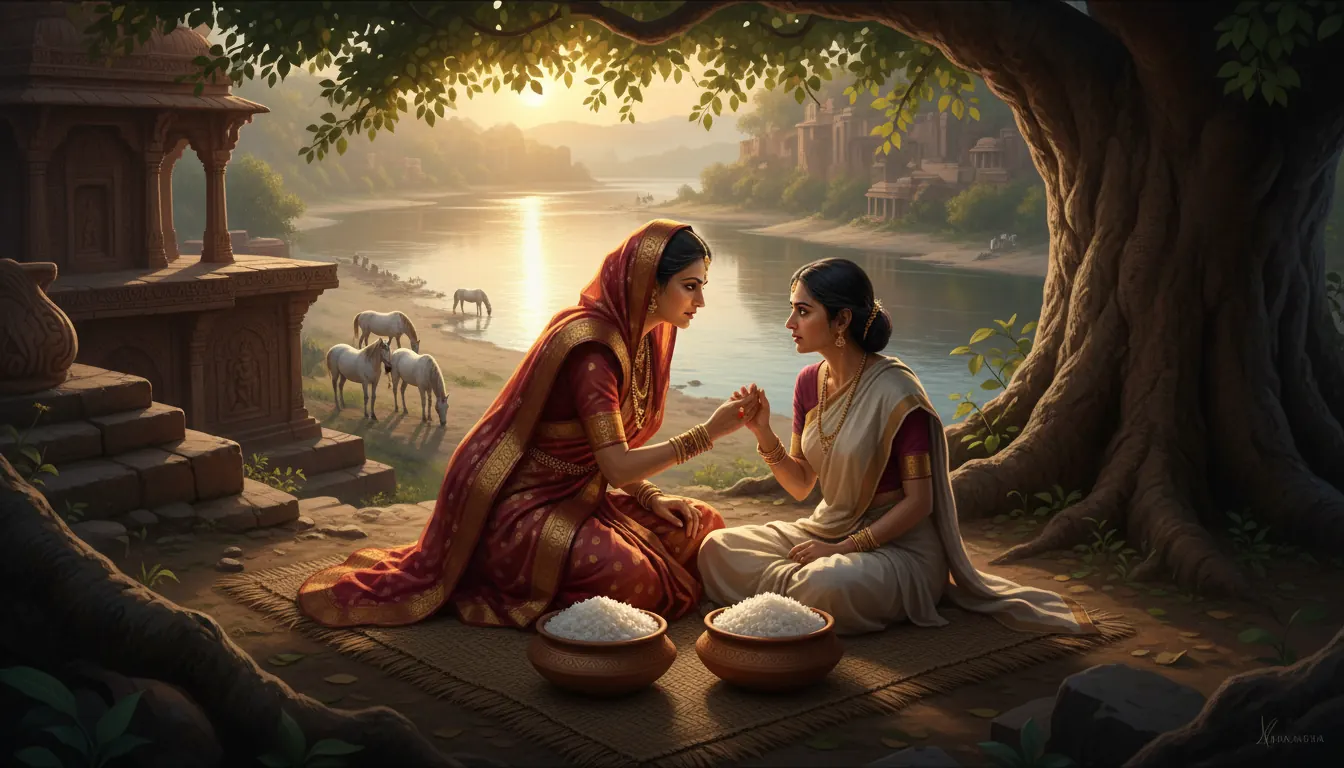
"He set the two bowls out. Boiled rice, that is all a charu is, rice and milk cooked and offered, the plainest food in the world. What is not plain is what has been said over it. Into one bowl he had poured, with the hymns, the entire accumulated energy of Brahma, everything he had gathered in a lifetime of penance that makes a man a knower of the Veda. That bowl was for his wife. Into the other he had put kshatriya energy, the force that holds a kingdom and breaks an army. That one was for her mother, who was a queen and the wife of a king and would want a son who could rule.
"He told each of them which bowl was hers. He told each of them which tree to embrace. Then he went away about his own business, because it did not occur to him that anyone would tamper with it.
"Satyavati, delighted at heart, went to her mother and told her everything the sage had said, and about the two balls of charu, and which was which, and which tree was for whom.
"She meant nothing by it," said Bhishma. "She was a girl telling her mother good news. That is all that happened, and it was enough."
The Mother's Argument
"Then the mother addressed her daughter Satyavati, and you should hear the words, because they are not the words of a wicked woman. They are the words of an ordinary one.
"'Daughter, I deserve more consideration from you than your husband does. Do as I say. The charu your husband has given you, duly consecrated with hymns, give that one to me, and take for yourself the one meant for me. Sweetly smiling girl of blameless character, if you have any respect for what I say, let us also exchange the trees meant for each of us.'
"And then the reasoning, which is the part I want you to attend to.
"'Everyone wants an excellent and stainless being for a son. The glorious Richika must have acted from that same motive in this, as will be seen in the end. That is why, beautiful girl, my heart leans toward your charu and your tree. And you too should think how to win an excellent brother for yourself.'
"There it is. She does not say, let me rob you. She says, everybody wants the best for a son, your husband wanted it too, that is why he kept the best for you, and while we are speaking of it, would you not like a splendid brother? She makes the theft a kindness the daughter is doing herself.
"And Satyavati, who had been raised to obey her mother and had been married perhaps four months, exchanged the bowls, and ate what was not hers, and embraced the peepul instead of the fig.
"When mother and daughter had acted in this way, both of them, Yudhishthira, became pregnant."
What the Sage Saw at Once
"That great rishi, the excellent descendant of Bhrigu, found his wife quick with child and was pleased at heart. Then he looked at her a second time, the way such men look, and the pleasure went out of his face.
"'Excellent lady, you have not done well in exchanging the charu, as will soon be plain. And it is clear that you have changed the trees as well.'
"She did not deny it. He did not wait for her to.
"'I had placed the entire accumulated energy of Brahma in your charu, and kshatriya energy in the charu of your mother. I had so ordered it that you would give birth to a brahmana whose virtues would be famous throughout the three worlds, and that she would give birth to an excellent kshatriya. Now that you have reversed it, your mother will give birth to an excellent brahmana, and you, excellent lady, will give birth to a kshatriya terrible in action. You have not done well, lady, in acting like this out of love for your mother.'
"Understand what he is telling her," said Bhishma. "He is not scolding her for disobedience. He is telling her that the line of Bhrigu, which has been a line of priests since there were priests, will now carry the warrior fire in it, and that the house of Gadhi, which has held a throne for six generations, will now produce a man of the Veda. Two dynasties turned around in one afternoon by two women moving two bowls, and neither of them wished any harm, and the thing was already done and could not be undone, because the hymns had been said and the rice had been eaten."
Let It Fall on My Grandson
"When she heard this, king, the excellent lady Satyavati was struck with sorrow and fell to the ground like a beautiful creeper cut in two.
"She came back to her senses and bowed to her lord with her head bent, and what she said then is the reason I am telling you this story at all.
"'Twice-born rishi, greatest of those versed in Brahma, take pity on me, your wife, who begs your pardon. Arrange it so that no kshatriya son is born to me. Let my grandson be the one famous for terrible deeds, if that is your wish. But not my son, brahmana. Grant me this favour.'
"She does not ask him to take the fire away. She has understood that it cannot be taken away, that it has been paid for and consecrated and swallowed and must come out somewhere. So she asks only that it be moved one generation further down, out of the child she is carrying and into a child not yet imagined, whom she is prepared to have because she cannot bear to have the other.
"'So be it,' said that man of austere penances to his wife.
"And in time she gave birth to a blessed son, and they named him Jamadagni, and he was a brahmana, gentle in a way, and he kept the fires. The terrible energy passed through him, sat in him like a coal under ash, and waited for one generation. It came out in his son. You have heard the name of that son. Rama of the axe, Jamadagni's son, who cleared the earth of kshatriyas thrice seven times, was Satyavati's grandson, and he was in the bowl before his grandmother was married."
The Kshatriya Who Fathered Brahmanas
"The celebrated wife of Gadhi," said Bhishma, "gave birth in her turn, by the favour of that same rishi, to the twice-born sage Vishvamitra, versed in the knowledge of Brahma.
"There is your answer, son of Pandu. The deeply devout Vishvamitra, though a kshatriya by descent, reached the state of a brahmana, and he did it without casting off his body, because the brahma energy that Richika had gathered into a bowl for his own wife went instead into a queen of the house of Kushika, and her son ate it before he was born.
"And he did not keep it to himself. He became the founder of a race of brahmanas. His sons were high souled progenitors of many races, devoted to austere penances, learned in the Vedas, founders of clans: the adorable Madhuchchhanda and the mighty Devarata, Akshina and Sakunta, Vabhru, Kalapatha, the celebrated Yajnavalkya, Sthula of high vows, Uluka and Mudgala, the sage Saindhavayana, the illustrious Valgujangha and the great rishi Galava, Ruchi and Vajra, Salankayana, Liladhya, Narada, Kurchamuka and Vahuli, Mushala, Vakshogriva, the great sage Kapila, and more than I will name while the sun is still up. Every one of them a knower of Brahma, and every one of them descended from a king."
Yudhishthira was quiet for a while.
"Then the whole of it," he said, "turned on a woman who wanted a better son than her daughter was going to have."
"It turned on that," said Bhishma, "and on a daughter who could not refuse her mother, and on a father who thought a poor man was not worth a girl. Nobody in the story does a great crime. Vishvamitra had the energy of the sun and the moon and the fire god, and he got it out of a bowl of rice that was set down for somebody else. If you have a doubt on any other matter, son of Pritha, tell me, and I will remove it while I can."
Dharma Lesson
A blessing seized out of turn does arrive, but never in the shape the taker intended. Nobody in this story commits a great crime: a father prices his daughter, a mother wants the better son, a girl cannot refuse her mother, and between them they turn the priestly line into a warrior line and the royal line into a house of sages. What has been consecrated cannot be unsaid, and the most that mercy could win was one generation of delay.