The Man Who Was Not Allowed In
A shudra's hermitage, a sage's kindness, and two lives turned inside out
In short
A shudra of great compassion climbs to a hermitage on Himavat and asks to be initiated. He is told he may serve but never wear the marks, so he builds his own hut a little way off and keeps silence, vows and hospitality for a lifetime. A visiting rishi befriends him and, out of pure kindness, shows him how to lay the seat and the kusa grass for the rite to the fathers. Both are reborn, the shudra as a king and the rishi as his priest.
Told in the Anushasana ParvaSet in Himavat and Kurukshetra16 min read
A Question About Teaching
By this point in the teaching Yudhishthira had learned to bring his hardest questions early, while the old man's voice was still strong and the sun had not yet gone round to the west of the arrow bed.
"Royal sage," he said, "there is something I want to know, and I want it explained in detail, not in a sentence. Suppose a man teaches someone of low birth. Suppose he does it out of friendship. It may be interested friendship, where he hopes for something back, or it may be disinterested friendship, where he hopes for nothing at all. Does the one who teaches incur any fault?"
Bhishma did not answer at once.
"The course of duty is exceedingly subtle," Yudhishthira went on, as though apologising for the question. "Men are often bewildered by it. I am one of them."
"On this," Bhishma said at last, "I will tell you, in order, what I heard certain rishis say long ago. Hear the rule first, and then hear the story, and do not confuse the one with the other. The rule is this. Instruction must not be given to anyone of low or mean caste. It is said that a teacher who instructs such a person incurs great fault."
"That is a hard rule."
"It is. Listen, chief of Bharata's race, while I tell you of something that happened long ago, which shows the evil that comes of instructing a low-born person who has fallen into distress. The thing happened in the asylum of certain twice-born sages that stood on the auspicious breast of Himavat, and no one in it did anything wicked. That is what makes it worth telling you."
The Asylum on the Breast of Himavat
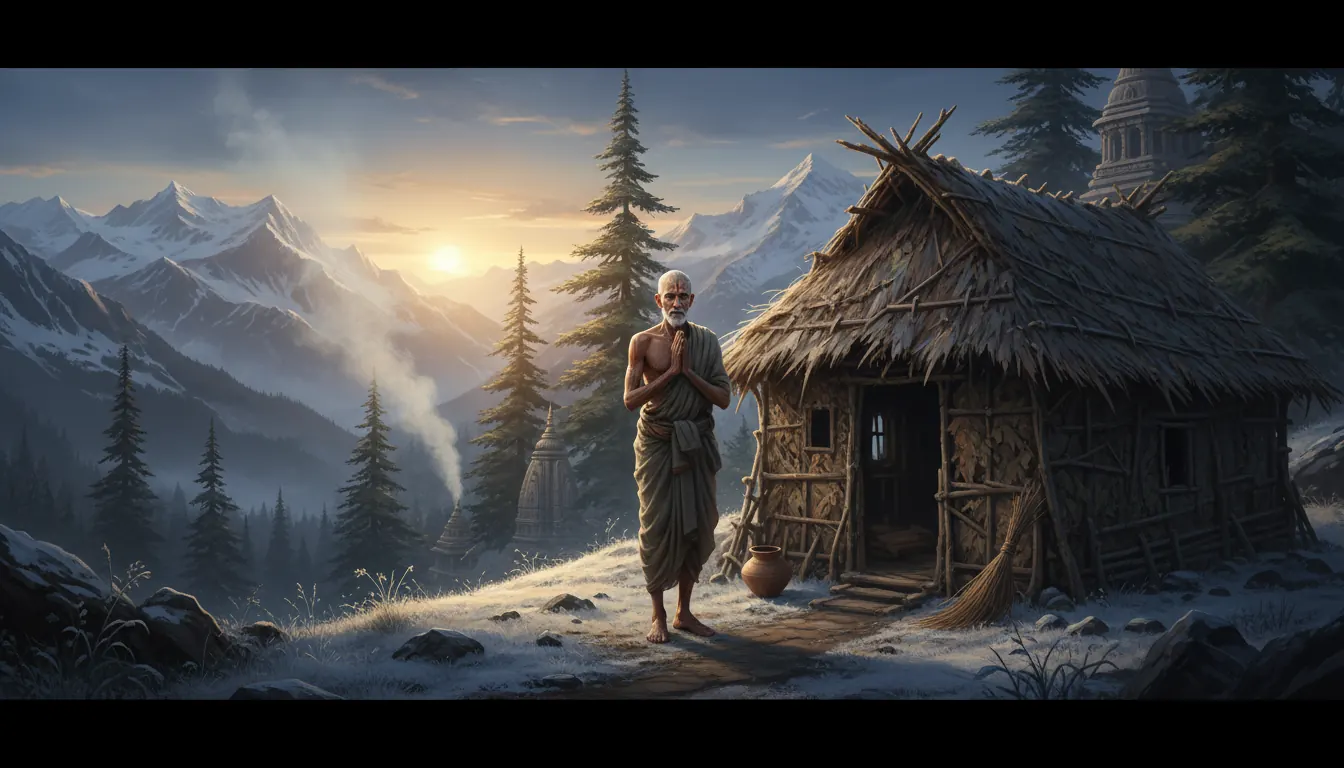
There, on the breast of that prince of mountains, stood a sacred asylum adorned with trees of many kinds, overgrown with many species of creepers and plants, the resort of animals and birds. Siddhas and Charanas lived in it. It was delightful in every season because there was always something in flower.
Many brahmacharins lived there, and many who had taken up the forest mode of life. Many brahmanas had settled there, greatly blessed men who were like the sun or fire in energy and brilliance. Ascetics of every kind were in that place, keeping all sorts of restraints and vows. Some had undergone Diksha, ate sparingly and were pure in soul. There were large numbers of Valakhilyas among them, and many who had taken the vow of Sannyasa. Because of all this the asylum resounded from morning to night with the chanting of the Vedas and with sacred mantras uttered aloud by the men who lived there.
Into that place, one day, came a shudra.
He came alone, and he came on foot, and he had no business there of any kind that anybody could name. He was a man with compassion for all creatures, and something in him had turned toward that mountain and would not turn back.
The ascetics did not drive him off. They honoured him duly, as guests are honoured, and gave him what they had. He, for his part, walked among them and looked at them, the many kinds of them, men of great energy, like the gods in purity and power, each keeping his own kind of Diksha, and his heart filled with joy. He had never in his life seen anything he wanted so much.
Seeing all this, the shudra felt drawn to devote himself to penances.
At the Feet of the Kulapati
He went to the head man of the group, the Kulapati, and touched his feet, and did not get up at once.
"By your grace, best of the twice-born," he said, "I want to learn the duties of religion and to practise them. Teach me those duties, illustrious one, and bring me into the life of Renunciation by performing the rites of initiation." Then, because it was going to be said by somebody and he preferred to say it himself, he said it. "I am certainly of a lower colour, illustrious one. By caste I am a shudra, best of men. I want to wait on you here and serve you. Be pleased with me, for I humbly seek your shelter."
The Kulapati was not a cruel man. He answered him plainly and without contempt, which in its way made the answer worse.
"A shudra cannot live here wearing the marks meant only for those who lead the life of Renunciation. If you like, you may stay here, waiting on us and serving us. By such service you will certainly win many regions of great happiness."
There it was. He might have the mountain and the company and the labour. He might carry water and sweep the platforms and cut fuel for other men's fires for as long as he lived, and heaven at the end of it. What he might not have were the marks: the shaven head, the staff, the water pot, the formal words said over him by a teacher that would make him what the others were.
The shudra stood there and began to think it over, saying to himself, What should I do now? My reverence for the religious duties that lead to merit is great. But let this much be settled: I will do what is for my own good.
A Little Way Off
What he settled on was this. He went to a spot far from that asylum, and there he made a hut of the twigs and leaves of trees.
He was careful about it. He built a sacrificial platform. He made a little space for his sleep, no more than he needed. He built some platforms for the use of the deities. Then he began a life ruled by strict observances and vows, and practised penances, and he did the whole of it without speaking at all.
He bathed three times a day. He kept vows about food and sleep. He made sacrifices to the gods and poured libations on the sacrificial fire and worshipped the gods in that way, morning and evening, with nobody watching and nobody to certify that any of it had been done correctly. He restrained all carnal desires. He lived sparingly on fruits and roots. He controlled his senses.
And every day, whoever came to that retreat he welcomed and entertained as a guest, offering them the herbs and fruits that grew plentifully around his hut. That was the one part of his discipline that had a witness. Men walking the mountain paths found a silent man in a leaf hut who would put food into their hands and gesture them to a seat and take nothing from them at all.
In this way he passed a very long time in that hermitage of his. From the asylum, on a still day, he could hear the Vedas being chanted a little way off, by the men who had told him he might sweep their floors.
The Visitor
One day an ascetic came to the shudra's retreat to get to know him. He had heard of the silent man, and he was curious, and that was the whole of his errand.
The shudra welcomed and worshipped the rishi with due rites and pleased him greatly. Everything was in order. The water was there for his feet, the seat was there, the fruits were there, and the man who set them out said nothing.
The rishi was a man of great energy, righteous in soul and strict in his vows, and he was not put off by the silence. He talked with his host about many pleasant things and told him where he had come from. It is a small thing to describe and it was not a small thing to receive. Nobody had told that man where they had come from in a long time.
After that the rishi came back. He came to the shudra's asylum countless times, to see him, walking the extra distance past the great hermitage with its chanting to sit in front of a leaf hut with a man who could not answer him. That is the entire nature of the friendship, and it is the reason for everything that follows: the rishi wanted nothing from him. There was nothing the man had to give.
The Seat Turned the Wrong Way
On one of these occasions the shudra broke his silence, because there was a thing he could not do without asking.
"I want to perform the rites ordained for the Pitris," he said. "Please teach me how."
"Very well," the brahmana said.
The shudra purified himself with a bath. He brought water for the rishi to wash his feet. He brought Kusa grass, and wild herbs and fruits, and a sacred seat, and the low seat called the Vrishi. And he set the Vrishi down toward the south, with its head turned to the west, because he had never been taught and had guessed.
The rishi looked at it. He knew at once that it was against the ordinance, and he knew what the ordinance said about who might be told, and he was sitting in a leaf hut on a mountain with a man who had fed him fruit for years.
"Set the Vrishi with its head toward the east," he said, "and purify yourself, and sit facing north."
The shudra did everything as the rishi directed. And then, having begun, the rishi did not stop halfway. The shudra, a man of great intelligence who held to righteousness, received from him every direction for the Shraddha as the ordinance lays it down: how to spread the Kusa blades, where to place the Arghyas, the rites for pouring the libations, and the food to be offered to the fathers.
When the rites in honour of the Pitris were over, the shudra said farewell to the rishi, and the rishi went back to his own home. Neither of them thought anything further about it. It had taken part of one afternoon.
Two Deaths and Two Births
After a long time, all of it spent in such penances and vows, the shudra ascetic died in those woods.
Because of the merit he had gained by those practices, he was born in his next life into the family of a great king, and in time he grew to great splendour. Everything the Kulapati had promised him, he got. He got it in the shape of a prince.
The twice-born rishi too, when his time came, paid his debt to Nature. In his next life he was born into the family of a priest, which is to say that a man who had been a rishi of austere penances came back a step lower down, into the class that serves at other men's altars and is paid for it.
Both of them grew up, and both gained great knowledge in the usual branches of study. The brahmana became well versed in the Vedas, and in the Atharvans too. In all the sacrifices ordained in the Sutras, in the Vedanga that deals with religious rites and observances, and in astrology and astronomy, the reborn rishi excelled. In the Sankhya philosophy too he began to take great delight. He was, by any measure anybody had, a learned and accomplished man.
Meanwhile the reborn shudra, who was now a prince, lost his father. He performed the last rites, purified himself by completing all the funeral ceremonies, and his father's subjects installed him as their king on his father's throne.
And soon after his own installation, the first thing he did was to install the reborn rishi as his priest.
The King Who Laughed
With the brahmana as his priest, the king passed his days in great happiness. He ruled his kingdom righteously and protected and cherished all his subjects, and there was no fault in him that anyone could find.
Except one. Every day, when he received blessings from his priest, and again during the performance of the religious and other sacred rites, the king smiled or laughed at him loudly.
It happened at the Homa. It happened at the rites of propitiation. It happened when the priest raised his hand to bless him in front of the court. The king would look at his priest and his face would break, and once or twice the laughter came out of him like something he had not intended to let go of. In this way, on numberless occasions, the reborn shudra who had become a king laughed at the sight of his priest.
The priest bore it for a long time, and then he became angry. There is no dignity to be salvaged from being laughed at daily by the man you are blessing.
On one occasion he met the king in a place where there was nobody else. He began by pleasing him with agreeable talk, and then, seizing the moment, he said, "King of great splendour, I ask you to grant me a single boon."
"Best of the twice-born," said the king, "I am ready to grant you a hundred boons, so why only one? I love you and revere you so much that there is nothing I would not give you."
"I want only one boon, king, since you are pleased with me. Swear that you will tell me the truth and not a lie."
The king said, "So be it. If I know the answer to what you ask, I will certainly tell you the truth. If I do not know it, I will say nothing."
The Truth He Had Sworn To
"Every day," said the priest, "when I give you my blessings, when I perform religious rites on your behalf, at the Homa and the other rites of propitiation, why do you laugh when you see me? When I see you laughing at me every time, I shrink with shame. I have made you swear to answer me truly. You must not say what is untrue. There must be some serious reason for the way you behave. Your laughter cannot be without cause. I am very curious. Tell me the truth."
"Since you put it to me like this," the king said, "I am bound to tell you, even if it is something you should not hear. Listen closely. I remember my former birth.
"In my former life I was a shudra, practising severe penances. You were a rishi of austere penances. And you, sinless one, were pleased with me and wanted to do me good, so you agreed to instruct me in the rites I once performed in honour of my Pitris. You taught me how to set the Vrishi and spread the Kusa blades, and how to offer libations and food to the spirits of the dead.
"Because of that transgression of yours, you have been born a priest, and I have been born a king. See the changes Time brings about. This is the fruit you have reaped for instructing me.
"That is why I smile when I see you. I do not laugh out of any disrespect. You are my teacher. I am truly sorry for this change in your fortunes. My heart burns at the thought. I remember our former births, and that is why I laugh when I see you."
Then he said the sentence that ended the man's employment. "All your austere penances were destroyed by the instruction you gave me. Give up your office of priest and try to win back a higher birth. Work hard so that in your next life you are not born lower than you are now. Take as much wealth as you want, learned brahmana, and cleanse your soul."
The Road Back Up the Mountain
Released by the king from the office of priest, the brahmana did not argue and did not complain.
He gave many gifts of wealth and land and villages to men of his own order. He kept many strict and severe vows as the greatest brahmanas lay them down. He travelled to many sacred waters and gave many gifts to brahmanas there. By giving cows to the twice-born he cleansed his soul, and came to know it.
Then he went back. He returned to the very asylum where he had lived in his former birth and practised very severe penances there, on the same mountain, within hearing of the same chanting. In the end that brahmana attained the highest success, and all the ascetics who lived in that asylum came to revere him.
"That, best of kings," Bhishma said, "is how that twice-born rishi fell into great distress. So brahmanas must never instruct shudras. A brahmana should avoid instructing the low-born, for it was by instructing a low-born person that a brahmana came to grief. Brahmanas, kshatriyas and vaishyas, the three orders, are counted as twice-born, and a brahmana incurs no fault by instructing them.
"That is why ascetics take the vow of silence and go through Diksha without speaking. For fear of saying something wrong, or something that may offend, ascetics often give up speech altogether. Even righteous men of every accomplishment, truthful and simple in their ways, have been known to incur great fault through words spoken wrongly. If the one instructed commits any sin because of the instruction, that sin clings to the brahmana who gave it. And instruction given in exchange for money always pollutes the one who gives it. Very often people are plunged into great misfortune by giving instruction."
Yudhishthira said nothing for a while. He had asked whether disinterested friendship made a difference, and he had been given a story in which it made none at all, and in which the man who was ruined had done nothing but turn a small wooden seat around so that a silent man on a mountain could feed his own dead correctly.
Dharma Lesson
The epic itself records a rule so harsh that a good man is ruined for a kindness, and it lets the king who profited by it laugh and grieve at the same time rather than pretend the ruling is comfortable. Bhishma states the rule, tells the story, and leaves Yudhishthira with the gap between them. Some of what the tradition hands down is meant to be looked at squarely, not swallowed.