The Ascetic Who Would Not Be Carried
A thought Garuda never spoke aloud costs him his wings
In short
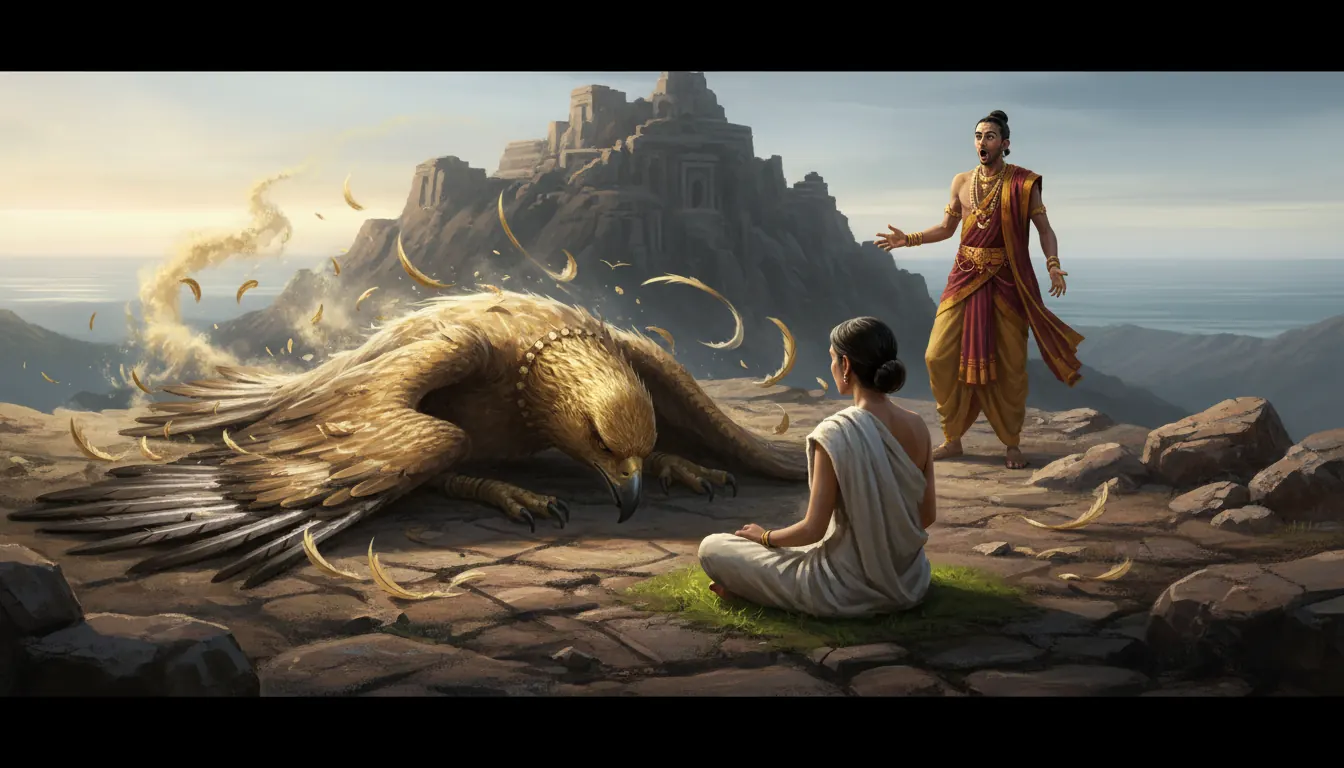
Carrying Galava east in search of eight hundred moon-white horses, Garuda rests on the peak of Rishabha, where a brahmana lady named Sandili feeds them and asks nothing. He wakes wingless, because while he slept he had privately decided she ought to be carried off to live among the gods. He confesses, and she gives the wings back stronger.
Told in the Udyoga ParvaSet in Forest Hermitage and The Ocean15 min read
Go, Galava, Go
"Persons that listen to the counsels of friends are rare," Narada was saying in the Kuru hall, to a prince who had heard the same thing from three other men that week. "Friends who offer good counsel are rarer still. Obstinacy should be avoided, son of the Kurus, for it brings great evil, and on this point an old story is told about the disgrace Galava met with through obstinacy."
Galava had waited on Vishvamitra for years without being asked to, out of respect and affection and the plain desire to do what was agreeable, and when at last the rishi said to him, "You have my leave, Galava. Go wherever you wish," the pupil would not go.
"What final gift shall I give you for your services as my teacher?" he said. "It is the final gift that makes a sacrifice successful. Such gifts are the fruit a man enjoys in heaven. They are peace and tranquillity in person. What shall I bring you? Tell me."
Vishvamitra knew perfectly well that he had been conquered by this young man's service, and that there was nothing owing.
"Go," he said.
"What shall I give?"
"Go."
"What shall I give?"
And the illustrious Vishvamitra, who had stood a hundred years in his own hermitage with a dish of hot food balanced on his head, subsisting on air, because a guest had told him to wait, felt at last a slight rise of anger.
"Give me eight hundred horses," he said, "every one of them as white as the rays of the moon, and every one with one black ear. Go now, Galava, and do not delay."
The Friend Who Came
After that Galava could not sit, or lie down, or eat. He grew pale and was reduced to a skeleton, and he lamented aloud in a way that a man only does when he believes nobody is listening.
"Where will I find rich friends? Where will I find money? Have I any savings? Where will I find eight hundred horses as white as the moon? What pleasure can I take in eating? The very love of life is dead in me. I will go to the far shore of the great ocean, or to the furthest edge of the earth, and give up my life there.
"Death is better than life for the man who has enjoyed his friends' wealth through their friendship and cannot return the favour. The religious acts of a man who promises to do a thing and fails to do it, and so is stained with falsehood, lose their power. What ungrateful person has ever won fame? Where is his place, and where is his happiness? I am that wretch."
And while he was saying it, his friend Garuda, the son of Vinata, came down out of the sky in front of him and was cheerful about it.
"You are a dear friend of mine," said Garuda. "When a friend is prosperous himself, it is his duty to see that his friend's wishes are fulfilled. Whatever prosperity I have is Vishnu, the younger brother of Vasava. I have already spoken to him for you, and he has been pleased to grant my wish. Come now. We will go together. I will carry you comfortably to the far shore of the ocean, or to the furthest end of the earth. Come, Galava, and do not delay."
It is worth noticing what had happened. The horses did not exist. Nothing about the debt had changed. But the man who had been talking about laying down his life stopped talking about it the moment somebody offered to carry him.
Which Quarter
"I have been commanded by God, who is the cause of all knowledge," said Garuda. "So I ask you: to which quarter shall I take you first, to see what lies there? The east, the south, the west or the north?"
And because he was Garuda, he could not simply wait for an answer; he had to describe them.
"There is the quarter where Surya, who lights the universe, first rises; where at evening the Sadhyas perform their austerities; where the Intelligence that fills the whole universe first sprang; where the two eyes of Dharma and Dharma himself are stationed; where the clarified butter first poured in sacrifice flowed out all around. That quarter is the gate of Day and of Time. There the daughters of Daksha gave birth to their children in the first age, and the sons of Kashyapa first multiplied. It was there that Shakra was first anointed king of the gods, and there that the divine Creator first sang the Vedas, and there that the Gayatri was first preached by Surya to the reciters of that hymn. That is the gate of the three worlds and the path of heaven. It is called Purva, the first."
He described the west as well, where the mountain called Asta receives the sun each evening and is the cause of the twilight, and out of which Night and Sleep issue at the close of every day as if to rob living creatures of half their allotted span; where Surabhi the mother of cows goes to the shore of a lake adorned with golden lotuses and pours forth her milk; where the headless trunk of Swarbhanu is seen in the middle of the ocean, still bent upon devouring the sun and the moon. And he described the north, which is called uttara because it is uttarana, that which saves from sin, where no one unkind or of unbridled passions can live; where in the asylum of Badari the eternal Krishna and Jishnu dwell with the Creator; where Mahadeva, receiving her first upon his head, afterwards let the Ganga fall from the heavens to the world of men; where Kubera was installed on the breast of Kailasa in the sovereignty of the yakshas and the rakshasas and the gandharvas.
"Take me east," said Galava, "where the two eyes of Dharma first open, where you say the gods are always present and both truth and virtue live. I want to meet all the gods. Take me there, younger brother of Aruna, so that I may see them."
"Climb on my back," said Garuda.
The Storm Made by the Wings
For the first while Galava said beautiful things, because that is what a passenger does.
"Devourer of snakes, as you fly your beauty is like the sun's in the morning, the maker of the day with his thousand rays."
Then the speed came on properly.
"The trees, broken by the storm of your beating wings, seem to chase after you as you go. You seem to drag the Earth herself after you in that storm, with all the waters of her oceans and all her mountains and woods. The tempest of your wings lifts the sea into the air with the fish in it, and the snakes and the crocodiles. I see fish with faces like our own. I see Timis and Timingilas and snakes with human faces, all of them crushed in that wind. My ears are deafened by the roar of the deep. I am so stunned that I can neither hear nor see. I have even forgotten my own purpose.
"Slow down, rover of the sky, and remember the danger to a brahmana's life. I can no longer see the sun, or the points of the compass, or the sky itself. I see only a thick gloom. I cannot see your body and I cannot see my own. I see only your two eyes, like two radiant gems, and at every step I see sparks of fire coming off your body. Stop these sparks. Put out the dazzle of your eyes.
"Son of Vinata, I have no business going with you. Stop. I have promised my teacher eight hundred white horses as bright as the moon, each with one black ear, and I see no way of keeping my pledge. There is one way I can see, and that is to lay down my own life. I have no wealth of my own and no wealthy friend, and no wealth, however vast, could buy the thing anyway."
Death Is God Himself
Garuda did not slacken. He laughed, at that height, over that water, with a brahmana clinging to his back and talking about suicide.
"You have little wisdom, twice-born rishi," he said, "since you wish to put an end to your own life. Death can never be brought about by one's own effort. Death is God himself. You do not get to schedule him because you are embarrassed about a debt."
"Then what am I to do?"
"Why did you not tell me your purpose before? There are excellent ways of getting all of it done. Here is the mountain called Rishabha by the sea. We will rest there for a while and refresh ourselves with food, and then, Galava, I will come back to the matter and we will settle it."
He went down toward the peak, and the noise of the wind of him fell away, and the sea flattened out again behind them and put back the fishes it had been holding in the air.
Galava, when he could hear his own voice again, tried to say something about the horses.
"Later," said Garuda. "There is a way to it and I know the way, and you have been so busy dying that you have not once asked me for it. First we eat."
The Woman on Rishabha
On the peak of Rishabha there lived a brahmana lady named Sandili, practising ascetic penances.
She was alone. There was no hermitage of pupils around her, no fire tended by attendants, nothing at all to show a visitor what her rank was or how far along she had come; and the two who landed, the best of the twice-born and the king of birds, bent their heads to her and worshipped her, because both of them could feel it in the air of that place even if they could not see it.
She asked after their welfare, as a householder does, and gave them seats. Then she brought them cooked food, and they took it, first dedicating it to the gods with the proper mantras, and they ate.
It is a small scene and nothing is said in it. A woman on a mountain feeds two travellers who arrived without warning, and does it well, and asks them nothing about themselves.
Afterwards the two of them laid themselves down on the ground, full, in the warmth, and fell into a profound sleep.
One of them slept the sleep of a tired traveller. The other, before he went under, lay looking at the bare rock and the single fire and the woman sitting by it, and thought about the matter for a while, and came to a conclusion about it, and never opened his mouth.
A Ball of Flesh With a Head and Legs
Garuda woke first, eager to leave that place, and found that his wings had fallen off.
Not broken. Not clipped. Gone, as though they had never been fastened on, so that the son of Vinata, who carries Vishnu, who took the Amrita out of heaven through a wheel of blades and a wall of fire, who had that morning been dragging the ocean into the sky behind him, was lying on a rock as a ball of flesh with only his head and his legs.
Galava woke and saw it and could not speak for a moment.
"What is this condition that has come over you," he said, "because we stopped here? Alas, how long will we have to stay in this place now? Have you harboured some evil and sinful thought in your mind? I am sure it cannot be a trivial sin you are guilty of."
Because that was the arithmetic of it, and both of them knew it. Whatever had been done, it had been done in silence, in sleep, on a mountain where the only other person present had given them her food and asked nothing; and the price of it had been every feather he had.
The Thought He Never Said Aloud
Garuda told him.
"Twice-born one, I did have the thought of carrying this lady away from this spot. She is crowned with ascetic success. I thought she should be living where the Creator himself and the divine Mahadeva and the eternal Vishnu live together, with Virtue and Sacrifice in person beside them. I thought that was the proper address for a woman of her attainment, and that this rock was not."
He had not proposed it to her. He had not mentioned it to Galava. He had lain down and worked out, privately, between himself and himself, where somebody else ought to live, and had gone to sleep having decided it.
"Now I will prostrate myself before this holy lady," he said, "for my own good, and pray to her. I will tell her that I had that thought with a heart full of pity. Whether I acted rightly or wrongly, that was the wish, and it was plainly against her own, and I cherished it out of respect for her. It is for her, in the nobility of her heart, to forgive me."
So he said it to her, lying there, unable to stand, in front of the woman he had intended to pick up and put somewhere better.
I Do Not Pardon Contempt
That lady was pleased with the prince of birds and with that bull among brahmanas, and she spoke to Garuda.
"Do not be afraid, beautiful-feathered one. Take back your wings and cast off your fears."
Then, having lifted the punishment first, she said the rest of it, and she did not soften it.
"You held me in contempt. I do not pardon contempt. Any sinful being who holds me in contempt will quickly fall from all the blissful regions.
"There is not a single inauspicious sign about me. I am perfectly blameless. Through the purity of my own conduct I have reached high ascetic success, and nobody put me here and nobody needs to move me. Purity of conduct bears virtue as its fruit. Purity of conduct bears wealth as its fruit. It is purity of conduct that brings on prosperity, and it is purity of conduct that drives away all inauspicious signs.
"Go from this place, blessed prince of birds, wherever you wish. Never hold me in contempt. And take care never to hold any woman in contempt, even one who truly deserves blame. You will have your strength and energy again, as before."
At these words of hers the wings came back on him, and when he stood up and opened them he found they were stronger than they had been before.
The Teacher on the Road
With Sandili's leave, Garuda took Galava on his back and departed. They searched, and they failed to find the kind of horses they were looking for, because eight hundred moon-white horses each with one black ear are not a thing that exists in quantity anywhere.
And on the road, of all people, they met Vishvamitra.
"Twice-born one," said that greatest of speakers, in front of the son of Vinata, "the time has come for you to give me the wealth you promised me of your own accord. I do not know what you intend. I have waited so long. I will wait a while longer. Look for the way to keep your promise."
Galava had nothing to say. Garuda looked at his despairing friend, who was overwhelmed with sorrow, and put it to him without any comfort in it.
"What Vishvamitra said to you before has now been said again in front of me," he said. "So come, Galava, best of brahmanas, and we will think the matter through. Until you give your teacher the whole of the wealth you promised, you cannot even sit down."
That, said Narada in the Kuru hall, is where obstinacy takes a man: he would not accept that nothing was owed, and now he could not rest until the impossible thing was paid, and along the road to paying it a friend who had only ever tried to help had lost his wings in his sleep for a kindness he never spoke. Duryodhana, who had been told that morning by Krishna and by the sages that he might still put the war down, listened, and Narada went on with the story.
Dharma Lesson
Condescension does not become harmless by staying unspoken. Garuda never made his offer, never asked her, and lost his wings anyway, because deciding where somebody else ought to live is the oldest form of contempt. Sandili forgives the man and refuses to forgive the thought, and tells him to hold no woman cheap, not even one who might deserve it.