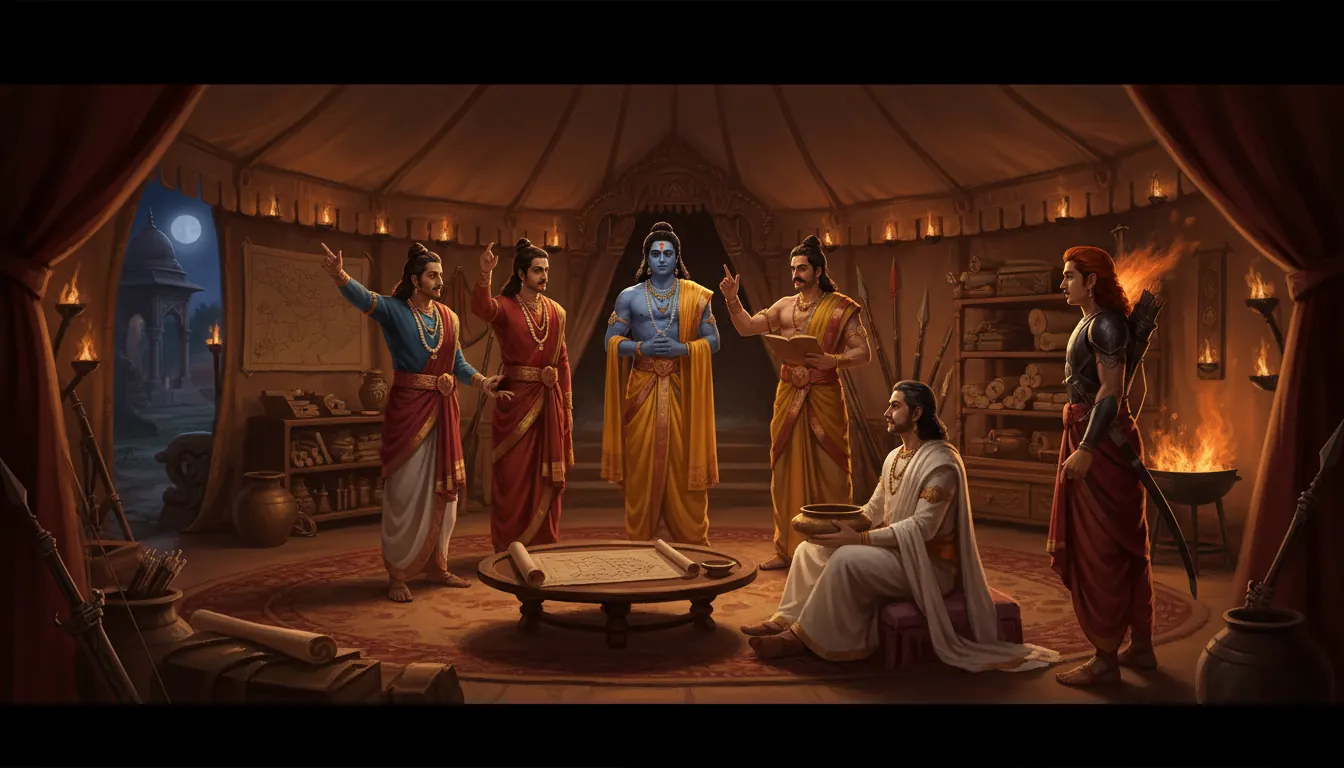
The Choosing of the Generalissimo
Five brothers name five different men, and Krishna names the sixth
In short
With the peace embassy dead, Yudhishthira asks his brothers who should command seven akshauhinis against Bhishma, and each answer is a self-portrait. Sahadeva names Virata, Nakula names Drupada, Arjuna names the fire-born Dhrishtadyumna, Bhima names Shikhandi because Shikhandi is Bhishma's death, and the eldest refuses to choose at all. Krishna praises every name, says the debt to virtue is paid, and appoints Dhrishtadyumna with Arjuna over all the leaders.
Told in the Udyoga ParvaSet in Upaplavya15 min read
Seven Divisions and No Head
Krishna had come back from Hastinapura that day with nothing, and had told them what the Kuru court had said and what it had tried to do to him, and now the light was going and there was one piece of business left that could not wait until morning.
Yudhishthira spoke to his brothers in Keshava's presence.
"You have heard all that happened in the court of the assembled Kurus," he said. "You have also understood what Keshava said. So draw up my troops in the battle array in which they are to fight. Here are seven akshauhinis gathered for our victory, and these are the names of the seven famous warriors who will lead them: Drupada, and Virata, and Dhrishtadyumna, and Shikhandi, and Satyaki, and Chekitana, and Bhimasena of great energy.
"All of them know the Vedas. All of them are very brave, and all have kept excellent vows. All of them are modest, all are versed in policy and accomplished in war, and all are skilled in the use of every kind of weapon."
He stopped there, because the difficulty was not the seven.
"Now tell me, Sahadeva," he said, "who is the warrior, versed in every kind of battle array, who could lead these seven, and could also withstand Bhishma in battle, Bhishma who is like a fire with arrows for its flames. Give me your own opinion, tiger among men, of who is fit to be our generalissimo."
It was the youngest who was asked first. That was deliberate. Yudhishthira had been in this family a long time and knew that if he asked Arjuna first, nobody after Arjuna would say anything worth hearing.
Sahadeva Names the Man Who Took Them In
Sahadeva did not hesitate, and he did not name a warrior. He named a host.
"Closely related to us," he said. "One who felt for us in our distress. A man of great might, who knows every virtue, skilled in weapons and irresistible in battle: the mighty king of the Matsyas, Virata, on whom we rely in the hope of winning back our share of the kingdom. He will be able to stand up in battle to Bhishma and to all those mighty chariot warriors."
Everybody in the tent understood the order in which he had said it. He had put the relation first, and the sympathy second, and the might third, and the skill fourth. A year ago the five of them had been a cook, a dancing master, a groom, a cattle-hand and a courtier's dice companion in that man's palace, sleeping in his rooms under false names, and Virata had not known who was under his roof, and had been decent to them anyway, and had given Uttaraa to Abhimanyu when he found out.
Sahadeva had tended his cattle. He had counted the herds and known the diseases of them and been thanked by that king in that king's own hall. When you ask a man who should lead an army, you find out what he cannot bring himself to be ungrateful about.
Nakula Names the Man Who Hates Drona
Then Nakula spoke, and Nakula was eloquent, and his answer took a while because he built it in courses like a wall.
"One who is worthy of respect in years, in knowledge of the scriptures, in perseverance, in family and in birth," he said. "One who has modesty, strength and prosperity. One who is well versed in every branch of learning. One who studied the science of weapons with the sage Bharadwaja. One who is irresistible and firmly devoted to truth. One who always challenges Drona and mighty Bhishma. One who belongs to one of the greatest royal houses and is a famous leader of armies. One who is like a tree of a hundred branches, with the sons and grandsons who surround him."
He came to the two lines that mattered.
"That king who, moved by wrath, performed with his wife the austerest of penances for the destruction of Drona. That bull among kings who always cherishes us like a father. That father-in-law of ours, Drupada, should be our generalissimo. In my opinion he will be able to withstand both Drona and Bhishma as they rush into battle, for that king is the friend of Drona, Angira's descendant, and knows the celestial weapons."
It was a strange recommendation and Nakula did not notice it was strange. He had praised the man twice for his enmity and once for his friendship with the same enemy, and had ended on the word father. Of all five brothers he was the one who thought about houses and alliances and who was owed what by whom; and asked to pick a commander, he had picked a relative with a grudge older than the war.
Arjuna Names the Fire-Born
After the two sons of Madri had given their opinions, Savyasachin spoke, and what came out of him was not an argument. It was a portrait, and he did it the way an archer describes a target he has already studied for years.
"This celestial being, the colour of fire, with mighty arms, who sprang into life through the power of ascetic penances and the favour of sages; who came out of the sacrificial fire-pit armed with bow and sword, clad in armour of steel, mounted on a chariot yoked to fine horses of the best breed, whose wheels rumbled as deep as the roar of mighty masses of cloud.
"This hero, like a lion himself in the build of his body and in his prowess, with a lion's shoulders and arms and chest, and a voice like a lion's roar. This warrior with handsome brows and fine teeth and round cheeks and long arms, sturdily made, with excellent thighs and large wide eyes and a strong frame. This prince whom no weapon of any kind can pierce, who looks like an elephant with rent temples.
"This Dhrishtadyumna, truthful in speech and with his passions under control, who was born for the destruction of Drona.
"It is this Dhrishtadyumna, I think, who will be able to bear Bhishma's arrows: arrows that strike with the vehemence of the thunderbolt and look like snakes with blazing mouths, that resemble the messengers of Yama in speed and fall like flames of fire consuming everything they touch, and that were borne before this by Rama alone in battle. I see no man but Dhrishtadyumna who is able to withstand Bhishma of great vows. Very quick of hand, versed in every mode of warfare, cased in a coat of mail that nothing can pierce: that is my opinion of who is fit to be our generalissimo."
Of all the men on that side, Arjuna was the one who had actually stood in front of Bhishma's arrows, at Virata's cattle raid, with a boy holding the reins. He was the only speaker that evening who described the enemy at greater length than the candidate.
Bhima Names a Death
Bhima's answer was the shortest of the four and it did not contain a single word about administration.
"That son of Drupada, Shikhandi, who was born for the destruction of Bhishma, as the sages and the Siddhas gathered together have said," he said. "When he displays his celestial weapons on the field of battle, men will see that his form is like that of the illustrious Rama himself. I see no one who can pierce that Shikhandi with weapons when he stands ready for battle in his chariot, clad in mail.
"Apart from the heroic Shikhandi, there is no other warrior who can slay Bhishma in single combat. That is why, king, I think Shikhandi is fit to be our generalissimo."
The others had named men who could withstand the grandsire. Bhima named the man who could end him, and he named him for that reason and for no other reason, and he did not pretend otherwise. He had been the first of them to say aloud in the assembly hall, years before, what he intended to do to Dushasana's chest and to Duryodhana's thigh, and he had not moved from any of it since. Ask Bhima who should command an army and he will hand you the instrument of a death and call it a nomination.
Four brothers had spoken. Four different men had been named, and not one of them was a brother, and every single answer had been about the man who said it.
The King Refuses to Choose
Then they all looked at Yudhishthira, who had asked the question, and who had the deciding of it, and who did not decide it.
"The strength and weakness, the might and the feebleness of everything in the universe," he said, "and the intentions of every person here, are well known to virtuous Keshava. Skilled or unskilled in weapons, old or young, let whoever Krishna of Dasharha's line points to be the leader of my forces.
"He is the root of our success or our defeat. In him are our lives, our kingdom, our prosperity and our adversity, our happiness and our misery. He is the Ordainer and the Creator. On him the fulfilment of our desires depends. So let whoever Krishna names be the leader of our army."
He glanced at the tent wall, where the light had gone almost entirely.
"Let that finest of speakers say it, for night is coming on. When we have chosen our leader, and worshipped our weapons with offerings of flowers and perfumes, we will march at daybreak to the field of battle under Krishna's orders."
It would be easy to call that evasion, and it was not. Four men had just named four candidates, and every one of the four had chosen out of his own history, out of gratitude or kinship or study or hatred. The eldest brother knew his own history perfectly well. He had put seven armies into the field over a game of dice he had insisted on playing, and he did not trust his own judgment about who should lead them, and he said so in front of everybody, and handed the decision to the one man in the tent who had nothing to avenge.
The Debt to Virtue Is Paid
The lotus-eyed Krishna answered, and he answered while looking at Dhananjaya, which everybody noticed.
"I fully approve of all the powerful warriors you have named to lead your troops," he said. "All of them are able to withstand your enemies. Indeed, they can frighten Indra himself in great battle, let alone the covetous and wicked-minded sons of Dhritarashtra."
Then he said the thing he had come back from Hastinapura to say.
"Mighty-armed one, for your good I made great efforts to prevent this battle by bringing about peace. By that we have been freed from the debt we owed to virtue. Fault-finding persons will not be able to reproach us for anything."
Nobody spoke. He had gone into that hall alone. He had asked for five villages. He had been answered with a plot to seize him.
"Foolish Duryodhana, who has no understanding, thinks himself skilled in weapons, and though he is really weak he thinks himself strong. Array your troops soon, for slaughter is now the only way to make them yield to our demands. The sons of Dhritarashtra will never be able to stand their ground when they see Dhananjaya with Yuyudhana as his second, and Abhimanyu, and the five sons of Draupadi, and Virata and Drupada and the other kings of fierce prowess, all of them lords of akshauhinis. Our army is very strong, invincible and irresistible, and without doubt it will destroy the Dhartarashtra host."
That was the whole of the peace, spoken over in one paragraph and closed. In the tent nobody argued about the war any more after that sentence. They argued about the fodder.
As for Our Leader
"As for our leader," said Krishna, "I would name that chastiser of foes, Dhrishtadyumna."
Arjuna's name had been the one he chose. Not the man who had sheltered them, not the man who was their wife's father, not the man who existed to kill Bhishma; the man born out of a fire for the destruction of Drona, who was in his own person the beginning of the whole quarrel between Drupada and his teacher, and who was young. Krishna had praised every name that was offered to him and then set all four of them aside, and no one in the tent objected, because the king had already said that whoever Krishna named would be the man.
All the monarchs who were there were filled with joy, and the shout the delighted kings sent up was tremendous, and after it the troops began to move about at great speed calling out to each other, Draw up, draw up. The neighing of horses and the roars of elephants and the clatter of chariot wheels and the blare of conchs and the sound of drums were heard everywhere together and produced a tremendous din, and the seven armies of the Pandavas began, in the dark, to become a thing with a shape.
Dhrishtadyumna himself said nothing that has been recorded. He was the son of a king who had spent a fortune and a lifetime of penance to produce him for one purpose, and he had just been handed seven akshauhinis by a man who had spent the whole of the previous fortnight trying to make sure they would never be needed.
News of the Grandsire
"When Yudhishthira heard that Bhishma had been installed in the command of the Kuru army," Janamejaya asked afterwards, "what did that mighty-armed son of Pandu say? What did Bhima and Arjuna say? And what did Krishna say?"
And Vaishampayana told him.
Word came in from the other side: Bhishma, the son of Ganga, the head of all the kings, the rival of Brihaspati in intellect, like the ocean in gravity and the mountains of Himavat in calm and the sun in energy, had been installed in the command of the Kuru army, to hold it until his death removed him.
Yudhishthira, who knew well what should be done in the face of dangers and calamities, summoned all his brothers and the eternal Vasudeva, and said it in a mild voice, as he said most things.
"Go your rounds among the soldiers, and stay on your guard, clad in mail. Our first encounter will be with our grandsire. Look now for seven leaders for the seven akshauhinis of my troops."
"You have spoken the weighty words that are fitting on an occasion like this," said Krishna. "This is what I would like too. Let that now be done which should be done next. Let seven leaders be selected for your army."
So they were summoned, those warriors eager for battle, and appointed each to the command of a division: Drupada and Virata; that bull of Shini's race, Satyaki; Dhrishtadyumna the prince of Panchala; king Dhrishtaketu; prince Shikhandi of Panchala; and Sahadeva the ruler of the Magadhas, who was not the son of Madri but the son of Jarasandha, and whose father Bhima had killed with his hands in a wrestling hall in Girivraja.
And Above Them All
And above all seven of them was placed, in command of all the troops, that Dhrishtadyumna who had sprung from the blazing sacrificial fire for the destruction of Drona.
And Dhananjaya of the curly hair was made the leader of all those high-souled leaders, so that the general had a general over him and everybody in the camp understood the arrangement without anyone needing to explain it.
And handsome Janardana, a man of great intelligence, the younger brother of Sankarshana, was chosen as Arjuna's guide and the driver of his horses.
That was the whole hierarchy, settled in a single evening: a fire-born prince over seven kings, Arjuna over the fire-born prince, and over Arjuna nobody at all, only a pair of hands on the reins belonging to the one person in the army who had refused to carry a weapon into it.
They worshipped the weapons that night with flowers and with perfumes, as Yudhishthira had said they would. Four brothers had named four men and had each of them, without meaning to, said aloud what he was most afraid of: Sahadeva that they would be ungrateful, Nakula that they would be alone, Arjuna that Bhishma could not be endured, Bhima that Bhishma could not be killed. The fifth had been afraid of his own choosing and had said that aloud too.
In the morning they marched.
Dharma Lesson
Who a man would put in command tells you what he is most afraid of, and four brothers name four men out of gratitude, kinship, study and hatred without noticing they are describing themselves. Yudhishthira knows his own judgment is not to be trusted here and says so in front of everyone. The leader worth having is the one chosen for the war ahead rather than for the debts behind.