In short
Ravana lodges Sita in a garden of asoka trees and sets armed rakshasa women around her, and she answers their threats by inviting them to eat her. Trijata brings a secret message from the counsellor Avindhya and recounts a dream of Ravana's fall. Ravana comes courting in his finery, offers her first place among his women, and is dismissed like a straw.
Told in the Vana ParvaSet in Kamyaka Forest and Lanka16 min read
A Woman Brought Back From a Chariot
Draupadi had been in the camp again for some weeks. Jayadratha had been caught and shaved and let go, and the brothers had stopped talking about it, and she had gone back to grinding the day's grain as though nothing had been done to her at all. Yudhishthira watched her do it and could not put the thing down.
"You said Rama suffered," he said to Markandeya. "You said he got her back. Tell me about her. Not about the bridge and not about the arrows. What was done to her in that house, and what did she do, all those months, with nobody to help her?"
"You are asking because of your own wife," said the sage.
"I am asking because of my own wife."
"Then listen," said Markandeya, "and understand first that Sita was carried off out of a hermitage in the woods, exactly as Krishna of Panchala was carried out of your camp, by a man who thought that a woman in the forest was a thing lying loose in the world. And understand second that Sita was alone for the whole of it. Your wife had five husbands and a shaved king delivered to her feet within a day. Sita had a grove of trees and one kind rakshasi, and she held out for months on that."
A Wood That Looked Like Nandana
When Ravana, burning with lust, reached his city of Lanka, he did not put Sita in a cell. That is the first thing to understand about him. He placed her in a home like Nandana itself, within a forest of Asoka trees, a garden so quiet and so green that it looked like the retreat of ascetics rather than the pleasure ground of a king of Rakshasas.
He gave her a beautiful place because he intended to be chosen. A cell would have been an admission that he had taken her by force, and the thing he wanted from her could not be taken by force at all, and somewhere under his ten heads he knew it.
So the large-eyed princess of Videha passed her days there in distress, in the loveliest garden in the southern world. She lived on fruits and roots. She practised ascetic austerities with fasts. She put off the ornaments of a queen and dressed in ascetic garb, the bark and the single cloth of a woman who has renounced the world, and she grew thin, day by day, thinking of her absent lord.
She made herself, in the middle of Ravana's garden, into precisely the thing that no garden is built for. He had furnished the place for a bride. She turned it into a hermitage, and sat down in it, and got thinner.
The Guard of Mismatched Women
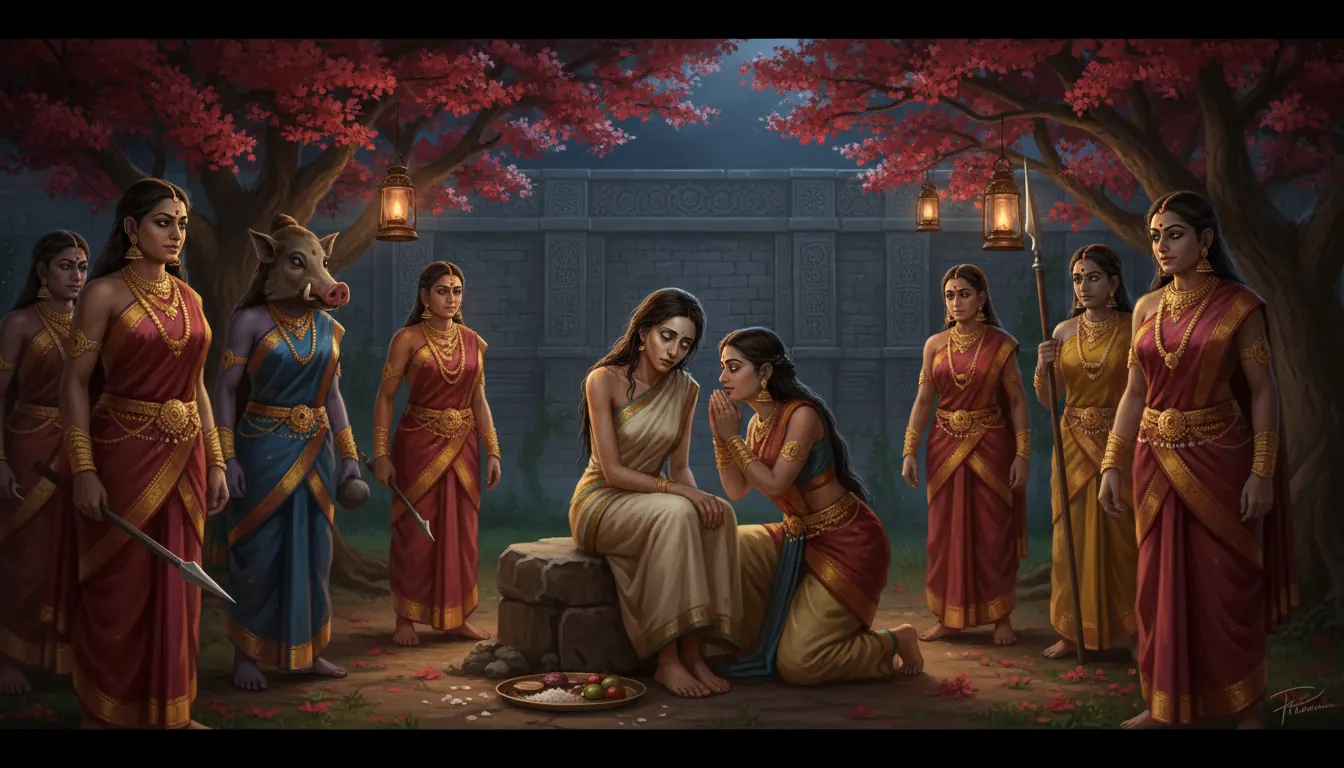
The king of the Rakshasas appointed many Rakshasa women to guard her, and armed them: bearded darts and swords and lances and battle-axes and maces, and flaming brands to carry in the dark.
They were not made alike. Some of them had two eyes and some had three. Some had eyes in the middle of their foreheads. Some had tongues so long they could not close their mouths, and some had no tongues at all. Some had three breasts and some had only one leg. Some wore three matted braids on their heads and some had a single eye and nothing beside it. And others had blazing eyes and hair stiff as a camel's, and these and the rest of them stood around Sita, surrounding her day and night, most watchfully, so that in a garden built to look like heaven she was never once out of sight of a weapon.
Those Pishacha women had frightful voices and terrible faces, and they always spoke to that large-eyed lady in the harshest tones they could manage. They had a favourite way of doing it. They did it in front of her, to one another, as though she were meat already and could not hear.
"Let us eat her up," they said. "Let us mangle her. Let us tear her into pieces, her, that is, who lives here disregarding our lord."
They said it every day. It was the whole of their argument and it never varied: submit to him, or we will devour you.
Eat Me Without Delay
Filled with grief at the separation from her lord, Sita drew a deep sigh, and answered them. She did not answer the threat. She accepted it, which is a different thing, and it took the weapon out of their hands.
"Reverend ladies," she said, "eat me at once. I have no wish to live without that husband of mine, with his eyes like lotus leaves and his wavy, dark-blue locks."
And then, in case they thought she was merely despairing, she told them precisely what she was going to do with the time they left her.
"Truly, without food and without the least love of life, I will waste my limbs away, like a she-snake inside a Tala tree. Know this for certain: I will never seek the protection of anyone but the descendant of Raghu. Now that you know it, do what you think fit."
There was nothing to answer. She had offered them the only thing they had to threaten her with, and she had put a fast against a garrison, and she was going to win, because the one outcome Ravana could not permit was a dead Sita and the one outcome she was walking steadily toward was exactly that.
The Rakshasas with the harsh voices went off to the king of the Rakshasas to report to him everything she had said, and for the first time in months the grove was empty of guards.
It is worth noticing what they carried to him. Not that she had wept, or begged, or asked after her husband. They went to tell their lord that the prisoner had invited them to eat her, and had compared herself to a snake going into a hollow tree to starve, and had named the only man whose protection she would ever seek, and had then told them to do as they thought fit. There was nothing in that report he could use.
Trijata's Errand
When those Rakshasas had gone away, one of their number stayed behind. Her name was Trijata. She was virtuous and pleasant in speech, and she came and sat by the princess of Videha and began to console her.
"Listen, Sita. I have something to tell you. Believe what I say, friend. Lady of fair hips, put away your fears and listen.
"There is a wise old chief of the Rakshasas called Avindhya. He always seeks Rama's good, and he has given me this message for your sake, and told me to reassure and cheer you and to give it in his name."
Then she said the message, and the message was three facts, delivered in order, by a counsellor of Ravana's own court risking his life to get them across a garden.
"Your husband, the mighty Rama, is well, and Lakshmana is with him, serving him. The blessed descendant of Raghu has already made friends with Sugriva, the king of the monkeys, and is ready to act for you.
"And, timid lady, do not be afraid of Ravana, whom the whole world condemns. You are safe from him because of Nalakuvera's curse. This wretch was cursed long ago for having violated his daughter-in-law Rambha, and the curse is this: that this lustful wretch is not able to violate any woman by force. He cannot touch you. He has not been able to touch you since the day he brought you here.
"Your husband will come soon, with Sugriva to protect him and the wise son of Sumitra at his side, and will take you away from here."
The Dream of the White Hill
"And there is one more thing," said Trijata. "I have had a most terrible dream of evil omen, foretelling the destruction of this wicked-minded wretch of Pulastya's race. Fate has robbed him of his senses, and he challenges the very gods. In my vision I have seen every sign of his downfall.
"I saw the Ten-headed one with his head shaven and his body smeared with oil, sunk in the mud, and the next moment dancing on a chariot drawn by mules.
"I saw Kumbhakarna and the others, stark naked, their heads shaven, decked with red wreaths and red unguents, running towards the south.
"Vibhishana alone I saw with an umbrella held over his head and a turban on it, his body decked with white wreaths and white unguents, climbing to the summit of the White hill. And I saw four of his counsellors, dressed in white, climbing that summit with him. All this means that they alone will be saved from the terror that is coming.
"The whole earth with its oceans and its seas will be covered with Rama's arrows. Your husband will fill the whole earth with his fame. I saw Lakshmana too, consuming all directions with his arrows, climbing onto a heap of bones and drinking honey there, and rice boiled in milk.
"And you, lady, I saw running towards the north, weeping, covered with blood, with a tiger guarding you. Princess of Videha, soon you will be happy, united with your lord, that descendant of Raghu, and with his brother beside him."
Hearing these words of Trijata, that girl with eyes like a young gazelle's began once more to hope for a union with her lord. And when at last the fierce and cruel Pishacha guards came back, they saw nothing at all: only the prisoner sitting with Trijata, as before.
The Banian in the Cemetery
She was living there afflicted with melancholy and grief on account of her lord, dressed in mean garb, seated on a stone, weeping incessantly, waited upon by Rakshasa women. Of all her ornaments she had one left: a single jewel on the marital thread on her wrist. She had kept that.
And Ravana, struck by the arrows of the god of desire, came to her and approached her presence.
He had dressed for it. That conqueror in battle of the gods, the Danavas, the Gandharvas, the Yakshas and the Kimpurushas came into the Asoka woods dressed in celestial robes, handsome of feature, decked with jewelled earrings, wearing a beautiful garland and a crown, like an embodiment of the spring season. Dressed with such care, Ravana looked like the Kalpa tree that stands in Indra's garden.
But though he was adorned with every embellishment, all of it inspired her only with awe, the way a beautified banian tree inspires awe in the middle of a cemetery: the ribbons and the paint make it worse, not better, because of what is underneath it. That night wanderer approaching that slender-waisted lady looked like the planet Saturn coming into the presence of the star Rohini.
She sat on her stone with her one jewel and watched him come, and she was frightened, and she looked like a helpless doe, and she did not get up.
Struck by the arrows of the god of the flowery emblem, he spoke to her. He had conquered gods in battle and had never in his life had to ask anyone for anything, and now he was standing in his own garden in his best crown, in front of a thin woman in bark cloth who had not eaten properly in months, waiting to be told what she thought of him.
The First Place Among My Women
"Sita, you have shown your husband more than enough regard," he said. "Lady of delicate limbs, have mercy on me. Let these maids in waiting adorn you now. Noble lady, accept me as your lord."
Then he made his offer, and his offer was an inventory. He did not say one word about her. He talked about himself for as long as she would let him.
"Put on costly robes and ornaments, and take the first place among all the women of my household. I have many daughters of the gods, and of the Gandharvas too. I am lord of many Danava and Daitya ladies. One hundred and forty million Pishachas obey my commands, and twice as many man-eating Rakshasas of terrible deeds, and three times as many Yakshas. Some of these are ruled by my brother, the lord of all treasures. In my drinking hall Gandharvas and Apsaras wait on me as they wait on him.
"I am the son of the twice-born rishi Visravas himself, a man of high ascetic merit. I am famed as the fifth Regent of the Universe. I have as much food and drink of the very best kind as the Lord of the gods himself.
"Let all the hardships of your life in the woods come to an end. Lady of fair hips, be my Queen, like Mandodari herself."
He offered her the first place in a household of stolen women, and counted his soldiers at her, and mentioned his brother twice, and finished by naming his own wife as the standard she would be raised to.
Less Than a Straw
The beautiful princess of Videha turned away, and regarded him as something less than a straw, and answered that wanderer of the night. Her tears were running as she spoke and her voice did not steady, and none of that made any difference to what she said.
"It is my sheer ill luck, king of the Rakshasas, that I must hear such grievous words from you. Blessings on you, Rakshasa who loves sensual pleasure. Turn your heart away from me. I am another man's wife, always devoted to my husband, and so you cannot possess me. A helpless human being like me cannot be a fit wife for you. What joy can you have in forcing an unwilling woman?"
Then she went after him in the one place he was vulnerable, which was his family.
"Your father is a wise brahmana, born of Brahma and equal to the Lord of creation himself. You are equal to a Regent of the Universe, so why do you not keep to virtue? You bring disgrace on your brother, that king of the Yakshas, the adorable lord of treasures who is the friend of Maheshvara himself: how can you feel no shame?"
Having said these words, Sita began to weep, her bosom shivering in agitation, and she covered her neck and her face with her garments. Her long and well-knit braid, black and glossy, fell from her head as she bent, and looked like a black snake lying along her back.
And hearing those cruel words, the foolish Ravana, thus rejected, spoke to her once more.
"Lady, let the god who bears the Makara on his banner burn me as he will. Still, I will not approach you on any account, since you are unwilling." And then, because he had to have the last word and did not have one: "What can I do to you, when you still care for Rama, who is only a human being, and therefore our food?"
Having said that to a lady of faultless features, the king of the Rakshasas made himself invisible then and there, and went away to whatever place he liked.
What Was Left to Her
And Sita, surrounded by those Rakshasa women, and treated with tenderness by Trijata, continued to live there in grief.
That is all. Nothing was rescued that day. The guards came back and took up their axes and their brands and their places, and the fast went on, and the woman on the stone had exactly what she had woken with, which was one jewel on a thread, a message she could not verify, and a refusal.
"He left with less than he came with," said Markandeya, in the Kamyaka wood, to a king who was listening very hard. "That is the whole of what happened. He came in dressed like the spring and counted a hundred and forty millions of servants at her, and she looked at him the way one looks at a straw on the floor, and he went out invisible because he could not bear to be seen walking. She did not have an army, or a brother, or a weapon, or a friend she could trust further than the end of one conversation. She had the ability to say no, and she used it, and it made her larger than the fifth Regent of the Universe in his own garden.
"Your wife did the same at the door of her hermitage in the Kamyaka, when a king of the Sindhus told her what she would be raised to if she were sensible. It is not a small thing, son of Kunti. Where a person has been stripped of every other means of acting, refusal is still an act, and it is enough."
Draupadi went on grinding the grain, and did not look up, and heard every word of it.
Dharma Lesson
Where a person has been stripped of every other means of acting, refusal is still an act. Sita had one jewel, a message she could not verify, and a fast she was prepared to die of, and she used the only power left to her so completely that her captor had to leave his own garden invisible. Markandeya tells it to a king whose wife had just been carried off in a chariot, and the point is not patience but the size of a no.