In short
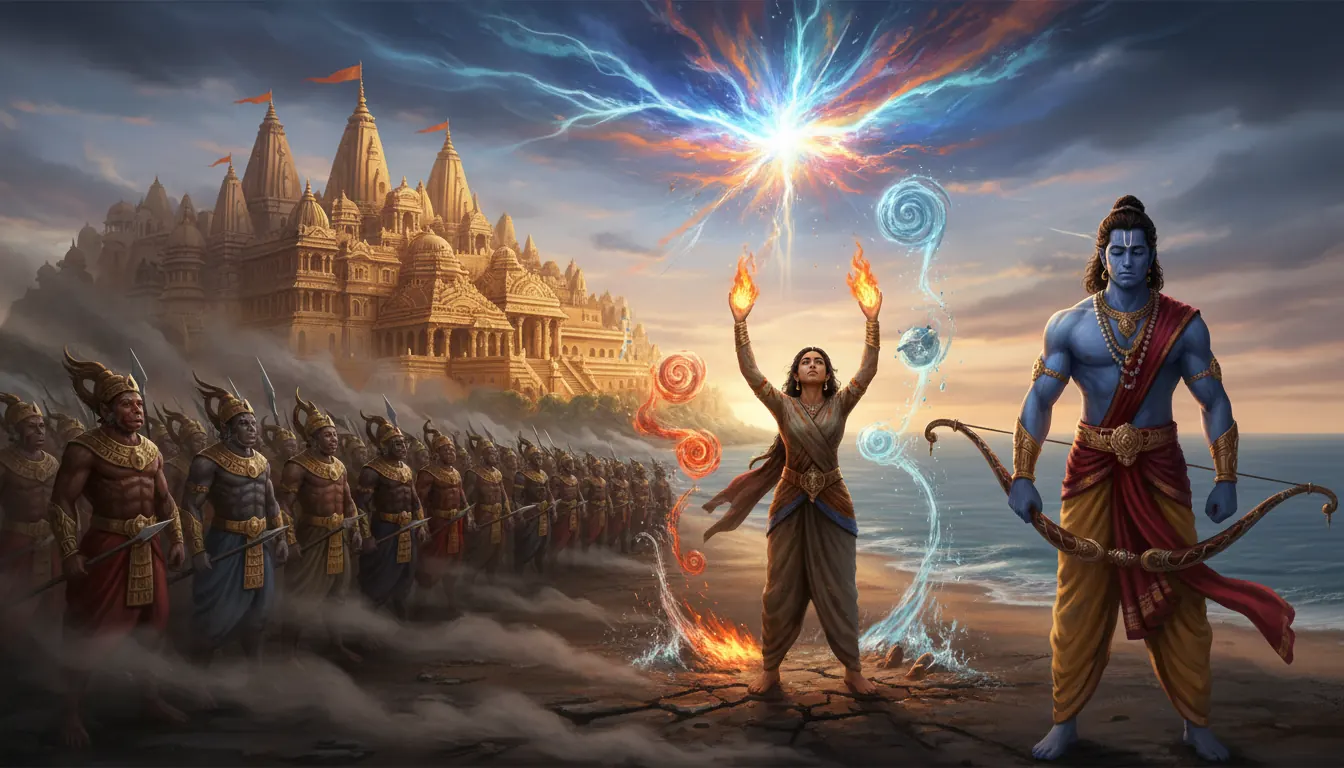
Ravana dead, Rama gives Lanka to Vibhishana, and Avindhya leads Sita out to him. Afraid for his honour, Rama tells her before the whole army that she is free to go. She calls on air, fire, water, space and earth to leave her body if she has sinned, and the sky answers, Brahma and the dead Dasaratha among the voices.
Told in the Vana ParvaSet in Lanka, Kishkindha and Kosala15 min read
The Sky Like a Festival
When he had slain Ravana, that wretched king of the rakshasas and enemy of the gods, Rama rejoiced greatly with his friends, with Sumitra's son beside him.
The gods came down with the rishis at their head and paid homage to mighty-armed Rama, blessing him and crying the word Jaya over and over, and the Gandharvas and all the dwellers of the heavenly regions honoured him with hymns and showers of flowers until the air over the burnt city was full of petals. Then, having paid him due homage, they all went back to the regions they had come from, and for a while the sky looked as though a great festival were being held in it.
On the ground, the army was counting its dead.
And Rama, conqueror of enemy cities, did the first thing a victor does, which tells you what kind of victor he is. He gave Lanka to Vibhishana. He did not garrison it, or burn what was left of it, or carry its treasure north. He gave the island to the brother who had walked out of it, and turned to go home.
Then word came out through the gate that they were bringing her.
Avindhya Brings Her Out
Ravana's old and wise counsellor, the one called Avindhya, who had sent messages to her through a rakshasi when it could have cost him his head, came out of the city in a small procession. Vibhishana walked at the front. Sita walked behind Vibhishana. Avindhya walked last, behind her, as an old servant does.
And with great humility Avindhya said to the illustrious descendant of Kakutstha: "Illustrious one, accept this goddess, Janaka's daughter, whose conduct is excellent."
At that, the descendant of Ikshvaku stepped down from his fine chariot and stood on the ground to receive her, and looked at her.
She was bathed in tears. She was stricken with grief. She was smeared with dirt, and her hair was matted, and she was wearing soiled clothes, because she had spent a year refusing to be dressed by anybody in Lanka.
Everything she was wearing was evidence of her fidelity. Every one of those marks was a refusal she had made and gone on making. And the man she had made them for stood and looked at the whole of it, and what he saw was not a wife who had held out. It was a woman who had been in another man's house for a year, in front of an army of monkeys and bears and rakshasas who were all now looking at him to see what he would do about it.
Rama was afraid of losing his honour. That is the reason the old text gives, and it does not give another.
Go Wherever You Like
"Daughter of Videha," he said, "go wherever you like. You are free now. I have done what I had to do."
He said it out loud, in the open, with Lakshmana at his shoulder and Sugriva's whole host within hearing.
"Blessed lady, as long as I was your husband, it was not right for you to grow old in the rakshasa's house. That is why I have slain that wanderer of the night."
So the war had not been fought for her. It had been fought for the insult; it had been fought because a man of his house could not let his wife grow old in another man's city. He was telling her, in front of everyone, that she had been the occasion of the war and not its purpose.
"But how can someone like us, who knows every truth of morality, embrace even for a moment a woman who has been in another's hands? Princess of Mithila, whether you are chaste or unchaste, I dare not enjoy you now, for you are like sacrificial butter that a dog has licked."
Whether you are chaste or unchaste. He did not accuse her of anything. That is what makes it worse rather than better: he was not saying she had done wrong, he was saying it no longer mattered whether she had, because the question could be asked, and a king cannot live with a question.
He had said it in the plural, too. Someone like us. Not I cannot, but one in my position cannot, which is the sentence a man reaches for when he is doing a thing he could not defend in his own name. He was speaking as the head of the house of Ikshvaku to an army and to whatever the army would say when it got home, and the woman he had crossed an ocean for happened to be standing in the way of it.
Like a Plantain Tree Cut From Its Roots
At those cruel words, that adorable girl suddenly fell to the ground, struck to the heart, like a plantain tree cut from its roots. The colour that had flooded her face out of joy at the sight of him vanished as quickly as the mist of a breath vanishes from a mirror.
And at Rama's words all the monkeys, and Lakshmana with them, stood as still as the dead. Nobody moved. Nobody spoke for him and nobody spoke against him. An army that had crossed the ocean on a bridge of stones for this woman stood in complete silence and looked at the ground.
Then the sky opened, and it did not open quietly.
The divine, pure-souled, four-faced Brahma, the Creator of the Universe himself, born from a lotus, showed himself to Raghu's son on his chariot. And Shakra came, and Agni, and Vayu, and Yama, and Varuna, and the illustrious Lord of the Yakshas, and the holy rishis. And King Dasaratha came too, in a radiant celestial form, on a chariot drawn by swans, a dead father arriving at his son's worst hour.
The sky, crowded now with gods and Gandharvas, became as beautiful as the autumn sky spangled with stars, and under it a woman was lying on the ground in dirty robes with her face in the dust.
If I Have Sinned
And the blessed and famous princess of Videha rose from the ground and stood among them all and spoke to broad-chested Rama.
She began by acquitting him, which nobody had asked her to do.
"Prince, I blame you for nothing, for you know well how one should behave towards both men and women. But hear what I have to say."
Then she called the elements as witnesses, and she called them in the only form of oath that cannot be faked, because it asks for the penalty to fall at once, in public, on the body of the person swearing.
"The ever-moving Air is always present inside every creature. If I have sinned, let him abandon my life.
"If I have sinned, then let Fire, and Water, and Space, and Earth, like Air whom I have already called upon, also abandon my life."
She had named the five things a body is made of, and asked them all to leave it, on the spot, if the charge that had not quite been made against her were true. She was inviting her own death in front of the army, as an argument.
"And as I have never, hero, even in my dreams, held the image of any other man in my heart, so be my lord, as the gods ordained."
Then she stopped, and stood there, and waited to see whether she would fall.
The Answer in the Air
When Sita had spoken, a sacred voice was heard in the sky, ringing through that whole region, and it gladdened the hearts of the great-souled monkeys, who had been standing there in misery with nothing to hit.
The Wind-god was heard first, because he had been invoked first.
"Son of Raghu, what Sita has said is true. I am the god of Wind. The princess of Mithila is sinless. So, king, be united with your wife."
Then the god of Fire spoke, and Fire is the witness at every marriage ever made, and he said: "Son of Raghu, I live inside the bodies of all creatures. Descendant of Kakutstha, the princess of Mithila is not guilty of even the smallest fault."
Then Varuna: "Son of Raghu, the fluids in every creature's body come from me. I tell you, accept the princess of Mithila."
Three of the five she had called upon answered aloud, one after another, and each of them said the same thing in the language of his own element: we are inside her, we would know, there is nothing there. The elements she had offered to be killed by came forward instead as her witnesses, and the army heard every word.
Space and Earth did not need to speak. She was still standing on the one and breathing in the other, and she had asked them both to let her go if she had sinned, and they had not let her go. The proof of those two was that she was upright at all.
What the Grandsire Said
And Brahma himself then said: "Descendant of Kakutstha, my son, in you, who are honest and pure and know the duties of royal sages, this conduct is not strange."
That is the gentlest sentence anyone spoke that day, and it is also the hardest. It does not say Rama was right. It says that from a man in his office, this was to be expected.
"But listen to what I say. Hero, you have slain this enemy of the gods, the Gandharvas, the Nagas, the Yakshas, the Danavas and the great rishis. It was by my grace that until now no creature could kill him, and I had my reasons for putting up with him for a while. But the wretch carried off Sita, and so brought about his own destruction.
"As for Sita, I protected her through Nalakuvera's curse. For Nalakuvera cursed Ravana long ago, saying that if he ever approached an unwilling woman, his head would certainly split into a hundred pieces. So let no suspicion trouble you. Take back your wife."
So it came out in the open air, in front of the army: the thing had never been possible. She had been safe from the first hour by a curse laid on him by a nephew he had wronged long before he ever saw her, and the Creator of the Universe had come down in person to say so, because nothing less would have settled it.
And last of all Dasaratha spoke. "I am pleased with you, my child. May you be blessed. I am your father Dasaratha. I command you to take back your wife and rule your kingdom, best of men."
"If you are my father, king of kings, I salute you with reverence," said Rama. "At your command I will indeed return to the lovely city of Ayodhya."
"Return to Ayodhya and rule that kingdom," his father answered gladly. "Glorious one, your fourteen years are over."
The Boons and the Debts
At this, Rama bowed to the gods, and with his friends saluting him he was united with his wife, as the Lord of the gods is united with the daughter of Puloman. What she said to him then is not recorded, and neither is what he said to her.
Then that scourge of his foes went round and paid what he owed.
He gave a boon to Avindhya, the old counsellor who had carried messages into the grove. He gave riches and honours to the rakshasa woman named Trijata, who had sat with a prisoner and told her a dream.
And when Brahma and all the gods, with Indra at their head, asked him what boons he would most like them to grant him, Rama asked for two things for himself and one for other people. He prayed for steadfastness in virtue, and for victory over all his foes. And then he asked that all the monkeys the rakshasas had slain might be brought back to life.
Brahma said, So be it. And the monkeys rose up off the field of battle, out of the heaps where they had been thrown, and stood up whole.
And Sita, so greatly blessed, granted a boon of her own to Hanuman. "Son, may your life last as long as the fame of Rama's deeds. And, yellow-eyed Hanuman, may heavenly food and drink always be yours by my grace."
Then the gods, with Indra at their head, all vanished in full view of those warriors of spotless deeds. And Matali, Shakra's charioteer, delighted, said to Rama in the midst of his friends: "You whose prowess can never be checked, you have driven away the sorrow of the gods, the Gandharvas, the Yakshas, the Asuras, the Nagas and human beings. As long as the Earth holds together, all creatures will speak of you." Then he paid homage to that son of Raghu and went away in the same chariot, bright as the sun.
The Chariot Going North
Rama, with Sumitra's son and with Vibhishana, and with all the monkeys led by Sugriva, set Sita in front, made arrangements for the protection of Lanka, and crossed the ocean again by the same bridge.
And he rode home on the Pushpaka: the beautiful sky-going chariot, able to go anywhere at the will of its rider, that Ravana had taken by force from his elder brother and been cursed for. The curse had said that the chariot would never carry him, but would bear the man who slew him. It was carrying that man now, north, with his wife aboard.
They came to the stretch of shore where he had once lain down on the sand to think about how to cross, and the king set up camp there with all the monkeys. Then in due time he called the monkeys before him and honoured them, and pleased them with gifts of jewels and gems, and sent them off one after another, by name.
When all the monkey chiefs and the cow-tailed apes and the bears had gone, Rama went back into Kishkindhya with Sugriva, and installed the victorious Angada as prince-regent of the kingdom. And then he flew on north, showing the princess of Videha the woods along the way, pointing out to her the places on the road he had walked south along without her.
The Sandals Given Back
When he reached the city of Ayodhya, the king sent Hanuman ahead as an envoy to Bharata, because after fourteen years a man does not simply walk in. Hanuman read Bharata's intentions from outward signs before he said anything, and only then gave him the good news of Rama's arrival.
And after the son of Pavana had come back, Rama entered Nandigrama, and there he found his brother waiting: smeared with dirt, dressed in rags, seated with his elder brother's sandals placed in front of him, which was how he had ruled for fourteen years. Bharata paid homage to his returned brother and handed back to him with great joy the kingdom he had held as a sacred trust, and it came back whole.
Vasishtha and Vamadeva together installed that hero on the throne at the eighth Muhurta of the day, under the star called Sravana. After the installation Rama gave Sugriva and Vibhishana of Pulastya's line leave to go home, honoured them with all kinds of gifts, and sent those friends of his away with a sorrowful heart. And then, after paying homage to the Pushpaka chariot, he joyfully gave it back to Vaishravana, its owner, and kept nothing at all out of the war. And with the help of the celestial rishi, he performed ten horse-sacrifices on the banks of the Gomati without hindrance of any kind.
"That is how Rama of boundless energy," said Markandeya, in a forest a long way north of any of this, "suffered such terrible hardship long ago because of his exile in the woods. Do not grieve, best of men, for you are a kshatriya, and you walk the path on which strength of arms must be shown. You have not even a trace of sin.
"The princess of Videha was rescued with almost no allies, after the slaughter of the Ten-necked rakshasa, and Rama's allies in that contest were monkeys and black-faced bears, creatures that were not even human. You have Dhananjaya for your brother, and this Bhima of terrible prowess, and the two sons of Madravati, who are mighty bowmen. Krishna, the daughter of Drupada, was carried off by force by the wicked-minded Saindhava, and these men brought her back, and King Jayadratha lay powerless before you. Think about all this, foremost of the Kurus, and do not grieve."
And the king, comforted, cast off his sorrows, and spoke to Markandeya once more.
Dharma Lesson
A public office can demand a proof that a private conscience never needed, and the cost of that proof is always paid by the person who did nothing wrong. Rama spoke in the plural, as one in his position, and the woman who had refused a year of Ravana's offers had to invite her own death in front of an army before the sky would say aloud what she had already proved with her body. Markandeya draws the lesson he means Yudhishthira to hear: a man who lost more than you have lost carried it without bitterness.