The Bhargava Weapon
Karna spends his teacher's last gift on the Panchalas
In short
Karna kills five hundred Kaikayas, hunts Yudhishthira down to the edge of the Pandava camp, and is talked off him twice by his own charioteer. Then, with the Kaurava army running and Duryodhana pleading, he pledges the troops his truth, strings the bow Vijaya and looses the weapon Rama of Bhrigu's race gave him, and the Panchalas and the Cedis lose their senses on the field.
Told in the Karna ParvaSet in Kurukshetra16 min read
Five Hundred of the Kaikayas
"The Kaikayas were in front of him," Sanjaya said, "and they were good. Great bowmen, mighty chariot warriors, put there for one purpose only, which was to keep Radha's son from getting any further into the line than he already was."
Dhritarashtra said nothing.
"He killed five hundred of them."
It was done with showers of arrows, one contingent at a time, the way a man cuts a hedge. He would press them until the front rank could not hold its ground, and then take the rank behind it, and the son of Adhiratha sent to Yama's realm a full five hundred of the warriors who had been posted to stop him in that battle.
The survivors did the only sensible thing. They saw that he was irresistible there, and they broke off and went to look for Bhimasena, because Bhimasena was somewhere in the press to the north of them and men wanted to be standing near him that afternoon.
That left the chariot force in front of Karna in pieces, and he broke those pieces into smaller ones with his arrows, and rode out through the gap alone.
He was in the same chariot he had begun the day in, with the same driver holding the reins. He was looking for something in particular, and after a while he found it.
Ahead of him, going slowly away from the fighting, was a chariot with a white umbrella over it, moving at the pace of a man who is not sure he can stay upright, with one rider on either side of it.
The King Between the Twins
Yudhishthira was exceedingly mangled with arrows and almost insensible, and he was proceeding slowly toward the Pandava encampment with Nakula on one side of him and Sahadeva on the other.
Karna came up behind, wanting to do Duryodhana a service, and pierced the son of Pandu with three fearsome arrows.
The king turned round on the platform of his chariot. That is worth saying plainly, because there was nothing left in him to turn round with. He pierced Radha's son in the centre of the chest, and then put three shafts into his driver, and stayed where he was.
Then the twin sons of Madri, the two guardians of Yudhishthira's chariot wheels, came in from both sides so that Karna could not kill him. Nakula and Sahadeva shot with great care and covered the son of Radha with arrows until he could hardly be seen.
Karna pierced them both with two broad-headed arrows of great sharpness and went on.
He killed Yudhishthira's horses next, the excellent ones, white as ivory, fleet as the mind, with black hair in their tails, all four. Then, smiling, he took a broad-headed shaft and knocked the headgear off the head of Kunti's son, so that the king of the Pandavas stood bare-headed in front of the whole field. Then he killed Nakula's horses, and cut through his chariot poles and his bow.
The two brothers, without horses and without chariots, climbed up into Sahadeva's chariot and stood there together, which is where their uncle saw them.
The Driver Objects
Shalya, king of the Madras, was uncle to Nakula and Sahadeva. It is easy to forget that when he is spoken of only as the man holding Karna's reins, and he did not forget it.
He was moved by compassion, and he said so, and the way he said it was the way a driver says a thing to the warrior standing behind him, which is to say without turning his head.
"You are to fight Pritha's son Phalguna today. Why then, with your rage at such a pitch, are you fighting Dharma's royal son? You are letting your weapons run out. Your own armour is being worn down. With your arrows spent and your quivers empty, with your driver and your horses tired and you yourself cut up by enemy weapons, when you finally come to Partha you will be laughed at and mocked."
It was good advice and it was true and there was nothing in Karna's answer at all, because he did not give one.
He stayed full of rage and kept attacking Yudhishthira, and kept piercing the two sons of Madri with many sharp arrows, and all the while, smiling, he used his arrows to make Yudhishthira turn his face away from the fight.
That is a formal expression, king, and I use it deliberately. To make a man turn his face from battle is to take something from him that arrows do not take. The son of Dharma turned his face away, in the open, with both armies in a position to see him do it, and there was not one thing he could have done about it.
The Second Handle
So Shalya laughed and tried a different way in, and this one worked, because it was not addressed to Karna's pity but to his vanity and his affection at the same time.
"Kill Partha, the man for whose sake Dhritarashtra's son has always honoured you. What would you gain by killing Yudhishthira? The two Krishnas are blowing their conchs; you can hear the blare of them from here. The twang of Arjuna's bow sounds like the roar of clouds in the rainy season. There he is, striking down our best chariot warriors with his downpours of arrows, devouring all our troops. Look at him. The two that are protecting his rear are Yudhamanyu and Uttamauja. The brave Satyaki is protecting his left wheel and Dhrishtadyumna his right."
And then, with the hook in it:
"There, Bhimasena is fighting the royal son of Dhritarashtra. Act, son of Radha, so that Bhima cannot kill the king today before the eyes of us all, so that the king escapes him. Look, Duryodhana has fallen into the power of Bhimasena, that ornament of battle. If you can go there and rescue him it will be a truly wonderful feat. Go and rescue the king, for he is in great danger. What will you gain by killing the sons of Madri, or king Yudhishthira?"
Karna heard that, and looked where he was told to look, and saw Duryodhana overpowered by Bhima in that dreadful battle, and left Ajatashatru and the twin sons of Madri where they stood, and turned the whole thing round.
He was carried away by horses as swift as birds, driven by the ruler of the Madras, and he did not look back at the man he had spent an hour breaking.
An Excellent Bed
After Karna had gone, Kunti's son Yudhishthira retreated, drawn by Sahadeva's swift horses, with both his brothers in the chariot with him.
He went quickly to the Pandava camp, in shame, his body badly torn by arrows, and got down from the chariot and sat down hastily on an excellent bed.
That is how it is told, king, and I have always thought the word excellent does a good deal of work in it. Everything in that tent was excellent. The bed was excellent, the coverings were excellent, the physicians were the best in the world and they came at once, and the arrows were extracted from his body one at a time while he lay on his side and did not make a sound.
His heart was afflicted with sorrow's dart, which no physician was going to draw out of him. He had been left without a chariot, bare-headed and speechless in front of two armies by a man he had been told for thirteen years was a charioteer's son, and he had been left alive, which was the part he could not put down.
When he could speak, he spoke to the twins, and what he said was not about himself.
"Go quickly to Bhimasena's division. Vrikodara is in battle, roaring like a cloud."
So Nakula, that bull among chariot warriors, and Sahadeva of great energy, both of them crushers of enemies, took another chariot and went, drawn by the swiftest horses, to Bhimasena's division, and took up their places there.
And the king was left lying in the tent with the arrows out of him, listening.
Drona's Son Against Gandiva
Meanwhile Drona's son came suddenly to where Partha was, surrounded by a large chariot force, and Partha, with Krishna to help him, held him back the way the land holds back the surging ocean.
Ashwatthama covered both Arjuna and Vasudeva with his arrows until neither could be seen, and the great chariot warriors of both armies were amazed. Arjuna, as if smiling, called up a celestial weapon; the brahmana checked it. He called up another; that was checked too. Every weapon Arjuna loosed to kill the son of Drona, the son of Drona checked in that encounter, and while the exchange lasted we saw him look like the Destroyer himself with his mouth gaping open. Having covered all the points of the compass with straight arrows, he pierced Vasudeva with three of them in the right arm.
Then Arjuna killed his horses, and caused a river of blood to run across that ground with creatures of many kinds floating in it. Ashwatthama killed his enemies in return and made a river of the same sort going the other way.
He shook his formidable gold-decked bow and struck Arjuna in the chest with a winged arrow, and Arjuna cut his bow off. He took up a spiked mace whose touch was like the touch of thunder and hurled it, and Arjuna cut that out of the air too, and it fell in pieces like a hill broken by a thunderbolt. He invoked the aindra weapon and covered the sky with the shower of it, and Arjuna fixed a weapon created by Indra on the string of Gandiva and destroyed the shower.
Then Partha knocked his driver from the driver's seat with a broad-headed arrow, and Drona's son picked up the reins himself and went on fighting while he drove, and covered Krishna with arrows while he did it, and every warrior on that field applauded the feat, ours and theirs together.
Smiling, Arjuna cut the traces of his horses with a razor-headed arrow, and the horses, already maddened by the force of his arrows, bolted with the chariot and took him out of the battle.
Stay, Stay
A loud noise arose from our troops when those horses bolted, and it was not a good noise.
The Pandavas, having obtained a victory and desiring to improve it, rushed at us from all sides shooting sharp arrows, and the vast Dhartarashtra host was broken, and re-formed, and broken again, and it was done in the very sight of your sons who are conversant with every mode of warfare, and of Shakuni the son of Subala, and of Karna himself.
Your sons tried to stop it. That army, afflicted on all sides, would not stay on the field. A confusion set in among them, terrified, many of them flying away in every direction at once, and the Suta's son stood up in his chariot and cried out loudly, "Stay! Stay!" and they did not stay.
The Pandavas were shouting by then, having seen it.
Duryodhana came to Karna, and there was nothing in the way he spoke except affection, which is the thing about your son that people who did not know him always left out.
"Look, Karna, how our army, hard pressed by the Pandavas, is running from the battle, even though you are here. You know this, mighty-armed one: do what the hour demands, scourge of your enemies. Thousands of our warriors, routed by the Pandavas, are calling for you alone, best of men."
Karna heard those grave words out to the end. Then, as if smiling, he spoke, and he did not speak to Duryodhana. He spoke to the ruler of the Madras, over his shoulder, in front of everybody, which was its own kind of answer to a long day of being talked at.
What Rama Gave Him
"Watch the prowess of my arms and the power of my weapons, ruler of men. Today I will kill all the Panchalas and the Pandavas in battle. Drive my horses on, tiger among men. Everything will be just as I have said."
And then he reached for the bow.
It is called Vijaya, and it is the finest of all weapons of its kind. Vishvakarma made it for Indra because he wished to please Indra, and with that bow Indra defeated the Daityas, and at its twang the Daityas saw the ten points of the compass empty. Indra gave it to Bhrigu's son. Bhrigu's son gave it to Karna.
He had gone up to Rama in the disguise of a brahmana, years ago, and lived with him and served him and learned everything he had, because a Suta could not be taught what a brahmana could be taught, and Karna wanted the teaching more than he minded the lie. It ended the way that kind of thing ends. Indra took the form of a worm and bored into his thigh while the teacher slept with his head on it, and Karna sat still and let the blood run rather than wake him, and Rama woke anyway and said that no brahmana born could have borne that pain, and cursed him: the great weapon he had obtained by deception would not occur to his memory at the hour of his death.
That curse took one weapon and one hour. It did not take the bow, and it did not take the other gift, and men forget that. What Bhrigu's son put into him in anger stayed in him, and worked, and worked at full strength; only the last hour of his life was mortgaged.
This was not that hour.
He strung Vijaya and rubbed the string repeatedly with his hand, the way he had done every morning since he was a boy in Adhiratha's house.
Millions and Millions
Before he shot, he did one more thing, and it is the thing I remember.
He asked the troops to stay on the field, and he did not order it and did not threaten them. He assured them upon his truth, and by an oath, that he would hold that ground; and men who had been running from the Pandavas a moment before stopped running, and came back, and stood, because Karna had given them his word and every man in that army knew what his word was worth.
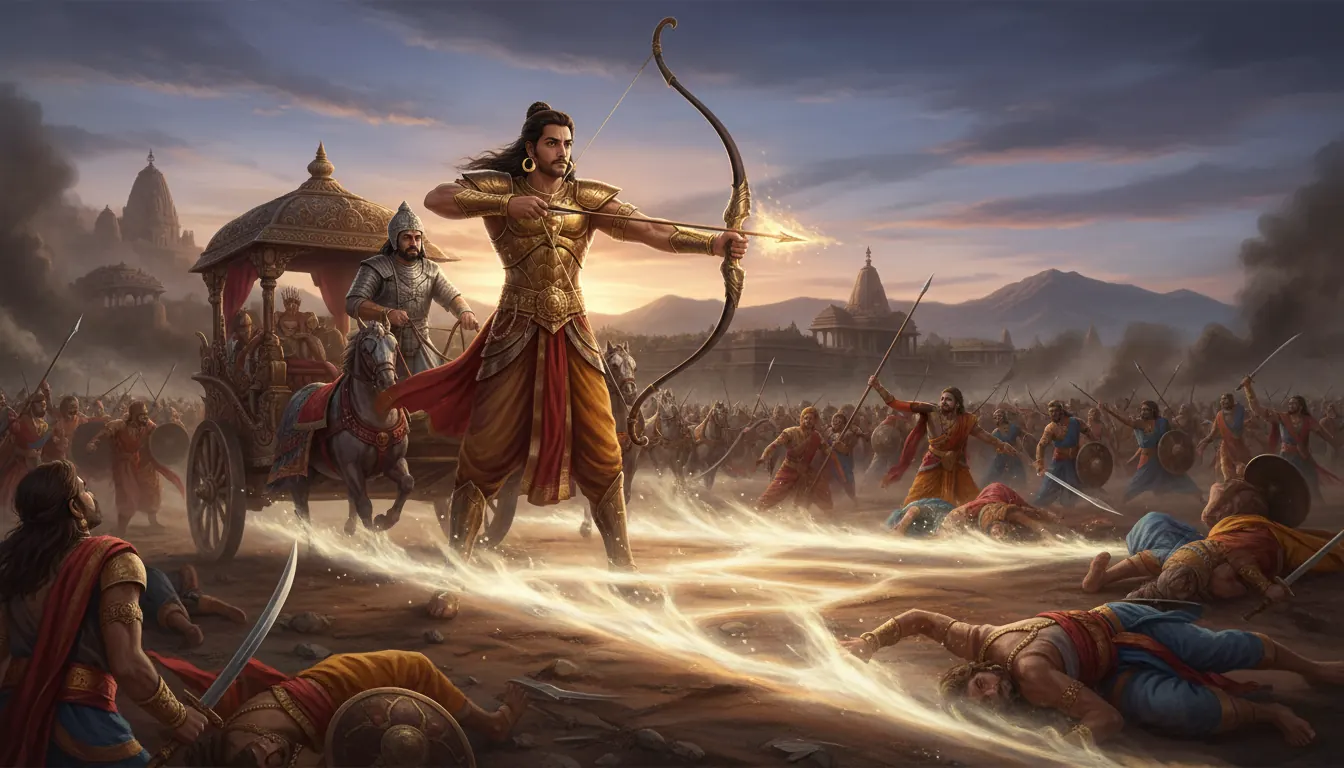
Then the mighty Karna, great of soul, fixed on his bowstring the weapon called the Bhargava.
From that weapon flowed millions and millions of sharp arrows.
The Pandava army was entirely covered by those blazing, terrible arrows fletched with the feathers of kankas and peacocks, and could see nothing at all. Loud wails rose from the Panchalas. Elephants by the thousand and horses by the thousand and chariots and men fell lifeless on every side, until the earth itself began to tremble under their weight, and the vast Pandava force was thrown into turmoil from one end to the other.
In the middle of it Karna, that scorcher of foes, while consuming his enemies, looked resplendent, like a smokeless fire.
The Panchalas and the Cedis lost their senses all over the field, like elephants in a forest fire. Those great men roared like tigers. Their wails were the wails of living creatures at the dissolution of the universe, and they ran wildly in every direction, panic-stricken and trembling with fear. Seeing them slaughtered like that, all creatures, even the beasts and the birds, were filled with fear.
And the Srinjayas, being cut down where they stood, began to call repeatedly upon Arjuna and upon Vasudeva, the way the spirits of the dead in Yama's dominions call upon Yama to come and rescue them.
Even Death Is Victory
Arjuna heard his own name coming out of that noise.
He had just finished with Drona's son. He had beaten a man whom the wielder of the thunderbolt himself could not have withstood, and he was standing in his chariot with Gandiva in his hand and his blood up, and he heard the Srinjayas calling him, and saw the bhargava weapon standing in the sky over the whole of his left wing.
He said to Krishna what he had probably been holding back all day.
"Look, mighty-armed Krishna, at the power of the bhargava weapon. Nothing can turn it aside. Look at the Suta's son too, full of rage in this great battle, like the Destroyer himself in prowess, carrying out this fierce feat. He drives his horses on without pause and glares at me again and again. I can never run from Karna in battle. A man who lives may meet either victory or defeat in battle. But for the man who is dead, even death is victory. How can a dead man be defeated?"
It was a plain statement of intention and it was also a farewell, and Krishna, who understood both, replied with what was suitable to the occasion and refused to go.
"Karna has wounded the royal son of Kunti badly and cut him up. First see him and comfort him, Partha, and then you will kill Karna."
And Keshava turned the chariot and went on, wanting to see Yudhishthira, privately thinking that in the meantime Karna would be overcome with fatigue. Dhananjaya went with him, avoiding the battle at Keshava's command, wanting to see the king too.
So while the Bhargava weapon went on emptying the field behind them, the one man on earth who could have answered it drove quickly away from it, looking for his brother; and he cast his eyes on every part of the army as he went, and could not find him anywhere.
Dharma Lesson
Rama of Bhrigu's race cursed the pupil who had lied to him, and the curse was exact: not the bow, not the teaching, not the strength of it, only the one hour in which the man would most need to remember. A gift given in good faith keeps working even after the giver has turned against you, and the price of the deception falls due once, at the end, on the day it can no longer be paid. Karna's arrows did everything he claimed for them; it was his last hour that had been mortgaged, and he had spent it before he knew.