Arjuna Against the Teacher's Son
The duel Ashwatthama could not win twice
In short
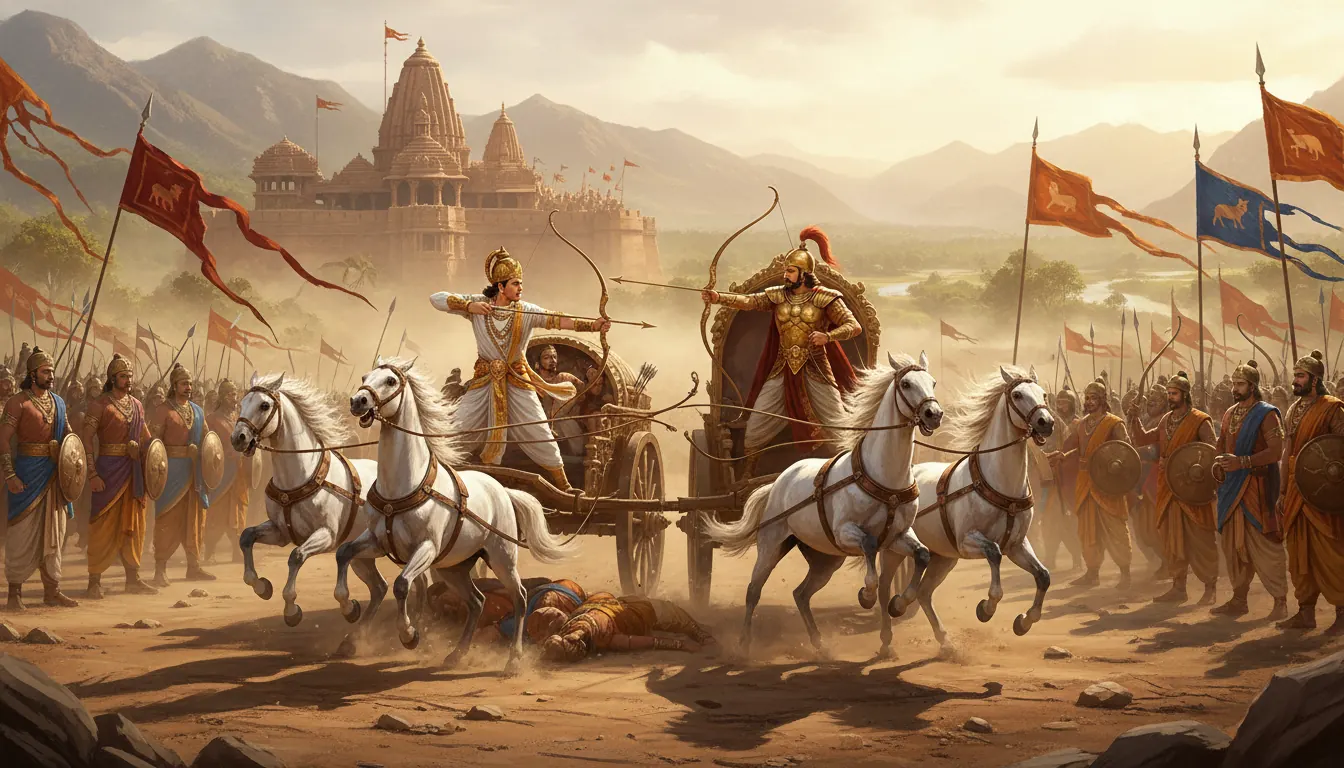
Twice in two days the two greatest living wielders of celestial weapons meet head on. Ashwatthama asks for the hospitality of battle, baffles every astra Arjuna invokes, and puts three arrows into Krishna's right arm. When his driver falls he takes up the reins himself and fights while steering, a feat both armies applaud, until Arjuna severs the traces and the horses bolt.
Told in the Karna ParvaSet in Kurukshetra15 min read
The Guest Who Asked for Hospitality
"Describe to me Arjuna's battle with the samsaptakas," the old king said, "and tell me too of Arjuna's battle with Ashwatthama."
"Listen, king," Sanjaya said, "and I will tell you of that battle, which destroyed bodies, sins and lives.
"Partha plunged into the samsaptaka force, which was like an ocean, and churned it violently, as a storm churns the deep. With keen broad-headed arrows he cut off the heads of brave warriors, heads with faces as bright as the full moon and with beautiful eyes, eyebrows and teeth, and Dhananjaya quickly strewed the earth there with them as if with lotuses plucked from their stalks. With his razor-headed arrows he cut off his enemies' arms, rounded, large and massive, smeared with sandal paste and other perfumes, still gripping their weapons, with leather guards on the fingers, and looking like five-headed snakes.
"Crowds of Siddhas, celestial rishis and Charanas all applauded him. Celestial drums sounded, and showers of flowers fell on the heads of Keshava and Arjuna. And a bodiless voice said, 'These two heroes always have the beauty of the moon, the splendour of fire, the force of the wind and the radiance of the sun. Standing together in one chariot they are as invincible as Brahman and Isana. These two heroes, the foremost of all creatures, are Nara and Narayana.'
"Bharata, when Ashwatthama heard and saw these wonders, he gathered himself with great care and resolve and charged at Krishna and Arjuna. Raising the hand that held an arrow, the son of Drona hailed the Pandava, shooting arrows with foe-killing heads, and said to him with a smile,
"'Hero, if you think of me as a worthy guest who has come to you, then give me today, with your whole heart, the hospitality of battle.'"
Which Duty Should I Turn to First
"Arjuna, challenged to battle in this way by his teacher's son, felt himself greatly honoured, and he said to Janardana,
"'I ought to be killing the samsaptakas, but Drona's son is challenging me again. Tell me, Madhava, which of these duties should I turn to first? Let the duties of hospitality come first, if you think that is right.'
"At that Krishna carried Partha, who had been challenged according to the rules of battle, up to Drona's son, as Vayu carries Indra to the sacrifice. Greeting Drona's son, whose mind was fixed on one thing, Keshava said to him,
"'Ashwatthama, be calm, and without losing a moment strike, and take what is struck at you. The time has come for those who depend on others to repay what they owe their masters. Quarrels between brahmanas are subtle things. But the outcome of a quarrel between kshatriyas is plain to see: victory or defeat. If you want the fine hospitality you are foolishly asking of Partha, then fight the son of Pandu calmly now.'
"It was said to him kindly, and every word of it was a knife. He was the son of a brahmana who had hired himself out for a house and a herd of cattle and had died on this field for it. He was standing in that army because of a debt, and Keshava had just named the debt in front of him and told him to go and pay it.
"When Vasudeva said this, that foremost of the twice-born answered, 'So be it,' and pierced Keshava with sixty arrows and Arjuna with three."
Arrows Out of the Pores of His Body
"Arjuna, filled with rage, then cut Ashwatthama's bow with three arrows. Drona's son took up another bow, more formidable still, strung it in the blink of an eye, and pierced Keshava with three arrows and Arjuna with a thousand.
"Then, carefully, Drona's son confused Arjuna in that battle and shot thousands, tens of thousands and millions of arrows. Arrows began to stream from the quivers, the bow, the bowstring, the fingers, the arms, the hands, the chest, the face, the nose, the eyes, the ears, the head, the limbs and the very pores of that reciter of the Vedas, and from the armour on his body, his chariot and his standard. Drenching Madhava and the son of Pandu in that thick shower of arrows, Drona's son roared with joy like a vast bank of gathering clouds.
"Hearing that roar, the son of Pandu said to Keshava, 'Look, Madhava, at the wickedness of my teacher's son toward me. He thinks we are dead, now that he has buried us in this dense shower of arrows. But by my training and my strength I will soon frustrate his purpose.'
"That foremost of the Bharatas cut every one of the arrows Ashwatthama had shot into three pieces and destroyed them all, as the sun destroys a thick fog.
"After this the son of Pandu once more struck the samsaptakas, with their horses and drivers, chariots and elephants, standards and foot soldiers, and then turned back, and offered Ashwatthama, his welcome guest, quiver after quiver of arrows, like a generous host offering a guest everything in his house. Leaving the samsaptakas, the son of Pandu rushed toward Drona's son, like a giver who turns away unworthy guests to go to one who is worthy."
Shukra and Brihaspati in One Constellation
"Then Arjuna and Ashwatthama fought, as splendid as the planets Shukra and Brihaspati, and their battle was like the one those two planets fight in the sky to enter the same constellation. Their blazing arrows were their rays, and as they tore at each other with them, those two terrors of the world looked like two planets that had left their orbits.
"Then Arjuna drove an arrow deep into Ashwatthama between the eyebrows, and with that arrow standing out of his forehead the son of Drona shone like the sun with its rays pointing upward. The two Krishnas, deeply wounded by Ashwatthama with hundreds of arrows, looked like two suns at the end of the Yuga.
"Then, when Vasudeva seemed dazed, Arjuna released a weapon that poured out torrents of arrows on every side, and struck the son of Drona with countless arrows, each like the thunderbolt or fire or the sceptre of Death. But Ashwatthama, a man of mighty energy and fierce deeds, then pierced both Keshava and Arjuna with well-aimed arrows driven with such force that Death himself would have felt the pain.
"Then Drona's son, without losing a moment, took aim with ten of his best arrows and sent them off so fast they seemed to be a single arrow. Shot with great force, five of them pierced Arjuna and the other five pierced Vasudeva. Struck by those arrows, those two foremost of men were bathed in blood, and everyone there took them for dead, killed by Ashwatthama, the warrior who had mastered the whole science of arms."
Why Make the Mistake of Sparing Him
"Then the chief of the Dasharhas said to Arjuna,
"'Why are you making the mistake of sparing Ashwatthama like this? Kill him. If you take him lightly, even this one man will cause great grief, like a disease that is left untreated.'
"There was a truth in it that neither of them said out loud on that chariot. Arjuna had grown up in the same yard as this man. They had been taught by the same hands, out of the same quiver, and every counter that Ashwatthama was using against him had been put into the boy's hands by the boy's father in Arjuna's hearing. It is one thing to kill a stranger who knows your art. It is another to kill a man who was taught it beside you.
"Arjuna, whose understanding was clear, answered Keshava of unfading glory with the words 'So be it,' and began, with great care, to cut the son of Drona to pieces with his arrows. In his rage he quickly pierced his opponent's massive arms smeared with sandal paste, his chest, his head and his matchless thighs with arrows whose heads were shaped like goats' ears, shot with great force from gandiva.
"Then Arjuna cut the traces of Ashwatthama's horses and began to pierce the horses themselves, and they bolted and carried Ashwatthama far from the field.
"As those horses, swift as the wind, bore him away, the shrewd son of Drona, badly wounded by Partha's arrows, thought for a while and did not want to go back and take up the fight with Partha again. He knew that victory always goes with the chief of the Vrishnis and with Dhananjaya. So that foremost of Angirasa's line, his hope gone and his arrows and weapons almost spent, reined in his horses, steadied himself a little, and entered Karna's force, which teemed with chariots, horses and men. His own horses had taken him off the field, as a disease is driven from the body by spells and medicines."
The Second Day, and the Weapons That Would Not Take
"The next day, while Karna was hunting for Yudhishthira across the field, Drona's son, surrounded by a large force of chariots, suddenly made for the spot where Partha was.
"As the shore withstands the surging ocean, the heroic Partha, with Saurin to help him, withstood Ashwatthama's furious charge. Then the valiant son of Drona, in a rage, covered both Arjuna and Vasudeva with his arrows, and when the great chariot warriors of the Pandava army, and the Kurus who were watching, saw the two Krishnas buried in arrows, they were amazed.
"Then Arjuna, as if smiling, called a celestial weapon into being.
"The brahmana Ashwatthama turned that weapon aside. In fact, every weapon that Arjuna released in his wish to kill the son of Drona, that great bowman turned aside in that fight. Arjuna called them up one after another, and one after another the son of his teacher took them out of the air as a man takes a thrown thing out of the air with his hand, and did not appear to hurry.
"As that terrible duel of weapons went on, king, we saw that the son of Drona looked like the Destroyer himself, with his mouth gaping wide. He covered every point of the compass, the main directions and those between, with straight arrows, and pierced Vasudeva in the right arm with three arrows."
Two Rivers of Blood
"Then Arjuna killed all the horses of his great-souled attacker and made a dreadful river of blood flow over the earth in that battle, a river that led to the other world, with every kind of creature floating on it. All the onlookers saw large numbers of chariot warriors from Ashwatthama's division, chariots and all, killed and destroyed by the arrows from Partha's bow.
"Ashwatthama too, killing his enemies, made a terrible river of blood flow there that led to Yama's kingdom.
"As that fierce and terrible battle between Drona's son and Partha went on, the fighters struck out without any regard for one another and rushed this way and that. Chariots lost their horses and drivers, horses lost their riders, and elephants lost their riders and their guides, and Partha made a terrible slaughter in that battle. Chariot warriors fell dead from the arrows of Partha's bow, and horses, stripped of their harness, ran this way and that.
"Seeing what Partha had done, the valiant son of Drona quickly closed with him, shook his formidable gold-adorned bow, and pierced him from every side with many sharp arrows. Bending the bow once more, the son of Drona cruelly struck Arjuna in the chest with a winged arrow. Badly wounded, the wielder of gandiva took up a terrible gold-adorned club and hurled it at the son of Drona.
"But Drona's son suddenly shattered the club with his arrows as it flew at him, and the warriors cheered. Cut to pieces by Drona's son's arrows, it fell to the earth like a mountain smashed by the thunderbolt."
The Reins in His Own Hands
"Enraged at this, Drona's son began to bury Bibhatsu in arrows with the power of the aindra weapon. When Partha saw that shower of arrows spread across the sky by the aindra weapon, he took up his bow gandiva, fitted to the string a mighty weapon created by Indra, destroyed the aindra shower, and soon covered the chariot of Drona's son with his own arrows.
"But the son of Drona, though overwhelmed by Partha's arrows, pushed his way through the shower the son of Pandu had shot, came up close, called up a mighty weapon, and suddenly pierced Krishna with a hundred arrows and Arjuna with three hundred small ones.
"Then Arjuna pierced his teacher's son in every vital part with a hundred arrows. He poured many more on the horses, the driver and the bowstring of Drona's son, in full view of your warriors, and with a broad-headed arrow knocked his opponent's driver out of the driver's seat.
"But Drona's son took up the reins himself and covered Krishna with many arrows.
"The skill we saw in Drona's son then was truly wonderful, for he drove his own horses while he fought Phalguni. Every warrior, king, applauded that feat of his. Men on both sides of that field stopped what they were doing to watch one man do with the reins in one hand what other men cannot do with two hands free, and the shout that went up for it came from the Pandava line as much as from ours.
"Then Bibhatsu, who is also called Jaya, smiling all the while, quickly cut the traces of Ashwatthama's horses with a razor-faced arrow. Already weakened by the force of Arjuna's arrows, the horses of Drona's son bolted, and a great cry went up from your troops, Bharata."
The Army That Would Not Stay
"Meanwhile the Pandavas, having won the upper hand and wanting to press it, charged your troops, shooting sharp arrows at them from every side. Driven by the hope of victory, the heroic Pandavas broke the vast Dhartarashtra army again and again, in full view of your sons, who knew every kind of warfare, and of Shakuni the son of Subala, and of Karna.
"Your sons tried to stop it, but that great army, battered on every side, would not stay on the field. Panic spread through your son's huge, terrified host as warriors fled in every direction. The Suta's son shouted, 'Stand, stand!' but your army, cut down by many great-souled warriors, would not stay on the field. The Pandavas shouted aloud when they saw the Dhartarashtra host in flight.
"Then Duryodhana, out of affection, said to Karna, 'Look, Karna, how our army, hard pressed by the Pandavas, is fleeing the battle, even though you are here. You know this, mighty-armed one: do what the moment calls for. Thousands of our warriors, routed by the Pandavas, are calling for you alone, best of men.'
"Hearing these grave words of Duryodhana's, the son of Radha, as if smiling, said to the ruler of the Madras, 'Watch the strength of my arms and the power of my weapons, ruler of men. Today I will kill all the Panchalas and the Pandavas in battle. Drive the horses on, tiger among men. Everything will happen exactly as I have said.'
"With these words the Suta's son, a man of great valour, took up his ancient bow, the finest of bows, and the day wore on toward afternoon."
The One Who Was Never Beaten
So it stood at the end of those two days.
Of all the men who had taken the field for Duryodhana, the son of Drona was the one whom nobody could fault. He had turned aside every celestial weapon Arjuna could call up. He had put three arrows into the right arm of Krishna. He had fought while driving his own horses and been applauded for it by the men he was trying to kill.
And twice within two days his own horses had carried him off the field with his weapons almost exhausted, because his traces were cut, and both times he came back to a camp that was losing, and both times there was nothing waiting for him there but the next morning.
He was the last thing his father left behind, and he was serving a debt his father had contracted and could not get out of. Sanjaya told the blind king all of this in order, the astras and the reins and the flight, and did not say the obvious thing, which was that skill answers for itself and not for the cause a man is hired into, and that a flawless craftsman on the wrong side simply takes longer to lose.
What that man would do about it, in the dark, after everything else had been lost, belonged to a later night and another parva.
Dharma Lesson
A man can be flawless at his craft and still lose, because skill answers only for itself and not for the cause it was hired to serve. Ashwatthama matches Arjuna weapon for weapon in both encounters, and twice his own horses carry him off the field to a camp that is losing anyway. What a man is good at does not decide what he is worth; what he serves with it does.