The Calf and the Wheel
Karna tells his charioteer the curse that will kill him
In short
Goaded all day by Shalya with the fable of the crow that ate from other men's dishes, Karna stops boasting and confesses two curses instead. One took a weapon from his memory; the other, laid by a brahmana whose homa calf he killed by accident, will sink his chariot wheel into the earth. He offers a kingdom's wealth for that curse and is refused every time.
Told in the Karna ParvaSet in Kurukshetra and Anga16 min read
The Crow That Ate From Dishes
"So the swan put the crow down on dry land," Shalya said, "and comforted him, and went off wherever he wished, as swift as the mind. And the crow, who had been fed on the leftovers of other people's dinners, gave up his pride in his might and energy and took up a life of peace and quiet."
He let the reins run through his fingers and let the silence sit exactly as long as it needed to.
"Just as that crow, fed on the leftovers of the vaishya children's dinners, looked down on his equals and his betters, so do you, Karna, fed by the sons of Dhritarashtra on the scraps from their dishes, look down on all your equals and betters."
The chariot went forward. Neither of them was looking at the other.
"Why did you not kill Partha at Virata's city, when you had Drona and Drona's son and Kripa and Bhishma and all the rest of the Kauravas to protect you? There, where the diadem-crowned Arjuna defeated you all with great slaughter, like a pack of jackals beaten by a lion, what became of your prowess? You saw your own brother killed by Savyasachin before the eyes of the Kuru heroes, and you were the first to run. On the shores of the Dvaita lake, when the Gandharvas came at you, it was you who deserted all the Kurus and ran, and it was Partha who freed Duryodhana and his wife. Rama himself spoke before the kings in the Kuru assembly of the prowess of both Partha and Keshava. You have heard Drona and Bhishma say in front of every king there that the two Krishnas cannot be slain."
A long breath.
"Like the sun and the moon, Keshava and Arjuna are famous for their splendour. You, however, are a firefly among men. Do not be so foolish as to scorn those two great lights. Those two are lions among men. Stop these boasts."
You Have Never Seen Them
The high-souled son of Adhiratha listened to all of that unconvinced, and answered it, and the answer began quietly, which was not what Shalya had been expecting.
"I know well what Vasudeva is and what Arjuna is. Saurin's skill at driving a chariot, the might of the son of Pandu, his high weapons: I know all of it well at this hour. You, however, Shalya, have never seen any of it with your own eyes."
It was the flattest insult available to him and he chose it deliberately: you have been told about them. I have stood in front of them.
"I will fight the two Krishnas without fear, the two greatest wielders of weapons there are."
And then, without any change of tone at all, he said the thing that turned the whole quarrel into something else.
"But the curse of Rama, that best of the twice-born, pains me greatly today."
Shalya did not answer, because there was nothing to answer. He had been holding the reins since dawn, saying every cruel thing that came into his head, and the man behind him had borne all of it with his jaw shut, and now, unprompted, in the middle of a battle, Karna had begun to tell him the truth about himself.
The Worm in the Thigh
"In the old days I lived with Rama disguised as a brahmana, wanting to win celestial weapons from him.
"At that time the chief of the gods, wishing to help Phalguna, put an obstacle in my way. He took the dreadful form of a worm, came to my thigh, and pierced it. My teacher was asleep at the time with his head resting on that thigh. The worm went on boring through it, and from the wound a pool of thick blood flowed out of my body onto the ground. For fear of waking my teacher I did not move my leg.
"When he woke, the brahmana saw what had happened. He looked at the blood, and at me, and saw how I had endured it, and said, 'You are no brahmana. Tell me truly who you are.'
"I then, Shalya, told him truly of myself, and said that I was a Suta.
"And when he heard my words, that great ascetic, his heart filled with rage, cursed me. He said: 'Because of the deceit by which you won this weapon, it will never come to your memory at the time of need, when the hour of your death comes. Brahma surely cannot dwell in one who is not a brahmana.'"
He stopped there a moment.
"I have forgotten that great weapon in this fierce and terrible battle. I have reached for it today. It is not there."
That is the shape of the thing, king, and it is worth saying slowly. The curse did not take his strength, or his aim, or the bow, or any of the hundred other weapons Rama had put into him. It took one weapon and one hour, and it left him in full possession of the knowledge that both were coming. A man told that he will die at a particular moment may at least walk carefully. Karna was told only that at the moment when he most needed the greatest thing he had, he would open his hand and find it empty.
Like the Continent Holding the Ocean
Then, having said the worst thing he knew about himself, he went straight back to boasting, because that was the only other way he had of standing upright.
"But know this, Shalya: I will kill in battle that fierce bowman, that tireless hero, that warrior who keeps every promise, that son of Pandu, Dhananjaya. I still have under my control today at least the weapon with which I will destroy great numbers of enemies.
"The boundless Ocean, lord of all waters, rushes on with fierce force to overwhelm countless creatures, and the land holds him and checks him. In the same way I will hold back the son of Kunti today, the greatest of all archers, while he shoots his countless arrows without pause, not one of which is wasted. Like Himavat bearing the mighty, all-crushing god of wind, I will stand without moving and bear the angry and vengeful Dhananjaya. Like clouds putting out a blazing fire that seems ready to consume the whole earth, I will put out the son of Kunti with my showers of arrows. He is a terrible snake full of deadly poison, hard to catch, with sharp fangs, and I will still him with my broad-headed arrows.
"Arjuna is proud. His weapons strike deep. His hands are very quick, he knows horses, he throws vast armies into turmoil, he is counted an Atiratha. That is what he is, and still I will cut his head from his body today. What other man who wanted to save his own life would fight that Savyasachin, who defeated all creatures, the gods themselves included, in the land called Khandava? None but me.
"I myself will gladly speak of Phalguna's prowess in an assembly of kshatriyas. Why, then, do you, a fool with a fool's understanding, tell me about Phalguna's prowess?"
Friendship Takes Seven Steps
"You do unpleasant things. You are cruel and mean, and since you cannot forgive, you belittle a man who can. I could kill a hundred men like you. I forgive you, because I am forgiving by nature and because the times demand it.
"Like a fool you have rebuked me for the sake of Pandu's son and told me many unpleasant things. Crooked-hearted as you are, you have said all this to me, whose heart is sincere. A curse on you, for you wrong your friends, and we are friends, because friendship takes seven steps."
It is an old saying, king, and Karna used it exactly. Walk seven steps beside a man and you are his friend; there is no further ceremony required and no way of unmaking it afterwards. They had walked a great many more than seven steps together on that chariot since sunrise.
"The hour we are living through is terrible. Duryodhana himself has come to battle. I am eager to see his purposes achieved. You, however, are acting in a way that shows you have no friendship at all for the Kuru king.
"A friend is one who shows affection for another, who gladdens another, who makes himself pleasant to another, who protects another, who honours another, and who rejoices in the joys of another. I tell you that I have all those qualities, and the king himself knows it. But one who destroys, who punishes, who sharpens his weapons, who injures, who makes us sigh, who makes us cheerless, and who wrongs us in many ways, is an enemy. All those qualities are to be found in you, and you show every one of them toward me.
"For Duryodhana's sake, to do what pleases you, for victory, for my own sake, and for the sake of God himself, I will fight Partha and Vasudeva with all my strength. Watch my feats today."
And Shalya, who was uncle to two of the men on the other side and had been manoeuvred into this war against his own inclination, sat holding the reins of a Suta's chariot and was told that he was being forgiven, and said nothing at all.
If Only the Wheels Do Not Sink
"Today you will see my excellent weapons, my brahmastra and my other celestial weapons, and my human ones too. Today I will kill that hero of fierce prowess as one maddened elephant kills another. Today, for my victory, I will hurl at Partha, by my mind alone, that weapon of boundless energy called the brahmastra.
"Arjuna will never be able to escape that weapon, if only the wheels of my chariot do not sink into the earth in battle today."
And there it was.
It went past Shalya's ear like an arrow he had not seen coming. He had been driving for hours through a torrent of self-praise, and in the middle of the largest boast of the morning a small condition had been attached, quietly, in the man's own voice, as though it were an ordinary thing to say about a chariot.
Karna did not stop.
"Know this, Shalya. I would not take fright at Yama himself armed with his rod, nor at Varuna armed with his noose, nor at Kubera with his mace, nor at Vasava armed with the thunderbolt, nor at any other enemy at all who might come to kill me. So I have no fear of Partha, nor of Janardana. I will meet them both in today's destructive battle."
And then, in the same breath, without any transition at all, he began to talk about a cow.
A Solitary Forest
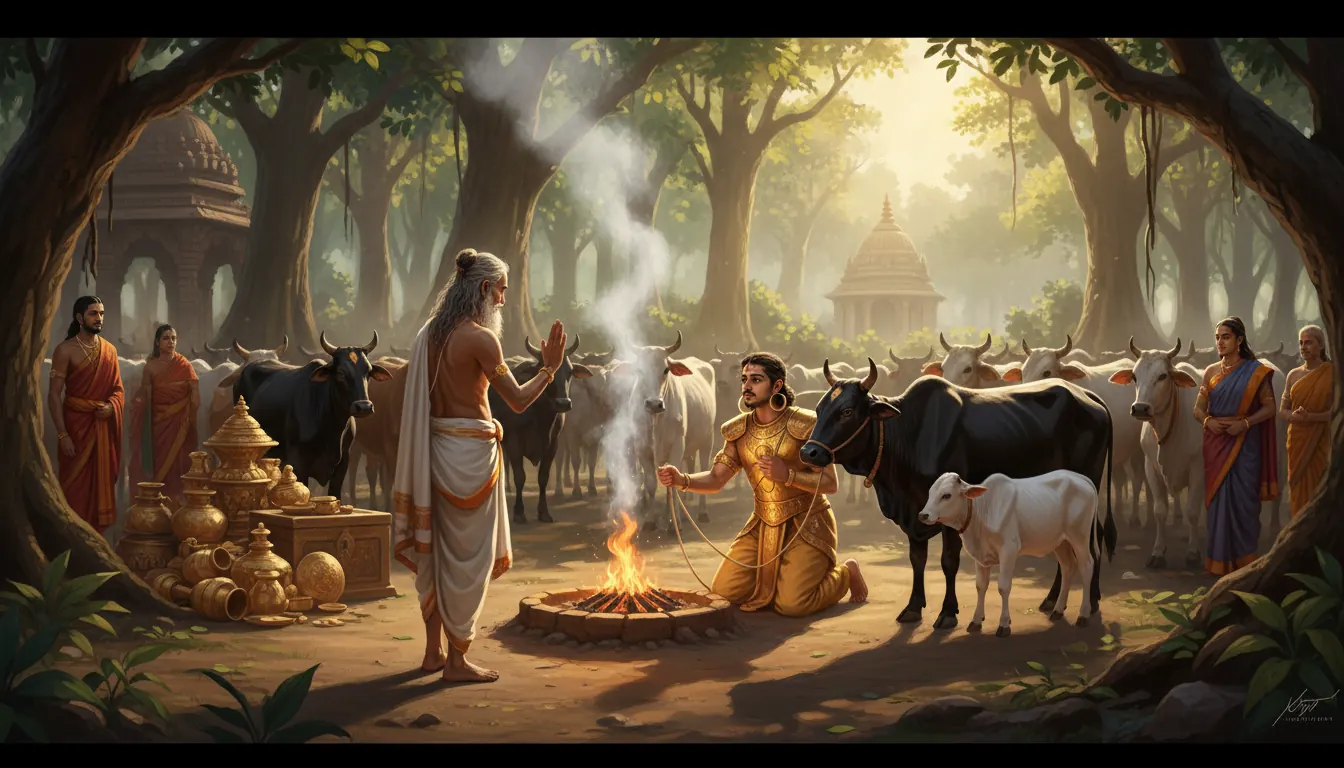
"Once, while I was wandering about practising with my bow called Vijaya, shooting many fierce and terrible arrows, I carelessly struck the calf of a brahmana's homa cow with one of them, and killed it without meaning to, while it was wandering in a solitary forest."
That is the whole of the crime, king, and I would not have you make it larger than it was. He was a young man in the years of his kingdom, alone, in a wood, shooting at nothing in particular to keep his hands sharp. The arrows went where such arrows go. One of them found a calf that belonged to a brahmana who kept a fire and needed that cow's milk for the offerings, and the calf died, and Karna had not meant it and would have given anything not to have done it.
He went to the man himself, which not every prince would have done.
"Then the brahmana said to me: 'Since you have senselessly killed the calf of my homa cow, the wheel of your chariot will sink into the earth at the time of battle, and fear will enter your heart.'"
Karna said it out, word for word, the way a man says something he has repeated to himself ten thousand times in the dark.
"From these words of the brahmana I am experiencing great fear."
What Was Offered
The kings of the Lunar race, who are lords of other people's fortunes, came and made offers on his behalf. They began with a thousand cows and six hundred bulls.
Even with such a gift, ruler of the Madras, the brahmana would not be satisfied.
So Karna offered seven hundred elephants with large tusks, and many hundreds of slaves, male and female.
That greatest of brahmanas would still not be satisfied.
So next he gathered a full fourteen thousand cows, every one of them black and every one with a white calf at her side. It is a specific thing to ask for and a hard thing to assemble, and the specificity is the point: he was replacing what he had destroyed, in kind, fourteen thousand times over, with the exact animal the man had lost.
He still could not win the favour of that best of brahmanas.
Then he offered a wealthy mansion, full of every object of desire, and in fact whatever wealth he had, all of it, and wished to give it with due worship, in the proper form, with the proper words, as one gives to a brahmana.
And the brahmana refused to accept the gift.
Understand what was happening there, king. This was not a man holding out for a better price. Karna had offered him everything a king possesses and then offered himself along with it, begging importunately for pardon, in front of witnesses, and the brahmana kept saying no to a fortune while standing in a poor man's clothes, and he was not saying no in order to be given more.
I Dare Not Speak What Is False
"Then, to me, who had offended him and had begged him so earnestly for pardon, the brahmana said this.
"'What I have said, Suta, is sure to happen. It cannot be otherwise. A false speech would destroy creatures, and the sin would be mine as well. So, to preserve virtue, I dare not speak what is false. And do not, again, destroy the means of a brahmana's living. No one in the world can make my words false. Accept those words. It will be your atonement for the sin of killing a calf.'"
That is the answer, king, and it took me a long while to understand it.
The brahmana was not punishing him. He was not withholding a pardon that he was free to give. He had said a thing, and having said it he could not unsay it without making a false speech, and a false speech from such a man destroys creatures, and the sin of it would have been his own. He was not refusing Karna's cattle out of anger. He was refusing to buy his own truth back from himself at any price a king could name, because it had stopped being his to sell the moment it left his mouth.
And he did the only kind thing left to him, which was to tell Karna what the curse was for. Accept those words. It will be your atonement. Not your ruin: your atonement. Carry it, and the debt is paid, and you may go.
Karna, who had a great deal in common with that brahmana and never once seemed to notice it, took the words and carried them for the rest of his life.
Be Silent Now
The chariot had gone a long way while all this was being said. Somewhere ahead of them the Pandava line was re-forming and men were dying in the ordinary manner, and on that one chariot two kings had been having a conversation that neither of them would have had with anybody else alive.
Karna finished it the way he had begun it.
"Though you rebuke me, I have still told you all this, for friendship's sake."
That is the sentence I would ask you to keep, king. Not the boasts. The man had spent the whole day being told by his own driver that he was a crow eating from other men's plates, and he answered it by handing that driver the two secrets that could kill him, and gave as his reason that they were friends.
"I know you, you who rebuke me like this. Be silent now, and hear what I am about to say."
And Shalya was silent, and took the horses forward, and Karna went on with what he had to say, and neither of them mentioned the wheel again.
It was still morning, and the two armies had barely closed. There were many hours left of that day. When the hour did come, and the left wheel of that chariot went down into the earth at the exact moment his memory went empty, there was nobody on the field who was surprised except the man standing on it, and even he was not surprised. He had told it to his enemies' own uncle himself, out loud, in the sunlight, before it happened.
Dharma Lesson
A wrong done carelessly cannot be bought back at any price, because the man wronged is not selling anything. The brahmana refuses a thousand cows and seven hundred elephants and a whole mansion of treasure not out of spite but because his own word has stopped being his to unsay: a false speech would destroy creatures, and the sin of it would be his. What he gives Karna instead is the only mercy left in the case, which is to name the curse an atonement and let the debt be finished by being carried.