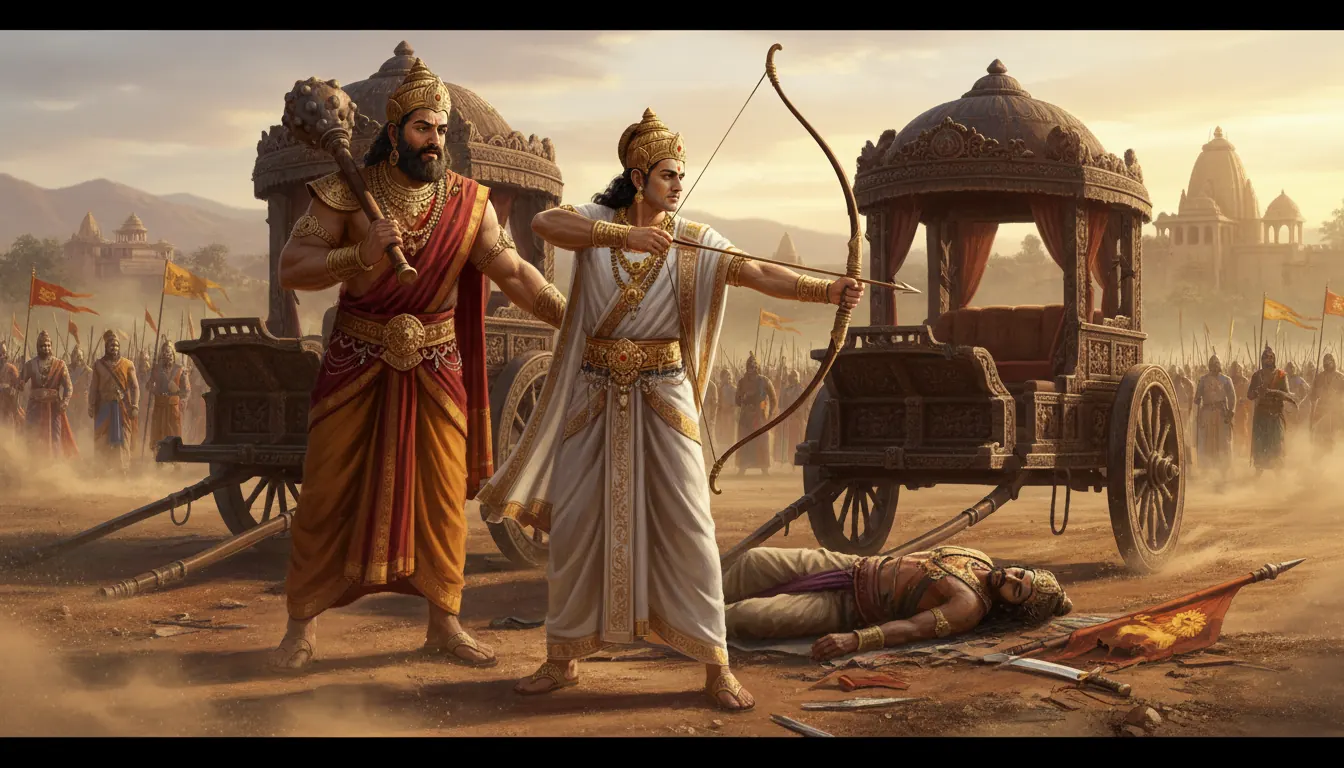
The King Against the King
Yudhishthira brings Duryodhana down and Bhima stops the blow
In short
On the sixteenth day Duryodhana drives straight at Yudhishthira, and Yudhishthira drives straight back. Twice in one day the quiet brother takes him apart, cutting away horses, driver, standard, bow and sword, splitting a death-dealing dart into three pieces in the air, and finally laying him senseless on his own chariot. Then Bhima says one sentence and the killing stops.
Told in the Karna ParvaSet in Kurukshetra17 min read
Wait, Wait
"Your son received him without any fear at all," Sanjaya said. "That is the part I want you to understand before I tell you the rest of it. It was the sixteenth day. Karna had been supreme commander since the morning, and there was a feeling in our lines, the first for many days, that the thing might yet be carried. Then Yudhishthira came up through the dust on the left, shooting arrows in great numbers, and your son did not go around him and did not wait for help. He put himself in front of him."
The king of the Pandavas came at him with speed, and pierced him as he came, and shouted the two words a man shouts when he means the other one to stand and settle it.
"Wait. Wait."
Duryodhana answered with nine keen arrows into the son of Pandu, and then, filled with a wrath that had been sixteen days collecting, put a broad-headed shaft into Yudhishthira's driver.
That was a mistake, though it did not look like one at the time. Yudhishthira the just was not a man who lost his temper often, and men who fought him tended to forget that when he did lose it he did not shout. He set thirteen arrows on his string, one after another, every one of them equipped with wings of gold and whetted on stone, and put all thirteen into your son.
"Monarch," said Sanjaya, "there is a way that soldiers describe a fight when they wish to be exact, and I will be exact, because I do not want you afterwards to say that I softened it. He counted them out. I stood where I could see him count them out."
Eight Arrows
With four shafts he killed the four horses.
With the fifth he cut the head of Duryodhana's driver off his trunk, and the body sat there a moment before it went over sideways.
With the sixth he brought the standard of the Kurus down onto the earth.
With the seventh he cut the bow.
With the eighth he cut the scimitar out of its sheath.
Then, with five more, king Yudhishthira the just afflicted the Kuru monarch deeply, and there was nothing left on that chariot to answer with.
Duryodhana got down off the horseless chariot and stood on the ground. That is the whole of it, and I would ask you to hold that picture for a moment, because it is not one that anybody expected to see on this field: the son of Dhritarashtra standing on his own two feet in the middle of a battle with no horses, no driver, no standard, no bow and no sword, in imminent danger of his life, and the man who had brought him to it was the brother he had always thought was the soft one.
He did not run. I will say that for him. He stood where the chariot had stopped and looked at Yudhishthira, and Yudhishthira looked back, and for the length of a breath there was nothing in the world but the two of them and the ground between.
Then the field came in on both sides at once.
The Rescue
Karna saw it first, or moved first, which on that day amounted to the same thing. Drona's son came from the other quarter, and Kripa behind him, and others whose names you would know, all of them rushing suddenly toward that one spot, desirous of rescuing the king, with no thought in them except that he was standing on the ground with nothing in his hands.
And the other sons of Pandu, seeing the same thing from the other side, closed in around Yudhishthira, because they had all understood at once what those eight arrows meant, and what would be done to the man who had shot them.
So the battle that followed was not a battle anybody planned. It began because two groups of men ran at each other over one patch of trampled ground.
Thousands of trumpets were blown in that engagement. A confused din of myriad voices went up until you could not tell an order from a scream, and there, where the Panchalas met the Kauravas, men closed with men and elephants with the finest of elephants, chariot-warriors with chariot-warriors and horse with horse.
For a little while it was beautiful. I have to say that too, or the account is not honest. The couples matched themselves fairly, each to his own kind, every one of them skilled and every one of them armed with something different, and they fought with great activity and great skill and observed the sanctioned practices of warriors. None of them fought from behind another. They killed one another face to face, in the open, and it was a thing worth watching.
For only a very short time did that battle present a beautiful aspect.
An Encounter of Mad Men
Then it became an encounter of mad men, in which the combatants showed no regard for one another.
A chariot-warrior would come up on an elephant and pierce it with keen shafts and send it to Yama's presence with straight arrows. Elephants got in among the horses and dragged them down and tore them open with their tusks in a dozen places at once. Horsemen surrounded the best of the enemy's horses and made a great noise with their palms and closed with them and killed them as they ran this way and that. Infuriated elephants routed whole bodies of cavalry and crushed the animals with their foreheads or spitted them, riders and all.
Foot-soldiers, running, threw down their ornaments as they ran, and the elephant-riders who knew the signs of victory when they saw them wheeled their beasts and made them pick the ornaments up off the ground and pierce them on their tusks, and while they were doing that other foot-soldiers came round behind and killed them.
Men were thrown up into the air by elephants with their trunks and speared on the points of the tusks as they came down. Men were whirled on high like fans and killed in the whirling. Men who were carried out of their own division into the middle of another were rolled repeatedly on the ground until there was nothing left of them worth the name.
Elephants were wounded with spears and lances and darts in the cheeks and the frontal globes and the soft places between the tusks, and huge beasts ripped open on their flanks by chariot-warriors and horsemen fell down on the earth like mountain summits split by thunder.
And where the weapons ran out the men used their hands: striking with fists, seizing each other by the hair, dragging one another down, throwing a foe on the earth and putting a foot on his chest and cutting off his head with great activity. Some struck a man with their feet who was already dead. Some cut the head off a foe who was already falling. Some put a weapon into a body that was still living and left it there.
The Hour Past Noon
In many cases, king, a man using this weapon or that took the life of a combatant who was engaged with somebody else and never saw who had killed him.
While the general engagement was at its height, hundreds and thousands of headless trunks stood up on that field and stayed standing. Weapons and coats of mail, drenched with gore, looked splendid, like cloth dyed a gorgeous red. The whole thing filled the world with its uproar the way the mad and roaring current of the Ganga fills it.
Afflicted with shafts, the warriors failed to distinguish friends from foes. Solicitous of victory, the kings fought on because they fought that fight they should. They struck both friends and enemies, whoever came into contact with them, and the combatants of both armies were deprived of reason by the fury of the men assailing them.
With broken chariots and fallen elephants and horses lying on the ground and men laid low, the earth, a mire of gore and flesh covered with streams of blood, became impassable.
Karna was slaughtering the Panchalas. Dhananjaya was slaughtering the Trigartas. Bhimasena was slaughtering the Kurus and all their elephant divisions.
That, king, is how the troops of both the Kurus and the Pandavas were destroyed, both sides driven by the wish to win great fame, at the hour when the Sun had passed the meridian.
Elsewhere on That Field
You should know what the rest of the day was doing while those two were finding each other, king, because it explains the end of this.
On the far wing the white-steeded Arjuna had routed your force the way the wind scatters a heap of cotton, and against him came the Trigartas and the Sivis and the Shalvas and the samsaptakas and the whole force of the Narayanas: Satyasena and Candradeva, Mitradeva and Satrunjaya, the son of Susruta, Chitrasena, Mitravarman, and the king of the Trigartas with all his brothers and sons. They came at him in hundreds of thousands like a river running at the sea, and they melted like snakes at the sight of Garuda, and still they would not leave him, like insects that will not leave a blazing fire.
Satyasena hurled an iron-mouthed lance with a golden shaft that went through the left arm of Madhava and into the earth, and the goad and the reins fell out of Krishna's hands. Arjuna saw the limb of Vasudeva pierced and said, 'Take the chariot to Satyasena, mighty-armed one, so that I may send him to Yama's home,' and Keshava picked up the goad and the reins and did it, and the head of that king, decked with earrings, came off at the front of his own army.
Then Arjuna invoked the Aindra weapon, and shafts came out of it in thousands, and there was a noise of chariots falling with their standards and quivers and yokes and axles and wheels. Thighs and necklaces and Angadas lay on that ground. Heads adorned with earrings and beautiful eyes, each of them like the full moon, lay on the field like stars in the firmament, and it seemed as if the wheels of his chariot stopped in fright in that bloody mire.
And nearer to us, Shikhandi, who was the cause of Bhishma's death, had met Kritavarma of the Bhojas, who smiled repeatedly while he fought him. They struck each other until both were bathed in blood like two bulls that have gored each other, and moved in a thousand circles with their chariots, and at the end of it Kritavarma sent one terrible and fatal shaft, and Shikhandi fainted and held himself up by his flagstaff, and his driver carried him out of the fight gasping for breath.
After the son of Drupada was carried off, our army was hopeful and theirs was not. That is where the field stood when the umbrella came in sight.
What the Blind King Asked
Dhritarashtra had been quiet a long while. When he spoke his voice had gone thin.
"I have heard from you, Sanjaya, of many griefs that are poignant and unbearable, and of the losses my sons have sustained. From what you have said, and from the manner in which this battle has been fought, it is my certain conviction that the Kauravas are no more."
He stopped, and then came at the thing he actually wanted.
"Duryodhana was left without a chariot in that dreadful battle. How did Dharma's son fight then, and how did the royal Duryodhana fight in return? And how did the battle that was fought in the afternoon go? Tell me all of this in detail, for you are skilled in narration."
So Sanjaya told him about the afternoon.
"When the troops of both armies were engaged according to their divisions, your son mounted another chariot and went looking for him. He was filled with rage like a snake of deadly poison. He came up out of the press and saw, some way off, a white umbrella held over a man in mail, and he knew whose umbrella it was, and he spoke to his driver.
"'Go on. Go on. Take me quickly, driver, to where the royal son of Pandu, clad in mail, shines under that umbrella held over his head.'
"And the driver, urged on like this, drove his royal master's fine chariot straight at Yudhishthira.
"And Yudhishthira, seeing him coming, filled with rage and looking like an infuriated elephant, urged his own driver.
"'Go to where Suyodhana is.'"
Two Bulls Roaring
So those two heroes and brothers, both of them among the foremost chariot-warriors, both of great energy, both filled with wrath, both difficult to defeat, approached each other and began to mangle each other with their arrows.
Duryodhana had the first of it. With a broad-headed arrow whetted on stone he cut the bow of the virtuous monarch clean in two.
Yudhishthira could not brook that insult. He threw the broken bow aside and his eyes went red, and at the head of his own forces he took up another bow and cut off Duryodhana's standard, and then his bow. Duryodhana took a third bow and pierced him with it, and after that they simply poured shafts at each other, wanting nothing in the world so much as to beat the other one, resembling a pair of angry lions, striking like a couple of roaring bulls.
They wheeled and wheeled again, each of them expecting to find the other's lapse.
Wounded with shafts sped from bows drawn to their fullest stretch, the two of them looked resplendent, like flowering Kinsukas covered over in red.
And then, king, they did the thing that told everyone on that field what kind of fight this had become. They roared like lions, both of them, again and again. They slapped their palms loudly. They made their bows twang loudly, and they blew their conchs with great force, at each other, at a distance of a few horse lengths, like two men who have been waiting the whole of their lives for exactly this and have decided that the rest of the war can do without them for a while.
And they afflicted each other very much.
The Dart Cut Into Three
Then Yudhishthira, filled with rage, struck your son in the chest with three irresistible shafts with the force of thunder, and your royal son pierced him in return with five keen shafts winged with gold and whetted on stone.
After that Duryodhana went for the ending. He took up a dart that could kill anyone, extremely sharp, that looked like a large blazing brand as he lifted it, and he hurled it.
Everybody watching that throw knew what it was and what it would do. It was in the air and it was coming, and there was one man on that chariot with one bow.
King Yudhishthira the just, with sharp shafts, cut it into three fragments while it was still advancing.
And then, without stopping, pierced Duryodhana with seven arrows.
The dart, equipped with a golden staff, producing a loud whizz as it turned, fell down in pieces, and while it was falling it looked resplendent, like a large brand with blazing flames going out.
Your son, seeing his dart foiled, struck Yudhishthira with nine sharp and keen-pointed arrows, and they went deep. Pierced by his mighty foe, that scorcher of foes took up a single arrow, and placed it on his bowstring, and stood a moment. Then, filled with rage and great valour, the son of Pandu shot it.
That arrow struck your son, that mighty chariot-warrior, and stunned him, and passed through his body and entered the earth behind him.
This One Is Not Yours to Kill
Duryodhana did not go down. Filled with wrath, he lifted up a mighty mace and came at king Yudhishthira the just to end the hostilities between the Kurus and the Pandus there and then, standing on his chariot with the weapon over his head, like Yama himself with his bludgeon.
And Yudhishthira, seeing him with that mace uplifted, hurled at your son a mighty dart, blazing with splendour, flying with great force, looking like a large blazing brand.
It took him in the chest as he stood. He was deeply pierced and deeply pained, and he fell down where he stood on the chariot and fainted.
There was one arrow left to shoot and one man on that field with the right to shoot it, and he had already fitted it.
Then Bhima, recollecting his own vow, spoke to his brother. He did not shout it. He said it the way a man says a thing he has been carrying for thirteen years.
"This one is not yours to kill, king."
And Yudhishthira abstained from giving his foe the finishing blow.
That is the whole of it, monarch. He had him. He had taken the horses and the driver and the standard and the bow and the sword in the first encounter, and the dart out of the air in the second, and the man himself lying senseless on his own chariot in front of two armies, and he put the arrow down and let him lie.
Understand what he put down. Your son unconscious on that terrace was the whole war. One shaft into that chest and there is no Kaurava cause left standing to fight for, no eighteenth day, none of what came after. Yudhishthira had earned that shot twice over in a single day with his own hands, in front of everybody, and no man living could have said he took it unfairly.
He put it down because in a hall in Hastinapura, long ago, with a woman being dragged about by the hair, his brother had sworn in front of the whole assembly that he himself would break those thighs, and a vow of Bhima's is not a thing that another man is entitled to spend for him. Dharma is sometimes only this: a weapon you have every right to use, and somebody else's word tied to it.
At that time Kritavarma came up quickly, advancing on your royal son where he lay sunk in an ocean of calamity. And Bhima, taking up a mace adorned with gold and twined with flaxen cords, rushed impetuously at Kritavarma.
That was the battle between your troops and the foe that afternoon, monarch, with every one of the combatants inspired by the desire for victory.
Dharma Lesson
Yudhishthira earned that killing twice in one afternoon, in the open, in front of both armies, and it was still not his to take. A vow made by somebody else is a claim on the world that the rest of us are bound to honour, even when honouring it costs us the war. Dharma is often nothing more elaborate than putting down a weapon you have every right to use.