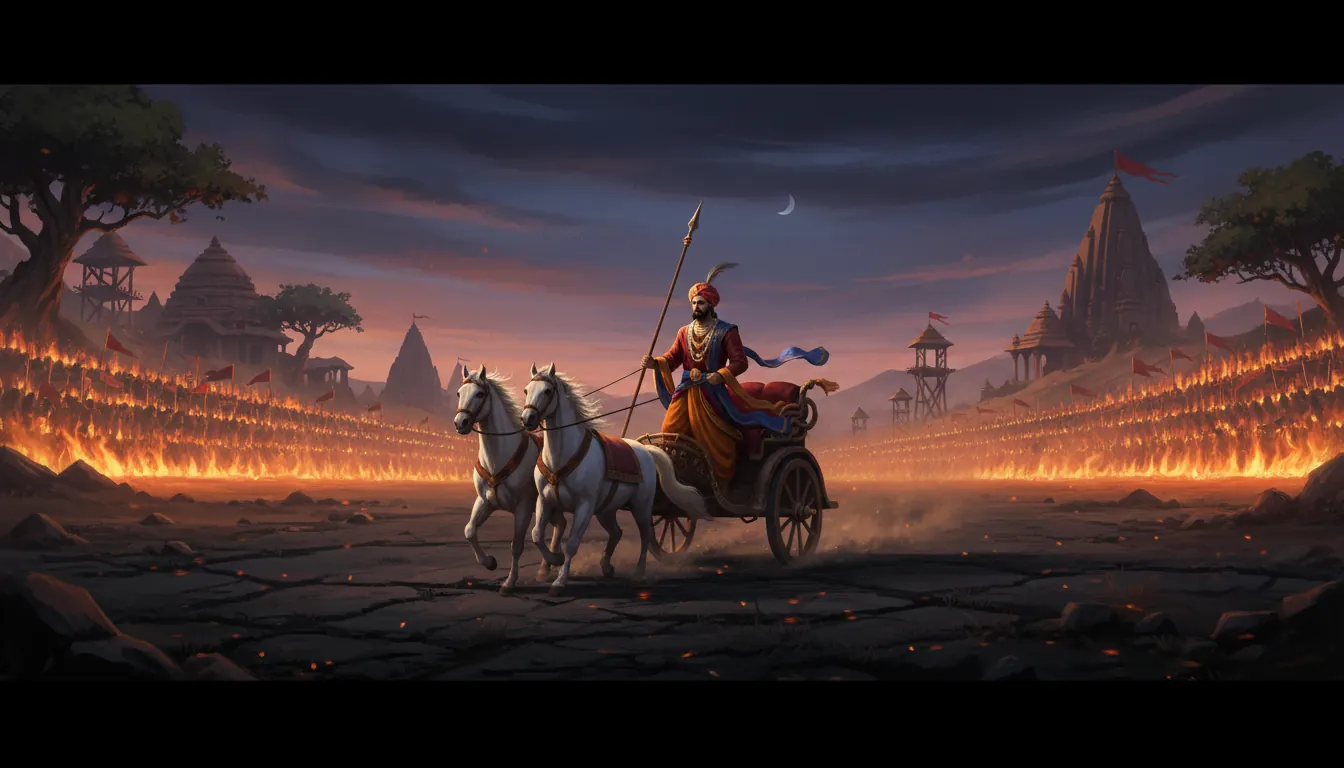
The Cat Who Played the Hermit
Duryodhana's last message to Yudhishthira is a fable about a holy man who ate his worshippers
In short
On the night before the war, with both armies camped along the Hiranvati, Duryodhana takes Shakuni's son Uluka aside and loads him with a message for Yudhishthira. It opens with a sloka of Prahlada's and a tale Narada once told Dhritarashtra: a cat who stood on the bank of the Ganga with his paws in the air until the birds praised him and the mice made him their maternal uncle, and who was found out at last by an old mouse who looked at the fur in his droppings and counted the days since Dindika went missing. Duryodhana turns the fable on his cousin as an accusation of hypocrisy, and then, in the same breath, admits that five villages were refused because the Kuru court wanted the war.
Told in the Udyoga ParvaSet in Kurukshetra, Ganga and Hiranvati17 min read
The Two Camps on the Hiranvati
"Come, Sanjaya, tell me in full detail everything that has happened in the camps of the Kuru and the Pandava troops."
The old king asked it from his seat in the hall, and he asked it the way a man asks about a fire he has already been told he cannot put out.
"I think destiny is supreme, and effort useless," Dhritarashtra said, "for although I understand the evils of a war that can only end in ruin, I still cannot restrain my son, who delights in gambling and takes deceit for wisdom. I understand everything, and still I cannot secure my own good. My mind can see the flaws in a plan, but when I come near Duryodhana, that mind of mine turns away."
Sanjaya did not leave him that comfort.
"The question does you credit," he said. "But you should not lay all the blame on Duryodhana alone. A man who comes to grief through his own misconduct should never blame time or the gods. The sons of Pandu were wronged in the match at dice, and they and all their counsellors bore those wrongs quietly, looking to your face alone."
Then he told the blind man what had been done on the last evening the world had before the war.
The Pandavas had camped by the side of the Hiranvati, and the Kauravas had set up their camps opposite. Duryodhana posted his troops strongly, paid homage to all the kings on his side, and placed outposts and bodies of soldiers to protect his warriors. Then he called for the men he trusted. He consulted with Karna first, and alone. Then with Karna and his own brother Dushasana. Then with those two and Shakuni, the son of Subala, all together.
When they had finished he sent for one more man and had him brought into his presence in private.
Uluka was Shakuni's son, and his grandfather was the king of Gandhara, and he was known in that camp by his father's trade. He belonged to the house whose hands had taken Indraprastha across a gaming cloth without a single arrow being loosed.
"Uluka," Duryodhana said, "son of a master of dice, go to the Pandavas and the Somakas."
The last embassy of that war was to be carried by a gambler's son, and it carried no offer at all.
The Sloka Prahlada Sang
"When you get there, repeat these words of mine to Yudhishthira where Vasudeva can hear them," Duryodhana said. "The terrible battle between the Kurus and the Pandavas that has been expected for so long has come at last. Sanjaya brought me your boastful words in the midst of the Kurus, the words that you, with Vasudeva and your younger brothers, roared out so deeply. Now the time has come to make them good. So do everything you have pledged yourselves to do."
Then he came to the eldest son of Kunti, and his tone changed, because with Yudhishthira the attack had to be made on the one ground Yudhishthira held.
"And to the eldest son of Kunti you must say this from me. Virtuous as you are, how can you and all your brothers, with the Somakas and the Kekayas, set your hearts on unrighteousness? How can you wish for the destruction of the universe, when to my mind you should be the one who drives away the fears of all creatures?"
That was the whole of the charge, and Duryodhana had a verse ready to hang it on.
"Bull of Bharata's race, we have heard the sloka that Prahlada sang long ago, when the gods had taken his kingdom from him: Gods, the man whose banner of righteousness is always raised while his sins are always hidden is said to follow the behaviour of the cat."
Prahlada was the asura king whom the epic keeps as its standing example of rectitude in the wrong family, the one who was known for judging cases against his own interest and against his own son. He had lost a kingdom to the gods. He had not accused the gods of cheating him. What he had said instead was that there is a recognised posture in the world, common enough to have a name, in which the banner of righteousness flies high over a house where everything shameful is kept indoors, and that the name of that posture is the behaviour of the cat.
Duryodhana had chosen to be the man quoting him.
"Here, king, I will repeat to you this excellent story that Narada told my father."
His father was sitting somewhere in Hastinapura while he said it, listening to a charioteer describe the camps. The last message Duryodhana would ever send to Yudhishthira was a tale the rishi Narada had told the blind king years before, in a hall, when it had still cost nothing to hear.
The Ascetic on the Bank of the Ganga
A wicked cat, once upon a time, made his home on the banks of the Ganga.
He gave up all work. He stood with his arms raised like a devotee, and pretending that his heart was purified, he said to every creature, to win its confidence: "I am now practising virtue."
The posture is a real one and it is not a light one. A man who holds his arms above his head and never lowers them keeps that vow until the arms wither in the air, and everyone who passes can see at a glance both what he has undertaken and how long he has kept it. It is the most legible penance there is. It is also, for a cat, the exact opposite of everything a cat is built to do. He was not crouching. He was not lying in wait in the reeds. He was not hiding at all, which is the point, because a creature that is standing in the open with its paws in the air has visibly given up the only advantage it was born with.
After a long time, all egg-laying creatures came to trust him.
They came to him all together and they all applauded that cat, and Narada names what the birds were doing in the plainest possible way. Worshipped by all feathered creatures, that devourer of feathered creatures regarded his purpose as already accomplished, as also the purpose of his austerities.
Read that twice. His austerities had a purpose. They were not a mistake he had drifted into and they were not a penance that failed to take. They had been undertaken for a reason, and the reason had now been served, and he knew it on the day the birds began to praise him.
He had been standing there a long time by then, and he had not yet eaten anything.
That is the part of the story that is hardest to hold in mind, and it is what makes the rest of it work. Whatever else the cat was, he was patient enough to starve for a season in order to be trusted. He bought the reputation first, in advance, at full price, and he waited for the market to open.
Let Him Be Our Maternal Uncle
And after some more time, the mice went to that place.
They did not arrive at their opinion of him on their own. They came late, into a settled situation, and they saw what everybody already there had been saying for a long time: that here was a virtuous person keeping his vows, and proudly exerting himself in a grand act. The birds had done the investigating. The mice inherited the verdict.
And having arrived at that settled conviction, they formed a wish.
"We have many foes," they said among themselves. "So let this one be our maternal uncle, and let him always protect the old and the young of our race."
Of all the words in the language of kinship they could have reached for, they chose that one. The maternal uncle is the safe relation. He is the mother's brother, the kinsman with no claim on the inheritance and no reason on earth to want the children of the house out of the way, the man to whom a boy is sent when his own home becomes dangerous. In the epic he is the one who comes to fetch you. The mice, who had many foes and were looking for the one kind of relative who could not profit by their deaths, gave that name to a cat.
Then they went to him, all of them, and said it aloud.
"By your grace we want to roam about in happiness. You are our kind shelter, you are our great friend. That is why all of us place ourselves under your protection. You are always devoted to virtue, always intent on gaining virtue. So protect us, wise one, as the wielder of the thunderbolt protects the gods."
They had come to ask a stranger for a guardian, and every proof they offered him of his own fitness was a thing they had been told by somebody else, and the only property they possessed that anyone in the world had ever wanted, they had brought with them.
The Terms He Named
The cat did not accept.
"I do not see how these two can go together," he said, "my ascetic life and this protection you ask me to give."
It is the finest stroke in the whole fable. The objection that ought to have come from the mice came from him. He raised it himself, in their hearing, and by raising it he made it impossible for any of them to raise it afterwards. A holy man cannot also be a bodyguard; the two lives do not fit together; he saw the difficulty before they did, and he said so, and they loved him for saying it.
Then he gave way, as he had always meant to.
"Still, I cannot refuse to do you the good you ask. But all of you, in return, must always obey my words. I am keeping a severe vow, and my austerities have made me weak. I see no way of moving from place to place. So all of you must carry me from here to the river-side every day."
Two conditions, and both of them are the same condition wearing different clothes. Obey me. Carry me.
His weakness was the proof of his holiness. It was also the reason they would have to come close enough to lift him, in numbers, every single morning, with their hands full and their attention on their footing. He had asked them to arrange, as a devotional service, the one situation a cat could never have arranged for himself: a daily procession of mice pressed against his body, on their way to a place he had chosen, out of sight of the rest.
"So be it," the mice said.
They handed over all their old and young ones to that cat.
Then that sinful creature of wicked soul, feeding on mice, gradually became fat and glowing and strong in his limbs. And thus, while the mice began to dwindle in number, the cat began to grow in vigour and strength.
Nobody in that colony had been deceived about anything except the direction the food was travelling. They had been told, truthfully, that he was too weak to walk. They had simply not been told what would make him strong.
Dindika, and Then Kilika
Then all the mice came together and said to one another: "Our uncle is growing stout every day, while we are dwindling in number every day."
They had the two facts. They had had them for some time. What they did not have was any way of joining the two facts together that did not require them to think a forbidden thought about a person they had publicly called their protector.
A certain wise mouse, named Dindika, found the way.
"All of you go to the river-side together," he said. "I will follow behind with our uncle."
"Excellent, excellent," they said, and applauded him, and they all did exactly as Dindika's words of grave meaning seemed to direct.
It is a clean experiment. Separate the crowd from the suspect, put one known mouse alone with him on the road, and see whether the count comes right at the other end. Dindika designed it, and Dindika made himself the only subject in it, and nothing in the story suggests he understood he was doing the second of those things.
The cat, however, not knowing all this, ate up Dindika that day.
He was not answering a question. He did not know a question had been asked. He ate the mouse who was walking beside him because a mouse was walking beside him.
Then a very old mouse, named Kilika, said these just words in the presence of all his kinsfolk.
"Our uncle does not really want to earn virtue. He has made himself our friend like a hypocrite, when in truth he is our enemy. The droppings of a creature that lives only on fruits and roots never contain hair or fur. And while his limbs are growing, our numbers are shrinking. Besides, no one has seen Dindika for eight days."
Three proofs, and not one of them is about anything the cat ever said. There is what is on the ground and what is in it. There is the arithmetic of two bodies moving in opposite directions. There is one name, with a number of days attached to it, counted by somebody old enough to keep counting after everyone else had stopped.
The old mouse never once disputes the vow. He simply declines to accept any of it as evidence, and looks instead at the fur.
Hearing these words, the mice ran away in all directions.
And that cat also of wicked soul went back to where he came from. He did not defend himself, because there was nothing left on that bank worth defending himself for. The penance had lasted exactly as long as the food.
Your Words Are One Thing
"Wicked one, you too practise this behaviour of the cat."
Duryodhana came out of the story the way a man comes out of a doorway, and put it straight into Yudhishthira's face.
"You treat your kinsmen the way the cat treated the mice. Your words are one thing and your conduct another. Your devotion to scripture and your peaceful manner are only a show for men to see."
The charge is exact, and it is worth stating precisely, because it is not the ordinary accusation of hypocrisy. It is this: that the man who had spent thirteen years saying he wanted no war, who had asked for five villages instead of a kingdom, who had wept over the coming ruin of the Bharata line, was at that hour standing at the head of seven armies on the field of Kurukshetra with his arms in the air, and that his kinsmen were what he proposed to live on.
And then, having made it, Duryodhana did something stranger than insult him. He gave him advice.
"Give up this hypocrisy, king. Take up the ways of a kshatriya and do everything a kshatriya should. Are you not virtuous, bull among men? Win the earth by the strength of your arms, best of the Bharatas, and make gifts to the brahmanas and to your dead ancestors as you should. Think of the good of your mother, who has suffered year after year: dry her tears, and honour her by defeating your foes in battle."
There is nothing wrong with a word of it. Take the earth with your arms, give it away properly, and dry your mother's eyes. It is what a kshatriya is for. It is nearly word for word what Kunti herself had sent across to her sons by Krishna's own mouth from the house she was living in. Duryodhana, who wanted Yudhishthira dead, and Kunti, who had carried him, were telling him the same thing within a few days of each other: stop calling it something else and fight.
The insult and the instruction were one sentence, and Duryodhana meant both halves of it.
Five Villages
Then, still speaking, Duryodhana said the thing that no fable could have got out of him.
"You begged most humbly for just five villages. Even that we refused, for all we wanted was to bring about a battle and to succeed in angering the Pandavas."
He was not confessing. He thought he was boasting. But there it is, said aloud in a tent to a messenger on the last night: the five villages had not been refused out of pride or greed or any mistake about what could be spared, but because a settlement was the one outcome the Kuru court could not permit.
"Remember that it was for your sake we drove out the wicked Vidura, and that we tried to burn you all in the house of lac, and be a man now."
The house of lac. He listed it. In a message meant to prove that his cousin was a hypocrite whose sins were always concealed, he read out the arson of Varanavata like a creditor reading a debt.
"When Krishna set out from Upaplavya for the Kuru court, you sent this message by him: hear, king, I am ready for war or for peace. Know, king, that the hour of battle has come. What greater stroke of good fortune does a kshatriya count than battle? You were born into the kshatriya order. You have received weapons once more from Drona and Kripa, so why do you rely on Vasudeva, who belongs to the same order of life as you and is no stronger than you?"
That was the end of what he had for Yudhishthira.
He was not finished. There were more messages to load onto Uluka before morning, a long one for Krishna, others for Bhima and Nakula and Sahadeva, for Virata and Drupada, for Dhrishtadyumna and Shikhandi, and then, after he had laughed aloud, a last long one for Arjuna, all to be delivered the next day in front of every king in the Pandava camp, and answered there.
But the fable went first, because Duryodhana had picked it to open with. He had asked for it to be repeated in Krishna's hearing, and had chosen the cat on the bank of the Ganga as the last thing he would ever say to his eldest cousin before the conches. Then, in the same breath, he had explained that he refused five villages in order to have this war.
He does not appear to have heard himself. Uluka took the whole of it down and went out to his horse, with the fires of the other camp burning across the flat ground in front of him.
Dharma Lesson
The old mouse Kilika never disputes a word of the cat's theology. He does not argue about the upraised arms or the purified heart; he looks at what is on the ground, notices that the excreta of a creature living on fruits and roots contains no fur, and counts the eight days since Dindika was last seen. A reputation for holiness is evidence about the people who granted it, not about the man who holds it, and the only honest check on it is arithmetic done by somebody willing to be rude. What gives the taunt its edge is the mouth it comes from: Duryodhana could aim the story at Yudhishthira and, a few sentences later, confess that he refused five villages because he wanted this war, without ever hearing the fable turn in his hand.