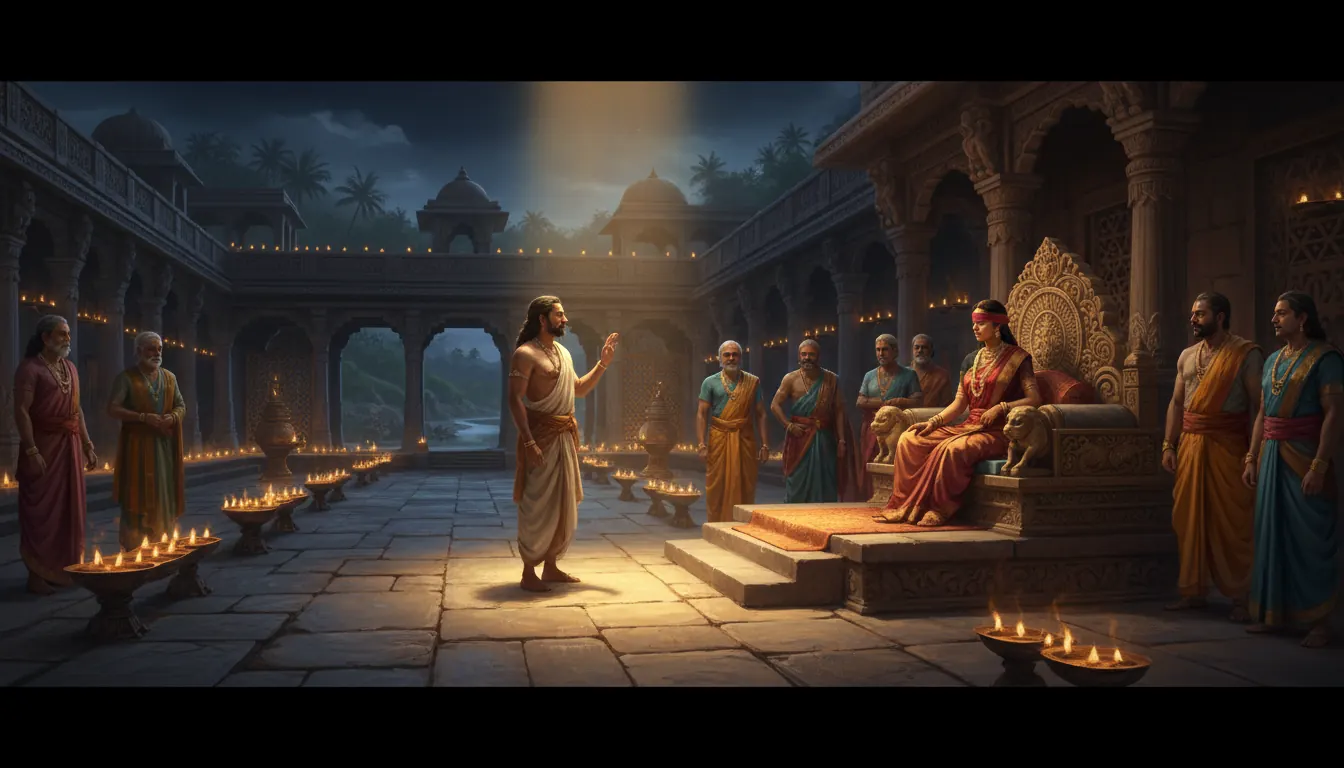
The Sacrifice of Battle
Duryodhana makes the coming war his own rite, and his father disowns him for it
In short
Sanjaya returns from Upaplavya and reads out to the Kuru court the roll of kings who have come for the Pandavas and the shares into which the enemy has been divided among them. Dhritarashtra begs his son to take half the earth and make peace, and Duryodhana answers by declaring the battle a sacrifice in honour of Yama, his chariot the altar and his fame the clarified butter, refusing even a needle-point of land. The king abandons him for ever and foretells the Kuru host levelled by Bhima's mace. Duryodhana replies that the gods act without desire, and that his own energy is greater than theirs.
Told in the Udyoga ParvaSet in Hastinapura and Upaplavya22 min read
The Roll of Those Who Came
Vaishampayana said that by then the court at Hastinapura had stopped pretending. The armies were counted, the messages had all been carried and answered, and what remained was an old blind king in a hall full of men who had already chosen sides, asking his charioteer questions he did not want answered. Sanjaya had come back from Upaplavya, where the sons of Pandu had gathered seven akshauhinis of troops and were cheerful about it.
"Sanjaya, whom did you see there who had come out of affection," Dhritarashtra said, "and who will fight my son's forces for the Pandavas?"
"I saw that Krishna had come, the foremost of the Andhakas and the Vrishnis, and Chekitana, and Satyaki too, who is also called Yuyudhana."
Chekitana was a Vrishni prince and Satyaki was Krishna's kinsman and Arjuna's pupil in arms, and Sanjaya said what each had brought. Those two mighty chariot warriors, proud of their strength and famed over all the world, had joined the Pandavas, each with a separate akshauhini of troops. Not their persons only. Their armies.
"And Drupada, the king of the Panchalas, has come with a full akshauhini to honour Yudhishthira, surrounded by his ten heroic sons, Satyajit and the others, led by Dhrishtadyumna and well guarded by Shikhandi."
Drupada was Draupadi's father. His son Dhrishtadyumna had come out of a fire kindled for the destruction of Drona, and his other child, Shikhandi, had been born to end Bhishma. He had furnished his soldiers with every necessary thing before he marched, which is a detail a charioteer notices and a king ought to.
"And Virata, lord of the earth, with his two sons Shankha and Uttara, and with the heroes Suryadatta and the others, led by Madiraksha, has joined the son of Pritha with one akshauhini of troops, bringing his brothers and sons."
Virata was the king in whose kitchens and stables and dancing hall the Pandavas had spent their thirteenth year unrecognised. He had brought his family with him.
"And the son of Jarasandha, the king of Magadha, and Dhrishtaketu, the king of the Chedis, have come separately, each with an akshauhini of troops. And the five Kekaya brothers, all with purple flags, have joined the Pandavas with an akshauhini of troops. That is how many I saw gathered there, and they will meet the Dhartarashtra host on behalf of the Pandavas. That great chariot warrior Dhrishtadyumna, who knows every battle array of men, gods, gandharvas and asuras, leads that host."
The son of the fire led it. Sanjaya let that stand a moment before he went on to the harder part.
How They Divided You Among Themselves
"King," Sanjaya said, "Bhishma, the son of Shantanu, has been given to Shikhandi as his share."
That was the word. Share. In the Pandava camp the enemy had been cut up and handed out like portions at a feast, every man in that hall allotted to somebody who wanted him, and Sanjaya read the list off in front of the men who were on it.
Bhishma to Shikhandi, with Virata and all his Matsya warriors to support him. The mighty king of the Madras, Shalya, to the eldest son of Pandu, though Sanjaya added, because it was said, that some thought those two were not well matched.
"Duryodhana with his sons and his ninety-nine brothers, and the rulers of the east and the south, have been given to Bhimasena as his share."
A hundred princes counted out to one man.
"Karna, the son of Vikartana, and Jayadratha the king of the Sindhus, have been given to Arjuna as his share. And every hero on earth who cannot be withstood and is proud of his might, Arjuna has also taken as his share."
Whatever was too dangerous to give to anybody else, Arjuna had simply taken.
The five royal brothers of Kekaya had claimed the Kekaya warriors on Dhritarashtra's side, kinsmen against kinsmen, and in their share were included the Malavas also, and the Salwakas, and the two famous warriors of the Trigarta host who had sworn to conquer or die. All the sons of Duryodhana and of Dushasana, with king Brihadbala, had been assigned to Subhadra's son, the boy Abhimanyu. The sons of Draupadi, on chariots with gold-embroidered banners, headed by Dhrishtadyumna, would advance against Drona. Chekitana wanted Somadatta in single combat. Satyaki was eager to fight the Bhoja chief, Kritavarma. Sahadeva, who sets up terrible roars in battle, had taken as his share the king's own brother-in-law, the son of Subala. Nakula had taken the deceitful Uluka and the tribes of the Saraswatas.
"As for all the other kings of the earth who will go to battle, the sons of Pandu have named them one by one and divided them up among their own shares. That is how the Pandava host has been divided. Now, without delay, do with your sons whatever you think best."
Consecrated by Death
Dhritarashtra heard the list to its end and answered it as a funeral.
"Alas, all my foolish sons, so fond of crooked dice, are already dead," he said, "since it is mighty Bhima they mean to face on the battlefield. And all the kings of the earth, consecrated by Death himself for the sacrifice, will rush at the Gandiva like moths into a fire."
He named the other side over again himself, as though the naming were a wound he wanted to press: Yudhishthira for their leader, the slayer of Madhu for their protector, Savyasachin and Vrikodara for their warriors, and Nakula and Sahadeva, Dhrishtadyumna, Satyaki, Drupada, Uttamaujas and the unconquerable Yudhamanyu of the Panchalas, Shikhandi, Uttara the son of Virata, the Kasayas, the Chedis, the Matsyas and the Srinjayas.
"Those are men from whom Indra himself could not snatch this earth against their will. Heroes, cool and steady in battle, who can split mountains. Alas, it is they whom this wicked son of mine wants to fight, ignoring me though I cry myself hoarse."
Duryodhana had been listening to his father talk this way for months and did not take a word of it seriously.
"The Pandavas and we are of the same race," he said. "We walk the same earth. Why do you think victory will go to the Pandavas alone? Bhishma, Drona, Kripa, the unconquerable Karna, Jayadratha, Somadatta and Ashwatthama, all mighty bowmen of great energy, could not be defeated even by Indra himself with all the gods beside him. I am strong enough to meet the Pandavas and their sons in battle. All these kings who care for my good will certainly catch the Pandavas in a net like a herd of young deer. With our crowds of chariots and our snares of arrows, the Panchalas and the Pandavas will all be routed."
"Sanjaya," said Dhritarashtra, turning away from his son as from a thing he could not repair, "this son of mine talks like a madman, for he cannot defeat Yudhishthira the just in battle. Bhishma truly knows the might of the great-souled Pandavas, which is why he wants no battle with those illustrious men. But tell me again what they are doing. Who is urging those mighty bowmen on, like priests kindling homa fires with libations of clarified butter?"
The Whale and the Little Fishes
"Bharata," Sanjaya said, "Dhrishtadyumna is always urging the Pandavas to war."
He gave the prince's words as he had heard them spoken. "Fight, best of the Bharatas. Have no fear at all. All the kings Dhritarashtra's son has courted, who will be the targets of showers of weapons in that fierce battle, all those angry kings gathered with their kinsmen, I alone will take on, like a whale snatching little fishes from the water. Bhishma and Drona and Kripa and Karna and Drona's son and Shalya and Suyodhana, I hold back all of them, as the shore holds back the swelling sea."
To this the virtuous king Yudhishthira had answered without heat, the way a man speaks to a commander he has chosen and does not intend to second-guess.
"The Panchalas and the Pandavas depend wholly on your prowess and steadiness. Bring us safely through the war. I know, mighty-armed one, that you stand firm in the duties of the kshatriya order. Those who know the scriptures hold that the hero who shows his prowess by rescuing men fleeing the field after a rout, looking for protection, is worth a thousand. You are surely the one who will deliver those overpowered by fear on the battlefield."
Then Dhrishtadyumna had turned to Sanjaya and used him for what he was, a messenger.
"Go, charioteer, without delay, and say this to everyone who has come to fight for Duryodhana, to the Kurus of the Pratipa dynasty with the Bahlikas, to the son of Saradwata and Karna and Drona and Drona's son, to Jayadratha and Dushasana and Vikarna and king Duryodhana and Bhishma: do not let yourselves be killed by Arjuna, whom the gods protect. Before that happens, let some good man go to Yudhishthira and beg that best of men to accept the kingdom at once. There is no warrior on earth like Savyasachin, whose prowess cannot be thwarted. The gods themselves guard the celestial chariot of the holder of Gandiva. No human being can defeat him. So do not set your minds on war."
Sanjaya delivered it in that hall, word for word, to men who had already made up their minds.
Half the Earth Is Enough
The king tried once more, and this time he did not argue about armies. He argued about land.
"Yudhishthira the son of Pandu has a kshatriya's energy and has lived a life of brahmacharya from his youth," he said. "Alas, it is he whom these foolish sons of mine want to fight, ignoring my laments. I ask you, Duryodhana, best of the Bharata race, give up your hostility. War is never praised, whatever the circumstances. Half the earth is quite enough to keep you and all your followers. Give the sons of Pandu back their proper share. All the Kauravas think this alone is just: that you should make peace with the great-souled sons of Pandu. Think about it, my son, and you will see that this army of yours means your own death. Your own folly keeps you from seeing it."
Then he counted, and the count was the most damaging thing he said all day, because it was not a prophecy about the enemy. It was an inventory of his son's own side.
"I do not want war myself, nor does Bahlika, nor Bhishma, nor Drona, nor Ashwatthama, nor Sanjaya, nor Somadatta, nor Shalya, nor Kripa, nor Satyavrata, nor Purumitra, nor Bhurishravas. In fact, not one of them wants war. The very warriors the Kauravas will have to rely on when the enemy presses them do not approve of the war."
Most of the names on that list were men who would die at Kurukshetra for a cause they had said aloud that they did not want.
"Child, let that be acceptable to you too. Alas, you are not seeking this war of your own will; it is Karna and the evil-minded Dushasana and Shakuni, the son of Subala, who are leading you into it."
That last sentence was meant kindly. It was a father leaving a door open, an account of the war in which Duryodhana was a young man led astray by bad company and could still turn round without disgrace. All he had to do was accept the version of himself in which he was weak.
Duryodhana would not go through the door. He stood up in the middle of the assembled Kurus and took the whole thing on himself.
The Sacrifice of Battle
"I challenge the Pandavas to battle," Duryodhana said, "without relying on you, or Drona, or Ashwatthama, or Sanjaya, or Vikarna, or Kamboja, or Kripa, or Bahlika, or Satyavrata, or Purumitra, or Bhurishravas, or others of your party."
He had just been told that his own warriors did not want the war. Very well. He would not ask them to want it. He would keep the war for himself and two other men.
"Bull among men, sire, Karna and I alone are ready to perform the sacrifice of battle with all its proper rites, with Yudhishthira as the victim."
Then he built the rite in the air, article by article, the way a priest lays out the vessels before he kindles the fire, and every item of it was a thing he was already carrying into the field.
"In that sacrifice, my chariot will be the altar. My sword will be the smaller ladle. My mace, the large one, for pouring libations. My coat of mail will be the assembly of spectators. My four horses will be the officiating priests. My arrows will be the blades of kusa grass. And fame will be the clarified butter."
Nothing in it was borrowed. The whole apparatus of the sacred rite had been made out of his own equipment, down to the priests, who were horses, and the offering, which was his own reputation poured into a fire. And the god it was made to was not Agni, and not Indra.
"King, when we have performed such a sacrifice in battle in honour of Yama, with everything it needs supplied by ourselves, we will come back victorious and covered in glory, having killed our enemies. The three of us, sire, Karna and my brother Dushasana and I, will kill the Pandavas in battle. Either I will kill the Pandavas and rule this Earth, or the sons of Pandu will kill me and enjoy it."
He had reduced the war to a wager with two outcomes and said both of them out loud, in order, without flinching at the second.
"King of unfading glory, I would give up my life, my kingdom, my wealth, everything, but I could not live side by side with the Pandavas. Venerable one, I will not give the Pandavas even as much land as the sharp point of a needle can cover."
Half the earth had been offered to him. He answered with the point of a needle.
I Now Abandon Duryodhana For Ever
"I now abandon Duryodhana for ever," Dhritarashtra said.
It is the one sentence in that hall nobody expected, and it came from the man who had spent a lifetime refusing to say it. He did not say it in a rage. He said it, and then went straight on to grieve for other people.
"Yet I grieve for all of you kings who will follow this fool on his way to Yama's realm. Like tigers among a herd of deer, the sons of Pandu, the greatest of fighters, will strike down your chief leaders gathered for battle."
Then he began to see it, and he described what he saw to a room full of living men as though he were reading out a record already written.
"I think the Bharata host, like a helpless woman, will be battered and crushed and flung far away by long-armed Yuyudhana. Shini's son will add his strength to Yudhishthira's army, which was strong enough without him, take his stand on the battlefield and scatter his arrows like seed on a ploughed field. And Bhimasena will take his position in the very front of the fighters, and all his soldiers will stand fearlessly behind him, as behind a rampart."
He turned to his son for the rest of it, and he did not threaten him. He told him what he would remember, and when he would remember it.
"Duryodhana, when you see elephants as huge as hills lying on the ground with their tusks broken, their temples crushed and their bodies soaked in blood, lying on the battlefield like hills split open, then, afraid to clash with him, you will remember what I said. When you see your host of chariots and horses and elephants burned up by Bhimasena, like the track a great fire leaves behind it, you will remember what I said. If you do not make peace with the Pandavas, overwhelming calamity will be yours. Killed by Bhimasena's mace, you will rest in peace. When you see the Kuru host flattened by Bhima like a great forest torn up by the roots, then you will remember what I said."
When he had said this to all those kings, Vaishampayana says, the king turned back to Sanjaya and asked him about something else, as though the disowning of his eldest son had been a piece of business he needed out of the way before he could go on listening.
Two Men on One Seat
"Tell me what Vasudeva and Dhananjaya said."
"I went into the inner rooms with my eyes lowered and my hands joined, to speak with those gods among men," Sanjaya said. Neither Abhimanyu nor the twins could go where the two Krishnas sat with Draupadi and Satyabhama.
"There I saw those two scourges of their enemies, merry with wine and wearing garlands, seated on a golden dais. And I saw Keshava's feet resting on Arjuna's lap, while those of the high-souled Arjuna rested on the laps of Krishna and Satyabhama."
Partha pointed him to a golden foot-stool. He touched it and sat on the ground instead, and saw the auspicious marks on Arjuna's soles.
"When I saw those young heroes, straight as sala trunks, sitting on one seat, a great fear seized me. They seemed to me to be Indra and Vishnu seated together, though dull-witted Duryodhana does not know it, because he relies on Drona and Bhishma and on Karna's loud boasts. In that moment I was convinced that Yudhishthira the just would certainly get what he wished for."
He was entertained with food and drink, then gave his king's message. Arjuna lifted Keshava's foot off his lap with a hand scarred by the bowstring and urged him to answer.
"Say this to the wise Dhritarashtra, where Bhishma and Drona can hear it. Perform all kinds of sacrifices, give gifts to the brahmanas, and enjoy yourselves with your sons and wives, for a great danger threatens you. Give your wealth away to those who deserve it, for king Yudhishthira is eager for victory."
It is the courtesy of an executioner. Duryodhana had made a sacrifice out of his chariot; Krishna told the Kurus to perform ordinary ones, of the sort men perform when putting a house in order.
Then, as Sanjaya was going, Krishna called after him with tears.
"That debt has grown with time, and I have not yet paid it off. You have made an enemy of Savyasachin, who has the invincible Gandiva for his bow and me for his helper. Whoever can defeat Arjuna could hold up the Earth with his two arms and throw the gods out of Heaven. Among gods, asuras and men, among yakshas, gandharvas and nagas, I find no one who can face him. The way you all fled in every direction in the city of Virata, routed by that one son of Pandu, is proof enough."
Bhishma had been at Virata, and Drona, and Karna. He was reminding them of a thing they had agreed to forget. Thus spoke Hrishikesha, roaring like rain-charged clouds, and the diadem-decked Arjuna, of white horses, spoke to the same effect.
The King Weighs Both Sides
Vaishampayana said that the monarch with the eye of wisdom weighed that speech for its merits and demerits, comparing both sides. He was an intelligent king who had always wanted victory for his sons, and he sat there doing arithmetic whose answer he did not want. The answer was that the Pandavas had strength and energy both human and divine, and that the Kurus were much weaker.
"This anxiety never leaves me, Duryodhana," he said. "It is always with me. Truly, I seem to see it with my own eyes. This is not a conclusion I have reasoned my way to."
Then he gave his reason, and it was not about soldiers. It was about gratitude.
"Every creature loves its young and does all it can to please them and do them good. The same is usually true of those who have been done a kindness. Good people always want to repay the good done to them and to please those who helped them. Remembering what was done for him at Khandava, Agni will certainly help Arjuna in this terrible clash between the Kurus and the Pandavas. And out of a father's love, Dharma and the other gods, duly invoked, will come together to help the Pandavas. I think that to save them from Bhishma and Drona and Kripa the gods will be filled with a wrath that strikes like the thunderbolt."
The Pandavas had fed Agni an entire forest, and their fathers were gods. Debts of that size do not go unpaid.
Then he described the man he could never stop describing: he who had the celestial Gandiva for his bow, a couple of inexhaustible quivers obtained from Varuna, and on his banner the monkey-image of celestial origin; whose chariot was unequalled on the earth girt by the four seas, the rattle of which was like the roar of the clouds; who took up five hundred arrows at a time and shot them, unseen, to a great distance; whom Bhishma and Drona and Kripa and Drona's son and Shalya, and in fact all impartial persons, regarded as impossible to defeat; who was equal to Kartavirya in strength of arms and to Indra in prowess.
"I see that great warrior wreaking havoc in this terrible battle. I think about it day and night, and I am unhappy and cannot sleep. A terrible destruction is about to overtake the Kurus, if nothing but peace can end this quarrel. I am for peace with the Parthas, not for war. Child, I have always thought the Pandavas mightier than the Kurus."
Greater Than the Gods
The passionate son of Dhritarashtra, inflamed with wrath, answered heaven itself.
"You think the Parthas cannot be defeated because the gods are their allies. Put that fear away. The gods became gods by being free of desire, greed and enmity, and by caring nothing for worldly affairs. Formerly, Dvaipayana Vyasa, and Narada, and Rama the son of Jamadagni told us this. The gods never engage in work from desire, or wrath, or covetousness, or envy. If Agni, or Vayu, or Dharma, or Indra, or the Ashvins had ever worked from worldly desire, the sons of Pritha could never have fallen into distress."
Gods who take sides do not leave sons in forests.
Then he stopped arguing and boasted.
"Under my spell Agni will go out at once, even if he blazes up all around to burn up every creature. The energy of the gods is great, but understand, Bharata, that mine is greater. If the Earth splits in two, or mountain peaks crack, I can join them again with my incantations in front of everyone. If a storm or a shower of stones comes to destroy this universe, I can stop it. When I make the waters solid, even chariots and foot soldiers can move over them."
His kingdom, he said, stood under his own protection, not heaven's: no fearful snakes in his dominions, and clouds that rained on his people as much as they wished and when they wished.
"The Ashvins, Vayu, Agni, Indra with the Maruts, and Dharma will not dare protect my enemies. If they could have protected my enemies, the sons of Pritha would never have suffered for thirteen years. Neither gods nor gandharvas nor asuras nor rakshasas can save anyone who has displeased me."
Then came the line that gives the speech away. "I tell you this so that you know it, not out of pride. I have never praised myself before, for self-praise is mean."
"You will hear that I have defeated the Pandavas and the Matsyas, the Panchalas and the Kekayas, Satyaki and Vasudeva. As rivers are lost when they enter the ocean, so the Pandavas and all their followers will be wiped out when they come near me. My intelligence, energy, prowess, knowledge and resources are far greater than the Pandavas'. Whatever knowledge of weapons the Grandsire has, or Drona, Kripa and Shalya, I have as well."
He had answered his father's arithmetic by declaring himself the larger number, and then he turned to Sanjaya to ask what Yudhishthira was doing about the war.
Dharma Lesson
Duryodhana never denies that the war will destroy him; he says plainly that either he will hold the earth or the Pandavas will hold it over his body. What he does is give the destruction a form. A sacrifice has vessels and an order of service, and a man performing one does not have to ask what he wants, only what comes next. That is the danger in this speech: the language of offering can dress an appetite until the man who feels it no longer recognises it, and when his father offers him half the earth to stop, he can refuse a needle-point of ground and hear his own refusal as piety.