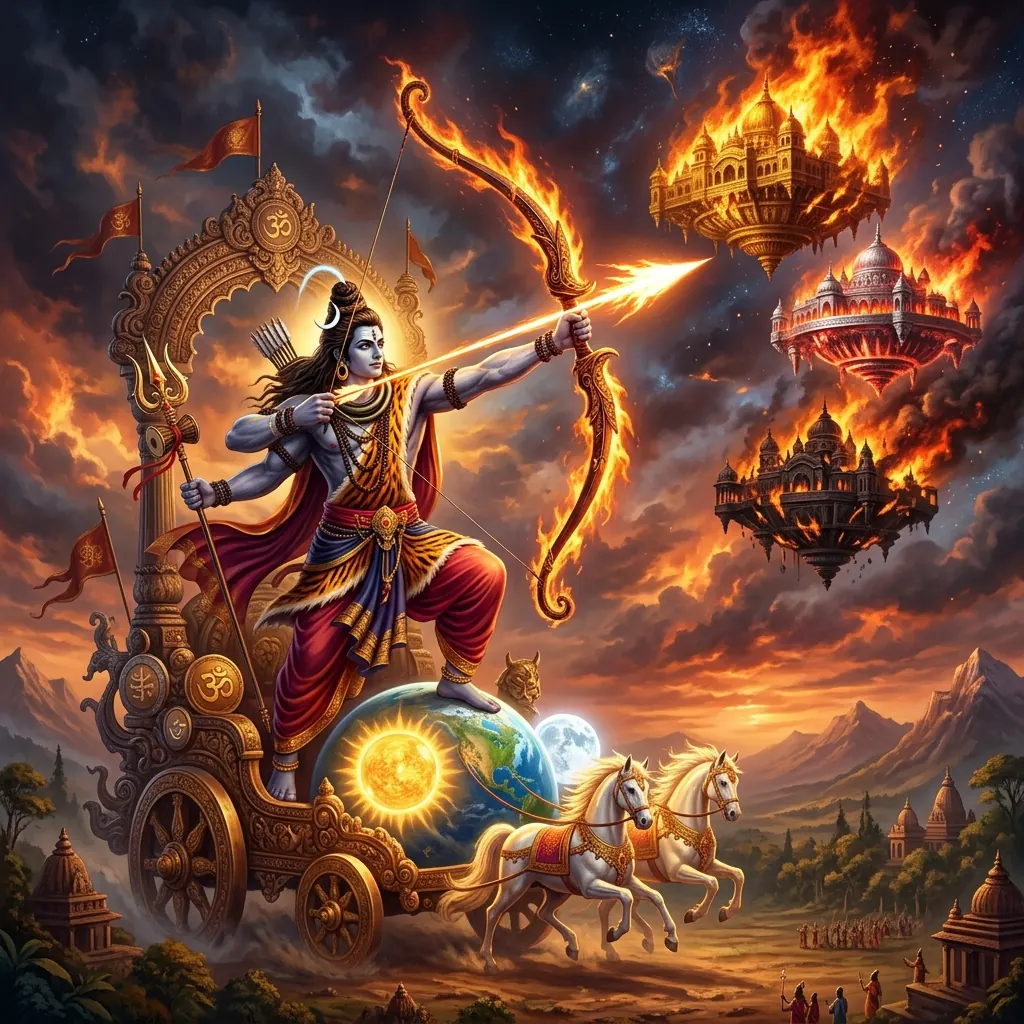
The Child Who Stopped Indra's Arm
A boy on Uma's lap holds the thunderbolt in the air
In short
Yudhishthira asks Krishna what he learned through the grace of Durvasa, and Krishna answers with the Sata-rudriya and the deeds behind it: the shaft through Daksha's sacrifice, the blinding of Bhaga and the breaking of Pushan's teeth, and the burning of the three cities with an arrow whose every part was a god. Then Mahadeva appears as a child with five locks of hair on Uma's lap, and Indra, filled with jealousy, lifts the thunderbolt and cannot bring it down. Brahma alone recognises the child, the gods hymn Uma and Rudra, the arm is restored, and Krishna reveals that this same god had lived in his house at Dwaravati as the brahmana Durvasa.
Told in the Anushasana ParvaSet in Kurukshetra, Mount Kailasa and Dwaraka15 min read
What Durvasa Left Behind
The grandsire lay on the bed of arrows and the talk had been of brahmanas all morning, and of one brahmana in particular. Krishna had just finished the account of the sage Durvasa, who had lived in his house at Dwaravati, burnt his beds and his coverlets, yoked Rukmini to a chariot and whipped her along the high road, and gone away at last leaving blessings behind him instead of a curse.
Yudhishthira did not let the subject go.
"Slayer of Madhu, I ask you to explain to me the knowledge you gained through the grace of Durvasa," he said. "Wisest of all who have intelligence, I want to know everything about the high blessedness of that high-souled one and all his names, truly and in detail."
It is a larger question than it looks. Yudhishthira had heard a story about a difficult guest. What he was asking for now was the identity of the guest, and Krishna answered it by beginning somewhere else entirely.
"I will tell you of the good I have gained and the fame I have won through the grace of that high-souled one," Vasudeva said. "I will speak to you on the subject, after first bowing to Kapardin."
Kapardin is the god of the matted hair. Krishna bowed to him before he would say a word about Durvasa, and then he told the king what he did with his own mornings.
"King, listen as I recite to you the Sata-rudriya, which I repeat with restrained senses every morning when I rise from bed."
That is the Hundred of Rudra, the great hymn of praise, and Krishna gave its pedigree before he gave its substance. The great lord of all creatures, the Grandsire Brahman himself, rich in penances, composed those Mantras, and he did not compose them lightly. He kept special penances for some time first, and only then were the words found.
"Sire, it is Shankara who created all the creatures in the universe, moving and unmoving," Krishna said. "There is no being higher than Mahadeva, king."
Yudhishthira had asked about a wandering ascetic in rags with a stick of Vilwa wood. He was going to be told about the lord of the universe, and it would be some time before the two were joined.
The Odour of His Body in Battle
"Truly, he is the highest of all beings in the three worlds," Krishna said. "No one can stand before that high-souled Being. There is no Being in the three worlds who can be thought his equal."
Then he described what standing before him is like, and the description is not of a weapon or an army. It is of a presence.
When Mahadeva stands filled with rage on the field of battle, the very odour of his body deprives all foes of consciousness. That is the first thing. Not a shaft, not a blow. The smell of him in the air, and the men who are near enough to catch it drop where they are, and they that are not slain tremble and fall down.
His roars are terrible, like the roar of the clouds. When they hear those roars in battle, the very hearts of the gods break in two. The gods themselves, who have nothing to fear from mortal armies, hear that sound coming across a field and something gives way inside them.
And then the eye. When the wielder of Pinaka becomes angry and, assuming a terrible form, merely casts his eye upon a deity, an asura, a gandharva or a snake, that creature finds no peace of mind even by hiding in the depths of a mountain cave.
Consider what is being said there. The god has not moved and has not spoken. He has looked, once, and the one looked at goes and finds the deepest hole in the deepest mountain and gets into it, and it does not help. There is no cave in the world thick enough to put between a creature and that glance.
This is the being Yudhishthira had been asking about, and Krishna was building him up deliberately, laying stone on stone, because of what he intended to set down at the end of the account. The hymn is called the Hundred of Rudra, and Rudra is the name that means the howler, the fierce one, the god who burns.
Having established that nothing in the three worlds can stand in front of him, Krishna gave two instances of what happens when he is crossed and when he is asked. The first was a sacrifice. The second was a war.
The Shaft Through the Sacrifice
When Daksha, that lord of all creatures, wishing to perform a sacrifice, spread his sacrifice out, he left one name off the list of those to be honoured.
The dauntless Bhava gave way to wrath at Daksha's slight of him. He did not argue the point and he did not send a messenger. He took his terrible bow and shot, and the shaft went into the sacrifice itself.
That is the detail worth pausing on. A sacrifice, in the old accounts, is not only a fire and a set of actions. It has a body. It can take a form and walk and be addressed, and Rudra pierced the embodied sacrifice through as a hunter pierces a deer, and he roared aloud while he did it.
When Maheshvara became angry and suddenly pierced the embodied form of sacrifice with his arrow, the gods were filled with grief and lost all happiness and peace of heart. They had come to a rite. They were standing in the wreck of one.
And the twang of the bow-string was worse than the arrow.
At that sound the whole universe was shaken. The gods and the asuras, son of Pritha, all grew joyless and dazed. The ocean rolled in agitation. The earth trembled to her centre. The hills and mountains began to move from their bases and ran on every side, which is a thing the world is not built to survive, mountains going about like animals. The vault of the sky cracked.
Then the light went out. All the worlds became enveloped in gloom and nothing could be seen. The light of all the luminaries became darkened, along with that of the sun himself.
One bowstring had been let go, once, and the sky had split and the sun had dimmed and the sea had come out of its bed, and it was still only the beginning of the god's anger.
The great rishis, filled with fear and wishing to do good to themselves and to the universe, did the only thing men of that kind can do. They performed the usual rites of propitiation and peace, reciting into the darkness while the mountains ran.
Meanwhile, Rudra of terrible prowess rushed against the deities.
Bhaga's Eyes and Pushan's Teeth
He came among the gods with his rage still on him, and the account names exactly whom he touched and what he took from each.
Filled with rage, he tore out the eyes of Bhaga. That god had presided over the shares and portions of the sacrifice, over who received what, and he lost his sight.
In his wrath, he kicked Pushan. He tore out that god's teeth as he sat eating the large sacrificial ball called Purodasa. Pushan was caught in the act of enjoying the offering, with the food in his mouth, and the mouth was broken.
Trembling with fear, the deities bent their heads to Shankara.
It did not work. Without being appeased, Rudra once more placed on his bow-string a sharp and blazing arrow, and every being present understood that the first shot had not been the end of anything.
Seeing his prowess, the gods and the rishis were all alarmed, and those chief gods began to pacify him. They did not fight and they did not flee to their caves, having just heard what caves are worth. Joining their hands in reverence, they began to recite the Sata-rudriya Mantras.
This is the hymn Brahma had composed after long penance, and this is the moment it was made for. The gods stood in the ruins of a sacrifice with a blazing arrow pointed at them and praised the archer, by his hundred names, out loud.
At last Maheshvara, praised like this by the gods, was pleased.
Then they did the thing that ought to have been done at the outset. The deities assigned a large share of the sacrificial offerings to him. Trembling with fear, they sought his protection, and the god who had come to destroy the rite for being left out of it was given his portion of the rite by the same hands that had omitted it.
And when Rudra was pleased, the repair began of itself. The embodiment of sacrifice, which had been split in two, was joined together once more. Whatever limbs of his had been destroyed by the shafts of Mahadeva became once more whole and sound.
Nothing had to be rebuilt. He had only to stop being angry.
The Arrow Made of Gods
The second instance was the one the deities asked for.
Long ago the asuras, beings of great energy, had three cities in the sky. One of these had been made of iron, one of silver, and the third of gold, and they hung in the sky above the worlds and could not be reached.
With all his weapons, Maghavat, the chief of the deities, was unable to pierce those cities. Indra had the thunderbolt, and it was not enough. Hard pressed by the asuras, all the gods then sought the protection of the great Rudra, and assembled together they addressed him.
"Rudra, the asuras threaten to spread destruction through every act. Slay the daityas and destroy their city to protect the three worlds, giver of honours."
When they had spoken, he replied, "So be it."
Then he built the arrow, and the making of it is the strangest catalogue in the whole passage, because every part of that shaft was somebody standing in the assembly.
He made Vishnu his excellent shaft-head. He made the deity of fire his shaft-reed. He made Surya's son Yama the wings of that shaft. He made the Vedas his bow and the goddess Savitri his excellent bow-string. And he made the Grandsire Brahma his charioteer.
The gods who had come asking for help were themselves the weapon. Vishnu went to the point of it, Agni became the shaft they were fitted to, Yama the feathers that would steer it, the Vedas bent in his hand, the mother of the sacred verse was drawn back and held, and the creator of the worlds took the reins and drove.
Applying all these, he pierced the triple city of the asuras with that shaft of his, consisting of three Parvans and three Shalyas. One arrow with three joints and three heads for three cities, loosed once.
And so, Bharata, Rudra burnt the asuras and their cities with that shaft of his, which shone like the sun and had the energy of the fire that appears at the end of the Yuga to consume all things.
Iron, silver and gold went out of the sky together, and the gods had their world back, and they had been the arrow that did it.
The Child With Five Locks of Hair
And then, said Krishna, the gods saw Mahadeva changed into a child.
He had five locks of hair, in the manner of a boy who has not yet been shorn, and he was lying on the lap of Uma. There was no bow anywhere and no bowstring and no fire. There was a woman sitting with a child on her knees, and the gods came and stood around and looked at him.
Uma asked the gods who he was.
That is the question of the story, and it is asked by the one who is holding him. Nobody could answer it. The one who might have answered lay in her lap saying nothing.
Seeing the child, Shakra became suddenly filled with jealousy and wrath.
This is Indra, who had lately been unable to pierce three cities and had watched another god do it with an arrow made out of his own colleagues. Now he looked at a boy on a goddess's lap and something in him could not bear it, and he resolved to kill him with his thunder.
He raised the arm. The account is careful about that arm. It looked like a mace of iron, and it had the thunderbolt in it, and it went up.
It did not come down.
The child, however, paralysed the arm of Indra with the thunderbolt in it. He did not strike and he did not speak and he did not get up off his mother's lap. The arm simply stopped, at the top of its lift, holding the weapon that had killed Vritra, and stayed there.
The gods were all bewildered.
They could not understand that the child was the Lord of the universe. All of them, the Regents of the world included, found their minds bewildered by that child, who was none other than the Supreme Being.
There is the whole difficulty in one line. They had just seen him destroy a sacrifice, blind one of their number and break the teeth of another, and burn three cities out of the sky, and they had recognised him every time, because he had come to them in the form their fear was expecting. He put on the shape of a small boy with unshorn hair and they lost him completely, and the king of the gods stood in the middle of them with his arm in the air, unable to lower it, looking at a baby.
He Is Rudra, He Is Shiva, He Is the Year
It was Brahma who worked it out, and he did not work it out by looking.
The illustrious Grandsire, reflecting with the aid of his penances, found out that that child was the greatest of all Beings, the lord of Uma, Mahadeva of immeasurable prowess. The knowledge came out of the same store the hymn had come from, the austerities he had performed long before.
He then praised the Lord. The deities also began to hymn the praises of both Uma and Rudra, mother and child together, the two of them sitting there while the assembly of heaven sang.
The arm of the slayer of Vala was then restored to what it had been.
Indra got his arm back and no punishment beyond the minute in which he could not use it, and nothing further is said about him. The paralysis had not been a sentence. It had been an answer to the question Uma asked, given in the only language the gods were able to read that day.
Then Krishna closed the circle he had opened at the beginning.
"Mahadeva," he said, "born as the brahmana Durvasa of great energy, lived for a long time in my house at Dwaravati. While he lived there he did many acts of mischief. They were hard to bear, but I bore them out of largeness of heart."
The guest in rags with the Vilwa stick, who burnt the furniture and ate food enough for thousands and laughed and wept without reason, had been this. Now the king knew what had been living in that house.
Then Krishna gave him the names.
He is Rudra; he is Shiva; he is Agni; he is Sarva; he is the vanquisher of all; he is Indra, and Vayu, and the Ashvins, and the god of lightning. He is Chandramas; he is Isana; he is Surya; he is Varuna. He is Time; he is the Destroyer; he is Death. He is the Day and the Night; he is the fortnight; he is the seasons; he is the two twilights; he is the year. He is Dhatri and he is Vidhatri and he is Vishvakarma, and he knows all things. He is the cardinal points of the compass and the subsidiary points also. Of universal form, he is of immeasurable soul.
"The holy and illustrious Durvasa has the complexion of the gods," Krishna said. "Sometimes he shows himself as one; sometimes he divides himself into two; and sometimes he shows himself in many forms, a hundred thousand of them. Such is Mahadeva. And he is the god who is unborn."
"In even a hundred years," he said, "one cannot exhaust his merits by reciting them."
Dharma Lesson
The gods recognised Mahadeva easily enough when he came as rage: the pierced sacrifice, the torn eyes, the arrow that burned three cities out of the sky. They lost him entirely when he came as a child on his mother's lap, because recognition had been running on fear rather than on knowledge. Only Brahma, who had earned his sight through penance, could name what was in front of everyone. Indra's arm was not paralysed as punishment but as an answer to Uma's question, and it was given back the moment the answer was understood.