The Foundations of Righteousness
Bhishma is asked whether the eye or the scripture decides, and answers with three foundations and a long list of small rules
In short
When Krishna has finished the names of Rudra, Yudhishthira asks the grandsire which is authority, direct perception or the scriptures. Bhishma dismisses the logicians who trust only what can be seen, shows that good conduct itself becomes unreliable once the wicked have trampled it, and lays down the three foundations of righteousness: overt acts, purity of mind, and the Vedas. He then gives the etiquette by which a good man can be told from a bad one, from who is given the road to how a sin is dissolved like salt in water, and ends by telling a king who has watched fools grow rich that unless seeds are sown, no crops appear.
Told in the Anushasana ParvaSet in Kurukshetra17 min read
The Question After the Names
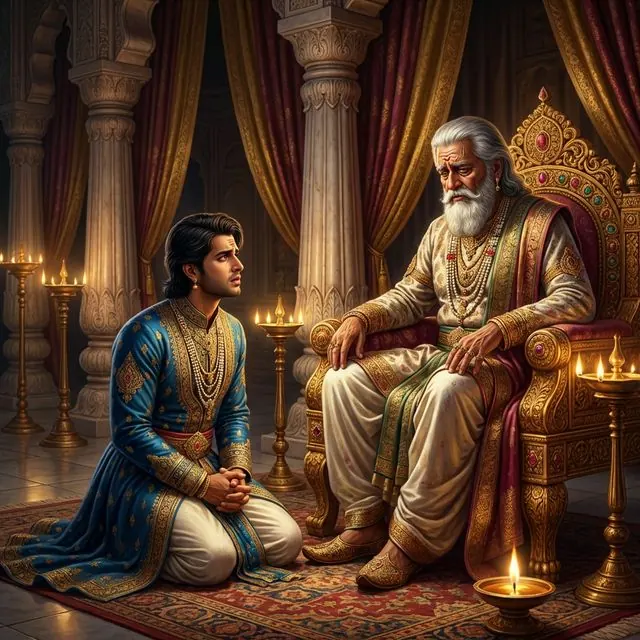
Vaishampayana said that when Krishna, the son of Devaki, had finished reciting the many names of Rudra, Yudhishthira turned back to the old man on the arrows and asked him a question about how a man is supposed to know anything at all.
"You are so wise," the king said, "the first of all who know duty. Of the two, direct perception and the scriptures, which should be taken as the authority when we have to reach a conclusion?"
"There is no doubt about this, I think," Bhishma said. "Listen to me, wise one, and I will answer you. The question you have asked is a proper one." Then the line a man learns only near the end of a long life. "Doubt is easy to hold. Resolving it is hard."
Doubts can arise, he said, in countless cases, both in what we perceive directly and in what we hear. So he began by describing the people who had got it wrong.
"Some men who delight in calling themselves logicians, and who truly believe their wisdom is superior, declare that direct perception is the only authority. They say that nothing exists, however true, that cannot be perceived directly, or at least they doubt that such things exist."
His verdict was short. Such claims are absurd, and those who make them are foolish, whatever their pride of learning.
Then he took the king's real difficulty seriously. "If, on the other hand, you doubt how the One could be the cause," he said, meaning the indivisible Brahman that no eye has ever reported, "my answer is that a man understands it only after a long course of years, with the help of Yoga practised without idleness."
Years, and the practice kept up without slackening, and a particular kind of man to keep it up: one who lives by whatever means come his way, not bound to this or that settled mode of life, and one who is devoted to resolving the question. No one else, truly, is able to grasp it.
"When a man reaches the very end of reasons, he comes to that excellent and all-embracing knowledge, that vast mass of radiance which lights the whole universe."
The end of reasons. Not the abandonment of them at the start, but the place a man arrives at when he has followed them out to where they stop.
"Knowledge drawn from inference can hardly be called knowledge," Bhishma finished. "It should be rejected. Words cannot define it or contain it. So it should be rejected."
Grass Over the Mouth of a Pit
Yudhishthira widened the question from two candidates to four.
"Tell me, grandsire, which of these carries the most authority: direct perception, inference from what is observed, the science of Agama or the scriptures, or the various practices that mark out the good."
That fourth one is the standard most people actually live by. Watch what decent men do, and do that. Bhishma answered by explaining why it fails, and his explanation is bleaker than anything the logicians had said.
"When wicked men of great power set out to destroy Righteousness," he said, "the good can protect it for a time, if they work at it with care and earnestness."
For a time. He does not stop there.
"But that protection does not hold in the long run, for in the end destruction does overtake Righteousness."
Then the image. Righteousness often turns out to be a mask hiding Unrighteousness, like grass and straw laid over the mouth of a deep pit so that no one can see it. A man walks across what looks like ground. The covering is real grass. The pit is also real, and it is under the grass, and the very greenness of the field is what hides it.
So the practices of the good are disrupted and destroyed by the wicked. Men of evil conduct, who throw aside the Srutis, wicked wretches who hate Righteousness, wreck the good way of life that could otherwise have been held up as a standard. Once enough people behave badly, behaviour stops being evidence.
"So," said Bhishma, "doubt hangs over direct perception, inference and good conduct alike."
Three of the four have now been struck down, and the king is left holding nothing. What Bhishma offers instead is not a fifth authority but a kind of person.
"Among the good, those whose understanding is born of the scriptures, and who are always content, should be held the foremost. Let those who are anxious and have lost their peace of mind go to them. Yes, Yudhishthira, wait on them, and ask them to resolve your doubts."
Put aside pleasure and wealth, which always follow greed. Wake to the conviction that Righteousness alone is worth seeking. Then go and sit with such men, because their conduct never goes wrong or comes to ruin, and neither do their sacrifices, their Vedic study or their rites.
"These three together, conduct in outward acts, purity of mind in one's behaviour, and the Vedas, make up Righteousness."
One and Indivisible
The king's difficulty came back at once, and he said so with unusual frankness.
"Grandsire, my understanding is clouded by doubt again. I am on this side of the ocean, searching for a way across. But I cannot see the far shore."
Then he stated the objection cleanly. If the Vedas, visible acts and purity of mind together make up the authority, then they differ from one another, and Righteousness is really of three kinds, though everyone says it is one.
"If you think, king, that Righteousness must really be of three kinds," Bhishma said, "I answer that reason supports your conclusion."
He conceded the logic and then set it aside. The truth is that Righteousness is one and indivisible, though it can be seen from three points of view. The paths of the three that form its foundation have each been laid down. Act as those instructions say.
"You should never argue about Righteousness and then go looking for answers to the doubts you have argued yourself into. Chief of the Bharatas, never let doubts like these take hold of your mind. Do what I tell you, without any scruple. Follow me like a blind man, or like someone with no judgment of his own who has to rely on another's."
It is a hard thing to say to a king, and the grandsire says it without softening. Then, having asked for obedience, he tells him what to obey, and it is four items long.
Harming no one. Truth. Freedom from anger, which is to say forgiveness. Generous giving.
"Practise these four, king who has no enemy, for these four are eternal Righteousness."
To these he added one more, and it is the one he always adds. Treat the brahmanas as your fathers and grandfathers treated them. Revere them, receive them with hospitality, serve them always. The universe rests on them.
"The foolish man who would overturn the weight of authority," Bhishma said, "by denying that something long accepted as a standard is a standard, will never become an authority among men himself. Such a man causes much grief in the world."
Two Ends
"Tell me, grandsire," Yudhishthira said, "what end awaits those who hate Righteousness, and what end awaits those who revere and keep it."
Bhishma answered in two paragraphs, and the shorter one is about hell.
"Men who hate Righteousness are said to have hearts overwhelmed by the qualities of passion and darkness. Such men always go to Hell."
That is the whole of it. He does not describe the place, and he does not enumerate the torments, and he does not linger. Rajas and tamas, passion and darkness, a heart with those two settled over it like weather, and a road that goes one way.
The other end takes longer to say because there is more in it.
"But the men, king, who always revere and keep Righteousness, who are devoted to truth and sincerity, are called good. They always enjoy the pleasures of heaven."
Then he named the habit that produces such men, and it is not an inward one. Because they wait on their teachers with reverence, their hearts always turn towards Righteousness. The turning of the heart comes second. Sitting at the feet of the old comes first.
Those who revere Righteousness reach the realms of the gods. And those beings, human or divine, who rid themselves of greed and malice, and wear down and mortify their bodies with austerities, win great happiness through the Righteousness that then becomes theirs.
He ended with an image about appetite, which is a strange way to end a passage about heaven, and is the reason the passage is remembered.
"The wise have said that the brahmanas, the eldest sons of Brahma, stand for Righteousness. The righteous always worship them, and their hearts hold them in as much love and longing as a hungry man's stomach holds for ripe, delicious fruit."
Not as a debtor regards his creditor. As a hungry man regards fruit. The righteous man in Bhishma's account is not performing an obligation when he honours the good. He is eating.
How to Tell Them Apart
"How do the wicked look," the king asked, "and what are the acts the good must do? Tell me the marks of the good and of the wicked."
The wicked are disposed of in one line. They are evil in their ways, ungovernable, impossible to hold to any rule, and foul-mouthed. The good are known by their acts, and Bhishma then does something a modern reader does not expect from a dying man discussing the foundations of dharma. He gives the household rules.
They never relieve themselves on the public road, or in the middle of a cow-pen, or in a paddy field. They feed the five first, and only then take their own food. They never talk while eating. They never go to sleep with wet hands, but rub them dry first.
Whenever they see any of the following they walk round it to show it reverence: a blazing fire, a bull, the image of a god, a cow-pen, a place where four roads meet, and an old and virtuous brahmana.
They make way, standing aside themselves, for those who are old, those weighed down with burdens, women, those who hold high office in the village or town, brahmanas, cows and kings. Six kinds of person, one kind of animal, and the rule is the same for the king and for the cow: you step off the path.
The righteous man is the one who protects his guests, his servants and other dependants, his own relatives, and all who seek his protection, and he always greets them with the usual courteous questions.
The gods have set two times for human beings to eat, morning and evening. One should eat nothing in between, and by following this rule about eating one is said to keep a fast. As the sacred fire waits for its libations when the hour for Homa comes, so a woman, when her monthly period is over, looks for union with her husband; and a man who never goes to his wife at any other time is said to keep the vow of Brahmacharya.
"Amrita, brahmanas and cows," Bhishma said, "these three are held to be equal."
Nectar, priests, cattle. So one should always worship the brahmanas and the cows with the proper rites.
The Word Twam
He went on down the list, and it grew more interior as it went.
There is no fault in eating the meat of animals killed in sacrifices with the help of Tantras from the Yajur Veda. The flesh of the backbone, and the flesh of animals not killed in sacrifice, should be avoided as one would avoid the flesh of one's own son. One should never let a guest go without food, at home or in a foreign land.
When one's studies are finished, one should give one's teacher the Dakshina. On seeing him, one should greet him with reverence, honour him and offer him a seat. By honouring his teacher a man lengthens his life and increases his fame and his prosperity.
One should never find fault with the old, nor send them on errands, nor stay seated while anyone old is standing. By acting like this, Bhishma said, one guards the length of one's own life.
One should never look at a naked woman, nor at a naked man, never have sexual union except in private, and eat out of the sight of others too.
Then four short verdicts, side by side. Teachers are the foremost of Tirthas. The heart is the foremost of all sacred things. Knowledge is the foremost of all things worth seeking. Contentment is the foremost of all happiness.
Morning and evening one should listen to the grave counsel of the aged, for a man gains wisdom by constantly waiting on those who are old and revered. When reading the Vedas or eating, one should use the right hand. One should keep speech, mind and senses fully under control. With well-cooked frumenty, Yavaka, Krisara and clarified butter one should worship the Pitris and the gods in the Shraddha called Ashtaka, and do the same in worshipping the planets.
One should not shave without calling down a blessing on oneself. When someone sneezes, those present should bless him. All who are ill or suffering from disease should be blessed, and long life should be prayed for them.
And then, out of that catalogue of small courtesies, one rule that is stated with the violence of a law.
"One should never address an eminent person familiarly with the word Twam. Not even in the greatest difficulty should one do this. To call such a person Twam and to kill him are the same."
Twam, the familiar you: the word used to a servant, an equal, or a pupil. Say it to a man above you, and persons of learning are degraded by it, and the grandsire ranks the offence with murder.
Salt in Water
The last part of the teaching is about the man who has already done wrong, and it begins with the observation that he is never as hidden as he thinks.
"A sinful man's heart always proclaims the sins he has committed," Bhishma said. "Men who have sinned deliberately are destroyed by trying to hide their sins from the good."
That is the trap. The hardened sinner hides, and thinks that neither men nor gods see what he does, and the hiding is itself the ruin. His sins grow while he sits on them, as the interest a moneylender charges grows from day to day, and in the end he is born into a miserable order of being.
The remedy is put in one image that everybody has seen.
"Pour water on salt and the salt dissolves at once. In the same way, when expiation is performed, sin dissolves."
So one should never hide a sin, for hidden it is sure to grow. When one has sinned, one should confess it before the good. They will destroy it at once.
And if a man does not enjoy in good time what he has stored up in hope, the stored wealth passes to another owner after he dies.
Then the sentence that stands behind the entire discourse on authority. The wise have said that the mind of every creature is the true test of Righteousness. That is why all creatures in the world have an inborn urge to achieve it.
"A man should achieve Righteousness alone, on his own," the old man said. "Truly, he should not proclaim himself righteous and go about with the banner of Righteousness held high for show. Those who practise it for the rewards it brings are called traders in Righteousness."
Worship the gods without giving way to pride. Serve your teacher without deceit. Lay up for yourself that priceless wealth in the next world which consists of gifts given here to the deserving.
Unless Seeds Are Sown
Yudhishthira had one more difficulty, and it was not a scholar's. It was the complaint of a man who had watched the wrong people prosper.
"We see that if a man is unlucky, he gets no wealth, however strong he is. If he is lucky, he comes into wealth even if he is a weakling or a fool."
He piled up the evidence. Hundreds of men gain nothing even when they try their hardest, and many gain wealth without trying at all. Men do evil continually for wealth and fail to get it; others enjoy wealth without doing any evil whatever; others still, who keep every duty the scriptures give them, have nothing.
He pressed it hardest on learning, the thing he had been taught to trust.
"A man may know nothing of the science of morals and policy even after he has studied every treatise on it. Another may be made a king's prime minister without having studied it at all. If learning brought the happiness of wealth, no learned man would ever be found living, for his very livelihood, under the protection of someone with no learning."
And then the line that shows what the war had put into him.
"If a man's time has not come, he does not die even when he is pierced with hundreds of arrows. And if his hour has come, he gives up his life even if he is struck with a blade of grass."
He said it to a man lying on hundreds of arrows who had not yet died.
Bhishma did not argue with it. He answered with a farmer's sentence.
"If a man sets himself to great labours and still fails to earn wealth, he should practise severe austerities. Unless seeds are sown, no crops come up."
It is by giving gifts in this life that one gains things to enjoy in the next, just as one grows wise by waiting on those who are old and revered. The wise have said that a man lives long by refraining from cruelty to any creature. So one should give and not ask, worship the righteous, speak sweetly to all, always do what pleases others, seek purity of mind and body, and always refrain from harming any creature.
"Even for insects and ants, their own acts and their Nature are the cause of their happiness and their woe. So it is right, Yudhishthira, that you should be at peace."
Dharma Lesson
Bhishma takes away three of the four things a man ordinarily leans on. The eye can be argued with, inference is not knowledge, and the conduct of respectable people stops being evidence once enough of them have gone bad. What is left is not a proof but a practice, and the practice turns out to be made of very small things: standing aside on the road, drying your hands, not calling an eminent person twam. The four that he calls eternal righteousness cost nothing and are available every hour, and the test of them is that they are done alone, with no standard carried aloft, by a man who is not trading.