The Death of Vasudeva
Krishna's Father Outlives Everyone
In short
Arjuna rides into a Dwaraka that has become the river of the dead and finds his uncle Anakadundubhi on the floor, too wasted to lift his head and smell his nephew's hair. The old man lays out a father's case against a son who was God, repeats Krishna's last instructions word for word, and says he has stopped eating. He dies by yoga at dawn, and Devaki, Bhadra, Rohini and Madira go onto the pyre with him.
Told in the Mausala ParvaSet in Dwaraka, Prabhasa and Indraprastha15 min read
A City Like a Woman Bereft of Her Husband
Vaishampayana said: As he went on to the city of the Vrishnis with Daruka beside him, that hero saw that Dwaraka looked like a woman bereft of her husband.
Arjuna had been in that city many times. He had been married out of it. He knew the sound it made. Dwaraka had always run like a river: the Vrishnis and the Andhakas for its water, horses for its fish, chariots for its rafts, the noise of instruments and the rattle of wheels for its waves; houses and mansions and public squares for its lakes, gems for its moss, the walls of adamant like garlands of flowers floating on the surface of it; the streets its currents, the great open squares its still deep pools, and Rama and Krishna the two mighty alligators lying in it.
What he rode into now was the Vaitarani, the river of the dead, bound up in Time's net. It was stripped of beauty and utterly joyless, and it looked like a lotus flower in winter.
The women came out. Sixteen thousand had been wedded to Vasudeva's son, and every one of them was now lordless, and had had nobody to say it to. When they saw the son of Pritha at the gate they set up a loud wail, all together, and the sound of it went up over the walls and out to sea.
Arjuna could not look at them. His eyes were blinded by tears, and he got down from the chariot and went a few steps into that crowd of Krishna's widows and fell on the earth.
Then Satya, the daughter of Satrajit, and Rukmini fell down beside him, and wailed aloud. Between them they raised him up and set him on a golden seat, and the ladies sat around him on the floor, pouring out their feelings, praising Govinda, telling him things about their husband that he already knew.
He comforted them as well as a man can who has come all that way to be comforted himself. Then he asked where his uncle was, and went to see him.
He Could Not Lift His Head
The Kuru prince saw the heroic and high-souled Anakadundubhi lying on the ground, burning with grief for his sons.
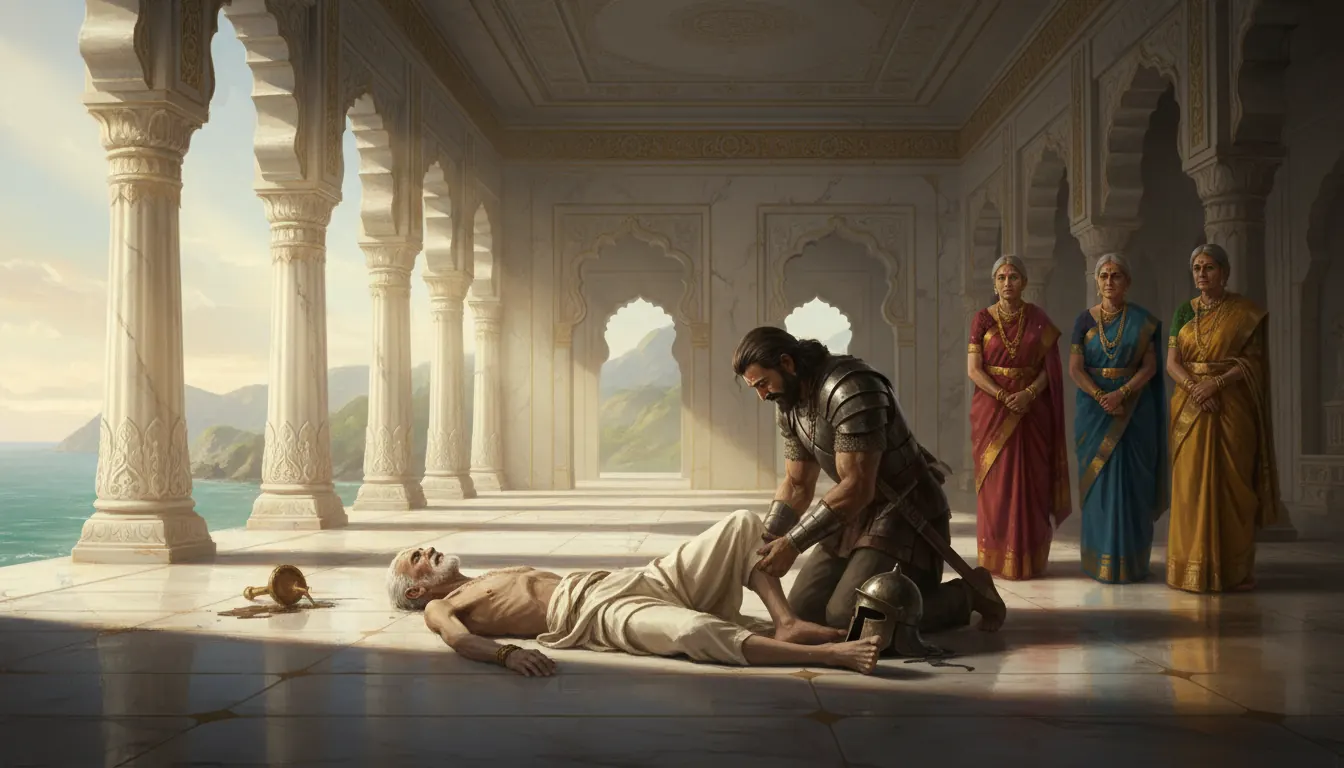
He was not in a bed. He had put himself down on the floor of his own house, the way a man does who has stopped intending to get up, and he was so wasted that when Arjuna came in he could not raise his head.
Arjuna, broad-chested and mighty-armed, more stricken than his uncle was, with his eyes bathed in tears, went the length of the room and touched his uncle's feet.
And the old man tried to do the thing an elder does. He wished to smell the head of his sister's son. It is the oldest greeting there is in that house: the hand behind the neck, the mouth to the crown of the head, the breath drawn in. He had done it to this boy at the wedding, and he tried to do it now, and failed, because he could not lift himself far enough off the floor to reach.
So the mighty-armed Anakadundubhi, deeply afflicted, put his arms round Partha instead and held on to him and wept aloud, remembering his sons, and his brothers, and his grandsons, and his daughters' sons, and his friends: the whole roll of them, name after name, out loud, into the shoulder of the only man who had come.
It Seems I Have No Death
"I can no longer see those heroes, Arjuna," he said, "who conquered all the kings of the Earth and the daityas a hundred times, and yet I am still alive. It seems I have no death."
That was where he began. Not with grief for the dead but with outrage at his own continuing.
"Through the fault of those two heroes who were your dear disciples, and whom you held in such regard, Partha, the Vrishnis have been destroyed. Those two were counted Atirathas among the greatest of the Vrishnis; you used to speak of them with pride in conversation; they were always dear to Krishna himself. And alas, Dhananjaya, those two have been the chief causes of the destruction of the Vrishnis."
He meant Pradyumna and Satyaki, and he was saying it to their own teacher: that the quarrel that started it had been taken up by the two best men in the city, over what had been done at Kurukshetra, in a war that had ended thirty-six years ago and had evidently not ended at all.
Then, having said it, he took it back, because he was a just man even at the bottom of his life.
"I do not blame the son of Shini or the son of Hridika, Arjuna. I do not blame Akrura, or the son of Rukmini. No doubt the curse of the rishis is the only cause."
Nobody in that room contradicted him, and nobody could. Satyaki had been Arjuna's own pupil, and so had Pradyumna, and Arjuna had boasted about both of them in company for years. And the old charges that set it off, Kritavarma helping Drona's son into a sleeping camp at night and Satyaki cutting down a one-armed man sitting in praya on the field, had been argued out on that beach by men with wine in them, thirty-six years late.
And having cleared every man he could have blamed, he had exactly one person left to bring the case against.
A Father's Case Against a Son Who Was God
"How is it," said Vasudeva, "that the lord of the universe, the slayer of Madhu, who put forth his prowess to destroy Kesin and Kamsa, and Chaidya swelling with pride, and Eklavya the son of the ruler of the Nishadas, and the Kalingas and the Magadhas, and the Gandharas and the king of Kashi, and many rulers assembled together in the midst of the desert, and many heroes belonging to the East and the South, and many kings of the mountain regions: alas, how could he stand by unmoved before such a calamity as a curse pronounced by rishis?"
It was a list, and he went through the whole of it, and every name on it was a thing his son had done for other people.
"You, and Narada, and the munis, knew him to be the eternal and sinless Govinda, the God of unfading glory. Alas, though he was mighty Vishnu himself, he watched the destruction of his own kinsmen and did not interfere."
Then he said the thing he had been working toward, and it was the sharpest sentence spoken in that book.
"Before your very eyes, hero, your grandson, who had been slain by Ashwatthama, was brought back to life by his power."
Parikshit. Dead in the womb, dead in his mother's body from the weapon of Drona's son, and Krishna had walked into that room and put the child back into life with everyone watching, including Arjuna, including the boy's mother, including the women of two houses.
"But that friend of yours," said the old man on the floor, "did not wish to protect his kinsmen."
He could do it. He had done it. He did it for a Kuru child in Hastinapura and he would not do it for his own city, his own sons, his own grandsons, or for the man who had fathered him and had now lost every son he had.
"My son must have allowed all this to happen himself," he said. "He was the Lord of the universe. But he did not wish to make the words of Gandhari and the rishis false."
He had the answer. He had had the answer the whole time. He stated it himself, correctly, in the middle of his own accusation, and it did not help him in the slightest, and he went on.
The Message He Was Left With
"When he saw his sons and grandsons and brothers and friends lying dead," said Vasudeva, "he said these words to me."
And then the old man repeated them, exactly, the way a man repeats the last thing that was said to him by someone who is not coming back, having gone over it in his head a hundred times since.
"The destruction of our race has come at last. Bibhatsu will come to this city, Dwaravati. Tell him what has happened, this great slaughter of the Vrishnis. I have no doubt that as soon as he hears of the destruction of the Yadus, that hero of mighty energy will come here without losing a moment. Know, father, that I am Arjuna and Arjuna is myself. You must do whatever he tells you."
The old man stopped there for a moment, because that sentence had been said about the man now kneeling on his floor, and it was the whole of the inheritance he had been left.
"The son of Pandu will do what is best for the women and the children," he went on. "It is he who will perform your funeral rites. After Arjuna leaves, this city of Dwaravati, with its walls and buildings, will be swallowed by the ocean without delay. As for me, I will go to some sacred place and wait for my hour, with the wise Rama beside me, keeping strict vows all the while."
"When he had said these words to me, Hrishikesha of inconceivable prowess left me with the children and went away to some place I do not know."
That was the last conversation between them. A set of instructions about the disposal of property and the conduct of a funeral, delivered by a son to a father, with no farewell in it at all, and then a door and a road and no address.
I Will Neither Eat Nor Live
"Thinking of those two high-souled brothers of yours," said Vasudeva, meaning his own two sons, "and of the terrible slaughter of my kinsmen, I have given up all food, and I am wasted with grief. I will neither eat nor live."
He had made the decision before Arjuna arrived. That was why he was on the floor and could not lift his head. It was not the illness of an old man; it was a kshatriya of the Vrishni line doing the one thing still available to him, deliberately, with his priests in the next room and his four wives in the house.
"By good fortune you have found me, son of Pandu. Do everything Krishna said, Partha. This kingdom, with all these women and all the wealth here, is yours now, son of Pritha. As for me, slayer of foes, I will cast off my life-breath, dear as it is."
Dear as it is. He had been the father of Krishna and the father of Balarama and the husband of Devaki, and had lived to be the last man of his generation standing in an empty house, and at the end of it he did not pretend that he was glad to go. He said the life was dear to him and that he was putting it down anyway.
He gave Arjuna a kingdom, a treasury and sixteen thousand widows in a single sentence, and asked for nothing back.
The Seventh Day From Now
That scorcher of foes, spoken to like this by his maternal uncle, answered with a heavy heart an uncle whose heart was just as heavy.
"Uncle, I cannot bear to look at this Earth now that she has lost that hero of the Vrishnis and my other kinsmen. The king, and Bhimasena, and Sahadeva, and Nakula, and Yajnaseni, who makes the sixth, are of the same mind as I am in this. The time has come for the king to depart as well. The hour of our departure is at hand too. You know better than anyone the course of time."
It was not consolation. It was one dying house telling another that it would not be far behind.
"But first, scourge of foes, I will take the women of the Vrishnis to Indraprastha, and the children and the old as well."
Then he stood up and went out and did the work. He asked Daruka for the chief officers of the Vrishni heroes, and entered Sudharma, the great hall where that race had held its court, and took his seat in it, and the citizens and the brahmanas and the ministers of state came in and stood around him. They were more dead than alive. Every one of them had lost somebody at Prabhasa, and most of them had lost everybody.
"I will take away with me what is left of the Vrishnis and the Andhakas," he told them. "The sea will soon swallow this city. Make ready all your chariots and load all your wealth on them. This Vajra, the grandson of Krishna, will be your king at Shakraprastha. On the seventh day from now, at sunrise, we will set out. Make your preparations without delay."
Seven days to empty the richest city in the world. They went out and began, and Arjuna passed that night in the mansion of Keshava, in the rooms of the man who was not there, and was suddenly overwhelmed with grief and bewilderment, and did not sleep.
When Morning Came
When morning came, Vasudeva of great energy and prowess reached the highest goal through Yoga.
He did it quietly, in the same room, on the same floor, without sending for anybody. He had said he would neither eat nor live, and he had been as good as his word within a day of the man arriving whom he had been waiting for.
The sound came afterwards. A loud and heart-rending wail was heard in Vasudeva's mansion, uttered by the weeping ladies, and they came into that room with their hair dishevelled and their ornaments and their floral wreaths thrown off, beating their breasts with their hands.
And four of them went and threw themselves on the body of their lord: Devaki, and Bhadra, and Rohini, and Madira.
Devaki, who had borne Krishna. Rohini, whose son Balarama was lying unburnt in the forest by Prabhasa. Bhadra and Madira, whose names the epic gives here and almost nowhere else, and who had shared that house for a lifetime.
They did not have to be persuaded of anything. They had already decided, in the way the women of that house decided things, without a discussion that anyone recorded.
The Umbrella From the Horse Sacrifice
Then Partha had his uncle's body carried out on a costly bier, borne on men's shoulders, and all the citizens of Dwaraka and the people of the provinces followed it in deep grief, for they had loved him while he lived.
Before that bier two things were carried.
The first was the umbrella that had been held over his head at the conclusion of the horse sacrifice he had performed while living. A man who completes that rite is a sovereign, and the umbrella is the proof of it, and it went out in front of him now over nobody, held up in the ordinary way above an empty space in the road.
The second was fire: the blazing fires he had worshipped daily all his life, carried in their vessels, with the priests who had attended to them walking alongside.
Behind the body came his wives, decked in ornaments, surrounded by thousands of women and thousands of their daughters-in-law.
The last rites were performed at the spot he had loved while he was alive. The four wives of that heroic son of Sura climbed the funeral pyre and were consumed with the body of their lord, and reached the regions of bliss that were his. The son of Pandu burnt his uncle together with those four wives, using many kinds of scents and perfumed wood, and as the pyre blazed up there was a loud sound of burning timber under the clear chant of the Samans and the wailing of the citizens who stood and watched it.
After it was all over, the boys of the Vrishni and Andhaka races, headed by Vajra, and the ladies with them, offered oblations of water to the high-souled hero.
Then Arjuna, who was careful in observing every duty, went on to the place where the Vrishnis had been slaughtered, and performed the last rites for all of them according to the order of seniority, and searched out the bodies of Rama and Vasudeva's son and had them burnt by persons skilled in that work. There was nobody else left to do it. Krishna had told his father that Arjuna would perform the funeral rites, and Arjuna performed them for every one of them.
Dharma Lesson
There is a grief that no theology answers, and a father is allowed to state it plainly even when he already knows the reply. Vasudeva gives the correct explanation of his son's silence in the middle of his own accusation, and it does not comfort him at all. Understanding why a thing had to happen is a different faculty from being able to bear it, and the epic does not pretend otherwise.