Arjuna Empties Dwaraka
One bowman escorts a dead city inland, and the sea walks behind him
In short
With Krishna gone and the Yadava men dead at Prabhasa, Arjuna sits in the Sudharma hall and tells the citizens of Dwaraka that the sea will soon take their city and that they leave on the seventh day. He burns the dead in the order of seniority, names the boy Vajra king, and leads a column of widows, children and old men out of the gates while the ocean floods every lane the last cart has cleared. In the country of the five waters, herdsmen with clubs take the women from him, because the Gandiva will barely string and the celestial weapons will not come. Vyasa tells him why, and what is left for him to do.
Told in the Mausala ParvaSet in Dwaraka, Panchanada and Indraprastha17 min read
The Hall Called Sudharma
Vaishampayana told Janamejaya that when the old man had finished speaking there was nothing cheerful left in that room for either of them to give the other.
Anakadundubhi, whom the world called Vasudeva, had laid it all out: the carnage at Prabhasa, the curse, Krishna's last instructions repeated word for word, and his own decision to take no more food. He had ended by handing his nephew a kingdom.
"Uncle, I cannot look at this Earth now that she has lost that hero of Vrishni's race and those other kinsmen of mine. The king and Bhimasena and Sahadeva and Nakula and Yajnaseni, the sixth of us, feel as I do about this. The time has come for the king to depart as well. Know that the hour of our own departure is near. You know better than anyone how time runs its course."
Then, having said that the Pandavas were finished, he said what he would do before he finished.
"But first, scourge of your enemies, I will take the women of the Vrishni race, and the children and the old, to Indraprastha."
He turned from his uncle and called for Daruka, who had driven Krishna's chariot for as long as there had been a chariot to drive, and who was now a charioteer without a master and one of the few grown men left in the city.
"I want to see the chief officers of the Vrishni heroes without delay."
So he went to Sudharma, the great hall where the Yadavas had held their court, grieving as he walked for the chariot warriors who used to fill it. He sat down in it. The citizens came in, and the brahmanas, and every minister of state, and stood around him in a ring, and Vaishampayana says of them only that they were more dead than alive.
Partha was more grieved than any of them. He said the things suited to the occasion, which is to say the only things that were of any use.
"I will take with me what is left of the Vrishnis and the Andhakas. The sea will soon swallow this city. Make ready all your chariots and load all your wealth onto them. This Vajra will be your king at Shakraprastha. On the seventh day from now, at sunrise, we will set out. Make your preparations at once."
Vajra was Krishna's grandson, a boy standing somewhere in that hall while it was settled over his head that he was a king.
Nobody argued. They went out and began to load the carts.
In the Order of Seniority
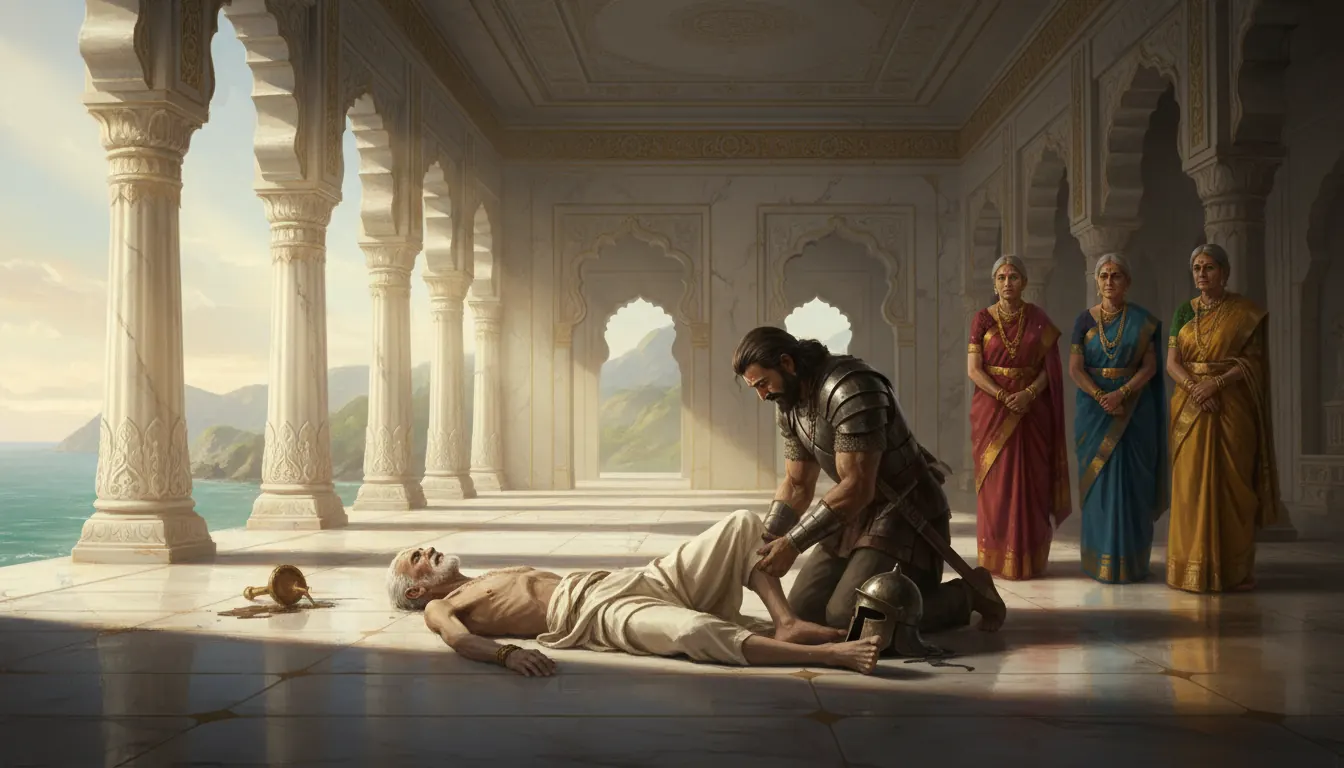
Arjuna spent that night in Keshava's mansion, in a house still standing with its rooms as they had been and the man gone out of them, and was suddenly overwhelmed by grief and bewilderment.
When morning came, Vasudeva reached the highest goal through Yoga. Devaki and Bhadra and Rohini and Madira went with their lord into the fire, and the Samans were chanted over the burning wood, and afterwards the boys of the Vrishni and Andhaka races, led by Vajra, went down to the water with the women and made the offerings for the dead. Boys and widows. That was the whole funeral party of the house of Sura, and there were six days left.
Phalguna was careful to keep every duty, and there was one duty left that nobody else in the world was in a position to perform.
He went out to the place where the Vrishnis had been slaughtered.
He had heard it described twice, and neither telling had prepared him for the sight of it. They were lying all around him, in the tide-line and in the grass above it, the Bhojas and the Andhakas and the Vrishnis together, men whose arms looked like maces of iron, and every one of them had been killed with a blade of grass. The Eraka grass of that shore had become iron in their hands through the curse of the brahmanas, and they had used it on one another until there was nobody left standing to use it on.
Seeing them lying slaughtered all around him, the Kuru prince was deeply dejected. But he did what had to be done in view of what had happened.
The rites were performed in the order of seniority. That is the detail to hold, because it is the whole of Arjuna's answer to the field. Not by the heap, but each man taken in his proper place in the line, elder before younger, as though the Yadava order still existed and he were only its executor. It took time he did not have. He spent it.
Then he went looking, with men to help him, for two bodies in particular, and they searched until they found them: Rama, and Vasudeva's son.
Arjuna had them burnt by men skilled in that work. He did not do it himself. He had the rite done properly, by men who knew the work, and stood there while it was done, and then performed the sraddha offerings that are made to the dead, and got up into his chariot on the seventh day, because the tide was coming.
A Cavalcade Without Heroes
They came out of Dwaraka at sunrise on the seventh day, and there was one bowman at the head of them.
The widows of the Vrishni heroes came first behind him, wailing aloud, riding in carts drawn by bullocks, mules and camels. The servants of the Vrishnis followed them, and their horsemen, and their chariot-men. The citizens and the country people set out at the same hour at Partha's command and spread out around the column on every side.
What was left of the army came too. The men who fought from the backs of elephants brought out their elephants, huge as hills, and the foot soldiers marched with the reserves behind them, and Vaishampayana, who is not usually cruel about such things, calls the whole of it a cavalcade without heroes, made up only of women and the old and the children.
The children of the Andhaka and the Vrishni races walked where they could see Arjuna.
Brahmanas went, and kshatriyas, and vaishyas, and the wealthy among the shudras, and they kept two things at the front of the procession where everybody could see them. One was the sixteen thousand women of Vasudeva's house. The other was Vajra, the grandson of Krishna, who was going to be a king in Indraprastha.
The widows of the other heroes of the Bhoja, Vrishni and Andhaka races, left without lords now, who set out that morning with Arjuna, numbered many millions.
That conqueror of enemy cities, that foremost of chariot warriors, escorted this vast procession of the Vrishnis, still rich in wealth of every kind, which looked, from any high ground behind it, like a veritable ocean.
Which was the wrong thing for it to look like, that morning, and nobody said so.
Whatever Ground Was Passed Over
After all the people had set out, the ocean, that home of sharks and alligators, flooded Dwaraka.
It did not come as a wave. It came the way a tide comes, and it came behind them, and it kept exact pace with them. Whatever ground they had passed over, the ocean flooded with his waters at once. The last cart cleared a lane and the water was in the lane. The column left the gate and the water was at the gate. The city was still full of wealth of every kind, because there had not been carts enough for all of it, and the sea took the wealth with the walls and the buildings and the streets.
The people looked back at it while they walked, and Vaishampayana records what they said to one another, and it is not a lament.
"How wonderful is the course of fate."
Then they walked faster. That is the sentence that stays: seeing this wonderful sight, the people of Dwaraka walked faster and faster.
When he had left Dwaraka, Dhananjaya went on by easy stages. He was escorting women who had just burned their husbands and children who did not understand what had happened, so he made short days of it, and he chose the halts himself. He had the Vrishni women rest in pleasant forests, and on mountains, and beside lovely streams. There is no hurry in that part of the account at all. The one man in the party who knew exactly how little time was left was the one arranging the rests.
They came at last to the country of the five waters, the land between the rivers, and the mighty Dhananjaya pitched a rich camp in the middle of it, in a country full of corn and cows and other animals.
It was good ground. It fed them. It also had people living on it, and those people came down to look at what had arrived: a great deal of gold, a great many unguarded women, and one man with a bow.
The Consultation of the Abhiras
The robbers of that country were Abhiras, herdsmen, and they were sorely tempted.
They did not rush in on the sight of it. They went away and assembled and held a consultation, sitting down together like a council of state to work out whether one man could be taken, and Vaishampayana gives their reasoning in their own words.
"There is only one bowman here, Arjuna. The procession is made up of children and old people. He is taking them through in defiance of us. The warriors of the Vrishnis have lost their spirit."
Every clause of it was true. That is what makes it hard to read. They were not deceived about anything. They had counted the escort correctly, they had judged the temper of the surviving Vrishni troops correctly, and the one figure in their arithmetic they had no way of checking was the value they had assigned to the name Arjuna, and they had guessed at it and their guess was right.
There were thousands of them and they were armed with clubs. Not with bows, not with darts, with the sticks they carried anyway for the cattle. Driven by the perverse course of time, they fell on that vast crowd with loud, lion-like shouts, terrifying it, eager for plunder and for slaughter.
The son of Kunti was up ahead on the road. He stopped the advance, turned with his followers, and went back down the column to the place where the herdsmen had struck it.
Then the mighty-armed warrior spoke to the attackers, and Vaishampayana notes that he was smiling while he did it, because he had done this before in more places than he could count and it had always ended the same way.
"Stop, you sinful wretches, if you love your lives. You will regret it when I pierce your bodies with my arrows and take your lives."
But for all the hero's words, they ignored him. He tried again and again to turn them back, giving them more warning than he had ever given a king. And they came on, and he reached back for the Gandiva.
The Horns of the Bow
The bow would hardly string.
It was the large, indestructible, celestial bow, and Arjuna tried to bend it, and it did not answer his hands. He got the loop over the horn at last with great difficulty, and by the time he had done it the battle was already furious around him.
Then he began to think of his celestial weapons, and they would not come to his mind.
Gods had given them to him and he had held them for a lifetime, and they had always been there in the place where a man reaches for such things, and now that place was empty. Seeing the fury of the battle, and the strength gone from his arm, and his weapons failing to appear, Arjuna was deeply ashamed.
The crowd was very large and the robbers attacked it at many points at once. The Vrishni foot soldiers, elephant warriors and chariot-men could not rescue the women who were being snatched away. Arjuna did his best to protect them and could not. In full view of all the warriors, many of the foremost ladies were dragged off, and others went away with the robbers of their own accord.
That last clause is in the text and it cannot be softened. Some of them chose to go. They had watched their city drown and their husbands burn, and a herdsman with a club was, to them, a life.
He struck the robbers with arrows from Gandiva while there were arrows. In former days his quivers had been inexhaustible. Now they ran dry, and when he found them empty the son of Indra began to strike the robbers with the horns of his bow, which is what a boy does with a stick.
The Mlecchas fell back as he watched, taking with them many of the foremost ladies of the Vrishnis and the Andhakas.
Then Dhananjaya stopped. He saw it all as the work of destiny, sighed long and heavily, and made no further effort, saying that he no longer had the power he had before.
He took the remnant of the women and the wealth still with them to Kurukshetra, and settled the survivors across the north in pieces: Kritavarma's son at Marttikavat with the widows of the Bhoja king, the son of Yuyudhana with his old men and children on the banks of the Saraswati, and the rest at Indraprastha, whose rule he gave to Vajra as he had promised in the Sudharma hall.
I Am Arjuna
The widows of Akrura went into the woods and would not be talked out of it. Rukmini and the princess of Gandhara and Saivya and Haimavati and queen Jambavati went into the fire. Satyabhama and the other dear wives of Krishna crossed beyond the Himavat to a place called Kalpa and lived on fruits and roots, contemplating Hari.
When there was no one left to settle, Arjuna, his eyes streaming with tears, entered Vyasa's hermitage, found the Island-born rishi sitting in a secluded spot, and gave his name.
"I am Arjuna."
Then he waited, which is not how the third Pandava had entered a place in many years.
"Welcome," said the son of Satyavati. "Sit down."
Vyasa looked at him: dejected, sighing heavily, full of despair. The questions he asked are a list of the things that can strip a man of his lustre.
"Have you been sprinkled with water from anyone's nails or hair, or from the end of anyone's cloth, or from the mouth of a jar? Have you lain with a woman during her monthly flow? Have you killed a brahmana? Have you been beaten in battle? You look like a man whose fortune has left him. I do not know of anyone who has defeated you. So why, chief of Bharata's race, do you look so very dejected?"
So Arjuna told him.
"He whose colour was like a newly risen cloud, whose eyes were like a pair of large lotus petals, Krishna, has cast off his body with Rama and gone up to Heaven. At Prabhasa, through iron bolts born of the curse the brahmanas pronounced, the Vrishni heroes have been destroyed. Not a single hero has escaped. The death of the wielder of Sarnga is as unbelievable as the ocean drying up, a mountain moving from its place, the vault of heaven falling, or fire turning cold.
"Something more painful than this has happened too. Before my very eyes thousands of Vrishni ladies were carried off by the Abhiras of the country of the five waters. When I took up my bow I found I could not even string it. The strength that was once in my arms seemed to have gone, and my weapons of every kind failed to appear. He who used to walk ahead of my chariot, burning up every enemy warrior as he went, I can no longer see. Now I am a wanderer with an empty heart, stripped of my kinsmen and of all I had."
He had come for directions, like a man who had lost the road.
Time Is the Seed of the Universe
Vyasa did not comfort him about Krishna. He explained the arithmetic instead.
"The mighty chariot warriors of the Vrishni and Andhaka races have all been consumed by the brahmanas' curse. You should not grieve for their destruction. What has happened was ordained. Krishna allowed it to happen, though he was fully able to prevent it. Govinda could change the very course of the universe with all its moving and unmoving creatures, let alone the curse of brahmanas, however great-souled. He who used to go in front of your chariot, armed with discus and mace, out of love for you, was the four-armed Vasudeva, that ancient rishi. Having lightened the burden of the Earth and cast off his human body, he has gone to his own high seat. And you too, with Bhima and the twins to help you, have accomplished the great work of the gods.
That was the answer to the first half. The second half, the one about the bow, he answered with a general law rather than a consolation.
"Understanding and strength and foresight come while the days of prosperity have not run out. These same gifts vanish when the hour of adversity comes. All this has Time for its root. Time is the seed of the universe. And it is Time that takes everything back again as it pleases. A man becomes mighty, and then loses that might and becomes weak. A man becomes a master and rules others, and then loses that place and becomes a servant, obeying the commands of others.
"Your weapons have done their work and gone back to where they came from. They will come into your hands again when the Time for their coming draws near. The time has come, Bharata, for all of you to reach the highest goal."
Nothing in that is an excuse offered to Arjuna, and nothing in it is a rebuke. The weapons were never his property. They were lent to a man for a piece of work, and the work is over, and the lender has taken them back, and the shame he felt at the roadside with a stick in his hand was the shame of a man who had mistaken a loan for a possession for most of his life.
Arjuna took his permission and went back to the city named after the elephant. He found Yudhishthira and told him everything that had happened with reference to the Vrishnis, and Vaishampayana, having brought him that far, stopped.
That is the end of the Mausala Parva.
Dharma Lesson
Arjuna does everything correctly and loses anyway. He burns the dead in their proper order, keeps the seventh-day promise, sets the boy on the throne and settles every survivor in a place where they can live, and in the middle of all that competence the herdsmen take the women out of his hands. Vyasa does not tell him he failed; he tells him that understanding and strength arrive with prosperity and leave with it, and that the weapons have gone back where they came from and will return when Time returns them. What a man is owed for his past service is nothing. What he can still do this morning for the people in front of him is everything, and Arjuna keeps doing it all the way to Indraprastha with an empty quiver.