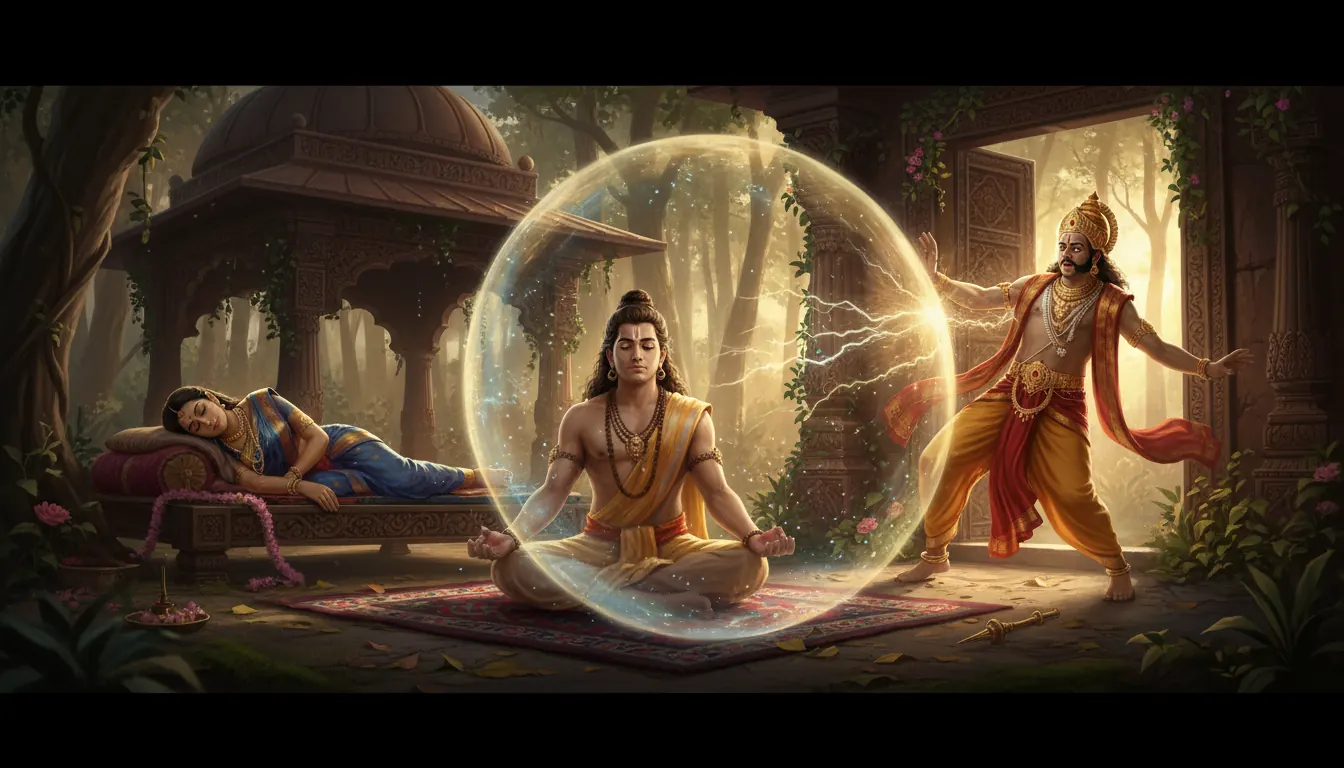
The Five Forms of Marriage
Bhishma on how a daughter is given, what a dower does not buy, and the honour owed to women
In short
Yudhishthira asks which duty stands at the root of all the others and is told it is the marriage of a daughter. Bhishma names the five forms of the rite, the ages and the forbidden degrees of kinship, and then works through the hard cases: the man who pays a dower and is passed over, the two maidens Bhishma himself carried away from Kashi, and the ruling prince Satyavat gave when the giver of a dower died before the wedding. He ends with the law of a daughter's inheritance, Yama's verse on the hells kept for men who sell their children, and the verse a princess of Videha sang about women.
Told in the Anushasana ParvaSet in Kurukshetra, Videha (Mithila) and Kashi23 min read
The Root of All Duties
Bhishma had been lying on the bed of arrows through a long stretch of days by then, answering whatever the king brought him, and the questions had worked their way down from kingdoms and gifts and penances to the ordinary business of a household.
"Tell me, grandfather," Yudhishthira said, "about the thing that is the root of all duties, the root of kinsmen, of home, of the Pitris and of guests. I think the marriage of one's daughter should be counted the first of all duties. Tell me, king, to what sort of man should one give one's daughter?"
It is worth noticing what he had just claimed. Not sacrifice, not almsgiving, not the protection of subjects. The giving of a girl in marriage, because everything else on his list depends on it. There are no kinsmen without it, no house to keep a fire in, nobody to feed the dead fathers, and nobody at the door to receive a guest. Strike out the marriage of daughters and the whole apparatus of dharma has nothing to stand on.
Bhishma began with the answer that is the least dramatic and the most important.
"After enquiring into the man's conduct and character," he said, "his learning and accomplishments, his birth and his deeds, good people should then give their daughter to accomplished bridegrooms. All righteous brahmanas act in this way. This is known as the Brahma marriage."
Four things to be enquired into, and the man's wealth is not one of them. His character, his learning, his family, and what he has actually done with his life. A father who has looked into those four and is satisfied gives his daughter and takes nothing, and that is the first and highest form of the rite.
"Once he has chosen a suitable bridegroom," Bhishma went on, "the girl's father should have him marry his daughter, after persuading him to it with gifts of many kinds. This form of marriage is the eternal practice of all good kshatriyas."
The kshatriya, in other words, pays. Not for the girl. For the man, to bring him to the wedding. The whole of the discourse that follows turns on that distinction, and the king was about to spend the rest of the morning discovering how narrow it is.
Five Forms, and Two That Are Not Righteous
Bhishma set out the rest of the list.
"When the girl's father, setting aside his own wishes, gives his daughter to a man whom she likes and who returns her feelings, those who know the Vedas call the marriage gandharva."
That is the third. The father has a preference and puts it aside, and the two young people have each other, and the union takes its name from the gandharvas who are supposed to know something about love. It is set down without apology among the good forms.
"The wise have called this the practice of the asuras: marrying a girl after buying her at a high price and satisfying the greed of her kinsmen."
That is the fourth, and the word in it is cupidity. The man buys. The kinsmen are greedy and are satisfied. Nothing in the description is about the girl at all.
"Killing her weeping kinsmen and cutting off their heads, the bridegroom sometimes carries off by force the girl he means to marry. Such a marriage is called rakshasa."
The fifth. The text keeps the detail that makes it unbearable, which is that the kinsmen are weeping while their heads come off, and that this is nonetheless a recognised form of marriage with a name and a place in the books.
"Of these five, the Brahma, the Kshatra, the gandharva, the asura and the rakshasa, three are righteous and two are unrighteous. The Paisacha and the asura forms should never be used. The Brahma, Kshatra and gandharva forms are righteous. Pure or mixed, these forms should be followed without doubt."
So the sale is condemned, and the seizure is left outside the righteous three, which is a hard sentence for a kshatriya to pass, and Bhishma of all men had reason to know it.
Then the plain rules of how many. A brahmana may take three wives. A kshatriya may take two. A vaishya should take a wife only from his own order. The children born of these wives are all to be regarded as equal. Of the three wives of a brahmana, the one from his own order stands foremost; of the two wives of a kshatriya, the same.
"Some say that men of the three higher orders may take wives from the shudra order, only for pleasure and not for virtue. Others forbid the practice. The righteous condemn it. A brahmana who fathers children on a shudra woman becomes liable to perform an expiation."
The Age of the Bride and the Forbidden Kin
From the forms Bhishma went to the plain numbers, which he gave without commentary, as a man recites a measure.
"A man of thirty should marry a girl of ten, called a Nagnika. Or a man of twenty-one should marry a girl of seven."
Then a prohibition that has nothing to do with age and everything to do with a father's need.
"A girl who has neither brother nor father should not be married, chief of the Bharata line, for she may be meant as a Putrika of her father."
A man with no son may appoint his daughter to stand in a son's place, so that her child will be his and will offer him water when he is dead. A girl in that position is not free to be carried off into another house, and a man who marries her without knowing it has quietly taken a line of descent out of the world. Bhishma states the rule and leaves the reason a single word wide, and the word is Putrika.
Then the case that the rules had not covered, which is the girl nobody comes for.
"Once she has reached puberty, the girl, if she is not married, should wait for three years. In the fourth year she should look for a husband herself, without waiting any longer for her kinsmen to choose one for her. The children of such a girl do not lose their standing, nor does union with such a girl become disgraceful. If, instead of choosing a husband for herself, she does otherwise, she incurs the reproach of Prajapati."
That is worth reading twice. Three years of waiting is the whole allowance made to the family that has failed her, and in the fourth year the choice passes to the girl, and the law goes ahead of the disapproval and declares in advance that neither she nor her children are to be thought less of for it. And then the sting in the tail: it is not the choosing that draws the reproach of Prajapati. It is the not choosing.
Last, the boundary of blood.
"One should marry a girl who is not a Sapinda of one's mother and not of the same Gotra as one's father. This is the usage, in keeping with the sacred law, that Manu has declared."
Not near kin on the mother's side. Not the same lineage on the father's. Between those two fences lies every marriage the discourse has been describing.
Whose Wife Does She Become
Yudhishthira had been counting cases while he listened, and he laid all five of them out at once.
"Wanting to marry, one man actually pays a dower to the girl's kinsmen. Another, with the kinsmen's consent, promises to pay one. Another says, I will carry the girl off by force. Another simply displays his wealth, meaning to offer part of it as a dower for her. Another, again, actually takes the girl's hand with the wedding rites. I ask you, grandfather, whose wife does the girl actually become? For us who want to know the truth, you are the eye we see with."
Five men and one girl, and four of them have done nothing but talk about money.
"Whatever human acts the wise have approved or settled in consultation are seen to bring about good," Bhishma said. "False speech, however, is always sinful."
He began with the one thing genuinely at stake in a broken promise, which is not property but a lie. If the girl bestows her hand upon a person other than he whom she had promised to wed, then she, the sons born of her, and the Ritwiks and teachers and disciples and Upadhyayas present at the marriage all become liable to expiation. The whole company at the fire is implicated in the falsehood.
"Some hold that no expiation is needed for such conduct," he added, and set the other principle beside it. "Manu does not approve of a girl living with a man she does not like. Living as the wife of a man she does not like leads to disgrace and sin."
So the two rules stand facing each other, the sanctity of the given word and the misery of the unwilling wife, and Bhishma did not pretend to dissolve it. He said instead where the sin is not.
"No one incurs much sin in any of the cases that follow. There is no great sin in carrying off by force, for marriage, a girl whom her kinsmen have given to the abductor with due rites, or a girl for whom a dower has been paid and accepted."
Then the point on which the whole discourse would turn. Mantras and Homa, performed for a girl whom her kinsmen have consented to give, accomplish their purpose. Performed for a girl not bestowed by her kinsmen, they do not. The engagement made by the kinsmen is binding and sacred. The engagement entered into by the wedder and the wedded, with the aid of Mantras, is very much more so, for it is that which creates a husband and a wife.
When a Better Man Comes to the Door
The king put the hardest version of the case.
"When, after a dower has been received for a girl, her father sees a more suitable man come forward for her hand, is the father to blame if he rejects the man whose dower he took? Either course seems to be at fault, for to cast off the man to whom the girl was promised can never be honourable, while to turn away the more suitable man can never be good. Of all duties this seems to call for the greatest deliberation. You are our eyes."
Bhishma cut the knot at the place where it was tied.
"Paying the dower does not make the girl a wife. The man who pays it knows this well. He pays it simply as the price of the girl. And again, good people never give their daughters away for the sake of dowers that others may offer. It is when the man who wants to marry has qualities that the girl's kinsmen do not like that they demand a dower from him."
There is the whole sociology of it in one line. A dower is what is asked of a man who is not good enough. Nobody demands a price from a bridegroom they actually want.
And then the distinction that saves the honest father. A man won over by another's accomplishments who says, marry my girl, and adorn her with proper ornaments of gold and gems, is not demanding a dower, and the bridegroom who complies is not giving one, for such a transaction is not a sale. To give a daughter while accepting what are strictly gifts of affection is the eternal practice.
"In matters of marriage some fathers say, I will not give my daughter to such and such a man. Some say, I will give my daughter to such a one. Some again say forcefully, I must give my daughter to such a man. These declarations do not amount to actual marriage. People are seen to ask one another for the hands of maidens, and promise, and draw back. Until the hand is actually taken with due rites, marriage cannot be said to have taken place."
The answer to the king's dilemma, then, was that there had never been a marriage to break. Only the giver incurs the sin of falsehood, and the rishis have commanded that maidens never be bestowed upon any but the most fit.
"The daughter is the root of desire and of descendants in the collateral line," Bhishma said. "That is what I think."
The Two Maidens I Carried Away
Then the old man on the arrows put himself into the argument as evidence.
"The practice of selling and buying daughters has been known to human beings for a long time," he said. "Because the practice is so familiar, you may, on careful examination, find countless faults in it. The giving or accepting of a dower alone could not be held to make a man and a woman husband and wife. Listen to what I say on this point."
"Long ago, after defeating all the Magadhas, the Kashis and the Kosalas, I carried off two maidens by force for Vichitravirya."
He was speaking of the morning at Kashi, when he had taken the princesses out of the middle of their own svayamvara and fought off every king in the hall to do it, for the sake of a younger brother who would be dead before he could grow into his kingdom. Bhishma does not tell the story here. He cites it, the way a judge cites the case that went against him.
"One of those two maidens was married with due rites. The other was not formally married, because the dowry paid for her had been paid in valour."
Dowry paid in the form of valour. That was the argument, and it had the shape of a good one: a man who has bought a girl with his own blood at the risk of his own life has paid more for her than any man who counted out gold.
"My uncle of Kuru's race, king Bahlika, said that the maiden carried off in this way and not married with due rites should be set free. Vichitravirya, it was held, should not marry her."
And Bhishma, who was already famous for knowing what was right, did not accept the ruling and go away quiet. He says so.
"Doubting my father's words, I went to others to ask their opinion. I thought my father was extremely scrupulous in matters of morality. Then I went to my father himself and spoke these words to him, wanting to learn something of the practices of righteous people. Father, I want to know what the practices of righteous people truly are. I repeated my wish several times, so great were my eagerness and curiosity."
He canvassed the elders, and then went back and asked the man himself, over and over, until he had it whole.
The Answer of Prince Satyavat
"If in your opinion the status of husband and wife comes from the giving and accepting of a dowry, and not from the actual taking of the maiden's hand with due rites," Bahlika answered him, "then the maiden's father, by letting his daughter go away with the one who gave the dowry, would show himself a follower of some creed other than the one drawn from the ordinary scriptures."
And then the sentences Bhishma had carried for a lifetime.
"Maidens cannot become wives through sale and purchase. Those who think that status comes from paying a dowry certainly do not know the scriptures. No one should give his daughter to such men. A wife should never be bought. Nor should a father sell his daughter. Only those of sinful soul, and greedy besides, who buy and sell female slaves to make them serving women, think the status of wife comes from accepting a dowry."
Then Bahlika cited a ruling of prince Satyavat.
"On this subject some people once asked prince Satyavat the following question. If a man who has paid a dowry to a maiden's kinsmen dies before the marriage, can another man take that maiden's hand in marriage? Clear away these doubts of ours, for you have great wisdom and are honoured by the wise."
The man they were asking was a prince honoured by the wise for his judgment.
"The maiden's kinsmen should give her to the man they consider suitable. There need be no scruples about this. The righteous act in this way without regard to the one who gave the dower, even if he is alive. And as for a giver who is dead, there is not the slightest doubt."
A dead man has no claim on a living girl, because he never had one while he lived either. The money had bought nothing, so death took nothing away.
He went on to the harder corner, the virgin widow whose marriage was never consummated because her husband was absent or dead. Some say she may unite with her husband's younger brother. Some say she may take to penances. Others maintain that the first practice, prevalent as it is, springs from desire and not from scripture.
And then the sentence that settles it. The Mantras accomplish their object of bringing about the indissoluble union at the seventh step. The maiden becomes the wife of the man to whom she is actually given with water, before the fire, walking the appointed circuits.
The Giver Who Went Away
"If a man, after paying a dowry for a maiden, goes away," Yudhishthira asked, "how should the maiden's father, or her other kinsmen who have the right to give her in marriage, act? Do tell me this, grandfather."
Not dead this time. Gone, and possibly coming back.
"Such a maiden, if she is the daughter of a rich father with no son, should be supported by her father while they wait for the return of the man who paid the dowry," Bhishma said. "Indeed, if the father does not return the dowry to the giver's kinsmen, the maiden should be regarded as belonging to the giver of the dowry. She may even raise children for the giver during his absence, by any of the means laid down in the scriptures. No one, however, has the right to marry her with due rites."
That is the whole cost of an unreturned payment. The father who keeps the money keeps his daughter in a condition that is neither maidenhood nor marriage, and the way out of it is to hand the money back.
Then Bhishma reached for the example everyone in the discourse had been circling, and he did not soften it.
"At her father's command, the princess Savitri long ago chose a husband and united herself with him. Some praise this act of hers, but others who know the scriptures condemn it. Other righteous people have not acted in this way. Others hold that the conduct of the righteous should always be taken as the first evidence of duty or morality."
The most celebrated wife in the epic, the woman who followed Yama into the forest and argued her husband's life back out of him, and Bhishma reports that the learned are divided about how she came to be married at all. He does not adjudicate it. He hands it to another man.
"On this subject Sukratu, the grandson of the great-souled Janaka, ruler of the Videhas, has given the following opinion. There is the well-known declaration of the scriptures that women are not fit to enjoy freedom at any time of their life. If this were not the path the righteous have walked, how could this scriptural declaration exist? To abandon eternal usage unrighteously is held to be the practice of the asuras. We never hear of such practice in the conduct of the ancients."
And then Sukratu of Videha said the one thing in the passage that lifts above the accounting.
"The relationship of husband and wife is very subtle. It is different from the natural relationship of male and female, which consists only in the desire for sexual pleasure."
The Daughter Is Like the Son
"On what authority is the wealth of men inherited by others when they have daughters?" Yudhishthira asked. "For her father, the daughter should be counted the same as the son."
"The son is like one's own self, and the daughter is like the son," Bhishma answered. "How then can another take the wealth, when one lives on in one's own self in the form of one's daughter?"
Whatever wealth is termed the Yautuka property of the mother forms the portion of the maiden daughter. If the maternal grandfather dies without leaving sons, the daughter's son should inherit it, for he offers pindas both to his own father and to his mother's father, and in justice there is no difference between the son and the daughter's son.
When a person has invested his only daughter with the status of a son, and a son is afterwards born to him, that son does not take all the wealth. He shares it with the daughter. And when such a father afterwards takes a son by adoption or purchase, the daughter is held superior to that son, for she takes three shares of her father's wealth and his share is limited to the remaining two.
Then the one case where the daughter's son inherits nothing.
"The sons born of a daughter whom her father sold for a price belong only to their father. Such sons can never belong, even as daughter's sons, to their maternal grandfather, who by selling their mother for a price lost all his rights in her."
And such children, Bhishma said, become full of malice, thieves of other people's wealth, deceitful and cunning, having sprung from that sinful form called asura.
Here he cited lines sung of old by Yama.
"The man who gains wealth by selling his own son, or who gives away his daughter after accepting a dower to make his living, must sink into seven terrible hells, one after another, known as Kalasutra. There that wretch has to feed on sweat and urine and excrement the whole time."
And one more form, condemned as soon as it is named. In the Arsha marriage the bridegroom gives a bull and a cow and the father accepts the gift. Some call that a dowry and some do not.
"Whether the gift is small or large, it should not be regarded as a sale. Yet, though some act in this way, it should never be taken as the eternal usage. Even a human being to whom one has no blood relationship should not be made the subject of a sale. What need is there, then, to speak of one's own children?"
The Verse of Daksha and the Song of the Videha Princess
"Those who know ancient history," Bhishma said, "recite the following verse of Daksha, the son of Prachetas. A maiden for whom her kinsmen take nothing in the form of a dowry cannot be said to be sold."
One line, and the whole argument stands inside it. Then he turned from the law to the practice.
"The maiden whose hand is taken in marriage should be given respect and kindness. Her father and brothers and father-in-law and husband's brothers should show her every respect and adorn her with ornaments. If the wife does not like her husband or fails to gladden him, from that dislike and absence of joy the husband can never have children to increase his line."
"Women should always be worshipped and treated with affection. Where women are treated with respect, the very gods are filled with joy. Where they are not worshipped, all acts become fruitless. If the women of a family grieve and shed tears, that family soon dies out. Houses that are cursed by women are ruined as if scorched by some Atharvan rite."
Manu, on the eve of his departure for Heaven, made over women to the care of men, saying that they are weak, that they fall an easy prey to the wiles of men, disposed to accept the love that is offered them, and devoted to truth; and that others among them are full of malice, covetous of honours, fierce in disposition, and impervious to reason.
"Women deserve to be honoured. You men, show them honour. The righteousness of men depends on women, and all pleasures and enjoyments depend on them. The begetting of children, the nursing of children already born, and the accomplishment of every act society needs, all these have women as their cause."
And he ended, as he had begun, with another man's words. A princess of the house of Janaka the ruler of the Videhas had sung a verse, and Bhishma sang it now.
"Women have no sacrifices ordained for them. There are no Shraddhas they are called on to perform. They are not required to keep any fasts. To serve their husbands with reverence and willing obedience is their only duty. By doing that duty they succeed in conquering heaven. In childhood, her father protects her. Her husband protects her in youth. When she grows old, her sons protect her. At no time in her life does a woman deserve to be free."
"Deities of prosperity are women," Bhishma said. "By cherishing women, one cherishes the goddess of prosperity herself, and by causing her pain, one causes that goddess pain."
Dharma Lesson
Bhishma spends the whole discourse taking money out of the middle of a marriage. A dower buys nothing, a promise is not a wedding, and the union is made at the seventh step and nowhere else, because what is being joined is not a transaction but two lives. The old man knew the cost of getting this wrong from the inside: he had carried two princesses out of Kashi on the strength of his own valour and been told by his elders to let one of them go. And having settled the law, he does not stop at the law. Honour women, he says, or the house is scorched from within.