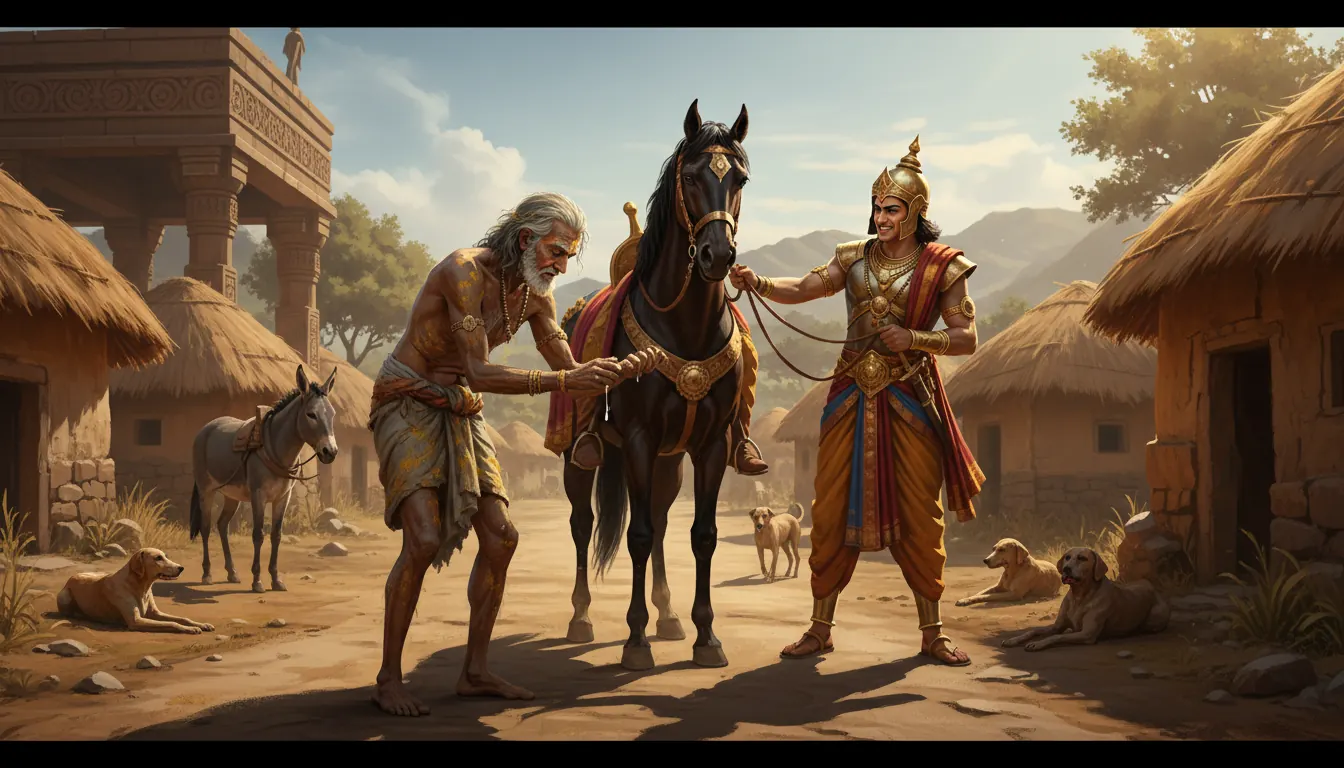
The Kinds of Sons and Their Shares
Bhishma divides a dead man's property, names the children of crossed orders, and settles who a son belongs to
In short
Yudhishthira asks how a brahmana's wealth is split among the sons of wives of four different orders, and Bhishma counts out the bull, the cart and the ten portions, then the eight portions of a kshatriya and the five of a vaishya. He goes on to name the offspring of every crossed union and the trades assigned to the mixed classes, and to say what marks reveal a man's origin. He ends with the twelve kinds of sons, the old quarrel of seed against soil, and the child found abandoned on the road.
Told in the Anushasana ParvaSet in Kurukshetra24 min read
The Doubt He Would Ask No One Else
Bhishma lay on the bed of arrows with the plain of Kurukshetra around him, and by now the questions the king carried out to him every morning had left the war a long way behind. What Yudhishthira brought him on this day was not a question about the soul. It was a question about property.
He began, as he always began, by saying why he was asking this man and nobody else.
"You know the ordinances of all the scriptures," he said. "You stand first among those who know the duties of kings. You are famous through the whole world as a great dispeller of doubts. I have a doubt, grandsire, and I ask you to explain it to me. I will ask no one else to resolve this doubt that has arisen in my mind."
Then the doubt.
"It has been laid down that a brahmana can take four wives: one that belongs to his own order, one that is a kshatriya, one that is a vaishya, and one that is a shudra. Tell me, best of the Kurus, which of those sons deserves to inherit the father's wealth, and in what order? Which of them is to take what share of it? I want to hear how the division of the father's property among them has been ordained."
It is a household question of the plainest kind. A man dies. There are four mothers in the house and children by all of them, and the fields and the cattle and the cart have to be split before the season turns. Yudhishthira now ruled a kingdom where that quarrel would come before him in some village every month, and he wanted the answer before it did.
Bhishma's first move was to take away half the premise of the question.
"The brahmana, the kshatriya and the vaishya are held to be the three twice-born orders," he said. "It has been ordained that a brahmana should marry within these three orders. Through poor judgment, or greed, or lust, a brahmana takes a shudra wife. But by the scriptures he has no right to take such a wife."
A man who did it, he said, came to a low end in the next world and had to perform expiation according to the rites, and the expiation must be twice as heavy if a child came of it.
And having said that the fourth marriage ought never to have taken place, he began to count out the shares of the son it produced.
A Bull, a Cart, and Ten Portions
"Now I will tell you how a father's wealth is to be divided," Bhishma said.
The first thing that happens is not a division at all. Before anything is counted, the son born of the brahmana wife takes two objects out of his father's property: a bull of good marks, and the best chariot or vehicle in the house. Those come off the top, and no share is reduced by their going.
What remains after that is divided into ten equal portions, and the ten are distributed like this.
The son by the brahmana wife takes four.
The son born of the kshatriya wife takes three. He has, Bhishma said, the status of a brahmana beyond any doubt; it is only the distinction attaching to his mother that puts him second.
The son born of the vaishya wife takes two.
That leaves one portion out of the ten, and it is here that the ordinance does something strange with itself. It has been said, Bhishma told the king, that the son a brahmana fathers on his shudra wife should take no part of his father's wealth at all, for he is not to be counted an heir. And then, in the same breath: a little, however, should be given to him, and the one remaining share should be given to him out of compassion.
He would not let that word pass without stopping on it.
"Compassion is one of the highest virtues," he said. "It is out of compassion that something is given to the son of the shudra wife. Whatever it is that stirs compassion, compassion is a cardinal virtue and always brings merit."
But he fenced the gift in twice. The tenth part is the son's only when the father has actually given it to him; he may not take it if his father does not give it. And whether the father happens to have other children by his other wives or has none at all, nothing more than a tenth is ever to come to this son. The compassion is real, and it is capped.
Within each group the arithmetic is simple. All the sons born of the same mother, or of mothers of the same order, share equally the portion that is theirs.
One more line closed the account, and it was aimed at the father rather than the heirs. If a brahmana happens to have more wealth than is needed to maintain himself and his family for three years, he should spend that surplus on sacrifices. A brahmana should never gather wealth to no purpose.
What the Wife Owns and the Daughter Takes
Having settled the sons, Bhishma turned aside to the women of the house, and the rules he gave there are short and worth having in full.
The highest sum that a husband should give his wife is three thousand coins of the prevailing currency. That is the ceiling on the gift, not on her use of it. What the husband gives the wife, Bhishma said, the wife may spend or dispose of as she likes. It is hers, and the giving is finished when it is given.
If the husband dies childless, the wife is to enjoy all his wealth. She is to live on it, be maintained by it, hold it; she is not to sell it or otherwise dispose of any portion of it. The estate keeps its shape and she keeps the estate.
Against that stands the other half of the rule. The wife should never take any portion of her husband's wealth without his knowledge. What she is given she owns outright; what she takes unasked she does not.
And then the sentence that reaches furthest of anything in the section.
"Whatever wealth the brahmana wife receives as a gift from her father should go, after her death, to her daughter," Bhishma said, "for the daughter is like the son. The scriptures have ordained, king, that the daughter is equal to the son, delight of the Kurus."
Property that has come down the mother's side goes down the mother's side. It does not fall into the ten portions and it is not touched by the arithmetic of the brothers. What her father gave her, her daughter takes, and the reason offered is not custom or convenience but a flat statement of equivalence set down twice in two sentences.
"This is how the law of inheritance has been ordained, bull of the Bharatas," he said. "Remembering these rules for dividing and disposing of wealth, one should never gather wealth to no purpose."
That is twice now that he had ended a passage on inheritance by warning against the accumulation of the thing being inherited. The old man dividing property into portions for a king who had just won the largest inheritance in the world kept returning, at the end of every list, to the observation that most of it should never have been piled up in the first place.
Yudhishthira, however, had not been satisfied by the ten shares. He had been counting them while they were being read out, and he had found something in them that he did not think held together.
The Wife Married Last and Ranked First
"If the scriptures declare that the son of a brahmana father by a shudra woman has no right to any wealth," the king said, "then by what special rule is he to be given a tenth of his father's property?"
Then the sharper half of the objection.
"A son born to a brahmana by a brahmana wife is unquestionably a brahmana. One born to a brahmana husband by a kshatriya wife or a vaishya wife has the status of a brahmana too. Why then should such sons share their father's wealth unequally? You have said that all of them are brahmanas, since their mothers belong to the three higher orders, which have an equal right to the name of twice-born."
It is a good objection. If the status conferred is identical, the shares should be identical, and Bhishma had made them four and three and two.
"All wives in this world are called by the name Data," Bhishma answered. "But although that name is given to them all, there is this great distinction to be observed."
And he made the distinction with a case rather than an argument. Suppose a brahmana has already married his three other wives, and takes a brahmana wife the very last of all. She is still to be regarded as the first in rank among all the wives, and as deserving of the greatest respect, and the order of the wedding days has nothing to do with it.
What that precedence means in practice is a list of household offices, and Bhishma gave the list.
In her apartments are kept the articles the husband needs for his baths, his personal decorations, the washing of his teeth, the application of collyrium to his eyes. In her apartments are kept the Havya and the Kavya and everything else he requires for the performance of his religious acts. If the brahmana wife is in the house, no other wife is entitled to attend to these needs of the husband. His food and drink, his garlands, his robes, his ornaments, all of these should be given to him by her hand, because she is first in rank and regard among all his wives.
"These are the ordinances of the scriptures as Manu laid them down," he said. "This is also the course of eternal usage. If a brahmana, led by lust, acts otherwise, he will come to be regarded as a Chandala among brahmanas."
The man who lets the household rearrange itself around his appetite does not lose caste in law. He loses it in name, and Bhishma used the harshest name available.
Why the Sceptre Comes Before the Ledger
Having ranked the wives, Bhishma went back and applied the same reasoning to their sons.
The son of the kshatriya wife has been said to be equal in status to the son of the brahmana wife. For all that, a distinction attaches to the second, because the brahmana is superior to the kshatriya in respect of the order of birth, and the kshatriya woman cannot be regarded as equal to the brahmana woman in that respect. Therefore the son of the brahmana wife is first in rank, and therefore it is he who takes, one after another, all the best things among his father's possessions: the bull of good marks and the best of the vehicles, before the ten portions are ever counted out.
Then came the question of why the kshatriya son should stand above the vaishya son, and here the old man stopped dividing property and gave a reason that was really about the world.
"Prosperity, kingdom and treasury belong to the kshatriya," he said. "All these have been ordained for him. The whole earth with her belt of seas, king, is seen to belong to him. By following the duties of his own order, the kshatriya gains great wealth. He holds the sceptre of royalty. Without the kshatriya there can be no protection."
And he made plain what protection meant, to a man who had spent eighteen days learning it.
"Thieves and others covet the possessions of all men, and kshatriyas protect them by keeping the duties of their order. Without this protection, people's wealth and wives and every other thing they own would be taken from them by force. The kshatriya, as king, becomes the protector and rescuer of all the others."
The order that keeps every man's property is ranked above the order that trades in property, and that is the whole of the reason the kshatriya wife's son takes three portions where the vaishya wife's son takes two.
He balanced it before he moved on. The brahmanas are highly blessed, for they are the deities of the very deities, and the kshatriyas, following the ordinances laid down by the rishis, should worship them according to due rites. The man with the sceptre guards everyone, and bows to one.
"You have set out the rules that apply to brahmanas," Yudhishthira said. "But what are the rules that apply to the others?"
Eight Portions, Five Portions, and the Eldest Brother
"For the kshatriya, two wives have been ordained," Bhishma said. "The kshatriya may take a third wife from the shudra order. Such practice prevails, it is true, but it is not sanctioned by the scriptures."
The property of a kshatriya is divided into eight shares. The son of the kshatriya wife takes four. The son of the vaishya wife takes three. The remaining eighth belongs to the son of the shudra wife, and belongs to him under the same condition as before: he takes only when the father gives, and not otherwise.
For the vaishya, one wife has been ordained. A second is taken from the shudra order, and again the practice prevails and again the scriptures do not sanction it, and again there is a difference of status between the two women. A vaishya's wealth is divided into five portions. The son of the vaishya wife takes four. The fifth belongs to the son of the shudra wife, if the father gives it, and not if he does not.
The shudra has one wife, taken from his own order, and can under no circumstances take another. And here the arithmetic simply stops. Even if he happens to have a century of sons by that one spouse, all of them share equally the wealth he leaves behind. There is nothing to grade, because there is only one kind of mother in the house.
That, said Bhishma, is the general rule everywhere. In all the orders, the children born of the spouse taken from the husband's own order share the father's wealth equally.
Equally, with one adjustment.
"The eldest son's share is to be greater than that of every other son," he said, "for he takes one share more than each of his brothers, made up of the best of his father's things. This is the law of inheritance, son of Pritha, as the Self-born himself declared it."
And the same order runs down the line. Where the mothers are equal and the sons are equal, the first-born takes one share more; the son next in age takes the share next in value; the youngest takes the share that belongs to the youngest. Marriages too should go in that order, the elder ones always preceding the younger ones.
"So among wives of all orders, those of the husband's own order are regarded as the first," Bhishma finished. "This is what the great rishi Kashyapa, the son of Marichi, declared."
The shares were done. The king now asked about the people the shares had never been written for.
The Names Given to the Children of Crossed Orders
"The orders become mixed through the lure of wealth, or through mere lust, or through ignorance of the true order of birth," Yudhishthira said. "What are the duties of those born in the mixed classes?"
In the beginning, Bhishma said, the Lord of all creatures created the four orders and laid down their duties, for the sake of sacrifice. Then came the rule that governs all the rest.
A man takes birth in himself in two of his wives: the one from his own order, and the one from the order immediately below it. Those children carry his status. The children he begets on wives lower than that are inferior, and their status is settled not by the father but by the mother.
So the brahmana's four wives yield two kinds of children. By the brahmana and kshatriya wives, brahmanas. By the vaishya wife, a son of lower standing. By the shudra wife, a son called Parashara, a name meaning one born of a corpse, because the shudra woman's body is held as inauspicious as a corpse. His duty is service to his father's race; even if he is older than his father's other sons, he must serve them and hand over whatever he earns.
The kshatriya's three wives yield the same pattern: sons of his own order by the kshatriya and vaishya wives, and by the shudra wife a son called Ugra. The vaishya takes birth in himself in both his wives. The shudra has one wife of his own order, and her son is a shudra.
Then the other direction, and a harder set of names. If a man of a lower order begets a son upon a woman of a superior order, that son falls outside the four pure orders altogether.
A kshatriya upon a brahmana woman begets a Suta, whose work is the reciting of eulogies of kings and great men. A vaishya upon a brahmana woman begets a Vaidehaka, given charge of the bars and bolts that protect the privacy of women of respectable households; no cleansing rites are laid down for him. A vaishya upon a kshatriya woman begets a Vandi or Magadha, whose duty is eloquent recitation of praise. A shudra upon a kshatriya woman begets a Nishada, whose work has reference to the catching of fish. A shudra upon a vaishya woman begets an Ayogava, whose work is that of a Takshan, a carpenter.
And a shudra upon a woman of the foremost order begets a Chandala, a man of fierce disposition, who must live in the outskirts of cities and towns, and whose assigned duty is that of the public executioner.
Fifteen Classes and the Trades They Live By
The list did not stop there, because the mixed classes marry.
People of the mixed castes, Bhishma said, beget children of their own status upon women of their own castes, children of lower status upon women below them, and children lower still upon women above them. In this way, from those outside the four orders and those further outside again, fifteen classes multiply, equally low or lower.
He named them, and named their work, which is how they are known.
Magadhas upon women of the class called Sairindhri beget children who adorn the bodies of kings, well acquainted with the preparation of unguents, the making of wreaths, and the manufacture of articles for the decoration of the person; free by birth, they still lead a life of service. Magadhas of another class upon Sairindhri women beget the Ayogava, who make nets for fish and birds and hunted animals. Vaidehas upon Sairindhri women beget the Maireyakas, who manufacture wines and spirits. From the Nishadas spring the Madgura and the Dasas, who ply boats. From the Chandala springs the Swapaka, who keeps guard over the dead.
Women of the Magadhi caste, by union with those four, produce four more who live by deceit: the Mansa, the Swadukara, the Kshaudra and the Saugandha. From the Nishadas springs the Madranabha, whose members ride in carts drawn by asses. From the Chandalas springs the Pukkasa, who eat the flesh of asses and horses and elephants, cover themselves with garments stripped from human corpses, and eat from broken earthenware. From the Vaidehaka spring the Kshudra, and the Andhra who live in the outskirts of towns. The Charmakara upon a Nishada woman begets the Karavara. From the Chandala springs the Pandusaupaka, who makes baskets from cleft bamboo. The Nishada upon a Vaidehi woman begets the Ahindaka.
Then Bhishma made the silence of the scriptures explicit. Duties have been laid down for the four principal orders only. As regards the others the scriptures say nothing, and those for whom no duties have been assigned need have no fears as to what they do to earn their livelihood. They build their habitations where four roads meet, or in crematoria, or on hills, or among forests and trees. The ornaments they wear are made of iron.
And then he opened the one door in the whole catalogue.
"Without doubt," he said, "people of the mixed castes may achieve success by helping cows and brahmanas, by practising the virtues of refraining from cruelty, compassion, truthful speech and forgiveness, and, if need be, by saving others at the cost of their own lives. I have no doubt, chief of men, that these virtues become the causes of their success."
The Cub That Cannot Hide Its Stripes
"There are men who belong to the mixed castes and are of very impure birth," Yudhishthira said. "They look respectable, but in truth they are not, and we may not be able to learn the truth about their birth. Are there any signs, grandsire, by which the origin of such men can be known?"
The king wanted a test he could apply from the outside, and the answer moved the test somewhere else entirely.
"Purity of birth is to be known from a person's acts," Bhishma said, "which must resemble the acts of those who are admitted to be good and righteous."
He gave the marks. Disrespectable behaviour. Acts opposed to those laid down in the scriptures. Crookedness and cruelty. Abstention from sacrifices and other acts that lead to merit. A son receives the disposition of either the father or the mother, and sometimes catches the dispositions of both, and cannot in the end conceal it.
"As the cub of a tiger or a leopard resembles its sire and dam in form and in its stripes or spots," he said, "so a person cannot help betraying his origin. However hidden the course of a person's descent may be, if that descent is impure, its character is sure to show itself. A man may, for his own purposes, choose to walk an insincere path and display conduct that looks righteous. But his own disposition, in the acts he does, always proclaims whether he belongs to a good order or to another."
So far the doctrine runs in one direction only. Then Bhishma turned it round and ran it back the other way, and the two sentences he used are the ones the whole discourse is remembered for.
"If a person belongs to a superior order but has no good conduct, he should receive no respect or worship. One may worship even a shudra if he knows his duties and is of good conduct."
Birth may be read from conduct. Then let it be read the whole way. The man of the highest order whose conduct is bad has told you what he is, and you owe him nothing; the man of the lowest order whose conduct is good has told you the same, and you may worship him.
"A person proclaims himself by his own acts, and by his good or bad disposition and birth," Bhishma said. "If the family a person is born into has been degraded for any reason, he soon raises it by his acts and makes it shining and famous."
Seed, Soil, and the Child Left on the Road
"Tell me about the different kinds of sons," Yudhishthira said, "and about who is entitled to have them. Disputes often arise over sons, and we are at a loss."
Bhishma counted the kinds. The son of one's loins is one's own self. The son begotten upon one's wife by a man invited for the task is Niruktaja; by somebody without permission, Prasritaja; by a man fallen from his status, Patitaja. There is the son given, the son made, one called Adhyudha, and the son born of a maiden in her father's house, who is Kanina. Besides these, six Apadhwansajas and six Apasadas.
The Apadhwansajas are the sons a brahmana begets upon wives of the three inferior orders, a kshatriya upon wives of the two orders below his, and a vaishya upon a wife of the order below his. The Apasadas run the other way: a shudra upon a brahmana woman begets a Chandala, upon a kshatriya woman a Vratya, upon a vaishya woman a Vaidya; a vaishya upon a brahmana woman a Magadha, upon a kshatriya woman a Vamaka; a kshatriya upon a brahmana woman a Suta.
"It cannot be said, king," Bhishma added, "that these six are not sons."
Then the old quarrel: is a man's son the one born in his soil, or the one begotten from his seed?
"A son belongs to the man from whose seed he has sprung," Bhishma said. "But if the owner of the seed abandons the son born of it, that son becomes the son of the man on whose wife he was begotten."
He would not soften it. A man who begets a son and then abandons him is not the father of that son, for seed alone cannot create sonship. When a man who wants a son marries a girl already with child, the boy is his, the fruit of his own soil. The child will carry the begetter's face, and it will make no difference.
And there is a third kind, in whose case neither seed nor soil counts.
"When someone takes up and rears a son whom his father and mother have cast off on the road," Bhishma said, "and cannot find the parents after searching for them, he becomes that boy's father, and the boy becomes his made son. Having no one else to claim him, he belongs to the one who brings him up."
That son takes the order of the man who raised him. His purificatory rites follow the practices of the rearer's race, and his bride comes from the rearer's order.
"So I have told you everything that bears on your questions," Bhishma said. "What else do you wish to hear?"
Dharma Lesson
The section is a property law and reads like one, and then it keeps breaking its own frame. The son who is entitled to nothing is given a tenth out of compassion, which Bhishma calls one of the highest virtues rather than an exception to the rule. The daughter is declared equal to the son in the same breath as the shares are made unequal. And when the king asks for a test that will expose low birth, he is told that conduct is the only evidence there is, and that a man of the highest order without good behaviour deserves no respect while a shudra of good conduct may be worshipped. A catalogue built to sort people ends by handing each of them the means to move.