The One Who Walked Ahead of the Chariot
Arjuna finally asks who has been winning his battles
In short
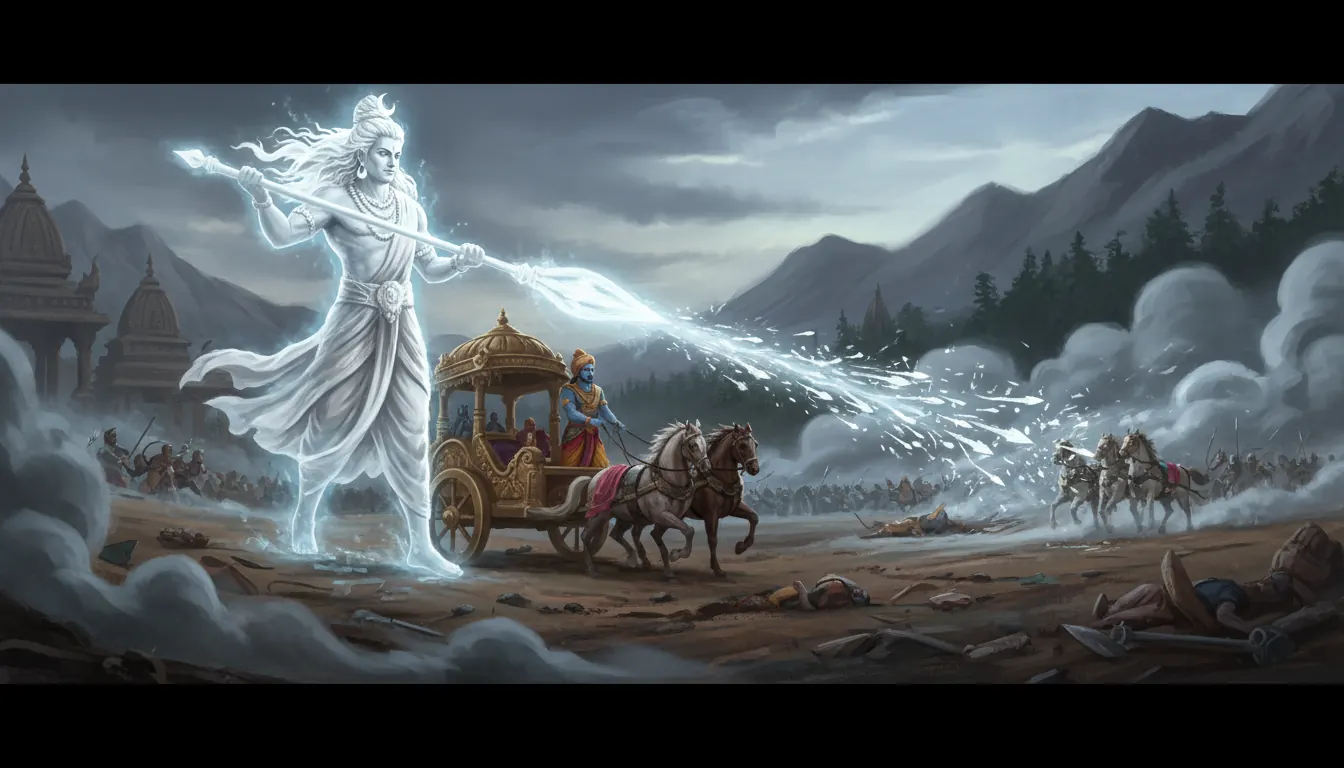
With Drona dead and the field quiet, Arjuna tells Vyasa about a figure he has seen for days: a blazing man with a lance, walking just ahead of his chariot without touching the ground, never throwing the lance, from which thousands of lances go out. Vyasa tells him it is Shankara and recounts the deeds of Mahadeva.
Told in the Drona ParvaSet in Kurukshetra and Mount Kailasa16 min read
The Field After the Teacher
"When Prishata's son had killed Drona, that Atiratha," Dhritarashtra said, "what did my sons and the Pandavas do next?"
"Nothing, king, for a while. That is the honest answer. The Kuru army had gone off the field in every direction at once and the Pandavas were standing in the middle of a plain with nobody in front of them and did not seem to know what to do with the quiet."
Somewhere out beyond the lines Bhima was still slapping his armpits. Arjuna had got down from his chariot and was standing on the ground, which he did not often do in the middle of a day, and he had not put the Gandiva down and he had not spoken to anybody.
And out of the smoke came an old man walking, in no hurry, the way he does. The son of Parashara went where he liked in that war and no arrow ever came near him. He had come there, they said afterwards, in the course of his wanderings.
Arjuna saw him and went straight over, and did not ask about Drona, and did not ask about the days to come, and did not ask any of the things a commander would ask.
He asked about something he had been seeing for a week and had told nobody.
It is worth saying what he had done in that week, king, so that you know what kind of man was asking. He had cut a road three yojanas deep through the array your teacher built on the day of Jayadratha's slaughter, which the Charanas in the sky called the last muster of its kind on earth. He had killed the Sindhu king inside a false dusk. He had fought all through the night that followed and through the whole of the next day. The bards on both sides had already begun making the songs. And the man in the middle of the songs walked up to an old ascetic on a burnt field and said, in effect, that he did not think the work had been his.
A Person of Blazing Hue
"Great rishi. While I was killing the foe in battle with showers of bright arrows, I kept seeing before me, going on ahead of my chariot, a person of blazing hue, as bright as fire.
"He carried a lance and he held it up. Wherever he went with that raised lance, all the enemy warriors broke before him.
"In truth it was he who broke them. People thought the foe had been broken by me. Following in his track, I only destroyed those he had already destroyed.
"Holy one, tell me who that was: that greatest of beings, armed with a lance, equal to the sun himself in energy, whom I saw in this way.
"He did not touch the earth with his feet.
"Nor did he hurl his lance even once. By his energy alone, thousands of lances came out of that one lance he held."
Sanjaya said: consider what that man was actually saying, king, on the day his enemies had begun calling him the greatest bowman who ever lived. He was saying that he had spent a week following something through a broken army and finishing off men who were already finished. He had not told Krishna. He had not told his brothers. He had waited for somebody to come who could be asked, and had gone on shooting in the meantime.
You Have Seen Shankara
"You have seen Shankara," Vyasa said.
And then he stood there on that field, with the fires still going and the carts still coming, and told him who that is, in the manner of the old teaching, which does not summarise.
"That First cause, from which the Prajapatis have sprung. That mighty Being of great energy. He who is the embodiment of heaven and earth and sky. The Divine Lord, the protector of the universe, the great Master, the giver of boons, called also Isana. Seek the protection of that boon-giving Deity, that lord of the universe.
"He is called Mahadeva, the Supreme Soul, the one only Lord, with matted locks, the home of all that is auspicious. Three-eyed and mighty-armed, he is called Rudra, with his locks tied up in the shape of a crown and his body clothed in skins. He is Hara and Sthanu. He is Shambhu, self-born, the lord of all creatures, the origin of the Past and the Future and the Present. He is Yoga and the lord of Yoga. He is called Sarva. He is above everything. The Soul of knowledge, beyond the reach of knowledge, the highest of all knowledge, he is unknowable, and by his grace he gives his worshippers the boons they desire.
"And his companions, Partha, are celestial beings of many forms. Some are dwarfs. Some have matted locks and some are bald. Some have short necks, some large stomachs, some huge bodies, some long ears. All of them have deformed faces and mouths and legs and strange clothing. Such are the followers by whom that Supreme Deity, called Mahadeva, is worshipped.
"That same Shiva, with all his energy, goes on ahead of you out of kindness."
Who Else Could It Have Been
"Ask yourself the other question," Vyasa said, "since you have asked me this one.
"In that fierce battle, Partha, the one that made the very hair stand on end, who but the divine Maheshvara, that greatest of all bowmen, that Deity of divine form, could even dream of defeating that force, protected as it was by those great fighters and bowmen, Ashwatthama and Karna and Kripa?
"You went through it. You have been going through it for days. Did you at any point work out how?"
Arjuna did not answer.
"No one dares to stand before the warrior who has Maheshvara walking ahead of him. There is no being in the three worlds equal to him. At the very scent of the angry Mahadeva, foes in battle tremble and lose their senses and fall down in great numbers. That is why the gods in heaven adore him and bow to him.
"Bow down yourself, son of Kunti, to him who is peace. To Rudra of the blue throat, utterly subtle, of great radiance. To him called Kapardin, him who is terrible, him of the tawny eyes, him who gives boons. To that great ordainer of red locks and righteous conduct. To him who lives in the mountains, and wears the bark of trees, and whose arms are decked with ornaments of gold. To him who is the lord of all trees and of all cattle, to him whose body is shrouded with trees, to him who is the commander of the celestial hosts, to him who has the sacrificial ladle in his hand.
"To him who wields the bow. To him whose favourite weapon is the bow; who is himself the arrow sped by the bow; who is the bowstring and the bow; and who is the teacher of the use of the bow."
That last one, king, was said to an archer standing in his own dust on the day his teacher had died. I do not think it was said carelessly.
The Teeth of Pushan
"I will now tell you, according to my knowledge and as I have heard them, the divine deeds of Mahadeva of supreme wisdom.
"If Mahadeva becomes angry, neither gods nor asuras nor gandharvas nor rakshasas, even if they hide themselves in the deep oceans, can have peace.
"In ancient days, Daksha gathered everything needed for a sacrifice. Mahadeva destroyed that sacrifice in his anger. He was very stern on that occasion. He shot an arrow from his bow and roared terribly, and the gods were filled with anxiety and fear. When he grew angry and the Sacrifice in its embodied form fled, the gods were terrified at the twang of his bow and the sound of his palms. The gods and the asuras all fell down and submitted to him. All the waters swelled up in turmoil and the earth trembled. The mountains split. All the points of the compass and the nagas were stunned. The universe was wrapped in a thick darkness and could no longer be seen. The splendour of all the heavenly lights, the sun with them, was destroyed.
"Pushan was eating the sacrificial cake at the time. Smiling, Shankara went up to him and tore out his teeth.
"The gods humbled themselves and fled trembling. Once more he aimed at them a shower of blazing, sharp arrows like flames of fire mixed with smoke. Seeing that shower of arrows, all the gods bowed down to Maheshvara and gave Rudra a substantial share in sacrifices. In their fear they sought his protection. His anger gone, the great God then restored the sacrifice. The gods who had fled came back.
"They are afraid of Maheshvara to this day."
The Chariot He Rode Against the Three Cities
"Once the valiant asuras had three cities in heaven, each of them fine and large. One was made of iron, another of silver, the third of gold. The iron city belonged to Tarakaksha, the silver to Kamalaksha, and the golden one had Vidyunmalin for its lord. With all his weapons, Maghavat could make no impression on those cities.
"In their distress all the gods sought the protection of Rudra and said, 'These terrible dwellers of the triple city have received boons from Brahma. Filled with pride, they are tormenting the universe. No one but you can kill them. Kill these enemies of the gods, and the creatures slain in every sacrifice will then be yours.'
"He accepted, and then he built himself a chariot, Partha, and I want you to hear what it was made of, since you have been standing in one for fifteen days.
"He made the two mountains Gandhamadana and Vindhya its two poles. He made the earth with her oceans and forests his war chariot. He made Shesha, that prince of snakes, the axle. He made the moon and the sun the two wheels. He made Elapatra and Pushpadanta the two pins of the yoke. He made the Malaya mountains the yoke, and the great Takshaka the cord that tied the yoke to the poles, and the creatures around him the traces.
"He made the four Vedas his four horses. He made the supplementary Vedas the bits. He made Gayatri and Savitri the reins, and the syllable Om the whip, and Brahma the driver.
"And making the Mandara mountains the bow, and Vasuki the bowstring, and Vishnu his excellent arrow, and Agni the arrowhead, and Vayu the two wings of that arrow, and Yama the feathers in its tail, and lightning the whetstone, and Meru the standard, Shiva mounted that chariot, which was made of all the celestial forces, and set out to destroy the triple city.
"He had an array formed, named after himself. And then he stood unmoving for a thousand years.
"When the three cities came together in the sky, he pierced them with that terrible arrow of his, which had three knots. The danavas could not even look at it."
The Child on Parvati's Lap
"While the triple city was beginning to burn, the goddess came there to see the sight. She had a child on her lap: a child with a bald head and five clumps of hair on it.
"The goddess asked the gods who that child was.
"Shakra, out of ill will, tried to strike the child with his thunderbolt. The divine lord Mahadeva, for the child was none other, smiled and paralysed the angry Shakra's arm where it was.
"Then Shakra, with his arm hanging useless, went with all the gods to lord Brahma of unfading glory. They bowed their heads to him and said, with joined hands, 'Brahma, we saw some wonderful creature lying on Uma's lap in the form of a child, and we did not salute it. He has defeated us all. We want to ask you who he may be. That boy, without fighting at all, has defeated us all with the greatest ease, with Purandara at our head.'
"The Grandsire reflected for a moment and understood. And he said, 'That child is the divine Hara, the Lord of the whole universe, moving and unmoving. There is nothing higher than Maheshvara. That Being of boundless splendour whom you saw with Uma had taken the form of a child for Uma's sake. Let us all go to him. You did not recognise the master of the universe.'
"So they all went back, with the Grandsire, to that child bright as the morning sun, and Brahma adored him: 'You are Sacrifice. You are the support and refuge of the universe. This whole universe with its moving and unmoving creatures is pervaded by you. Lord of the past and the future, let Shakra, struck by your anger, have your grace.'
"Maheshvara was pleased. Wishing to show his grace, he laughed aloud. And the arm of Shakra, the wielder of the thunderbolt, was restored to its natural state."
Why He Is Called Each of the Things He Is Called
"I could not list all the attributes of that God even if I recited them without stopping for a thousand years, son of Pandu. But take the names, since names are what a man can carry away with him.
"Because he always protects the creatures of the universe, and plays with them, and is the lord of all creatures, he is called Pashupati.
"Because that God has many forms in the past, the future and the present, he is called Vahurupa.
"Because he possesses the worlds, he is called Sarva. Because his form is like smoke, he is called Dhurjjati. Because the Viswedevas are in him, he is called Vishvarupa.
"Because three goddesses adore him and turn to him, Firmament, Water and Earth, he is called Tryamvaka.
"Because he always increases every kind of wealth and wishes mankind well in all their acts, he is called Shiva.
"Because he protects this vast universe, he is called Mahadeva. Because he is great and ancient and is the source of life and of its continuance, he is called Sthanu. Because the rays of the sun and the moon that appear in the world are spoken of as the hair of the Three-eyed one, he is called Vyomakesa.
"Because he strikes Brahma and Indra and Varuna and Yama and Kubera and in the end destroys them, he is called Hara. Because he is the Past, the Future and the Present, and in fact everything in the universe, he is called Bhava.
"And because Maheshvara, with his two eyes closed in meditation, created by sheer force of will a third eye on his forehead, he is called the Three-eyed.
"Half his soul is fire and half is the moon. In his auspicious form he practises Brahmacharya. In his terrible form he devours everything. And because he burns, because he is fierce, because he has great prowess, and because he devours flesh and blood and marrow, he is called Rudra."
You Were Shown Him Once Before
"Such is the deity called Mahadeva, armed with Pinaka, whom you saw killing your foes ahead of your chariot."
And then Vyasa said the thing that made Arjuna sit down on the pole of his own chariot.
"You have seen him before, Partha. After you had vowed to kill the ruler of the Sindhus, Krishna showed you this God in your dream, sitting on the top of that greatest of mountains."
The night of the vow. The bed of kusa grass with the weapons laid round it. The mountain, and the errand, and the thing that had been given him there.
"It is he who gave you the weapons with which you killed the danavas. This glorious God goes ahead of you in battle."
So it had not been a favour done once and finished. The gift had walked in front of him every morning since, and he had gone on shooting behind it for a week thinking he was doing it himself, and the only reason he now knew otherwise was that he had happened to be standing on an empty field when a wanderer came past.
"That hymn approved by the Vedas, called the Sata-Rudriya, in honour of that God of gods, that excellent, famous, life-giving and sacred hymn, has now been explained to you. This hymn of four divisions, able to accomplish every aim, is sacred, destroys all sins, drives away all stains and kills all sorrows and all fears. The man who always listens to it defeats all his foes and is highly honoured in the realm of Rudra.
"Go and fight, son of Kunti. Defeat is not for you, that have Janardana on your side for your adviser and your protector."
And having spoken those words to Arjuna, king, the son of Parashara went away to the place he had come from, in no hurry, the way he does.
And Arjuna got back up into his chariot, and Krishna took the reins without asking what had been said, and the fifteenth day drew to its close.
He never mentioned it again, king, so far as anybody heard. He did not tell his brothers. He did not put it into any of the speeches he made afterwards, and when men praised him for the road he cut on the fourteenth day he let them, because there is no graceful way to stand in front of an army and explain that the breaking had been done by somebody walking a few paces ahead of you who never once put his feet down.
Dharma Lesson
The victories a person is proudest of may have been decided by something walking ahead of them that they never thought to ask about. Arjuna cut a road through an army for a week and then said plainly that he had only been finishing men who were already broken. Honest accounting of one's own success is itself a form of worship, and it is the question, not the credit, that brings the answer.