Four Faces and a Blue Throat
Uma asks her husband to account for himself
In short
Narada tells Krishna what the pilgrims saw on Himavat. Uma covers her husband's eyes for a joke, the world goes dark, a third eye opens and burns the mountain, and afterwards, before she asks about duty, she asks about him. Why four faces, why a bull, why the blue throat, why a burning ground for a home. He answers every one.
Told in the Anushasana ParvaSet in Himavat and Kurukshetra19 min read
The Fire Out of Krishna's Mouth
"I will describe the power of that great god who has a bull for his emblem," said Bhishma. "Listen as I tell you too of the doubt that filled the mind of Rudra's wife, and of Rudra himself."
Yudhishthira had asked for discourses fraught with wonder, and the grandsire went a long way round to reach one, because the story he wanted had been told in front of Krishna and had to be introduced by way of Krishna.
"Once the righteous Krishna kept a vow lasting twelve years. To see him after he had gone through the rite of initiation, there came to that place Narada and Parvata, and the Island-born Krishna, and Dhaumya, the greatest of silent reciters, and Devala, and Kashyapa, and Hastikasyapa, and many other rishis with their disciples. They were given the kind of hospitality offered to the gods alone, and they sat down on seats, some green, some the colour of gold, and some set with peacock plumes.
"Then, while they sat there conversing sweetly, the energy of Narayana rose in the form of fire from the fuel of that vow and issued out of the mouth of Krishna. It began to consume the mountain, with the trees and creepers and little plants, the birds and the deer and the beasts of prey and the reptiles, until the summit was empty of every living creature and its cries. Then that fire of mighty flames, once it had consumed everything, came back to Vishnu and touched his feet like an obedient disciple. And Krishna turned a kindly look on the mountain and brought it back to what it had been, flowering and full of birds.
"The ascetics sat there with their hair standing on end and their eyes blurred with tears, and Krishna asked them, with perfect courtesy, why they were amazed."
Tell Me Something Wonderful
"Krishna explained the fire to them," said Bhishma. "He had come to that mountain to obtain by penance a son who would be his equal in energy, and the Grandsire had told his soul that half the energy of the great god who has the bull for his emblem would be born as that son. The fire was that errand, going and returning.
"Then he asked the ascetics for payment.
"'Now I ask you to tell me something truly wonderful that you have heard of or seen on earth or in heaven. I long to taste the honey of the words that will fall from your lips. Anything I know already, or learn by my own inspiration, no longer seems wonderful to me. But anything told by pious people and heard from the good deserves to be received with respect and faith. Such accounts last on earth for a long time, as lasting as letters carved in rock.'
"That is a strange thing for the lord of the universe to say and I have thought about it often. He was telling them that what he knows by being what he is gives him no pleasure, and that a thing only becomes wonderful when a good man tells it to you. So the ascetics put their heads together and appointed one of their number to speak, and they chose the one who is always chosen.
"'Narada, you should describe in full, from the beginning, that wonderful and unimaginable thing that happened on the mountains of Himavat, which those of us who had gone there on our pilgrimage saw.'
"And Narada, that friend of Narayana, began the account of the conversation between Shankara and his wife Uma."
The Company on the Mountain
"Once," said Narada, "the lord of all the gods, whose emblem is the bull, practised severe penances on the sacred mountains of Himavat.
"He was not alone. He was surrounded by hundreds of ghostly beings, and if you wish to know what the household of that god looks like, here it is. Some of them were ugly and awkward, some were very handsome, and some looked most wonderful. Some had faces like a lion's, some like a tiger's, some like an elephant's. Some had faces like a jackal's, some like a leopard's, some like an ape's, some like a bull's. Some had faces like an owl's, some like a hawk's, some like those of many kinds of deer. There were Kinnaras with them, and Yakshas and Gandharvas and Rakshasas. It resounded with the beat of Mridangas and Panavas and the blare of conchs, and the ghostly tribes danced in joy, and the peacocks danced with them with their plumes outspread.
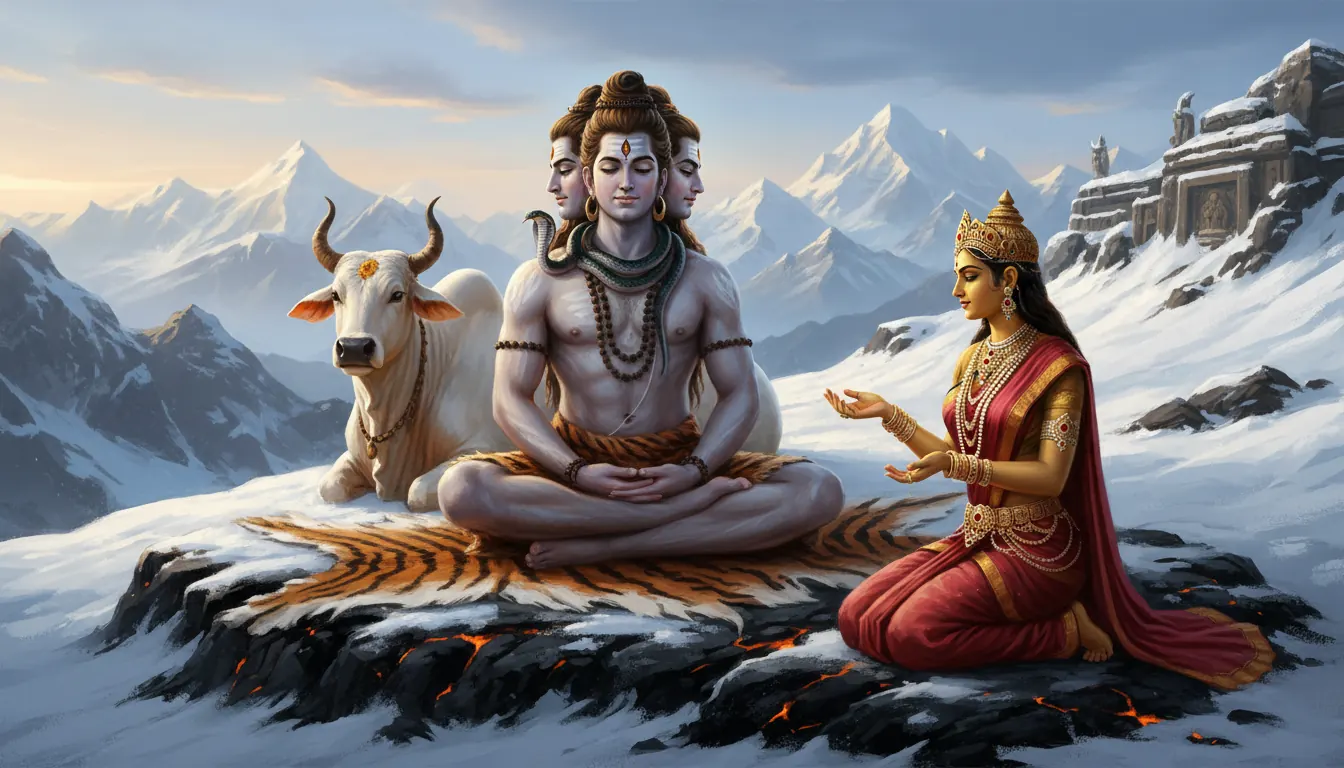
"And in the middle of all that noise sat the great god himself, on a peak adorned with fine minerals as if it were a splendid couch. Round his loins was a tiger-skin. A lion-skin was his upper garment. His sacred thread was a snake. His arms were decked with a pair of red Angadas. His beard was tawny. He had matted locks on his head. Terrible to look at, he is the one who fills the hearts of all the enemies of the gods with fear, and he is also the one who reassures all creatures by driving their fears away.
"The great rishis, seeing him, bowed until their heads touched the ground, and were cleansed of every sin by the sight. That is what we saw when we came up the path. And then his wife arrived, and everything that follows happened because she was in a good mood."
Two Hands Over His Eyes
"The daughter of Himavat came to her lord surrounded by the wives of the ghostly beings," said Narada. "She was dressed like her lord, and the vows she kept were like his. She held on her loins a jar filled with the waters of every Tirtha, and the presiding goddesses of all the mountain streams walked in her train, and she came on raining flowers and sweet perfumes on every side.
"And the beautiful Uma, smiling, wanting to play a joke, came up behind Mahadeva and covered his eyes with her two beautiful hands.
"It was a wife's joke. What it did was this. As soon as those eyes were covered, all the regions became dark and life seemed to be extinct everywhere in the universe. The Homa rites stopped. The universe was suddenly without the sacred Vashat. All living creatures became cheerless and filled with fear. When the eyes of the lord of all creatures were closed, the universe seemed to become sunless, and there was nothing playful about it anywhere except in the two hands that had done it.
"Then the darkness disappeared. A mighty, blazing flame of fire came out of Mahadeva's forehead, and a third eye, like another sun, appeared on it. That eye began to blaze like the Yuga-fire, and it began to consume that mountain.
"Himavat burned. The Was trees and the straight-trunked trees, the lovely sandal trees, the excellent medicinal herbs, the minerals, the summits, all of it went up, and the fire soared to the very heavens and covered every side like a dozen suns. The herds of deer and the other animals came running in fright to the place where Hara sat and sought his protection, and the retreat filled up with terrified creatures, and that is the sight I most remember: everything that could still move on that mountain running towards the god who was burning it, because there was nowhere safer.
"The large-eyed daughter of the prince of mountains bowed her head and stood before him with her hands joined. She could not bear to see her father in that state. And Sarva, seeing her overcome by a wave of womanly gentleness, turned kindly looks on the mountain, and in a moment the whole of Himavat was restored, and every tree on it was covered with flowers."
The Questions of the Daughter of the Mountain
"Then the faultless goddess spoke to her lord," said Narada.
"'Holy one, god armed with the trident, a great doubt has filled my mind. Why has this third eye appeared on your forehead? Why was the mountain burnt up with its woods and everything on it? And why have you restored the mountain to what it was? Once you had burnt it, why did you cover it with trees again?'
"'Faultless goddess,' said Maheshvara, 'because you thoughtlessly covered my eyes, the universe was left without light in a moment. When the universe was sunless and everything was dark, I created the third eye to protect all creatures. The great energy of that eye crushed and burnt up this mountain. But to please you, goddess, I repaired the harm and made Himavat what he was once more.'
"He had answered her, and she did not stop. This is the moment the whole story turns on, and it is easy to walk past it. A woman standing on a mountain that has just been burned and remade for her sake looks at her husband and realises that she has never once asked him about himself. So she asked. Not about duty, which is what everyone asks that god. About his face.
"'Holy one, why are your faces on the east, the north and the west so handsome and so pleasant to look at, like the moon itself? And why is your face on the south so terrible? Why are your matted locks so tawny and so erect? Why is your throat blue like a peacock's plumes? Why is the Pinaka always in your hand? Why are you always a brahmacharin with matted locks? Lord, you should explain all this to me. I am your wife, who tries to follow the same duties as you. And I am your devoted worshipper, god whose emblem is the bull.'
"And the wielder of Pinaka was very pleased with her, and said, 'Blessed lady, listen as I explain why my forms are as they are, and the reasons for each.'"
The Woman Assembled Out of Beauties
"'Long ago,' said the blessed and holy one, 'Brahman created a blessed woman called Tilottama by gathering grains of beauty from every beautiful thing in the universe.
"'One day that lovely-faced lady, whose beauty of form had no rival in the universe, came to me, goddess, to walk around me, but really driven by the wish to tempt me.
"'In whatever direction that lady of beautiful teeth turned, a new face of mine instantly appeared. That is how eager I was to see her. All those faces of mine became pleasant to look at. So, out of the desire to see her, I became four-faced by the power of Yoga. In becoming four-faced I showed my high Yoga-power.'
"He told it to his wife exactly like that," said Narada, "without softening it and without pretending it had been anything other than what it was. The most famous ascetic in the universe was walked around by a woman put together out of every lovely thing there is, and he could not bear to lose sight of her for the length of one circuit, and grew a face after her each time she passed out of view. Four faces, and a reason for each of them that any husband would rather not have given.
"But he did not leave them useless. Hear what he does with them now.
"'With my face that is turned to the east, I rule the universe. With my face that is turned to the north, I play with you, faultless one. My face that is turned to the west is pleasant and auspicious. With it I ordain the happiness of all creatures. My face that is turned to the south is terrible. With it I destroy all creatures.'
"Four faces, and one of them exists in order to look at her. That was the answer to why three are as handsome as the moon and one is dreadful. The dreadful one is pointed at the south, where the dead go, and it is doing necessary work, and it is not turned towards his wife."
The Thunderbolt at the Throat
"'I live as a brahmacharin with matted locks on my head,' said Mahadeva, 'out of the wish to do good to all creatures. The bow Pinaka is always in my hand to carry out the purposes of the gods.'
"Two answers in two lines," said Narada, "and both of them say the same thing, which is that neither the discipline nor the weapon is for himself. The locks are the mark of a man under vow, and he keeps the vow on behalf of creatures who do not know he is keeping it. The bow is kept strung because the gods will need it and not because he wants a war.
"Then he answered the question about his throat, and it is the shortest answer he gave and the ugliest thing in it.
"'Long ago, Indra, wanting my prosperity for himself, hurled his thunderbolt at me. That weapon scorched my throat. That is why I am blue-throated.'
"That is all. No battle described, no vengeance recorded, no curse laid on the king of the gods, who is still king of the gods and still receives his share. The most recognisable feature of the greatest of the deities, the blue throat that every child can name him by, is a burn scar, and the man who gave it to him did it out of envy of his prosperity and was allowed to walk away.
"Understand what the goddess was being told, one item at a time. The four faces are an old embarrassment. The matted hair is a vow undertaken for strangers. The bow is somebody else's errand. The throat is where Indra struck him. She had asked why her husband looked so strange, and every answer was a thing that had been done to him or for others, and not one of them was an ornament he had chosen."
The Froth From a Calf's Mouth
"'When there are so many fine and beautiful vehicles, greatest of all beings,' said Uma, 'why have you chosen a bull for your vehicle?'
"It is a wife's question and there is a little mockery in it. He rides a farm animal. The Regents of the world go about on elephants and horses and swans and he goes about on the thing that pulls a cart.
"'Long ago,' said Maheshvara, 'the Grandsire Brahma created the celestial cow Surabhi, who gave abundant milk. After she was created, a great number of cows sprang from her, all of them giving plenty of milk as sweet as nectar.
"'Once some froth fell on my body from the mouth of one of her calves. This enraged me, and my anger scorched all the cows, which then became many different colours. Then Brahma, Master of all the worlds, who knows every subject, calmed me. It was he who gave me this bull, both as a vehicle to carry me and as the emblem on my banner.'
"He does not defend the anger," said Narada. "He states it. A calf shook milk off its muzzle, some of it landed on him, and the herds of the world were burnt into every colour that cattle have worn since, which is why you will never find two of them alike in a field at dawn. And when he had been calmed, the one who calmed him did not fine him or curse him. He handed him a bull.
"That is worth sitting with. The answer to his scorching the cattle was to be given a bull to carry him, so that the god who lost his temper at a herd now cannot go anywhere in the universe except on the back of one of them, and cannot raise his standard in any battle without their shape flying over his head. He has ridden his own bad morning ever since."
Why He Will Not Leave the Burning Ground
"Then the goddess asked the question she had been working towards all along," said Narada, "and she did not spare him a single detail of it.
"'You have many homes in heaven, of many forms and with every comfort and luxury. Why, holy one, do you live in the cremation ground and leave all those delightful mansions behind? The cremation ground is full of the hair and bones of the dead, crowded with vultures and jackals, and strewn with hundreds of funeral pyres. Full of carrion and muddy with fat and blood, with entrails and bones strewn all over it, and always echoing with the howls of jackals, it is surely an unclean place.'
"She had lived in it with him. That is what gives the question its edge. She was not repeating a rumour, she was reciting an address.
"'I always wander over the whole earth looking for a sacred spot,' said Maheshvara. 'But I see no spot more sacred than the cremation ground. So of all homes, the cremation ground pleases my heart most, shaded as it usually is by banyan branches and adorned with torn garlands of flowers.
"'Sweetly smiling one, the hosts of ghostly beings who are my companions love to live in such places. I do not like, goddess, to live anywhere without those ghostly creatures by my side. So the cremation ground is a sacred home to me. Indeed, gracious lady, it seems to me heaven itself.'
"There is the answer, and there is the whole of him in it. He will not live in the palaces because his friends are not admitted to the palaces. The beings with the faces of owls and jackals and apes, who are welcome nowhere else in the universe, are welcome on the burning ground, and he will live where they can live. Every frightening thing about that god, when you get behind it and look, turns out to be a scar or a promise. The faces are an old shame. The throat is Indra's blow. The bull is a gift that calmed his anger. And the graveyard is loyalty."
And Then She Asked About Duty
"The catechism ended there," said Narada, "and the goddess turned back to the world.
"'Holy one, lord of all creatures, I have a great doubt. These ascetics have practised many kinds of austerities. In the world one sees ascetics wandering everywhere in many forms and wearing many kinds of dress. For the good of this great gathering of rishis, and of me, please settle this doubt of mine. What are said to be the marks of Religion or Duty?'
"And when the daughter of Himavat asked that question, the assembly of rishis there worshipped the goddess and praised her with words adorned with Riks and with hymns full of deep meaning. We had been sitting on that mountain the whole time. We had heard a god account for his own face to his wife, and we had said nothing, and now that she had turned the talk back to the duties of ordinary people we stood up and praised her, because we knew what she had done for us.
"'Not harming others, truthful speech, compassion for all beings, peace of soul, and giving gifts as far as one can,' said Maheshvara, 'are the first duties of the householder. Not lying with other men's wives, protecting the wealth and the woman placed in one's care, refusing to take what is not given, and avoiding honey and meat: these are the five chief duties. Indeed, Religion or Duty has many branches, and all of them are full of happiness.'
"And from there he went on to the four orders, and the householder and the mendicant, and the religion of the rishis, and all of that is another discourse and a long one."
Bhishma stopped there and let Yudhishthira have the point.
"You will hear men say that god is unapproachable and that his forms are not to be enquired into. She enquired into them. She covered his eyes for a joke, she watched her father's mountain burn and be put back, and then she asked her husband to account for himself item by item, and he did it, in order, without anger at her. There is no one in the three worlds who knows what those four faces are for except the woman who asked."
Dharma Lesson
The things that make a being look frightening from outside are usually scars and promises seen from the wrong side. The four faces are an old embarrassment, the blue throat is where Indra's thunderbolt struck, the bull is a gift given to calm his anger, and the burning ground is loyalty to companions welcome nowhere else. Only someone who loves a person enough to ask, item by item, ever learns which is which.