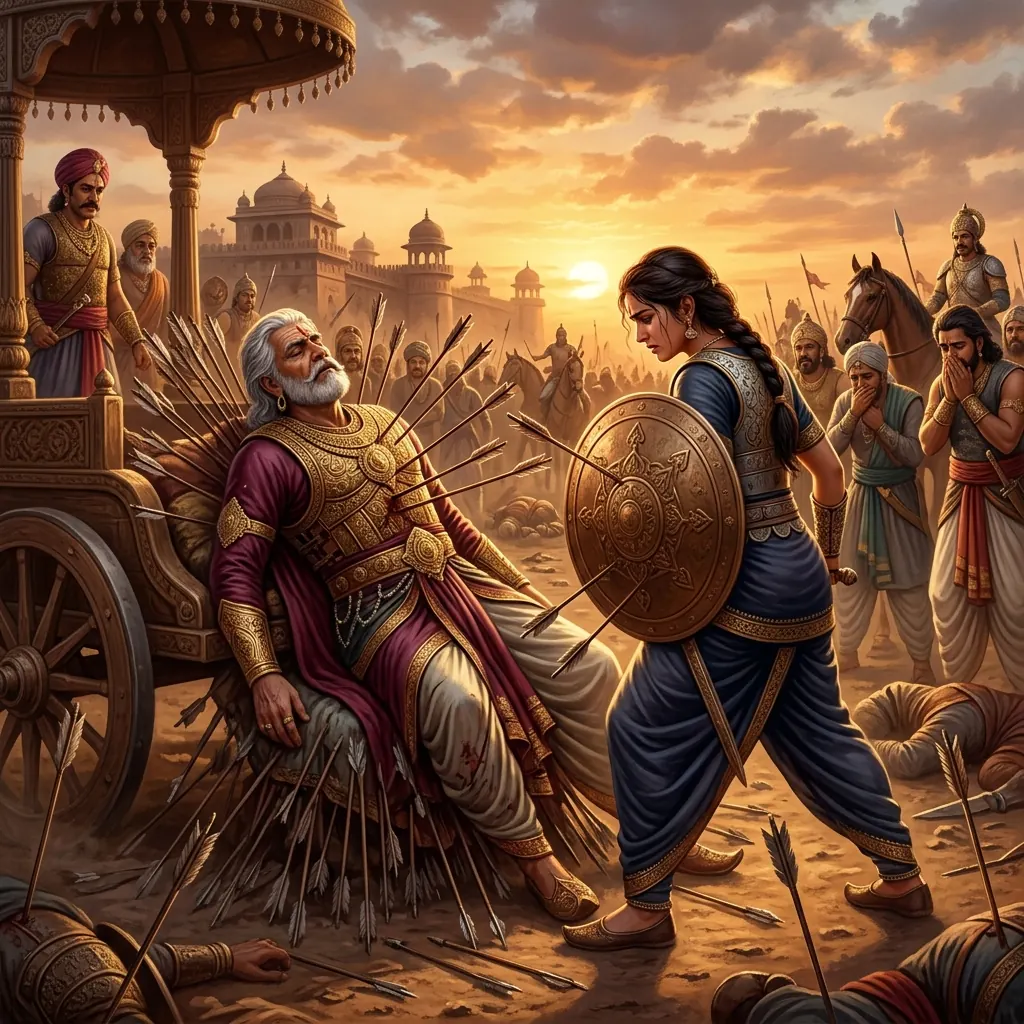
The Last Push on the Tenth Day
Tenth day: Bhishma asks Yudhishthira to kill him, and the champions of both armies pair off across the field while Dushasana alone stands between him and Arjuna
In short
On the morning of the tenth day Bhishma tells Yudhishthira to his face that he no longer wishes to protect his own body, and both armies close on him. Abhimanyu trades shafts with Duryodhana and then with Brihadbala of Kosala, Paurava and Dhrishtaketu cut each other down with swords and are carried off the field together, Bhima leaves the elephant corps lying like mountains, and Dhrishtadyumna's mace and iron dart both come apart in the air short of Drona. Behind all of it Dushasana fights Arjuna and shields the grandsire at the same time, and Shikhandi shoots at an old man who will not shoot back.
Told in the Bhishma ParvaSet in Kurukshetra and Kosala21 min read
Strive to Slay Me
When Sanjaya came to the tenth day, the blind king asked the question he had been circling since the war began.
"How, Sanjaya, did Shantanu's son Bhishma of mighty energy fight the Pandavas and the Srinjayas on the tenth day of battle? And how did the Kurus hold off the Pandavas? Describe to me the great battle Bhishma fought, that ornament of battle."
Day after day, Sanjaya said, the diadem-crowned Arjuna had sent mighty chariot-warriors to the other world, and day after day Bhishma, true to his vow, had made a great slaughter in the Partha host.
And then, after scorching the Pandava army for ten days, Bhishma of virtuous soul gave up all wish to protect his life. Wishing to be slain at the head of his troops, he thought: I will slay no more great warriors in large numbers.
He said it out loud, too, and he said it to the enemy. Seeing Yudhishthira near him on the field, he addressed him.
"Yudhishthira, you of great wisdom, who know every branch of learning, listen to the righteous words I speak, words that lead to heaven. Bharata, I no longer wish to protect this body of mine. I have spent a long time slaying large numbers of men in battle. If you wish to do what pleases me, strive to slay me, with Partha and the Panchalas and the Srinjayas at your front."
Yudhishthira understood that this was his intention. Dhrishtadyumna, son of Prishata and commander of the Pandava forces, heard the same words and urged the array on. And the king who had walked across this field before the first day to touch the old man's feet and ask his leave now gave the order.
"Advance! Fight! Defeat Bhishma in battle. You will all be protected by that conqueror of foes, Jishnu, whose aim never fails. And this great bowman, the commander of our forces, the son of Prishata, and Bhima too, will surely protect you. Srinjayas, have no fear of Bhishma in battle today. Without doubt we will defeat Bhishma today, with Shikhandi at our front."
The Pandavas advanced resolved to conquer or to go to heaven, with Shikhandi and Arjuna to the fore. From the other side, urged on by Duryodhana, many kings went towards Bhishma where he stood, with Drona and Drona's son and a large force, and the mighty Dushasana at the head of all his brothers born of the same mother.
One army was trying to reach him. The other was trying to stand in front of him. Nothing else happened on the tenth day that was not some version of those two things.
The Pairing of the Field
Before the dust closed over everything, Sanjaya was able to see who had gone against whom, and he named them in order, because for a little while that morning the whole enormous mess of the war resolved itself into a set of single combats.
Satyaki, the grandson of Shini, took Ashwatthama. Dhrishtaketu, the king of the Chedis, took the descendant of Puru, whom men called Paurava. Yudhamanyu, one of the two princes set to guard the wheels of Arjuna's chariot, went against Duryodhana at the head of his followers. Virata with all his Matsyas encountered Jayadratha, the ruler of the Sindhus, supported by his own troops. The heir of Vardhakshatra encountered Chitrasena, who was a son of Dhritarashtra and armed with an excellent bow. Yudhishthira himself proceeded against the mighty bowman Shalya, the ruler of the Madras. Bhimasena, well protected, went straight at the elephant division of the Kaurava army. Dhrishtadyumna, prince of Panchala, in a fury and with his brothers beside him, went against Drona, the greatest of all who wield weapons, invincible and irresistible.
And Prince Brihadbala, the ruler of the Kosalas, who bore a lion on his standard, went against Subhadra's son, whose standard bore the device of the Karnikara flower.
Duryodhana's brothers, accompanied by many kings, went against Shikhandi and Arjuna together, eager to kill them both.
Then the combatants of both armies rushed at each other with awful prowess and the earth shook under their tread. The divisions of the two hosts became mingled with one another. With the blare of conchs and the lion-like shouts of the soldiers the uproar became awful, and it was heard on all sides. The splendour of the bracelets and diadems of all those heroic kings, a splendour equal to that of the Sun or the Moon, was dimmed. The dust that rose looked like a cloud with the flash of bright weapons for its lightning, and the twang of bows and the whiz of arrows and the beat of drums and the rattle of chariots made the roar of those clouds.
Chariot-warriors felled chariot-warriors. Elephants killed elephants. Foot-soldiers slew foot-soldiers. The battle fought there for Bhishma's sake was like the battle between two hawks over a piece of flesh.
The Boy and the King
Abhimanyu, displaying his prowess for the sake of Bhishma, fought with Duryodhana, who was supported by a large force.
He was sixteen years old and he was fighting the king of the Kurus, and Sanjaya, who was watching for a blind man's sake, did not condescend to either of them in the telling.
Duryodhana, roused to wrath, struck Abhimanyu in the chest with nine straight arrows and then with three more. Arjuna's son, inflamed, hurled at Duryodhana's chariot a terrible dart like the rod of Death himself. It came at the king with great speed, and Duryodhana, who was a mighty chariot-warrior whatever else he was, cut it in two in the air with one broad-headed arrow of great sharpness.
Abhimanyu watched his dart drop on the earth in two pieces. Then, wrathful, he pierced Duryodhana with three shafts in the arms and the chest, and afterwards struck the Kuru king with ten fierce shafts in the centre of the chest.
The battle between those two, Sanjaya said, was fierce and absorbing to watch and pleasing to the senses, and it was applauded by all the kings on the field. He also said plainly what each of them was fighting for, and the two purposes did not match. Subhadra's son was fighting to bring about Bhishma's death. The bull of Kuru's race was fighting for Arjuna's defeat.
Not far from them, that bull among brahmanas, the son of Drona, roused to wrath, struck Satyaki in the chest with a fierce arrow. The grandson of Shini, a hero of immeasurable soul, struck the teacher's son in every vital limb with nine shafts winged with the feathers of the Kanka bird. Ashwatthama answered with nine, and then quickly with thirty more into the arms and chest. And that great bowman of the Satvata race, deeply pierced by Drona's son, pierced him back with arrows, and neither of them moved the other, and neither of them stopped.
Two Shields of a Hundred Moons
The longest duel of the morning was fought by two men whose names are barely known outside it.
Paurava was a descendant of Puru, the ancient king from whom the whole Kuru line takes its name, and he fought on Duryodhana's side. Dhrishtaketu was king of the Chedis, the son of that Shishupala whom Krishna had killed at Yudhishthira's sacrifice, and he had brought his father's kingdom over to the Pandavas. Both were mighty chariot-warriors and both were of gigantic stature.
Paurava covered Dhrishtaketu with his shafts and mangled that great bowman exceedingly. Dhrishtaketu, a man of great strength, quickly pierced him with thirty arrows. Then Paurava cut off Dhrishtaketu's bow and shouted aloud and pierced him with whetted shafts, and Dhrishtaketu took up another bow and put seventy-three sharp arrows into him.
After that they went through each other's equipment methodically. Each succeeded in cutting off the other's bow. Each slew the other's horses. Without their chariots, they came down onto the earth and met with swords.
Each of them took up a beautiful shield made of bull's hide, decked with a hundred moons and graced with a hundred stars. Each took up a polished sword of brilliant lustre. And so equipped they rushed at each other like two lions in a deep forest, both seeking the companionship of the same lioness in her season.
They wheeled in beautiful circles. They advanced and retreated and displayed the other movements of that art, each seeking an opening in the other, and for a while the war went on around two men doing something older and more formal than the war.
Then Paurava, in a rage, called out to Dhrishtaketu.
"Wait. Wait."
And struck him on the frontal bone with that large scimitar of his.
The king of the Chedis, in the same moment, struck Paurava on the shoulder-joint with his own large scimitar of sharp edge.
Those two scourges of their foes, having met and struck each other, both fell down on the field.
Jayatsena, a son of Dhritarashtra, took Paurava up onto his chariot and carried him out of the battle. And Sahadeva, the son of Madri, valiant and of great prowess, carried Dhrishtaketu away.
Neither man was dead. Neither man was in the war any longer that day.
The Lion and the Karnikara Flower
Elsewhere Chitrasena and Susharma had found each other. Chitrasena pierced the lord of the Trigartas with nine swift arrows, and then with sixty, and then with nine more. Susharma, roused to wrath, pierced Dhritarashtra's son with hundreds. Chitrasena answered with thirty straight shafts, and Susharma pierced him again, and that was the shape of it for a long time, two men who had nothing to settle except the war itself.
But the fight men remembered from that quarter of the field was the second one Abhimanyu fought.
Leaving Duryodhana, and adding to his fame and honour in that battle for the destruction of Bhishma, Subhadra's son took on Prince Brihadbala of Kosala. He fought him, Sanjaya said, putting forth his prowess for the aid of his father Partha, and then meant to go on towards Bhishma's front. The Kosala prince did not let him go on.
Brihadbala pierced Arjuna's son with five shafts made of iron, and then with twenty straight ones. Abhimanyu pierced the ruler of the Kosalas with nine shafts of iron and did not succeed in making him tremble, and so pierced him again with many more. Then Phalguni's son cut off Brihadbala's bow and struck him with thirty arrows winged with the feathers of the Kanka bird. Brihadbala took up another bow and angrily pierced the son of Phalguni with many arrows.
Both were in a rage. Both knew every mode of fighting. And Sanjaya, reaching for something to measure it against, went all the way back to the wars of the gods: the battle between those two, he said, was like the meeting of Vali and Vasava long ago, on the occasion of the battle between the gods and the asuras.
The lion on one standard and the Karnikara flower on the other stood over it while it went on. There was no result. Neither prince could break the other, and the boy who had wanted to get through to Bhishma's front did not get through, and both of them were still alive at the end of the tenth day, which is worth saying because Abhimanyu would kill Brihadbala on the thirteenth.
Bhima in the Elephants
Bhimasena had asked for the elephant division, and he got it.
Fighting against those beasts, Sanjaya said, he looked highly resplendent, like Shakra armed with the thunder after splitting large mountains. That is the image the text chooses and it is exact, because what Bhima did that morning was less like fighting than like weather.
Elephants huge as hills, slaughtered by Bhimasena, fell down in numbers on the field and filled the earth with their shrieks. They resembled massive heaps of antimony. Lying prostrate with their frontal globes split open, of mountain-like proportions, they seemed like mountains strewn over the earth's surface.
An elephant corps was the most expensive thing a king could put on a battlefield and the most frightening thing an infantryman could see coming, and one man on foot among them was reducing them to landscape.
While that was going on, the mighty bowman Yudhishthira, protected by a large force, pressed hard on Shalya, the ruler of the Madras, in that dreadful battle. Shalya, displaying his prowess for the sake of Bhishma, pressed the son of Dharma hard in return. This was the uncle of Nakula and Sahadeva, the man who had been tricked into the Kaurava army on the road to the war and who would drive Karna's chariot before the end, and Yudhishthira could not move him.
And the king of the Sindhus pierced Virata with nine straight, sharp arrows, and then struck him once more with thirty. Virata, the old lord of the Matsyas who had sheltered the Pandavas through their thirteenth year, was commanding a large division, and he struck Jayadratha in the centre of the chest with thirty shafts of keen point.
Sanjaya paused over those two long enough to describe them. The ruler of the Matsyas and the ruler of the Sindhus, both armed with beautiful bows and beautiful scimitars, both decked with handsome coats of mail and weapons and standards, and both of beautiful forms, looked resplendent in that battle.
He had been watching men die since sunrise and he still noticed that two of them were magnificent to look at.
The Mace and the Dart
Dhrishtadyumna had been born out of a fire for the purpose of killing Drona, and Drona knew it, and on the tenth day the prince of the Panchalas came at him with his brothers behind him.
Drona encountered him and fought fiercely with his straight shafts. Then he cut off the large bow of Prishata's son and pierced him deeply with fifty arrows.
That is how the exchange opened, and it never really improved. Dhrishtadyumna took up another bow and sped many arrows at Drona, who was contending with him. Drona cut off all of those arrows, striking each one with his own, and then sped five fierce shafts at Drupada's son.
So Dhrishtadyumna stopped shooting.
Excited with rage, he hurled at Drona a mace resembling the rod of Death himself. It was decked with gold and it came impetuously, and Drona checked it with fifty arrows and the mace fell to the earth in fragments, cut apart in the air by shafts from a bow.
When he saw his mace checked, the son of Prishata hurled a fine dart made wholly of iron.
Drona cut that dart with nine arrows, and then struck that great bowman with the rest.
There is a whole life in that sequence. The man was made to kill this teacher and he could not get anything through to him: not arrows, not the mace, not the iron dart. Everything he threw came apart in the air short of the target and fell down between them. And it would stay that way for five more days, until Drona sat down on the floor of his chariot and took his hands off his weapons, and then Dhrishtadyumna would need no bow at all.
Thus took place, Sanjaya said, that fierce and awful battle between Drona and the son of Prishata, for the sake of Bhishma.
Everything was for the sake of Bhishma that day, including the duels that had nothing to do with him.
The Fire-Chamber
Arjuna got at the son of Ganga at last and struck him with many sharp arrows, rushing at him as one infuriated elephant in a forest rushes upon another.
King Bhagadatta of Pragjyotisha, of great prowess, put his elephant across the path and checked Arjuna's course with showers of arrows. Arjuna pierced the beast with many polished arrows of iron, bright as silver and keenly pointed, and then, without finishing the quarrel, called out to the man ahead of him.
"Go on, go on towards Bhishma, and slay him!"
Shikhandi went. The ruler of the Pragjyotishas, seeing that this was no longer the fight that mattered, abandoned Arjuna and drove off against Drupada's chariot. And Arjuna went on towards Bhishma, with Shikhandi ahead of him, while all the brave combatants of the Kaurava army rushed at him with great vigour and loud shouts. Like the wind dispersing masses of summer cloud, Arjuna dispersed them.
Shikhandi came up to the grandsire of the Bharatas without any anxiety and pierced him with a great many arrows.
And Bhishma, that morning, was burning.
His chariot was his fire-chamber. His bow was the flame of that fire. Swords and darts and maces were the fuel of it, and the showers of arrows he shot were the blazing sparks with which he was consuming kshatriyas. As a raging conflagration with a constant supply of fuel wanders among masses of dry grass when the wind is behind it, so Bhishma blazed up, scattering his celestial weapons.
He slew the Somakas who followed Arjuna. He felled chariot-warriors, and horses along with their riders, and he made large bodies of chariots look like forests of palmyras stripped of their leafy heads. Hearing the twang of his bow and the slap of his palms, both like the roll of thunder, the troops trembled all over the field. His arrows were never wasted. They never fell after merely touching a body; they went through.
Fourteen thousand great chariot-warriors of noble birth, brave men who never retreated, with standards decked with gold, from the Chedis, the Kashis and the Karushas, came at him that day and were sent to the other world with their horses and chariots and elephants. There was not one great chariot-warrior among the Somakas who came near Bhishma and came away with his life.
Two men on that field went towards him anyway. Arjuna with his white horses and Krishna for his charioteer, and Shikhandi, prince of Panchala, of immeasurable energy.
The Look He Gave Shikhandi
Shikhandi, approaching Bhishma, struck him in the centre of the chest with ten broad-headed arrows.
The son of Ganga only looked at him. He looked at the Panchala prince with wrath, as if to burn him up with that look, and remembering that he had been born a woman, he did not strike him, in full sight of everyone.
Shikhandi did not understand it. That is the detail the text insists on and it is the cruellest thing in the day: the man who had been born for this one purpose, out of one life into another, did not know why the arrows were not coming back.
Arjuna understood it perfectly and used it.
"Rush in quickly and slay the grandsire. What need is there to say more, hero? Slay the mighty chariot-warrior Bhishma. I see no other warrior in Yudhishthira's army able to fight Bhishma in battle except you, tiger among men. I say this truly."
So Shikhandi covered the grandsire with every kind of weapon, and Bhishma ignored those arrows entirely and used his own to hold back the angry Arjuna alone, and went on sending the rest of the Pandava army to the other world at the same time. Surrounded on all sides, that Bharata hero consumed brave warriors like a conflagration in a forest consuming numberless trees.
And then Dushasana did the one thing anybody ever praised him for.
The prowess of that son of Dhritarashtra was wonderful, Sanjaya said, for he fought Partha and protected the grandsire at the same time. Everyone there was delighted with that feat. Alone he fought with all the Pandavas, Arjuna among them, and he fought with such vigour that the Pandavas were unable to resist him. Dushasana stripped many chariot-warriors of their chariots. Many mighty bowmen on horseback and many elephants, pierced by his keen arrows, fell down on the earth, and many elephants he wounded ran away in all directions. As a fire blazes forth with bright flames when it is fed, so did he blaze, consuming the Pandava host.
No chariot-warrior of that host dared even to go against him except Arjuna.
And Shikhandi kept shooting at an old man who would not shoot back, and the arrows whose touch was like the bolts of heaven and whose points were as fatal as snake venom caused Bhishma little pain. He took them laughing, as a man suffering from the heat gladly takes torrents of rain.
The Weapon He Put Away
Duryodhana rode along his own line and told his men what they were standing behind.
"Rush at Phalguni from all sides. Bhishma, who knows the duties of a commander, will protect you. With his tall standard bearing the golden palmyra, Bhishma stands there, protecting the honour and the armour of all the Dhartarashtra warriors. The gods themselves, striving with all their might, cannot defeat the illustrious and mighty Bhishma. What need is there to speak of the Parthas, who are mortal? So, warriors, do not flee from the field because you have Phalguni for a foe. I myself will fight the Pandavas today with all my might, together with all of you, lords of the earth."
They believed him. In a rage, fighters of the Videhas and the Kalingas and the many tribes of the Daserkas fell upon Arjuna, and after them the Nishadas, the Sauviras, the Bahlikas, the Daradas, the Malavas, the Surasenas, the Sivis, the Vasatis, the Shalvas, the Sakas, the Trigartas, the Ambashthas and the Kekayas, like flights of insects upon a fire.
Arjuna called to mind many celestial weapons and aimed them at the great chariot-warriors at the heads of those divisions, and consumed them all. While he was creating thousands upon thousands of arrows, Gandiva shone brilliantly in the sky. Those kshatriyas, with their tall standards torn and overthrown, could not approach the ape-bannered one even together, and the earth was soon covered on all sides with retreating troops.
Then he turned on Dushasana. The arrows went through him, iron-headed, and entered the earth behind him like snakes going into ant-hills. Arjuna slew his horses and felled his charioteer. With twenty arrows he stripped Vivingsati of his chariot and struck him with five more, and piercing Kripa and Vikarna and Shalya with arrows made wholly of iron he took the chariots from all of them. Kripa and Shalya and Dushasana and Vikarna and Vivingsati fled.
It was still only the forenoon. Partha blazed in that battle like a smokeless conflagration, and made a river of bloody current flow between the two hosts, and the field was strewn with princes falling and fallen, decked in their ear-rings and bracelets, and dogs and crows and vultures and jackals set up loud howls at the sight of the food before them.
Then Bhishma invoked a celestial weapon and rushed at the son of Kunti in the sight of all the bowmen.
And Shikhandi, clad in mail, put himself in front of it.
Bhishma withdrew the weapon. Its brilliance went out like a lamp, and the old man stood there with his hands empty of it, and while he stood there Arjuna went on slaughtering the troops behind him.
Dharma Lesson
Bhishma had already given his life away before the tenth day began, and told the enemy king so, and then went on killing fourteen thousand men because he had not yet been relieved of the duty of fighting. Every duel in this stretch of the war was fought for his sake by men who did not know that the stake had already conceded. That is what an oath does when it outlives the reason for it: it keeps a good man useful to a cause he no longer believes in, and the only person who can end the arrangement is the one it is destroying.