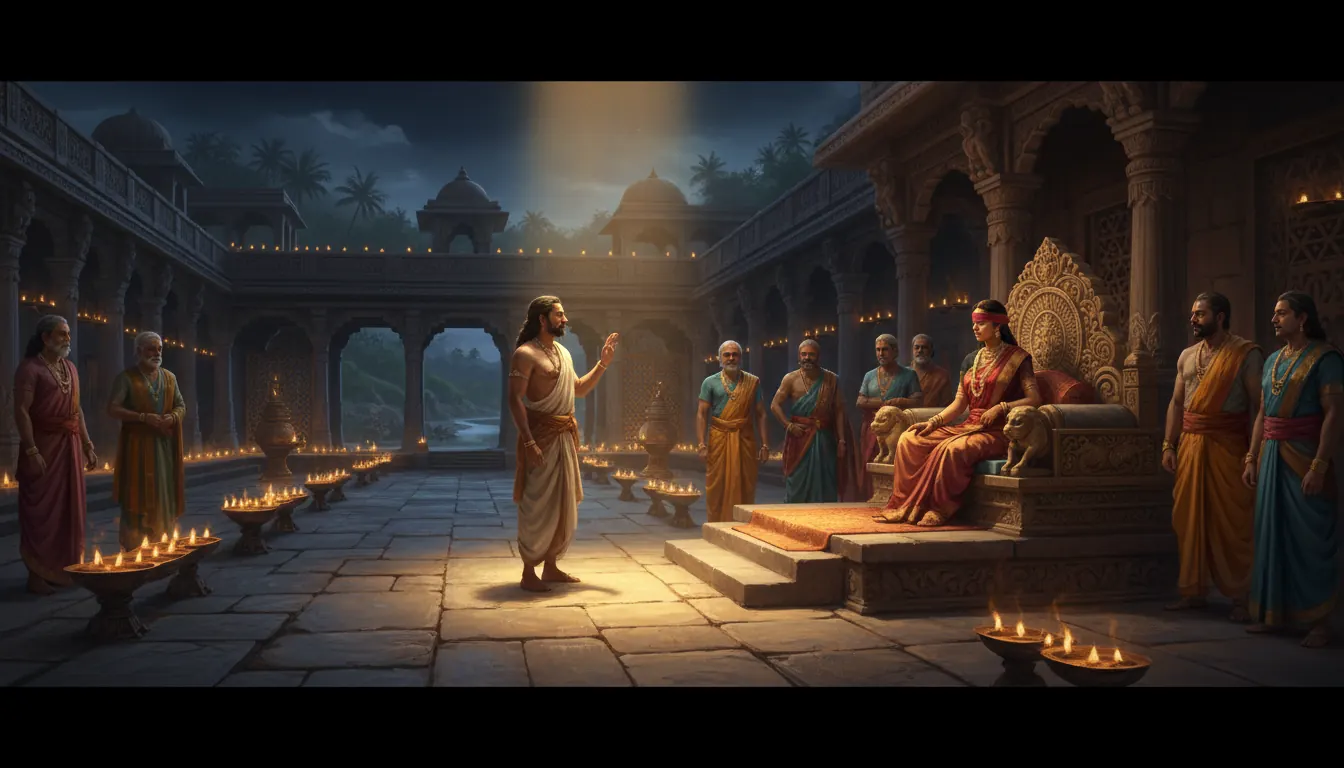
Sanjaya Describes the Earth
The blind king asks what the earth is worth, and his charioteer answers with the whole of it
In short
After Vyasa leaves the hall, Dhritarashtra asks Sanjaya what the earth is, since millions of men are about to die for a piece of it. Sanjaya sets out the five elements and the nineteen classes of creatures, then the island of Sudarshana that men see in the face of the moon, the six ranges and the golden mountain Meru, the Northern Kurus with their milk-yielding trees, Bhadraswa and the great Jamvu tree, and the far Varshas of Romanaka, Hiranmaya and Airavata where the sun gives no heat. The account ends with Hari on his eight-wheeled chariot north of the milky ocean, and with the blind king thinking about his sons.
Told in the Bhishma ParvaSet in Hastinapura, Mount Meru and Uttarakuru23 min read
The Question After Vyasa Left
Vaishampayana said that when Vyasa had finished speaking of the omens and the signs by which victorious armies may be known, he took his departure, and the hall at Hastinapura was left with an old blind king in it and nothing more to be said.
Dhritarashtra reflected in silence. It was only a short space of time, and then he began to sigh, and went on sighing, and at last he turned to the man who sat beside his chair and told him things.
Sanjaya was the son of a suta, a charioteer by birth and a counsellor by use, and Vyasa had given him the celestial eye, so that whatever happened on the field at Kurukshetra he would see it from where he sat and be able to report it. He had not yet had to use the gift. The armies were still assembling.
"Sanjaya," the king said, "these kings, these lords of the earth, so brave and so delighted by battle, are set on striking one another down with weapons of every kind, ready to lay down their very lives for the earth. Nothing can restrain them, and they are striking one another down to swell the population of Yama's realm. Longing for the prosperity that comes with owning the earth, they cannot bear one another."
Then he asked the question that a blind man might be forgiven for asking, and that nobody with eyes ever thinks to ask at all.
"So I think the earth must have many great qualities. Tell me all of them, Sanjaya. Many thousands, many millions, many tens of millions, many hundreds of millions of heroic men have come together at Kurujangala. I want to hear, in accurate detail, where the countries and cities they have come from lie and how large they are. Through the power of that twice-born rishi Vyasa, whose energy has no measure, you have the lamp of divine sight and the eye of knowledge."
He wanted to know what the thing was worth. Not the war, the ground. His sons and his nephews were about to kill one another over the earth, and he had never once been told what the earth was.
"Wise king," Sanjaya said, "I will tell you the merits of the earth as far as I know them. See them with your eye of wisdom."
Nineteen Kinds of Living Thing
He began not with countries but with what stands on them.
"Creatures in this world are of two kinds, mobile and immobile."
The mobile ones are of three kinds according to their birth. There are the oviparous, that come out of eggs. There are the viviparous, that are born from the body of the mother. And there are those engendered by heat and damp, which is where the epic puts the insects and the small crawling life that seems to rise out of wet ground without any parent at all. Of these three, the viviparous are the highest, and among the viviparous the highest are men and animals.
Then Sanjaya counted the animals, because they can be counted.
"Animals of many forms are of fourteen species. Seven live in the woods, and seven are domestic."
The seven wild are lions, tigers, boars, buffaloes, elephants, bears and apes. The seven domestic are cows, goats, sheep, men, horses, mules and asses. Man is on the second list, between sheep and horses. It is the list the Vedas use, and the list on which the sacrifices rest, and a creature has to be on it to be part of that machinery at all.
"Among domestic creatures, men are the highest, while lions are the highest of those that live in the woods. All creatures sustain their lives by living on one another."
The immobile are the vegetables, of five species: trees, shrubs, creepers, creeping plants that exist for only a year, and all the stemless plants of the grass kind.
Then he did the arithmetic that gives the whole passage its point. Of mobile and immobile creatures there are thus one less than twenty classes, that is to say nineteen. Add the five universal constituents out of which every one of them is made, and the sum is twenty-four.
"Twenty-four in all, these are described as the Gayatri, as is well known to all. He who truly knows these to be the sacred Gayatri, rich in every virtue, cannot be destroyed in this world."
The holiest verse in the Vedas has twenty-four syllables. Sanjaya had just counted the world out and got the same number, and then he told the king what followed from it.
"Everything springs from the earth, and everything, when it is destroyed, returns into the earth. The earth is the support and refuge of all creatures, and the earth is eternal. Whoever has the earth has the entire universe with all its moving and unmoving beings. That is why kings, longing to possess the earth, kill one another."
Five Elements and the Wheel in the Moon
"Tell me in detail, Sanjaya, the names of the rivers and mountains, and of the provinces, and of all the other things that rest on the earth, and their dimensions."
Sanjaya began further back than that.
"Because the five elements are present in them, the wise have said that all things in the universe are equal. These elements are space, air, fire, water and earth. Their respective attributes are sound, touch, vision, taste and scent."
The order matters, because each element carries not only its own attribute but the attributes of every element before it in the list. Space has sound alone. Air has sound and touch. Fire has sound, touch and vision. Water has four, and lacks only scent. And earth, the last and the fullest, has all five, its own scent and the four it inherits, which is why the rishis who know the truth call it the greatest of them all.
"When the universe is all of one kind, they exist separately and independently. But when they leave their natural state and combine with one another, then creatures spring into life with bodies. It is never otherwise."
The elements are destroyed in order, each merging into the one before it, and they come into being the same way. Men try to measure their proportions by reasoning, and Sanjaya added a warning that he plainly meant.
"Matters that are beyond conception should never be worked out by reasoning. Whatever is above human nature is a mark of the inconceivable."
Then he named the place they were sitting in.
"Son of Kuru's line, I will describe to you the island called Sudarshana. This island is round, shaped like a wheel. It is covered with rivers and other waters, with mountains like masses of cloud, and with cities and many delightful provinces. It is full of trees laden with flowers and fruit, and with crops of every kind and other wealth. And it is surrounded on every side by the salt ocean."
And then the image that a blind man could hold.
"Just as a person can see his own face in a mirror, so the island called Sudarshana is seen in the disc of the moon. Two of its parts seem to be a peepul tree, while two others look like a large hare."
The dark markings on the moon are the shape of the land they were standing on. Everything outside the peepul and the hare and the deciduous plants that fringe them is water.
"I will describe the rest to you shortly. Listen now to what I describe in brief."
Six Mountains and the Mountain of Gold
"You have described the island properly in brief," the king said. "Tell us now how large the expanse of land is that lies in the part shaped like a hare. Then you may speak of the part that looks like the peepul tree."
So Sanjaya laid down the bones of the world, which are six ranges running east to west, each of them reaching from the eastern ocean to the western.
Himavat first. Then Hemakuta. Then that best of mountains called Nishadha. Then Nila, abounding with stones of lapis lazuli. Then Shveta, white as the moon. And Sringavat, composed of all kinds of metals. These six are always the resorts of Siddhas and Charanas, and the space lying between each of them measures a thousand yojanas, and in that space are many delightful kingdoms.
"And these divisions are called Varshas, Bharata. Creatures of many species live in all those kingdoms. This, the land where we are, is in the Varsha that is called after Bharata."
North of it is the Varsha called after Himavat. Beyond Hemakuta is Harivarsha. South of the Nila range and north of the Nishadha stands a mountain called Malyavat, also running east to west, and beyond Malyavat northwards is Gandhamadana.
Between those two lies the mountain that the whole account has been walking toward.
"Between these two is a globular mountain called Meru, made of gold. Bright as the morning sun, it is like fire without smoke. It is eighty-four thousand yojanas high, and its depth also is eighty-four yojanas. It stands bearing the worlds above, below and on every side."
Besides Meru are situated four islands: Bhadraswa, and Ketumala, and Jambudvipa which is otherwise called Bharata, and Uttara Kuru, which is the abode of persons who have achieved the merit of righteousness.
And then, in the middle of the measurements, Sanjaya put in a small story about a bird, and did not explain it.
The bird Sumukha, the son of Suparna, looked about him on Meru and saw that all the birds on that mountain were of golden plumage. Every one of them. There was no difference between the good birds, the middling birds and the bad ones, since gold covered all three alike. He reflected on this, and decided that he should leave the mountain.
He flew off it, out of a place where nothing could be told apart, and the sun and the moon and the Wind-god went on circling the golden peak behind him without noticing that he had gone.
Who Lives on Meru
The mountain is rich in heavenly fruits and flowers and covered all over with mansions of burnished gold, and Sanjaya named its residents in the order in which they would be named at a court.
There the gods, the Gandharvas, the Asuras and the Rakshasas, with the tribes of Apsaras, are always at play. There Brahman and Rudra and Shakra, the chief of the gods, gathered together and performed many kinds of sacrifices with plentiful gifts. Tumvuru and Narada and Viswavasu, and the Hahas and the Huhus, go there and worship the greatest of the gods with many hymns. The high-souled seven rishis, and Kashyapa the lord of creatures, come on every parva day, which is to say at the turning of every fortnight, as regularly as men go to market.
And upon the summit, Ushanas, otherwise called the Poet, sports with the Daityas, who are his disciples. The teacher of the Asuras keeps a summer school at the top of the world.
Then the accounting, which is the part of the passage a king would understand best.
"The jewels and gems that we see, and all the mountains rich in precious stones, come from Meru. The holy Kubera enjoys a fourth part of it. Of that wealth he gives only a sixteenth part to men."
Every gem in every crown in Hastinapura is a sixteenth of a fourth of one mountain.
On the northern side of Meru is a delightful and excellent forest of Karnikaras, covered with the flowers of every season and occupying a range of hills. There the glorious Pashupati himself, the creator of all things, surrounded by his heavenly attendants and with Uma beside him, takes his pleasure, bearing a chain of Karnikara flowers on his neck that reaches down to his feet, blazing with radiance, his three eyes resembling three risen suns.
"Siddhas who are truthful in speech, of excellent vows and austere penances, can see him. Maheshvara cannot be seen by people of wicked conduct."
And from the summit of that mountain, like a stream of milk, the sacred and auspicious Ganga, otherwise called Bhagirathi, adored by the most righteous, of universal form and immeasurable, issues out with a terrific noise and falls with impetuous force on the delightful lake of Chandramas. That lake is like an ocean, and Ganga made it herself by falling into it.
When she first leapt from the mountains no mountain could support her weight, and the bearer of Pinaka held her on his head for a hundred thousand years before he let her down.
The Ladder That Runs North
"On the western side of Meru is Ketumala, and there also is Jambukhanda. Both are great seats of humanity."
Sanjaya described those people the way a man describes a country he has been told about and does not expect to see. The measure of human life there is ten thousand years. The men are all of a golden complexion and the women are like Apsaras. All the residents are without sickness, without sorrow, and always cheerful, and the men born there shine like melted gold.
On the summits of Gandhamadana, Kubera the lord of the Guhyakas, with many Rakshasas and accompanied by tribes of Apsaras, passes his time in joy. Beside Gandhamadana are many smaller mountains and hills. There the measure of human life is eleven thousand years, the men are cheerful and have great energy and great strength, and the women are all of the complexion of the lotus and highly beautiful.
Beyond Nila is the Varsha called Shveta. Beyond Shveta is Hiranyaka. Beyond Hiranyaka is Airavata, covered with provinces.
"The last Varsha in the far north, and Bharata's Varsha in the far south, are both shaped like a bow."
Five Varshas lie in the middle, Shveta and Hiranyaka and Elavrita and Harivarsha and Haimavat, of which Elavrita exists in the very middle of all. Seven in all, with Airavata at one end and Bharata at the other, and between them a rule that Sanjaya stated plainly to a man whose whole quarrel was about a patch of the last one.
"Among these seven Varshas, each one surpasses the one just south of it in these qualities: the period of life, stature, health, righteousness, pleasure, and profit."
So the world is a staircase, and the six things men want most increase at every step of it going away from Kurujangala. Bharatavarsha, over which those millions had assembled, is the bottom stair. In these Varshas, Sanjaya added, creatures of diverse species live together, which is the one thing his own country could not manage.
"This is how Earth is covered with mountains."
Bindusaras and the Seven Rivers
"The huge mountains of Hemakuta are otherwise called Kailasa. There Vaishravana spends his time in joy with his Guhyakas."
Immediately to the north of Kailasa, near the mountains of Mainaka, there is a huge and beautiful mountain called Manimaya, with golden summits, and beside it a large, beautiful, crystal and delightful lake called Vindusaras, with golden sands along its beach.
Sanjaya slowed down there, because things had happened at that lake.
It was there that king Bhagiratha sat for many years, looking at the river that had come down because of him and was afterwards called by his name. Innumerable sacrificial stakes made of gems may be seen there, and a Chaitya tree made of gold. It was there that he of a thousand eyes and great fame won ascetic success by performing sacrifices. There the Lord of all creatures, the eternal creator of all the worlds, surrounded by his ghostly attendants, is adored. And there Nara and Narayana, Brahman, and Manu, and Sthanu as the fifth, are ever present.
"And there the heavenly stream Ganga, with her three currents, flowing out of the region of Brahman, first showed herself."
Then she divided. Seven streams came out of the one river: Vaswokasara, Nalini, the sin-cleansing Saraswati, Jamvunadi, Sita, Ganga, and Sindhu as the seventh. The Supreme Lord himself made the arrangement of that inconceivable and celestial stream, and on that spot sacrifices have been performed a thousand times over at the end of every Yuga, when creation begins again.
"As for the Saraswati, in some parts of her course she can be seen and in others she cannot. This heavenly sevenfold Ganga is known throughout the three worlds."
Then he told the king who keeps which mountain, briefly, the way a steward lists tenants. Rakshasas reside on Himavat. Guhyakas on Hemakuta. Serpents and Nagas on Nishadha, and ascetics on Gokarna. The Shveta mountains are the home of the gods and the Asuras. The Gandharvas always reside on Nishadha, and the twice-born rishis on Nila. The mountains of Sringavat also are regarded as the haunt of the gods.
"These, great king, are the seven Varshas of the world as they are divided. Creatures of every kind, moving and unmoving, are placed in all of them. Many kinds of prosperity, both from heaven and from human effort, are to be seen in them. They cannot be counted."
He had finished the hare. The two islands Naga-dwipa and Kashyapa-dwipa are its two ears, and the beautiful mountains of Maleya, whose rocks are like plates of copper, are another part of that same shape, and the whole of it is what men see when they look up at the moon.
The Northern Kurus
"Tell me in detail, wise Sanjaya, about the regions to the north and the east of Meru, and about the mountains of Malyavat."
"On the south of the Nila mountain and the northern side of Meru are the sacred Northern Kurus, which are the residence of the Siddhas."
The trees there bear sweet fruits and are always covered with fruits and flowers at once. All the flowers are fragrant and the fruits of excellent taste. Some of the trees yield fruit according to the will of the person plucking them. Others are called milk-yielding, and these always give milk, and the six different kinds of food, with the taste of Amrita itself. Those same trees yield cloth, and in their fruits are ornaments ready for the use of man.
The entire land abounds with fine golden sands. Parts of it have the radiance of the ruby or the diamond or the lapis lazuli. All the seasons there are agreeable, and nowhere does the ground become miry. The tanks are charming and delicious and full of crystal water.
Then Sanjaya described the people, and the description is unlike any other in his account.
"The men born there have fallen from the world of the gods. All are of pure birth and all are extremely handsome in appearance. There twins of opposite sexes are born, and the women resemble Apsaras in beauty."
They drink the milk of the milk-yielding trees, sweet as Amrita. The twins grow up equally, both equal in beauty, both alike in virtue, both equally dressed, and they grow up in love with one another like a pair of chakravakas, the birds that are never seen apart. The people of that country are free from illness and are always cheerful. They live eleven thousand years, and, said Sanjaya, they never abandon one another.
That is the whole of the marriage law of the Northern Kurus. No choosing, no bride price, no swayamvara, no dice, no cousins, no house of lac, no thirteen years in a forest. A man and a woman are born on the same day into the same fortune and stay together for the length of it.
And when they die, a class of birds called Bharunda, with sharp beaks and great strength, take them up and carry them off and throw them into caves in the mountains, so that there is no burning ground in that country either.
"I have now described the Northern Kurus to you briefly, king."
The Tree That Named the Land
"Now I will describe to you the eastern side of Meru, as is proper."
The foremost region there is called Bhadraswa, where there is a large forest of Bhadra-salas and a huge tree called Kalamra, a yojana in height, always graced with fruit and flowers together, and worshipped by the Siddhas and the Charanas. The men of Bhadraswa are all fair of complexion, with great energy and great strength. The women are of the complexion of lilies, white as the moon, their faces like the full moon, their bodies as cool as moonlight, and all of them accomplished in singing and dancing. Human life there lasts ten thousand years, and drinking the juice of the Kalamra they continue youthful for ever.
Then Sanjaya came to the tree that the whole island is named after.
"South of Nila and north of Nishadha there is a huge Jamvu tree that is eternal. Worshipped by the Siddhas and Charanas, that sacred tree grants every wish. This division has always been called Jambudvipa after that tree."
He gave its dimensions. A thousand and a hundred yojanas is the height of that prince of trees, which touches the very heavens. Two thousand five hundred cubits measure the circumference of a single fruit of it, and the fruit bursts when it is ripe. Falling upon the earth, these fruits make a loud noise, and then pour out a silvery juice on the ground.
That juice becomes a river. It runs circuitously round Meru and comes at last to the Northern Kurus, so that the people with the milk trees drink from it too.
"Whoever drinks the juice of that fruit finds peace of mind. He never feels thirst again. Old age never weakens those who drink it."
There also is produced a species of gold called Jamvunada, used for heavenly ornaments, brilliant, of the colour of the small red insect men call Indragopaka. The men born there have the complexion of the morning sun.
And on the summit of Malyavat is always seen the fire called Samvataka, which blazes forth at the end of the Yuga for the destruction of the universe. Malyavat measures a thousand and fifty yojanas, and the men born on it are of the complexion of gold, and are all fallen from the region of Brahman, and are utterers of Brahma. They undergo the severest of ascetic austerities and their vital seed is drawn up.
For the protection of creatures, all of them enter the sun. Sixty-six thousand of them go in advance of Aruna, surrounding the sun, and after being heated by his rays for sixty-six thousand years they pass into the disc of the moon.
The Varsha Where the Sun Gives No Heat
"Tell me truly, Sanjaya, the names of all the Varshas, and of all the mountains, and of all those that dwell on them."
"On the south of Shveta and the north of Nila is the Varsha called Romanaka."
The men born there are of white complexion, of good parentage and handsome features, and without enemies. Not victorious over enemies. Without any. They live eleven thousand five hundred years, ever of cheerful hearts.
"North of Shveta is the Varsha called Hiranmaya, where the river Hiranvati flows. There lives Garuda, the greatest of birds."
The people there are followers of the Yakshas, wealthy, handsome, of great strength and cheerful hearts, and they live eleven thousand five hundred years.
The mountains of Sringavat have three beautiful summits, one made of jewels and gems, another of all kinds of gems and adorned with mansions, where the self-luminous lady Sandili lives.
"North of Sringavat, reaching to the edge of the sea, is the Varsha called Airavata. And because this jewelled mountain is there, this Varsha surpasses all the others."
This is the top of the staircase, described by what it lacks.
The sun gives no heat there. Men are not subject to decay. The moon with the stars is the only source of light. The men born there have the radiance and complexion of the lotus, eyes like lotus petals, and its fragrance on them. Their eyes do not blink. They go without food. Their senses are under control, they have fallen from the region of the gods, and they are without sin of any kind. Thirteen thousand years is the measure of their lives.
And on the north of the milky ocean, the Lord Hari of boundless power dwells on his golden chariot with eight wheels, having the speed of the mind, its complexion that of fire.
"He is the Lord of all creatures. The universe merges into him when dissolution comes, and from him it comes forth again. He is the actor, and it is He that makes all others act. He is earth, water, space, air and fire, and fire is His mouth."
Dhritarashtra had asked what the earth was worth. He had been given seven Varshas, six ranges, a golden mountain, a tree eleven hundred yojanas high, and countries where nobody is sick and nobody has enemies. Then he sat and thought about his sons.
"Without doubt, son of a suta, it is Time that destroys the universe, and Time that creates everything again. Nothing here is eternal. It is Nara and Narayana, who know all things, who destroy all creatures. The gods speak of him as Vaikuntha, while men call him Vishnu."
Dharma Lesson
Dhritarashtra asks about the earth the way a man asks the price of a thing he has already decided to buy, and Sanjaya answers by making it enormous. Seven Varshas, six ranges from ocean to ocean, countries where men live thirteen thousand years and nobody has an enemy, and the strip of ground the two armies are standing on at the bottom of the whole staircase. The teaching is in the proportion. Everything springs from the earth and everything merges back into it, and the man who holds the earth holds the universe, which is exactly why kings kill each other for a field near Kurujangala and think they have taken hold of something.