The Lords of the Waters and the Treasures
Balarama walks the Saraswati past the fords where Varuna, Kubera, Indra and Surya won what they hold
In short
While the war goes on at Kurukshetra, Balarama walks up the Saraswati and is told at each ford what was won there. The celestials install Varuna as lord of all waters, Agni hides in the Shami wood from Bhrigu's curse, Kubera sits still until the treasures of the world come to him, Indra completes a hundred horse sacrifices and becomes Satakratu, Parashurama gives away the earth as a fee, and Surya sacrifices for the sovereignty of everything that shines. Between them stands Varuna's Rajasuya, a perfect sacrifice that ended in kshatriyas killing kshatriyas.
Told in the Shalya ParvaSet in Saraswati, Alaka and Yamuna17 min read
The Question After the War God
Janamejaya had just heard how the gods anointed Skanda their generalissimo, and he was not ready to let the narrator move on.
"This history I have heard from you, twice-born one, is truly wonderful," he said, "this detailed account of how Skanda was installed with all the proper rites. I feel cleansed by listening to it. My hair stands on end and my mind is glad. But I am curious about another matter. How did the gods install the Lord of the waters in that tirtha long ago? Tell me that, for you are very wise and skilled at telling."
Vaishampayana was answering him, and the thing he was answering out of was a journey. While the Kurus and the Pandavas were killing each other at Kurukshetra, Balarama, the elder brother of Krishna, the wielder of the plough, had refused to lift a weapon for either side and had gone up the Saraswati instead. He walked her banks from ford to ford with brahmanas beside him, bathing at each, giving away gold and cloth and cattle at each, and at every one of them the ascetics who lived there told him whose tirtha it was and what had been won on that spot.
That is the whole shape of these sections. A river, a man in white unguents with a garland of wild flowers, and at every bend of the water an older story about somebody who had been given an office, or had bought one with penance, or had paid for one with a sacrifice.
He had come from the tirtha of Skanda. The next ford was called Taijasa, and it was the place where Varuna had been made lord of all waters.
"Listen, king," said Vaishampayana, "to this wonderful history of what truly happened in an earlier Kalpa."
As Shakra Protects the Gods
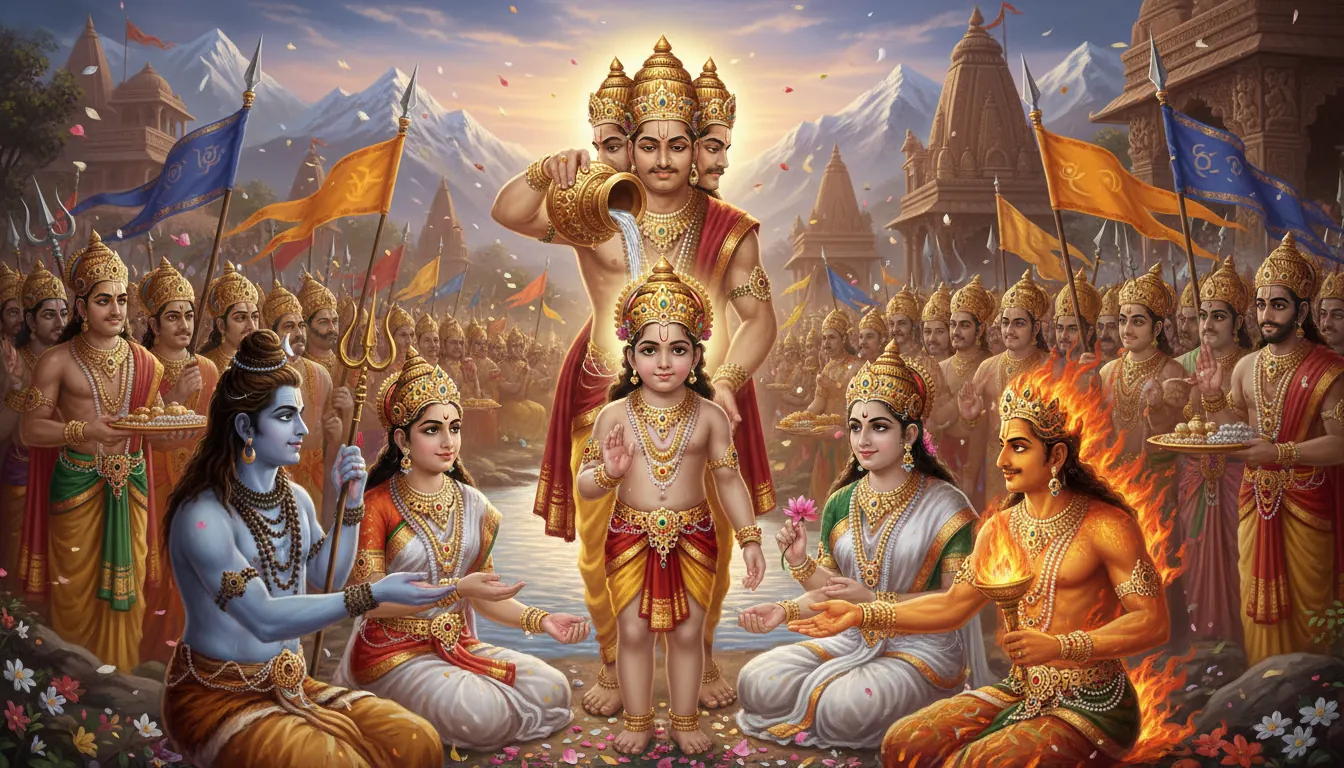
Long ago, in the Krita age, all the gods came to Varuna with due ceremony and said this to him.
"As Shakra, the Lord of the gods, always protects us from every fear, so you must be the Lord of all the rivers. You always live, god, in the Ocean, that home of makaras. This Ocean, the lord of rivers, will then be under your rule. And you will wax and wane with Soma."
It is worth reading the offer slowly, because it is an argument as much as a request. They did not tell him that he deserved the office or that he was the strongest of them. They told him where he already lived. He was in the sea already, among the makaras, in the water that every river runs down into, and the gods were proposing only that the fact be made into a title. And they attached a condition to it that was not a burden but a tether: he would rise and fall with Soma, the moon, so that the lord of the waters would never be a law to himself but would move with something outside him.
Varuna answered them, saying, "Let it be so."
That is the entire negotiation. All the gods then gathered and made Varuna, who lived in the ocean, the Lord of all the waters, by the rites laid down in the scriptures. When they had installed him as lord of all the creatures of the water and worshipped him duly, they went back to their own homes and left him to it.
And he did it. Installed by the gods, the illustrious Varuna began to protect seas and lakes and rivers and every other body of water as he should, exactly as Shakra protects the gods. The clause in their petition became his working description.
Baladeva, the slayer of Pralamba, bathed in that tirtha too and gave away many kinds of gifts, and then walked on to the ford called Agnitirtha, where the eater of clarified butter had once hidden himself inside a piece of wood.
The God Inside the Shami Wood
Agnitirtha is the spot where Agni, disappearing from view, became concealed within the entrails of the Shami wood, and the account of what that cost the world is given in the gods' own words.
When the light of all the worlds had gone out, the gods went to the Grandsire of the universe and said, "The holy Agni has disappeared. We do not know why. Do not let all creatures be destroyed. Create fire, mighty Lord."
Notice what they ask Brahma for. Not to find the missing god. To make another one. They had lost the fire and they were prepared to have a new fire manufactured rather than live one more day without it, which is the measure of what Agni is to a world that must cook and must sacrifice.
"For what reason did Agni, the Creator of all the worlds, disappear?" Janamejaya asked. "How also was he discovered by the gods? Tell me all this in detail."
Agni of great energy, said Vaishampayana, had become badly frightened by Bhrigu's curse. That was all. The carrier of every offering, the mouth by which the gods eat, had been cursed by a rishi and was afraid, and he went and got inside the entrails of the Shami wood and stayed there.
When he disappeared, all the gods led by Vasava searched for the missing god in great distress, and they found him. They saw him lying inside the entrails of the Shami wood. The gods, led by Brihaspati, were very glad to have found him, and then they went back to where they had come from.
They did not lift the curse. Nobody could. Agni, from Bhrigu's curse, became an eater of everything, precisely as Bhrigu, that utterer of Brahma, had said he would. He came out of hiding and went back to work as a god who would thereafter consume anything at all, clean or unclean, without distinction.
The Shami wood keeps the mark of it. That is the wood the fire is still churned out of.
Everything Came to Him of Its Own Accord
From there the wise Balarama went to Brahmayoni, where the holy Grandsire of all the worlds had done his work of creation, and where long ago the Lord Brahman and all the gods had bathed with the proper rites. He bathed, he gave away gifts of many kinds, and he went on to a tirtha called Kauvera.
That is the ford where Ailavila, the son of Visrava, whom the world calls Kubera, chief of the yakshas, sat down and practised the severest austerities and won lordship over all treasures.
The manner of it is the point. While he lived there doing his penances, every kind of wealth and every precious gem came to him of its own accord. He did not go and take them. He did not conquer a region and empty its vaults. He sat still in one place on the bank of a river doing something extremely difficult, and the wealth of the world walked in and presented itself, which is how the epic distinguishes a treasury that is earned from a treasury that is seized.
What he asked for, and got, was a list. The lordship of all treasures. The friendship of Rudra, whose energy has no measure. The status of a god, which he had not been born with. The regency over one particular point of the compass, the north. And a son named Nalakuvera.
The Maruts, those wind-gods who go in troops, came there and installed him duly in his sovereignty, and he received as his vehicle a well-fitted celestial chariot, as swift as thought, together with all the wealth of a god.
At that spot Rama saw the fine woods of Kubera, still standing round the place where the penance had been done. He bathed in the tirtha, gave much wealth to the brahmanas, and, anointed with white unguents, went on quickly to another ford, one crowded with all kinds of creatures, where the fruits of every season are always to be found and flowers and fruits of every kind are always abundant.
Its name was Vadarapachana, the place where the jujubes were cooked.
The Ford of the Jujubes
Ascetics and Siddhas lived there in great numbers, and the tirtha had its name from a pot of five jujubes.
Sruchavati, the daughter of Bharadwaja, had kept the vows of a brahmacharini at that spot for many years, unrivalled on earth for beauty, wanting the Lord of the celestials for a husband. Indra came to test her in the shape of the rishi Vasishtha, told her that everything is attainable by penances and that penances are the root of great happiness, set her to boil five jujubes, and went off to recite mantras at a ford nearby. The jujubes would not soften. Her fuel ran out with the fruit still hard. She fed her own feet into the fire, and did not change her face while they burned, and Agni himself consumed her limbs while she went on cooking because a rishi had told her to cook.
Indra showed himself, gave her heaven and his own company, and gave the place her boon: that this hermitage would become the greatest of tirthas in the world, able to cleanse every sin, and should be known by the name Vadarapachana.
It had already held one such contest. In that same spot the seven rishis once left Arundhati behind when they went to Himavat for fruits and roots, and a drought of twelve years fell. Mahadeva came to her as a brahmana and asked for alms, and she had nothing but jujubes, and he told her to cook them, and she cooked and listened to his discourses and fasted, and the twelve years went past her like a single day. He told the seven rishis to their faces that her merit was equal to theirs, and he granted her the boon that a man who fasts here and stays three nights will gain the fruit of a twelve-year fast. Indra later bettered even that for Sruchavati's sake: one night here, and a bath with the soul fixed, and realms of bliss that are hard to win by any other means.
The girl herself had been born out of a leaf cup. Bharadwaja's seed had fallen at the sight of the apsara Ghritachi, and he held it in his hand and kept it in a cup made of the leaves of a tree, and named the child who was born in it Sruchavati.
Balarama bathed there, gave away much wealth to the best of the brahmanas, and went with his soul fixed firmly in meditation to the tirtha of Sakta, and from there to the ford that carries Indra's own name.
A Hundred Horses and a New Name
The mighty chief of the Yadus went on to Indra's tirtha, bathed there with the proper rites, and gave away wealth and gems to the brahmanas. Then they told him what the ford was for.
There the chief of the celestials had performed a hundred horse sacrifices.
That is a sentence the epic uses often and rarely explains, so it is worth unfolding once. The horse sacrifice is the rite of a king who claims to have no equal; the animal wanders for a year with an army behind it, and every ruler whose ground it crosses must either let it pass or fight. To perform one is a career. Indra performed a hundred of them on that one spot, and gave away enormous wealth to Brihaspati, the teacher of the gods.
With the help of brahmanas versed in the Vedas, Shakra performed all those sacrifices there by the rites the scriptures lay down, and in those sacrifices nothing was stinted. Horses of every kind were brought there. The gifts to brahmanas were lavish. Nothing in them was done narrowly or cheaply or in the hope that some part of the cost might be avoided.
When he had duly completed those hundred sacrifices, Shakra of great splendour came to be called Satakratu, which is to say, He of the Hundred Rites.
It is the name he carries through the rest of the epic, and it is worth knowing where it came from. Indra is called many things for what he destroyed. He is the slayer of Vala, the chastiser of Paka, the wielder of the thunderbolt. This one title, among the names used most often of him, he did not get by killing anybody. He got it by paying for a hundred fires and giving the fee away.
That blessed and sacred tirtha, able to cleanse every sin, then came to be named after him as Indra-tirtha. Balarama bathed there with due rites, honoured the brahmanas with gifts of fine food and robes, and then went on to that other great tirtha which is named after Rama.
The Whole Earth as a Fee
The Rama in question was not the son of Dasaratha. It was Rama of Bhrigu's race, the axe-bearer, the son of Jamadagni, and the tirtha remembers what he did after the killing was over.
The greatly blessed Rama, rich in ascetic merit, repeatedly conquered the Earth and killed all the leading kshatriyas. Repeatedly is the word the text uses, and it is the whole indictment: he did not do it once in a rage, he did it again and again, going round the world and coming back to find that the order he had emptied had filled up again.
Then he came to this ford and performed a Vajapeya sacrifice and a hundred horse sacrifices, with the help of his teacher Kashyapa, that best of munis.
Read that against the ford he had just come from. Indra performed a hundred horse sacrifices and became Satakratu and kept his heaven. Parashurama performed as many, and the fee he paid at the end of them was the whole earth with her oceans, given to Kashyapa. He had taken the earth from the kshatriyas by force and he handed it entire to a brahmana as a sacrificial present, and after that he had no ground of his own to stand on. That is the arrangement under which the kshatriyas got the world back.
He was not finished giving. He bathed there with due rites, gave gifts to the brahmanas and honoured them, and gave many gifts of many kinds of gems, and cattle, and elephants, and female slaves, and sheep, and goats. And then, with nothing left that a man could be envied for, he retired into the woods.
Balarama bathed in that sacred and greatest of tirthas, the haunt of gods and twice-born rishis, duly honoured the ascetics living there, and proceeded to the tirtha called Yamuna, where an older sacrifice had ended very differently.
The Rajasuya That Started a War
Long ago Varuna, the radiant and greatly blessed son of Aditi, had performed the Rajasuya sacrifice in that tirtha.
This is the same Varuna the celestials had installed in the first of these fords, and by the time of this rite he was no longer a god who had been handed an office by his colleagues. The Rajasuya is the sacrifice of a paramount sovereign, and it cannot be performed by anyone who has not made everybody else acknowledge him first. Varuna had done that the hard way. After conquering men and gods and gandharvas and rakshasas in battle, that slayer of enemy heroes performed his grand sacrifice on the bank of that river.
Two battles hang off it, one at each end.
When that greatest of sacrifices began, a battle broke out between the gods and the danavas that filled the three worlds with terror. The rite had not been finished. It had only been begun, and the beginning of it was enough to set the two halves of heaven at each other.
And after that greatest of sacrifices, the Rajasuya of Varuna, was completed, a terrible battle broke out among the kshatriyas.
The text says it in one line and leaves it there, and the man walking the riverbank was in a position to hear it properly. Balarama had left Kurukshetra precisely because both the men fighting there were his pupils and he would not choose between them. He was being told, at a ford on the Saraswati, that a sacrifice of paramountcy had once been completed in good order, with every rite performed correctly and every fee paid, and that what came out of the far end of it was kshatriyas killing kshatriyas. Yudhishthira had performed the Rajasuya too, at Indraprastha, and the dice game had followed it, and then this.
The ever-generous and mighty Baladeva honoured the rishis there and gave many gifts to those who wanted them. Then, full of joy and praised by the great rishis, that hero, always decked with garlands of wild flowers, with eyes like lotus leaves, went on to the tirtha called Aditya.
The Ford Where the Sun Was Made Lord
There, in the last of these fords, the holy Surya of great splendour performed a sacrifice and won sovereignty over every shining body in the universe, and gained his great energy too.
Every other office on this stretch of the river had been granted by somebody. The gods went to Varuna and asked him to hold the waters. The Maruts installed Kubera in his lordship of treasures. Indra bought a name with a hundred fires and Rama of Bhrigu's race bought his peace with the earth itself. The sun's case is the plainest of all: he sacrificed, and he came out of it lord of everything in the sky that shines, and the light he is known by was part of what he was given. What burns overhead is not simply his by nature. It was won at a spot on a riverbank that a man could still walk up to and bathe in.
The crowd that lives at that ford is the proof of what it is worth. In that tirtha situated on the bank of that river, all the gods with Vasava at their head, the Viswedevas, the Maruts, the gandharvas, the apsaras, the Island-born Vyasa, Shuka his son, Krishna the slayer of Madhu, the yakshas, the rakshasas and the pisachas, and diverse others numbering by thousands, all crowned with ascetic success, always reside.
In that same blessed and sacred tirtha of the Saraswati, Vishnu himself had bathed long ago after killing the asuras Madhu and Kaitabha. The virtuous Island-born bathed there and gained great Yoga powers and high success. The rishi Asita-Devala, rich in ascetic merit, bathed in that very water with his soul rapt in deep Yoga meditation, and gained great Yoga powers too.
And Balarama, who could have been at Kurukshetra taking one side or the other, stood in the same water with his plough laid by, giving away what he had brought to give, at the ford where the sun had once had to earn the right to shine.
Dharma Lesson
Every office on this stretch of the river was received rather than seized. Varuna was asked, and tied to the moon so that he would never be a law to himself. Kubera sat still and the wealth of the world walked in. Indra earned one of his best-known names not by killing anything but by paying for a hundred fires and giving the fee away, and Parashurama, who had taken the earth by force, could only be quit of it by handing it over entire. Set against them is Varuna's flawless Rajasuya, which broke into war at both ends: a rite performed perfectly can still leave men fighting, and Balarama, walking away from a battlefield where his own pupils stood on opposite sides, was in the right place to hear it.