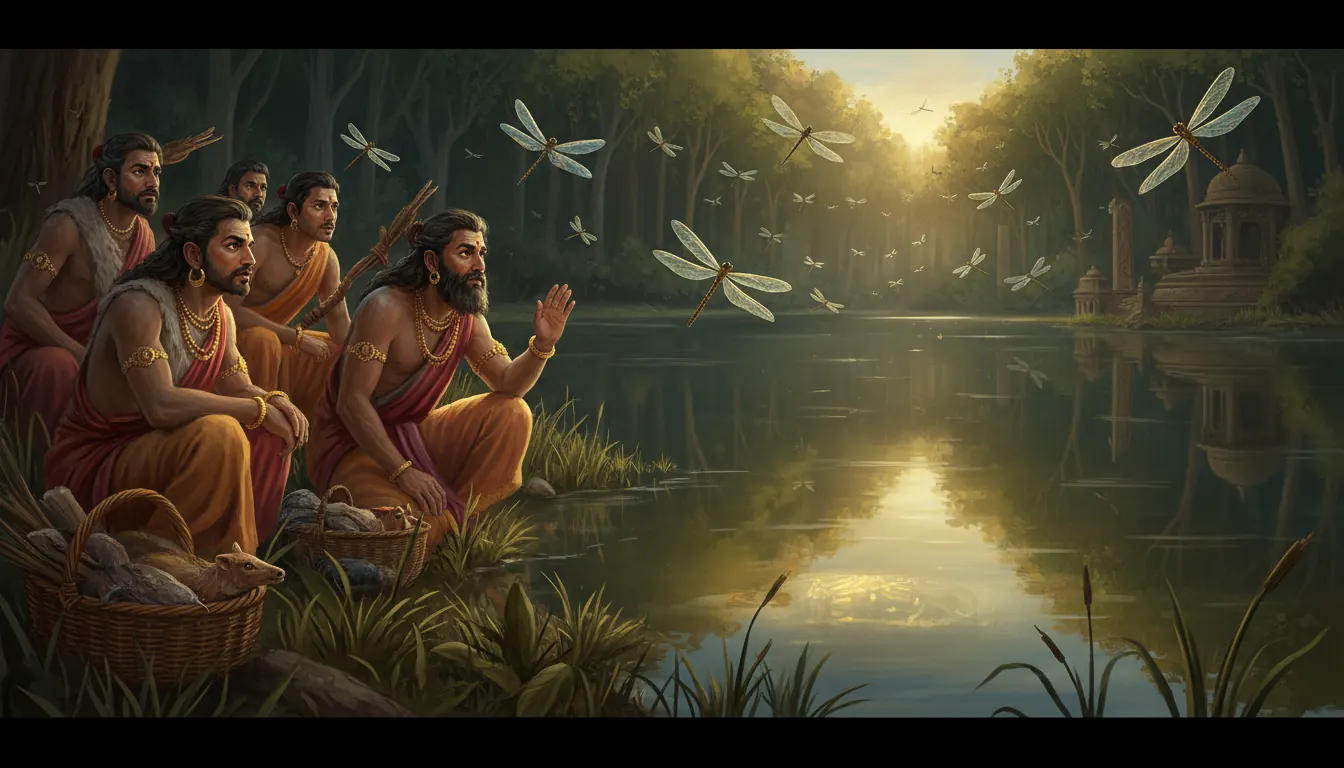
The Flight of the Royal Ladies
The last of the eleven armies dies, Duryodhana walks into a lake, and the Kaurava camp runs for Hastinapura
In short
On the evening of the eighteenth day the remnant of the Kaurava host is exterminated in a moment for want of anyone to lead it, and Duryodhana, wounded and alone, abandons his dead horse and walks east with his mace to the Dvaipayana lake. Sanjaya is captured, condemned by Dhrishtadyumna, and saved by Vyasa, and on the road to the city he meets the king for the last time. Behind them the camp empties: the old men appointed to guard the royal women take them up the road to Hastinapura in the dark, in the sight of anybody who cares to look. Yuyutsu takes leave of Yudhishthira to escort them, and reports to Vidura in a palace that has already lost its beauty.
Told in the Shalya ParvaSet in Kurukshetra, Dvaipayana Lake and Hastinapura20 min read
The Last Charge of the Gandharas
Sanjaya was telling it to a blind man in a hall, and he had reached the last hour of the eighteenth day.
Sahadeva had struck Shakuni's head from his shoulders a moment before, and the followers of Subala's son went out of their minds. They were ready to lay down their lives in that dreadful battle. They came back with darts and swords and lances, set on one thing only: that the son of Madri who had done it should not outlive their master.
Arjuna met them. So did Bhimasena, a man of great energy, who by that hour of the day looked like an angry snake full of venom, and the two of them put themselves in front of their younger brother the way men stand in front of something they have decided will not be touched.
With his Gandiva, Dhananjaya foiled the purpose of those warriors. With his broad-headed arrows Bibhatsu cut off the horses, the heads, and the arms, weapons still in their grip, of the men rushing at him. The horses of those heroes, quick and spirited as they were, fell dead to the earth when Savyasachi struck them, and the riders came down after them.
It was the last charge the horsemen of Gandhara ever made, and it lasted about as long as it takes to say so.
Sanjaya was in a position to describe all of it. He was Dhritarashtra's charioteer and reporter, a suta of the court, and Vyasa had given him a sight that reached across the whole field. On the eighteenth day that gift had become nearly superfluous. There was not much field left to see. The army he had been sent out to watch had been reduced to a strip of churned ground with about a hundred chariots standing in it, and the dust of it was still moving.
When king Duryodhana saw that slaughter of his own troops, he was filled with rage.
Kill Them Quickly and Come Back
He gathered together what was left of his chariots, which still numbered a hundred, and with them whatever elephants, horses and foot soldiers he could find still standing, and he gave the last order he would ever give to an army.
"Meet all the Pandavas in this battle, with their friends and allies, and the prince of Panchala too with his troops, kill them quickly, and then come back from the fight!"
Those warriors, hard to beat in battle, received his command respectfully and went once more against the Parthas.
It should be read as it stands, because it is the order of a man who has stopped calculating. He was not asking them to hold a line or to cover a withdrawal. He was asking them to kill five brothers, a Panchala prince, and every ally either of them had, and then to come back and report. And they accepted it respectfully, which is the last courtesy anyone paid him on that field.
The Pandavas buried them in arrows like venomous snakes. That army was wiped out by those great-souled warriors the moment it came into battle, and Sanjaya gave the reason for the speed of it in one clause: it could find no protector. There was nobody at its head. Bhishma was on his arrows, Drona was ashes, Karna had died the day before, Shalya had fallen at midday, Shakuni that hour. Men who had spent eighteen days being told where to stand were sent forward with nobody in front of them, and the thing came apart the way a wall comes apart when the last course is pulled out.
The loose horses ran this way and that, and they raised such thick dust that the main points of the compass and those between could not be told apart.
Eleven akshauhinis had been assembled for the king's son. All of them, said Sanjaya, were killed by the Pandus and the Srinjayas.
Of all those thousands upon thousands of great-souled kings, only Duryodhana could now be seen alive, badly wounded, looking all around him and seeing the earth empty, while the Pandavas roared aloud at having achieved everything they had set out to do. He could not bear the whistle of their arrows. He was stunned. With no troops and no animals left, he made up his mind to leave the field.
The Blind King Asks for a Number
The old man in the hall interrupted him there.
"When my troops had been killed and our camp left completely empty," Dhritarashtra said, "how strong were the troops the Pandavas still had, Suta? I want to know this. So tell me, Sanjaya, for you are skilled at telling. Tell me too what my son did, the wicked Duryodhana, that lord of the earth, the only man left of so many, when he saw his army wiped out."
It is worth noticing what the question is. Everything the king loves is already dead, and what he asks for first is a count of the enemy. He had been asking for counts for eighteen days. He wanted to know the arithmetic of the disaster before he could bear the shape of it, and he wanted, perhaps, to hear that the other side had paid something too.
Sanjaya gave him the figure without softening it.
Two thousand chariots. Seven hundred elephants. Five thousand horse. Ten thousand foot. That was what remained of the mighty host of the Pandavas, and Dhrishtadyumna stood in the battle watching over that force.
So the Panchala prince who had been born out of a fire to kill Drona spent the last minutes of the war doing the ordinary work of a commander, keeping seventeen thousand tired men together in one place while his allies finished. It is a small detail and it answers the king's question completely. The Pandavas still had an army. It was a wreck of an army, a small remnant of what had come to the field, but it had a head on it and it was standing in formation.
On the other side of that dust, king Duryodhana, the foremost of chariot warriors, looked for a single warrior on his own side and did not see one.
He was the lord of eleven akshauhinis, and he was standing in the middle of the field of Kurukshetra by himself.
Eastward, On Foot, With the Mace
When that lord of the earth saw his enemies roaring and his own army destroyed, he left his dead horse and fled from the field with his face turned east.
The horse was dead under him. He left it where it lay, took up his mace, and went away on foot toward a lake.
He had not gone far when the king remembered the words of the wise and virtuous Vidura.
Sanjaya does not quote them. He does not have to. Everyone in that hall had heard Vidura say it, in that room, more than once, over the course of years: that this policy would end in the destruction of the kshatriya order and of their own house, that the sons of Pandu would not be cheated forever, that the man who takes what is not his loses what is. Beyond doubt, said Sanjaya, Vidura in his great wisdom had foreseen this, this great slaughter of kshatriyas and of ourselves in battle.
Thinking of this, his heart burning with grief at having seen his army destroyed, the king made up his mind to go down into the depths of that lake.
Behind him the field was being cleared. The Pandavas, with Dhrishtadyumna at their head, rushed in a rage at the small remnant that was left. With his Gandiva Dhananjaya foiled the purpose of the troops who, armed with darts, swords and lances, were still roaring aloud, and when he had killed them with his sharp arrows along with their allies and kinsmen, Arjuna stood in his chariot with its white horses and looked truly splendid.
That is the image Sanjaya chose for the end of the war, and he was not on Arjuna's side. A man standing in a chariot in the evening light with nothing left in front of him.
With the fall of Subala's son, and of horses, chariots and elephants with him, the army of the Kurus looked like a great forest flattened by the wind.
Of Duryodhana's host, which had numbered many hundreds of thousands of warriors, not another great chariot warrior could be seen alive: only the heroic son of Drona, and Kritavarma, and Kripa the son of Gotama, and the king himself, walking east with a club on his shoulder.
Nothing Will Be Gained by Keeping Him Alive
There was one more man of the Kaurava party standing on that field, and he was not a warrior.
Dhrishtadyumna saw him. Sanjaya, who had spent the war watching the fighting and had taken up arms himself only that afternoon, was taken, and the Panchala prince laughed when he looked at what he had caught.
He turned to Satyaki, and what he said about the prisoner he said in the prisoner's hearing.
"What is the use of taking this one? Nothing will be gained by keeping him alive."
When he heard this, Shini's grandson, that great chariot warrior, raised his sharp sword and made ready to kill him.
Sanjaya reports his own execution in the same flat voice he uses for everything else. He does not say that he begged, and he does not say that he was afraid, though he tells us a few sentences later that when he finally walked off the field his limbs were bathed in blood. He was a suta. He had carried messages between these men for years, he had told Duryodhana to his face in open court that his policy was ruin, he had sat at Dhritarashtra's knee describing the deaths of the man's sons one by one, and at the end of it a Panchala prince decided he was not worth a rope and a Vrishni hero raised a sword over him.
At that very moment the Island-born Krishna, a man of great wisdom, arrived there.
Vyasa had made this war in the sense that he had fathered the fathers of both houses, and had spent the whole of it appearing at the edges of it and saying short things. He said one now.
"Let Sanjaya go free and alive! On no account must he be killed!"
When he heard the Island-born's words, Shini's grandson joined his hands. He set the man free. Then he said, "Peace be with you, Sanjaya. You may go."
With his leave, Sanjaya took off his armour, handed over his weapons, and set out in the evening on the road to the city.
The Man Standing Alone on the Road
When he had gone about two miles, he saw Duryodhana.
The king was standing by himself, mace in hand, terribly mangled. His eyes were so full of tears that he could not see, and Sanjaya stood dejected in front of him, and he looked at Sanjaya without recognising him.
Seeing him standing alone on the field and giving way to grief, Sanjaya says, I too was so overcome with sorrow that for a little while I could not speak a single word.
Then he told him about his own capture, and about his release through the grace of the Island-born.
After thinking for a moment and coming back to himself, the king asked about his brothers and his troops. Sanjaya had seen everything with his own eyes, and so he told him everything: that his brothers had all been killed, and that all his troops had been wiped out. He told him that there were three chariot warriors left alive on their side, because Vyasa had told him so as he set out.
Drawing deep breaths and looking at him again and again, the king reached out and touched him with his hand.
"Apart from you, Sanjaya, there is no one left alive of all who fought in this battle! I do not see another man on my side, while the Pandavas still have their allies alive. Sanjaya, tell that lord, the blind king Dhritarashtra, that his son Duryodhana has gone down into the depths of a lake. Without the friends I had so lately, robbed of sons and brothers, his kingdom taken by the Pandavas: who in my place would want to live? Tell the king all this, and tell him too that I have escaped alive from that dreadful battle, and that, alive though badly wounded, I will rest in the depths of this lake."
With these words the king entered the lake.
That ruler of men, by his power of illusion, held the waters back and made a space for himself within them. The surface closed and held, and the last of eleven armies lay down under it, armed, awake, and out of the world.
The King Does Not Know We Are Alive
When he had gone into the lake, Sanjaya stood on the bank with nobody on his side, and saw three chariot warriors coming toward the spot on tired horses.
They were Kripa, the son of Sharadvan, who had taught both sets of princes their weapons when they were boys; Ashwatthama, the son of Drona, who had been Duryodhana's friend since before either of them had a beard; and Kritavarma of the Bhoja race, who had brought a Vrishni army to this side while Krishna went to the other. All three, riddled with arrows, came together to that place.
When they saw him they urged their horses on, and when they reached him they said, "By good luck, Sanjaya, you are still alive!"
Then they all asked after the king. "Is our king Duryodhana still alive, Sanjaya?"
He told them that the king was well in body. He told them everything Duryodhana had said to him. And he pointed out to them the lake that the king had entered.
When Ashwatthama heard this he looked out over that wide water and began to wail in grief.
"Alas, alas, the king does not know that we are still alive! With him among us, we are still well able to fight our enemies!"
That cry is the hinge of everything that follows, and it is worth stopping on. Ashwatthama was not grieving because the war was lost. He was grieving because his friend had gone under the water believing himself the last man, when three men who would have died for him were standing on the bank. Everything he does over the next night, and it is the worst thing anybody does in the poem, comes out of the sentence he shouted at a lake.
Those mighty chariot warriors wept there for a long time, and then fled at the sight of the sons of Pandu.
The three of them took Sanjaya up into Kripa's richly adorned chariot and went to the Kuru camp. The sun had set a little before.
The Women Who Had Never Been Seen by the Sun
When the soldiers at the camp's outposts learned that all the king's sons had been killed, they wept aloud.
Then the old men who had been put in charge of the ladies of the royal household set out for the city, taking the princesses with them.
What follows is the passage the whole section is remembered for, and Sanjaya sets it down in short sentences without commentary, which is the only way it can be borne.
Loud were the wails of those weeping women when they heard that the whole army had been destroyed. Crying without pause, they made the earth ring with their voices like a flock of she-ospreys. They tore at their bodies with their nails. They struck their heads with their hands. They unbound their braids, crying aloud all the while. Filling the air with cries of "Oh!" and "Alas!" and beating their breasts, they wept and wailed and shrieked.
Then Duryodhana's friends, deep in grief and choked with tears, set out for the city, taking the ladies of the royal household with them.
Around that procession the camp emptied itself. The camp guards fled toward the city, carrying many white beds spread with costly coverlets, because in a rout men carry away whatever their hands close on. Others put their wives in mule carts and went. And the one sentence that says more about what had happened to that house than any count of the dead:
Those ladies, whom even the sun could not see while they were in their houses, were now exposed to the gaze of the common people as they went toward the city.
They were queens of the Kuru house. Every arrangement of their lives had been built to keep them out of sight, and the whole apparatus of screens and inner apartments and appointed old men that had done it for a hundred years was gone in an afternoon, and they went up the road to Hastinapura in the dark with their hair down and their faces bare, in front of anybody who cared to look. Women who were very delicate now hurried along, having lost their loved ones and their kinsmen.
Behind them came the cowherds and the shepherds and the common men of the camp, in a panic, terrified of Bhimasena. Even they were filled with a great fear of the Parthas. Looking at one another, all of them fled toward the city.
The Son Nobody Counted
In the middle of that general flight there was one man on the field who stopped to think about it.
Yuyutsu was a son of Dhritarashtra by a vaishya woman, the only one of that hundred and one who had walked across to the Pandava side on the first morning of the war, and who had therefore spent eighteen days watching his brothers die from the other bank. Out of his mind with grief, he thought about what he should do.
"Duryodhana has been defeated in battle by the Pandavas of terrible prowess! He had eleven akshauhinis of troops under him! All his brothers have been killed! All the Kauravas, led by Bhishma and Drona, have perished! By the will of Destiny, I alone have been saved! Everyone in the Kuru camp has fled! Alas, they are running in every direction, their strength gone and no one to protect them! Such a sight was never seen before! Stricken with sorrow, their eyes wide with fear, they are running in every direction like a herd of deer, looking at one another! Those of Duryodhana's counsellors who are still alive have fled toward the city, taking the ladies of the royal household with them! I think the time has come for me too to go into the city with them, once I have the leave of Yudhishthira and Vasudeva!"
With this in mind that mighty-armed prince went before both those heroes. King Yudhishthira, who is always compassionate, was very pleased with him. He embraced that son of a vaishya mother and sent him off with affection.
Riding his own chariot, Yuyutsu drove his horses hard and saw to the removal of the ladies to the city. The sun was setting. With those women he entered Hastinapura, his eyes full of tears and his voice choked with grief.
The Only Staff of the Blind King
There he found Vidura sitting with tears in his eyes; he had come away from Dhritarashtra sick at heart. Yuyutsu bowed down and stood before him.
"By good luck, my son, you are alive in this general destruction of the Kurus! But why have you come without king Duryodhana? Tell me the reason in full!"
Yuyutsu told him: that after the fall of Shakuni the king had left the horse he rode and fled in fear toward the east, that the encampment had emptied behind him, that the guardians of the ladies had put the wives of the king and of his brothers on vehicles and gone, and that he had got the leave of Yudhishthira and Keshava and come to Hastinapura to protect the people who were fleeing.
Vidura, who knew every custom and every feeling proper to that hour, praised him.
"You have done the right thing, given what has happened. And out of compassion you have kept the honour of your race! By good luck we see you back alive from this terrible battle that has destroyed so many heroes, and it is like seeing the sun in its blazing glory! You, my son, are now in every way the only staff of the blind king, who has no foresight, who is struck by calamity and by Destiny, and who, though warned again and again, could not stop following his evil policy. Rest here today. Tomorrow you may go back to Yudhishthira!"
Then Vidura, with tears in his eyes, took leave of him and entered the king's palace, which rang with cries of "Oh!" and "Alas!" from grieving citizens and villagers. The cheerless mansion seemed to have lost all its beauty. Comfort and happiness seemed to have deserted it. It was empty and in disorder, and Vidura's grief, already full, grew at the sight, and he went in drawing deep breaths.
Yuyutsu spent that night in his own house. People praised him, because he was alive and he was the king's son and somebody had to be praised, and he found no joy in it. He passed the time thinking of the terrible destruction of the Bharatas at one another's hands.
Dharma Lesson
An army is not only the men in it, and a war is not only the men who fight it. The poem spends its longest and steadiest passage here not on the death of eleven Akshauhinis but on what happened in the hour afterwards to women who had never in their lives been looked at by a stranger, and it insists on the small indignities: the untied hair, the mule-carts, the stolen bedding, the common people standing along the road. Duryodhana chose this for them thirteen years before, in a hall, when he chose it for another man's wife. The only figure who comes out of the evening with credit is the son nobody counted, who asked permission, took nothing, and rode back to protect the people who were running.