The Mysteries of Religion, Part One
The deities, the Pitris and the rishis each give up a duty whose reason is secret
In short
Yudhishthira asks how a poor man should conduct himself and what the best of gifts is, and Bhishma answers with a conversation no living man heard. In an assembly of gods, ancestors and sages, a celestial messenger learns where the three rice-balls of the Shraddha go, Shakra prescribes expiation for the creatures men kill without noticing, Brihaspati names four ordinary discourtesies against sun, wind, fire and cow, and Vishnu explains in which everyday forms he accepts worship. Vasishtha and the seven rishis then ask what is left for men who cannot afford a rite at all, and Brahman tells them to drink the moon.
Told in the Anushasana ParvaSet in Kurukshetra, Amaravati and Brahmaloka23 min read
A Mystery to the Gods Themselves
Vaishampayana, telling the whole of it over again to Janamejaya long afterwards, said that the king put his question that morning like a man asking after a stranger rather than after himself.
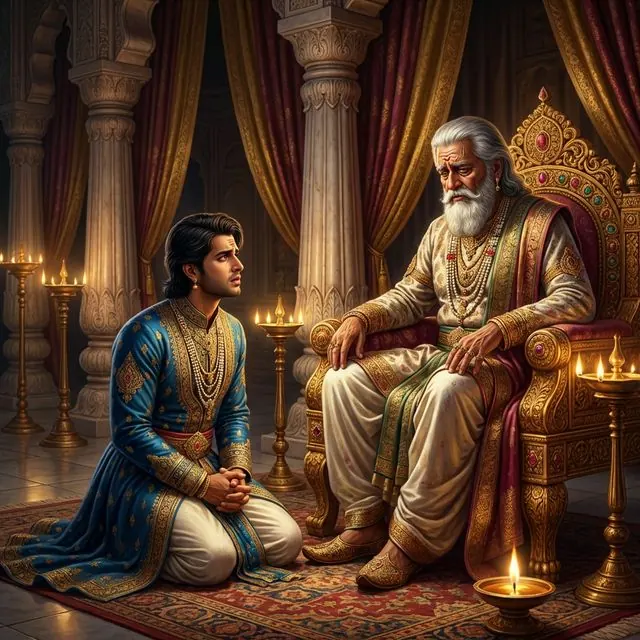
"Grandsire," Yudhishthira said, "tell me how a poor man who wants to achieve his own good should conduct himself, once he has been born human and come into this world of action that is so hard to reach. Tell me too which is the best of all gifts, and what should be given in what circumstances. Explain these mysteries to us."
Bhishma lay on the arrows and did not answer out of his own authority.
"Listen to me closely, king, as I explain these mysteries of duty to you in the same way that the holy Vyasa explained them to me long ago. This subject is a mystery even to the gods."
That is the frame, and it should be held onto, because everything that follows is a report of a conversation nobody living heard. Yama himself had not been born knowing these things. Yama of stainless deeds won the knowledge of them through well-kept vows and Yoga meditation, as the high reward of his penances. What pleases which deity; what pleases the Pitris, the rishis, the Pramathas who attend on Mahadeva, the goddess Sri, Chitragupta who keeps Yama's accounts, and the mighty Elephants that stand at the cardinal points of the compass; the merits of the great gifts, and the merits that belong to all sacrifices. Whoever knows these, said Bhishma, and acts on what he knows, is freed from his stains if he has any.
Then he answered the second half of the king's question before the first, and he answered it from the wrong end. Before telling a poor man what to give, he told him whose gifts he must never take.
"One oilman is equal to ten butchers. One drinker of alcohol is equal to ten oilmen. One courtesan is equal to ten drinkers of alcohol. A single territorial chief is equal to ten courtesans. And a great king is said to be equal to half of all these put together."
Ten thousand butchers, then, make one chief, and a great king is weighed against half of that whole ladder together. So, said Bhishma, one should not accept gifts from any of these.
The Messenger Nobody Could See
Wealth and Pleasure are attractive by nature, Bhishma said, and need no advocate. Religion has to be listened to on purpose. So a man should sit down and give his whole attention to the sacred teachings about it, for the rewards of hearing the mysteries of Religion are very great, and those teachings contain the ritual of the Shraddha, in which the mysteries of the Pitris are set out.
Then he told the king where that ritual came from.
Once upon a time a celestial messenger came of his own accord to Indra's court and stayed there unseen, and out of that invisibility he spoke to the chief of the gods.
"I have come at the command of the two gods who are the foremost of all physicians, to this place where I see human beings, Pitris and gods gathered together. Why is sexual union forbidden to the man who performs a Shraddha, and also to the man who eats at one? Why are three rice-balls offered separately at a Shraddha? To whom should the first of those balls be offered? To whom the second? And whose is the third, the one that remains? I want to know all this."
The gods seated toward the east applauded that traveller of the sky, and the Pitris themselves took up the question.
"Welcome, and blessings on you. The question you have asked is a lofty one and full of deep meaning. If a man has sexual union on the day he performs a Shraddha, or eats at one, his Pitris have to lie on his seed for a whole month."
That is not a reason about purity in the abstract. It is a picture of the dead made to lie somewhere filthy for thirty days on account of an hour of a living man's appetite.
"As for the order of the rice-balls, we will explain what should be done with each in turn. The first rice-ball should be thought of as thrown into the waters. The second should be given to one of the wives to eat. The third should be cast into the blazing fire. That is the rule laid down for the Shraddha. The Pitris of a man who follows this rule are pleased with him and always content. His children multiply, and inexhaustible wealth is always at his command."
Water, the Wife, and the Fire
The messenger had been given the rule. He came back at once for the reason behind the rule, and his second question is the better one.
"Whom does the rice-ball given to the waters reach? How does giving it to the waters please the gods, and how does it rescue the Pitris? The second ball is eaten by the wife. How do the man's Pitris come to eat it? The last ball goes into the blazing fire. How does it find its way to you, or to whom does it go?"
"This is a great question you have asked," the Pitris said. "It holds a mystery and is full of wonder. The gods themselves and the Munis praise the rites done in honour of the Pitris, yet even they do not know for certain what the rules for those rites finally mean."
Then they named the single exception, and there is only one. Apart from the great-souled and immortal Markandeya, that learned and famous brahmana who is always devoted to the Pitris, none of them is versed in these mysteries.
Bhishma, on the arrows, said he had the answer from Vyasa, and gave it in three sentences.
The rice-ball that goes into the water pleases the god of the moon, and that god, once pleased, pleases the other gods and the Pitris with them in turn. The second ball is eaten by the wife of the man performing the rite, and the Pitris, who always long for descendants, give children to the woman of the house. The third ball, cast into the blazing fire, pleases the Pitris themselves, and in return they grant every wish of the person who offers it.
One ball buys the moon's goodwill, one buys a child, one buys whatever the man happens to want.
There is a further consequence, and it falls on the priest. The brahmana who serves as Ritwik at a Shraddha becomes, by that very act, the Pitri of the man performing it. So he too should keep away that day even from his own wedded wife. And the brahmana invited to eat the offerings should eat them only after purifying himself with a bath, and should conduct himself piously that day, refraining from every kind of harm or wrong. Such a man's children multiply, and the one who feeds him reaps the same reward.
Vidyutprabha Asks About the Worms
When the Pitris had finished, a rishi of harsh penances named Vidyutprabha, whose body shone like the sun, stood up in the assembly. He had listened to a long discourse about ancestors and offerings, and the thing that troubled him was lower to the ground than any of it.
"Blinded by folly, men kill many creatures of the lower orders, worms and ants and snakes, sheep, deer and birds. The sin they incur by these acts is heavy. But what is the remedy?"
He was not asking about murder. He was asking about the killing a man does by walking about, by ploughing, by lighting a fire, by living at all, and about which he can neither be innocent nor stop. All the gods, the rishis rich in penances and the blessed Pitris applauded him for it, and Shakra answered.
"Think in your mind of Kurukshetra, Gaya, the Ganga, Prabhasa and the lakes of Pushkara, and dip your head in water. That cleanses a man of all his sins, as Chandramas is freed from Rahu."
Five sacred waters, and not one of them needed in the flesh. The man holds them in his mind and puts his head under whatever water he has. He should bathe in this way for three days running, and fast on each of those days. Besides this, after bathing he should touch the back of a cow and bow his head to her tail.
Then Vidyutprabha, who had asked the question, offered two rites of his own to the god he had asked it of.
"I will describe a subtler rite. If a man rubs himself with the astringent powder of the hanging roots of the banyan, anoints himself with the oil of Priyangu, and eats Shashtika rice mixed with milk, he is cleansed of all his sins. Here is another mystery that few know, which the rishis discovered through meditation. I heard it from Brihaspati as he recited it before Mahadeva. If a man climbs a mountain and stands there on one foot, arms raised and hands joined, and, fasting, looks at a blazing fire, he gains the merit of harsh penances and the rewards of fasting. Scorched by the rays of the sun, he is cleansed of all his sins. Whoever does this in both summer and winter blazes with energy like the Sun, or shines in beauty like the Moon."
Four Things Made to Rescue the Worlds
The chief of the gods, he of a hundred sacrifices, sitting among the gods, turned to his own teacher.
"Holy one, explain to us properly what those mysteries of religion are that bring happiness to human beings, and what faults they commit, together with the mysteries that go with them."
Brihaspati named four faults, and every one of them is a small piece of ordinary rudeness that no man would think of as a sin at all.
"Those who pass urine facing the sun; those who show no reverence for the wind; those who do not pour libations on the blazing fire; those who milk a cow whose calf is very young, wanting to get as much milk from her as they can. These commit sins."
Then he gave the reason, and the reason is the whole of his teaching. The Sun, the Wind, the bearer of sacrificial offerings, and cows, who are the mothers of all creatures, were created by the Self-born himself to rescue all the worlds. These four are the gods of human beings. They are the light a man wakes in, the air he breathes, the fire on his hearth and the animal in his yard, and the offence in each case is that he treats what keeps him alive as though it could not notice him.
"Listen, all of you, to the conclusions of religion. Wicked men and wicked women who pass urine facing the sun live in great disgrace for eighty-six years. A man who has no reverence for the wind has children who fall from his wife's womb before their time. Men who do not pour libations on the blazing fire find that when they do light it for some rite they want to perform, the fire refuses to eat their offerings. Men who drink the milk of cows whose calves are very young never have children to carry on their line. Such men see their children die, and their lines dwindle."
Each punishment is cut to the shape of the offence. Insult the sun in the open, and the world knows your name for eighty-six years. Slight the wind, and the breath goes out of what is in the womb. Neglect the fire, and it will not eat from your hand on the day you want something of it. Take the calf's milk, and bury your own children.
"So one should always avoid what is forbidden and do only what has been laid down. What I am telling you is the very truth."
The Bull With the Blue Coat
After the teacher had finished, the blessed gods with the Maruts, and the blessed rishis, put a question to the Pitris, and it was the practical one the whole assembly had been circling.
"Pitris, what acts of human beings, who mostly have little understanding, please you? Which gifts have a merit that never runs out? By what acts can men free themselves from the debt they owe the Pitris? We are very curious."
The answer was three items long.
"Bulls of a blue colour should be set free. Gifts of sesame seeds and water should be made to us on the day of the new moon. In the rainy season, lamps should be lit. By these acts men can free themselves from the debt they owe the Pitris. Such gifts are never wasted. Men who have children in faith rescue their dead ancestors from wretched Hell."
At this Vriddha-Gargya, an aged rishi rich in penances and of great energy, was so filled with wonder that the hair on his body stood on end, and he asked the question that turns a rule into a mystery.
"Tell us what merit there is in setting free bulls of a blue colour. And what merit is there in giving lamps in the rainy season, and in giving water with sesame seeds?"
"If a blue bull, once set free, lifts a little water with its tail," the Pitris said, "the Pitris of the man who freed it are satisfied with that water for a full sixty thousand years. The mud such a bull throws up with its horns from the bank of a river or lake sends them, beyond doubt, to the realm of Soma."
An animal turned loose flicks its tail in a puddle, and the wet on it feeds the dead for sixty thousand years. The man who freed it is not there and does not see it happen.
"A man who gives lamps in the rainy season shines as brightly as Soma himself, and is never under the power of the quality of Darkness. Men who, on the day of the new moon, give sesame seeds and water mixed with honey from a copper vessel are regarded as performing a Shraddha properly, with all its mysteries. They have healthy, cheerful children. The merit earned by the giver of the Pinda takes the form of the growth of his line."
The Forms in Which I Accept Worship
When the Pitris had finished speaking, Indra spoke to the mighty Hari.
"Lord, what acts please you? How can men win your favour?"
"What I greatly hate is the disparagement of brahmanas," Vishnu said. "Beyond doubt, when brahmanas are worshipped, I count myself worshipped. All superior brahmanas should always be greeted with reverence, after being fed hospitably. One should also honour one's own feet in the evening. I am pleased with men who do this, and with those who worship and make offerings to the whorl seen on cowdung when it first drops from the cow. Those who see a brahmana who is a dwarf in stature, or a boar that has just come up out of the water with mud from the bank on its head, never meet with any evil. A man who worships every day the Aswattha tree, the substance called Gorochana, and the cow is regarded as worshipping the whole universe with its gods, Asuras and human beings. Truly, dwelling in these, I accept in my own form the worship offered to them. Men of little understanding who worship me in some other way worship me in vain."
Indra objected, and his objection is the one a modern reader would make.
"Why do you praise the round marks on cowdung, the feet, the boar, the dwarfish brahmana, and mud thrown up from the ground? It is you who create them and you who destroy them. You are the eternal nature of all mortal and passing things."
Vishnu smiled a little, and answered by listing his own history.
"It was with my round discus that the Daityas were slain. It was with my two feet that the world was covered. In the form of a boar I killed Hiranyaksha. In the form of a dwarf I conquered Vali, the Asura king. Great-souled men who worship these please me, and they never meet with defeat."
That is the whole of the argument. The whirl on the fresh cowdung is his discus. The feet a man salutes at nightfall are the two strides that measured the worlds. The pig coming up out of the river with mud on its head is the boar that lifted the earth. The short brahmana at the door is the dwarf who took the universe from Vali. Nothing here has been made holy by decree. The god has told Indra where in the ordinary yard his own deeds are still lying about, and asked to be greeted there.
Dharma on Who May Not Be Fed
Vishnu added two acts. If a brahmana living as a Brahmachari comes to one's house, and one offers him the first portion of one's food, which is his by right, and eats what is left, one is regarded as eating Amrita. And if one worships the morning twilight and then stands facing the sun, one gains the merit of bathing in all the tirthas.
Then the speakers came quickly, each with one thing.
Balarama gave the rite of the first waking moment. A man who rises at early dawn and touches a cow, ghee and curds, and mustard seeds and the larger kind called Priyangu, is cleansed of all his sins.
The gods together gave the vessel. If a man takes a copper vessel, fills it with water, faces east, and resolves on a fast or a vow, they are pleased with him and all his wishes are fulfilled. Men of little understanding who keep fasts in any other way gain nothing. In making offerings to the gods, in giving and receiving alms, in presenting the ingredients of the Arghya, and in offering water with sesame seeds to the Pitris, copper should be used.
Dharma gave the list of men who must not be fed at a Shraddha, and it is long because it is a list of the ways a brahmana stops being one. Never give the offerings to a brahmana who has taken service under the king, or who rings the bell or does the minor duties at acts of worship, or who keeps cows, or is in trade, or practises some art for a living, or is an actor, or quarrels with his friends, or has no Vedic learning, or has married a shudra woman. Whoever gives the offerings to such a man falls from prosperity, and his line does not grow.
Then Dharma turned from the invited priest to the uninvited stranger. When a guest leaves a house unsatisfied, the Pitris, the gods and the sacred fires all leave it disappointed. A man who fails in hospitality toward a guest who has come to his house is as sinful as those who kill women or cows, as the ungrateful, as those who kill brahmanas, and as those who defile their teacher's bed.
Agni spoke of the man who lifts his foot to kick a cow, or a blessed brahmana, or a blazing fire. Such a man's disgrace spreads through the world and reaches the borders of heaven. His Pitris are filled with fear. Fire refuses his offerings. For a hundred lives he rots in hell, and is never rescued.
Merit for Men Who Have Nothing
Vishvamitra gave a single appointment in the calendar. A man who offers the Pitris rice boiled in sugared milk, facing south at noon, in the shade cast by an elephant's body, in the month of Bhadrapada under the constellation Magha, is regarded as performing a great Shraddha every year for thirteen years.
Then the cows themselves spoke, and gave away the words in which they wish to be addressed. A man is cleansed of all his sins who worships a cow with these mantras: "Vahula, Samanga, you who are fearless everywhere, you who are forgiving and full of blessing, friend, source of all plenty: long ago, in the realm of Brahman, you were present with your calf at the sacrifice of Indra, wielder of the thunderbolt. You took your place in the sky and in the path of Agni. The gods with Narada among them worshipped you then and called you Sarvamsaha." Such a man reaches at last the realm of Indra the Thousand-eyed.
After this the famous seven rishis, with Vasishtha at their head, rose and walked round Brahman the Lotus-born, and stood around him with joined hands. Vasishtha, the foremost of all who know Brahma, spoke for them, and the question he asked is the one Yudhishthira had begun with, worlds away.
"By what acts can righteous men who have none of this world's goods win the merit of sacrifices?"
Every rite named in this assembly costs something. Copper vessels, ghee, sesame, lamps, bulls to be bought before they can be set free. The seven rishis were asking what is left for the man who has none of it.
"This is an excellent question, blessed ones," Brahman said. "It is auspicious and lofty and full of mystery. Listen to how men can win the merit of sacrifices even when poverty keeps them from performing them. In the bright fortnight of the month of Pausha, when the constellation Rohini is in conjunction, if a man purifies himself with a bath and lies under the open sky in a single garment, with faith and full attention, and drinks the rays of the moon, he gains the merit of performing great sacrifices."
A man with one cloth, lying on his back in the open in the cold month, drinking moonlight. That is the Grandsire's answer to the poverty of the world, and there is nothing in it that anybody can be too poor to buy.
The Last of the Secrets
Surya, whom they called Vibhavasu, priced his rite as low. Two offerings, he said: a palmful of water, and rice grains with ghee, called Akshata. On the day of the full moon one should stand facing the moon and offer him both, and one is counted as having poured libations on the three fires. But whoever cuts down a large tree on the day of the new moon is stained with the killing of a brahmana, and incurs it by killing even a leaf; and whoever chews a tooth-stick that day harms the god of the moon, so that his offerings are refused and his family dies out.
Sri spoke of houses. A sinful house in which vessels, seats and beds lie scattered about, and in which women are beaten, the gods and the Pitris leave in disgust, without accepting the offerings made there.
Angiras gave a rite that takes a year. The children of a man multiply if he stands every night for a full year under a Karanjaka tree with a lamp to light it, holding roots of the Suvarchala plant.
Gargya gave a whole code. Be hospitable. Give lamps in the sacrificial shed. Do not sleep by day, and do not eat meat. Never harm cows or brahmanas. Always recite the names of the Pushkara lakes and the other sacred waters. A hundred sacrifices use up their own merit; these duties, kept with faith, do not. And at a Shraddha, dressed in white, one should have brahmanas pronounce their blessings, and should recite the Bharata.
Dhaumya listed what a household keeps without noticing: broken utensils, broken bedsteads, cocks and dogs, trees grown inside the house. In a broken utensil is Kali himself, in a broken bedstead the loss of wealth. With a cock or a dog in sight, the gods do not eat. Under a tree in the house, scorpions and snakes.
Jamadagni cut across the catalogue. A man whose heart is not pure goes to Hell though he worship the gods with a Horse-sacrifice, or a hundred Vajapeyas, or hang head downward. A very poor brahmana who gave only a Prastha of barley meal with a pure heart reached the realm of Brahman.
Vayu spoke last, and ended on a remedy rather than a sin. A man who thinks it acceptable for a shudra to light the fire for his offerings, or sees no fault when women unfit to assist at Shraddhas assist at them, is stained, and is born a shudra in his next life. But he should fast throughout and for three days pour cow's urine mixed with cowdung, milk and ghee on the sacred fire. After a full year the gods accept his offerings again, and his Pitris are satisfied when the Shraddha comes.
Dharma Lesson
The king asked what a poor man should do, and the gods answered with things that cost almost nothing: a palmful of water, a lamp in the rains, a bull turned loose, a cow's back touched after bathing, five sacred rivers held in the mind instead of travelled to. Brihaspati's four faults are not crimes but discourtesies, and his reason is that sun, wind, fire and cattle were made to keep men alive, so that treating them as though they cannot notice is the original ingratitude. Vishnu makes the same move from the other side, refusing worship offered anywhere but in the ordinary yard where his own deeds are still lying about. And Jamadagni, near the end, prices a hundred Vajapeyas below one measure of barley given with a clean heart.